A General Theory of Paths: Signatures, Jump Lifts, and Expected Signatures of Self-Exciting Processes
Pith reviewed 2026-06-30 08:33 UTC · model grok-4.3
The pith
Affine Hawkes processes admit finite-dimensional linear closures for truncated expected signatures after state-weight augmentation.
A machine-rendered reading of the paper's core claim, the machinery that carries it, and where it could break.
Core claim
After augmenting the state with weights, affine and exponential Hawkes processes possess finite-dimensional linear closures for their truncated expected signatures; for scalar Hawkes clocks the baseline intensity, excitation amplitude and decay rate are recoverable by solving the resulting linear system.
What carries the argument
State-weight augmentation that preserves the linear closure property of the truncated expected signature under the Hawkes intensity rule.
If this is right
- Scalar Hawkes clocks permit explicit algebraic recovery of baseline, excitation and decay parameters from the expected signature.
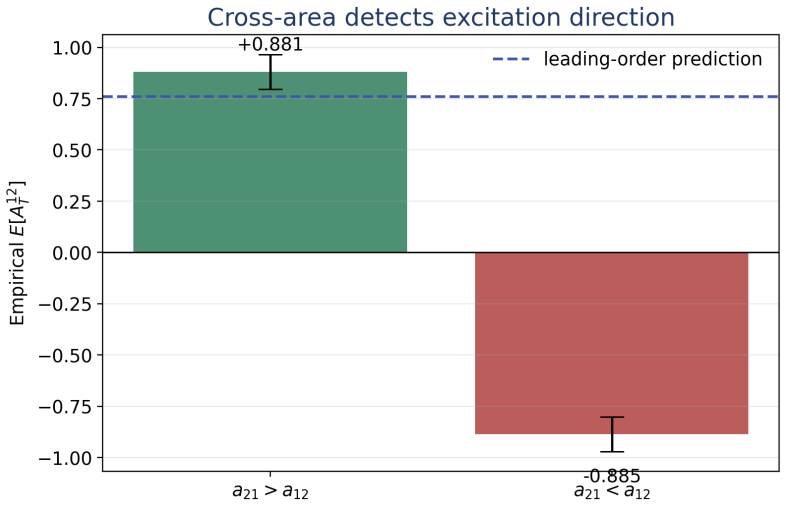
- An antisymmetric second-level cross-area statistic detects the signed direction of two-channel Hawkes excitation to first order.
- For pure-jump finite-variation paths the forward Itô signature coincides with the iterated-sums signature.
- The Marcus signature equals the exponential image of the iterated-sums signature under Hoffman’s map.
Where Pith is reading between the lines
- The same augmentation technique may close expected-signature dynamics for other linear intensity point processes.
- Signature coefficients could serve as moment conditions for parameter estimation in empirical self-exciting data without solving the likelihood.
- The geometricity-defect bracket supplies a first-order diagnostic for the presence of roughness or jumps in observed streams.
Load-bearing premise
Augmenting the state with weights keeps the truncated expected signature dynamics both linear and finite-dimensional.
What would settle it
An explicit low-order calculation for a scalar Hawkes process in which the expected-signature ODE after augmentation either becomes nonlinear or requires infinitely many dimensions.
Figures


read the original abstract
This paper develops a path-first theory using the signature as a universal coordinate for deterministic paths, rough paths, jump streams, and path-valued random variables. Geometricity is presented as a first-order algebraic property with second-order obstructions: a bracket for non-geometric lifts, and a covariance when averaging random paths. This framework links the shuffle identity, Marcus-Ito distinction, expected signatures, signature kernels, and free nilpotent group geometry. We offer four main contributions. (1) The Geometricity-Defect Theorem identifies quadratic covariation and coordinate covariance as the canonical failures of shuffle multiplicativity. (2) The Hopf Square proves that for pure-jump finite-variation paths, the forward Ito signature equals the iterated-sums signature, while the Marcus signature is Hoffman's exponential image of it. (3) Affine and exponential Hawkes processes are shown to admit finite-dimensional linear closures for truncated expected signatures after state-weight augmentation. For scalar Hawkes clocks, this allows explicit identification of baseline, excitation, and decay parameters. (4) An antisymmetric second-level cross-area is proved to detect two-channel Hawkes excitation direction to first order. Secondary results cover kernel-MMD decompositions, free nilpotent truncations, stable-law thresholds, heavy-tail normalizations, and a large-deviation principle. All identities and formulas are validated by a reproducibility script.
Editorial analysis
A structured set of objections, weighed in public.
Referee Report
Summary. The manuscript develops a signature-centric framework for deterministic paths, rough paths, jump streams, and random path-valued processes. It states four main contributions: (1) the Geometricity-Defect Theorem identifying quadratic covariation and coordinate covariance as obstructions to shuffle multiplicativity; (2) the Hopf Square relating the forward Itô signature, iterated-sums signature, and Marcus signature for pure-jump finite-variation paths; (3) finite-dimensional linear closures for truncated expected signatures of affine and exponential Hawkes processes after state-weight augmentation, enabling explicit identification of baseline, excitation, and decay parameters for scalar Hawkes clocks; (4) an antisymmetric second-level cross-area detecting two-channel Hawkes excitation direction to first order. Secondary results address kernel-MMD decompositions, free nilpotent truncations, and a large-deviation principle, with all identities validated by a reproducibility script.
Significance. If the finite-dimensional linear closures in contribution (3) hold without residual nonlinear or infinite-dimensional couplings, the work would supply a concrete computational bridge between rough-path signatures and self-exciting point processes, together with an explicit parameter-recovery procedure. The reproducibility script that validates all stated identities and formulas is a clear strength that supports verifiability.
major comments (2)
- [Abstract, contribution (3)] Abstract, contribution (3): the claim that state-weight augmentation yields a finite-dimensional linear closure for the truncated expected signature of affine/exponential Hawkes processes is load-bearing for the explicit parameter identification. The manuscript must exhibit the precise augmented state vector, the resulting finite matrix acting on the truncated tensor algebra, and confirm that the jump measure and intensity dynamics produce no nonlinear remainder terms after truncation; without this explicit construction the finite-dimensionality assertion cannot be verified from the given description.
- [Abstract, contribution (3)] Abstract, contribution (3): for the scalar Hawkes clock the paper asserts that baseline, excitation, and decay parameters are explicitly identifiable from the closed linear system. The derivation should state the precise truncation level at which the identification becomes possible and demonstrate that the map from the expected-signature vector back to the three parameters is invertible and independent of auxiliary fitting choices.
minor comments (2)
- [Abstract] The abstract refers to “state-weight augmentation” without a preliminary definition or reference to the section where the augmented state is introduced; a brief parenthetical or footnote would improve readability.
- [Abstract] The reproducibility script is cited as validating all identities, yet the manuscript does not indicate which specific equations or numerical examples are covered by the script; an explicit list or table of covered results would strengthen the claim.
Simulated Author's Rebuttal
We thank the referee for the careful review and for identifying the need for greater explicitness in contribution (3). We will revise the manuscript to supply the requested constructions while preserving the existing reproducibility script.
read point-by-point responses
-
Referee: [Abstract, contribution (3)] Abstract, contribution (3): the claim that state-weight augmentation yields a finite-dimensional linear closure for the truncated expected signature of affine/exponential Hawkes processes is load-bearing for the explicit parameter identification. The manuscript must exhibit the precise augmented state vector, the resulting finite matrix acting on the truncated tensor algebra, and confirm that the jump measure and intensity dynamics produce no nonlinear remainder terms after truncation; without this explicit construction the finite-dimensionality assertion cannot be verified from the given description.
Authors: We agree that the explicit augmented state vector, matrix, and absence of nonlinear remainders must be displayed for verification. In the revision we will define the augmented state as the scalar intensity together with the truncated signature components (up to the closing level), derive the finite matrix on the truncated tensor algebra that encodes the linear evolution, and confirm that the affine intensity and exponential jump measure produce a closed linear system with no residual nonlinear terms after truncation. The reproducibility script already checks the resulting identities; the new text will make the matrix and closure explicit. revision: yes
-
Referee: [Abstract, contribution (3)] Abstract, contribution (3): for the scalar Hawkes clock the paper asserts that baseline, excitation, and decay parameters are explicitly identifiable from the closed linear system. The derivation should state the precise truncation level at which the identification becomes possible and demonstrate that the map from the expected-signature vector back to the three parameters is invertible and independent of auxiliary fitting choices.
Authors: We will state the precise truncation level at which the linear system closes for the scalar Hawkes clock and exhibit the explicit linear map from the expected-signature vector to the triple (baseline, excitation, decay). Invertibility will be shown by verifying that the relevant submatrix has full rank; the map is obtained directly from the closed ODE and is therefore independent of auxiliary fitting choices. These details will be added to the revised manuscript. revision: yes
Circularity Check
No circularity: derivation chain self-contained
full rationale
The abstract and contributions present the Geometricity-Defect Theorem, Hopf Square, Hawkes linear closures after state-weight augmentation, and parameter identification as derived consequences of the signature framework and jump-lift constructions. No quoted step reduces a claimed prediction or closure to a fitted parameter, self-defined quantity, or load-bearing self-citation by construction. The reproducibility script and explicit identification for scalar Hawkes clocks are presented as outputs of the theory rather than inputs. The augmentation property is invoked as an assumption whose validity is separate from circularity analysis.
Axiom & Free-Parameter Ledger
Reference graph
Works this paper leans on
-
[1]
Annals of Mathematics , volume =
Chen, Kuo-Tsai , title =. Annals of Mathematics , volume =
-
[2]
Annals of Mathematics , volume =
Ree, Rimhak , title =. Annals of Mathematics , volume =
-
[3]
Reutenauer, Christophe , title =
-
[4]
, title =
Lyons, Terry J. , title =. Revista Matem\'atica Iberoamericana , volume =
-
[5]
and Caruana, Michael and L\'evy, Thierry , title =
Lyons, Terry J. and Caruana, Michael and L\'evy, Thierry , title =
-
[6]
and Hairer, Martin , title =
Friz, Peter K. and Hairer, Martin , title =
-
[7]
Annals of Mathematics , volume =
Hambly, Ben and Lyons, Terry , title =. Annals of Mathematics , volume =
-
[8]
Advances in Mathematics , volume =
Boedihardjo, Horatio and Geng, Xi and Lyons, Terry and Yang, Danyu , title =. Advances in Mathematics , volume =
-
[9]
Annals of Probability , volume =
Chevyrev, Ilya and Lyons, Terry , title =. Annals of Probability , volume =
-
[10]
Journal of Machine Learning Research , volume =
Chevyrev, Ilya and Oberhauser, Harald , title =. Journal of Machine Learning Research , volume =
-
[11]
, title =
Chevyrev, Ilya and Friz, Peter K. , title =. Annals of Probability , volume =
-
[12]
and Shekhar, Atul , title =
Friz, Peter K. and Shekhar, Atul , title =. Annals of Probability , volume =
-
[13]
, title =
Hoffman, Michael E. , title =. Journal of Algebraic Combinatorics , volume =
-
[14]
Acta Applicandae Mathematicae , volume =
Diehl, Joscha and Ebrahimi-Fard, Kurusch and Tapia, Nikolas , title =. Acta Applicandae Mathematicae , volume =
-
[15]
, title =
Hawkes, Alan G. , title =. Biometrika , volume =
-
[16]
and Oakes, David , title =
Hawkes, Alan G. and Oakes, David , title =. Journal of Applied Probability , volume =
-
[17]
, title =
Gillespie, Daniel T. , title =. Journal of Computational Physics , volume =
-
[18]
IEEE Transactions on Information Theory , volume =
Ogata, Yosihiko , title =. IEEE Transactions on Information Theory , volume =
-
[19]
Lewis, P. A. W. and Shedler, G. S. , title =. Naval Research Logistics Quarterly , volume =
-
[20]
Electronic Communications in Probability , volume =
Dassios, Angelos and Zhao, Hongbiao , title =. Electronic Communications in Probability , volume =
-
[21]
Davis, Mark H. A. , title =. Journal of the Royal Statistical Society: Series B , volume =
-
[22]
Cuchiero, Christa and Svaluto-Ferro, Sara and Teichmann, Josef , title =. arXiv preprint arXiv:2302.01362 , year =
-
[23]
Sato, Ken-iti , title =
-
[24]
and Victoir, Nicolas B
Friz, Peter K. and Victoir, Nicolas B. , title =
-
[25]
Bernoulli , volume =
Bonnier, Patric and Oberhauser, Harald , title =. Bernoulli , volume =
discussion (0)
Sign in with ORCID, Apple, or X to comment. Anyone can read and Pith papers without signing in.