A Hybrid Origin for the Multiple Ring-Gap Structures in the Large Protoplanetary Disk V1094 Sco: A Low-Mass Planet and Secular Gravitational Instability
Pith reviewed 2026-06-30 22:43 UTC · model grok-4.3
The pith
The ring-gap structures in the V1094 Sco disk arise from a low-mass planet creating gaps near 100 au together with secular gravitational instability forming the outer rings at 170-230 au.
A machine-rendered reading of the paper's core claim, the machinery that carries it, and where it could break.
Core claim
The authors conclude that V1094 Sco supports a hybrid origin in which a low-mass planet of 55 plus or minus 35 Earth masses produces the double gap near 100 au while secular gravitational instability assembles the outer ring system between 170 and 230 au. The gas disk extends to 760 au in Keplerian rotation, but the dust rings reach only 380 au, with upper limits on turbulent viscosity of alpha less than or equal to 10 to the minus 3 and possibly 10 to the minus 4. The outer rings lack a scattered-light counterpart and exhibit spacing incompatible with planet gaps alone, while the full set of gap properties is inconsistent with one planet per gap across the disk.
What carries the argument
Secular gravitational instability, which concentrates dust into long-lived midplane rings in weakly turbulent gas disks.
If this is right
- A single low-mass planet can produce multiple gaps at intermediate radii while secular gravitational instability operates separately at larger radii.
- Weak turbulence with alpha less than or equal to 10 to the minus 3 permits secular gravitational instability to create stable dust concentrations beyond 100 au.
- The modeling of gap widths and depths across the disk rules out any simple one-planet-per-gap scenario for the full structure.
- Long-lived midplane dust concentrations assembled by secular gravitational instability can serve as sites for planet formation at large stellocentric distances.
Where Pith is reading between the lines
- Other extended disks with low turbulence may exhibit similar outer rings if observed at comparable resolution, suggesting the hybrid pattern is not unique to V1094 Sco.
- Direct measurements of midplane dust concentrations in additional large disks could test whether secular gravitational instability commonly operates beyond the reach of planet-driven gaps.
- The coexistence of the two mechanisms implies that planet formation models must incorporate both dynamical excitation by companions and instability-driven dust trapping at different radii.
Load-bearing premise
The outer rings at 170-230 au form via secular gravitational instability rather than planets, based on their regular spacing and absence of a scattered-light counterpart.
What would settle it
Detection of scattered light from the outer rings or a turbulence measurement showing alpha greater than 10 to the minus 3 across the outer disk would falsify the secular gravitational instability interpretation.
Figures





read the original abstract
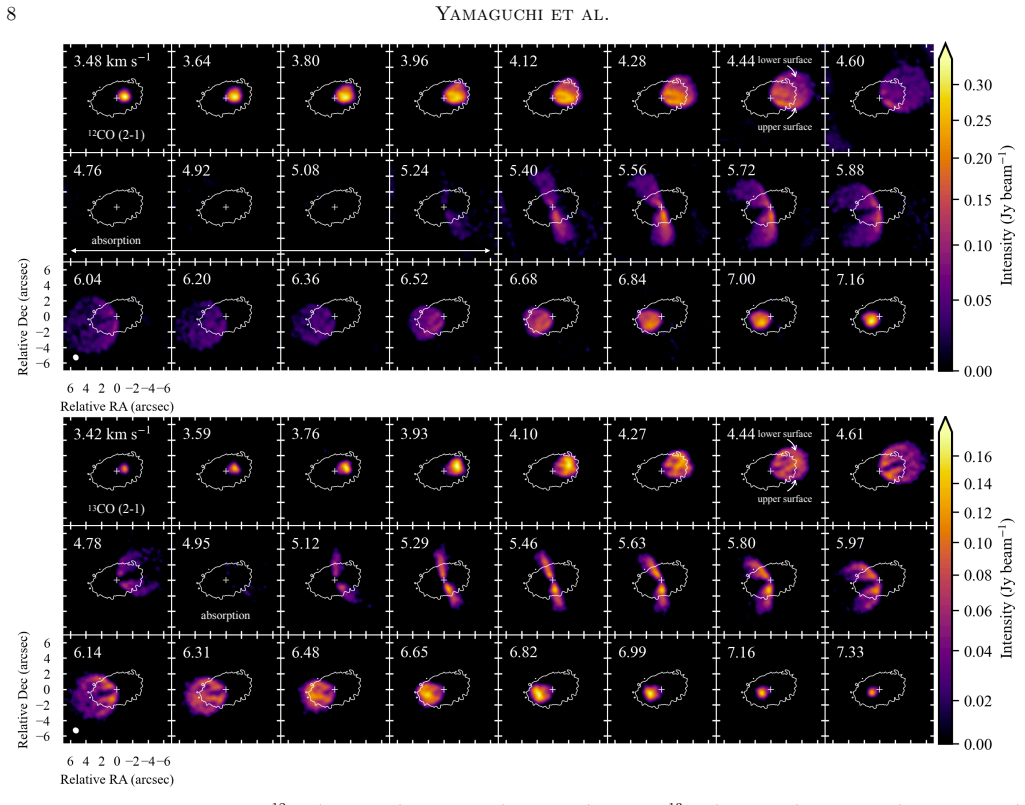
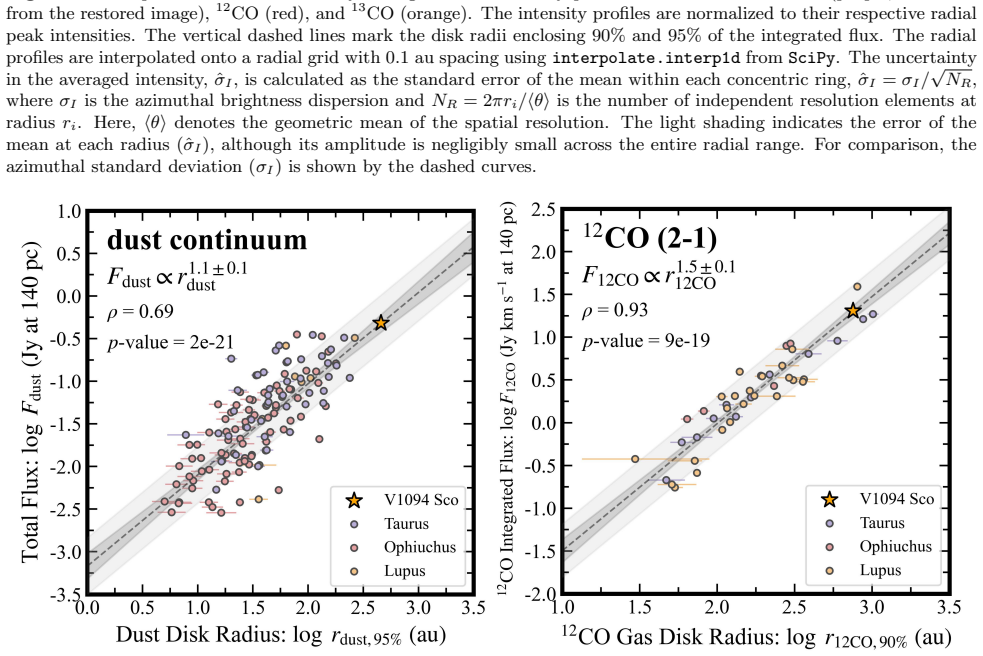
High spatial resolution observations reveal that some protoplanetary disks host multiple ring-gap pairs at large stellocentric radii, yet their physical origin remains unsettled. We present a multi-wavelength analysis of the V1094~Sco disk using Atacama Large Millimeter/submillimeter Array Band~6 continuum and $^{12}$CO and $^{13}$CO $J=2-1$ emission, together with a Very Large Telescope/SPHERE near-infrared scattered light image. The continuum image shows four narrow dust ring-gap pairs extending to exceptionally large radii ($r \sim 380$ au), while the CO isotopologues trace a spatially extended gas disk ($r \sim 760$ au) in Keplerian rotation. From the dust ring widths, we place conservative upper limits on the turbulent viscosity parameter, $\alpha \lesssim 10^{-3}$ and potentially $\lesssim 10^{-4}$, implying weak turbulence. The ensemble of gap widths and depths is inconsistent with a simple one-planet-per-gap interpretation. At $r \simeq 100$~au, a double gap and its scattered light counterpart are consistent with multi-gap excitation by a single low-mass companion of $(55 \pm 35)\,M_{\oplus}$. At $r \simeq 170$-$230$~au, the outer ring system shows regular spacing and no clear scattered light counterpart, indicating mechanisms that operate primarily at the disk midplane. These outer rings are quantitatively compatible with secular gravitational instability. V1094~Sco therefore supports a hybrid pathway in which weak turbulence in an extended disk allows secular gravitational instability to assemble long-lived midplane dust concentrations that can cradle planet formation beyond $\sim100$~au, alongside planet-driven substructures at intermediate radii.
Editorial analysis
A structured set of objections, weighed in public.
Referee Report
Summary. The manuscript presents a multi-wavelength analysis (ALMA Band 6 continuum and CO isotopologues plus VLT/SPHERE NIR scattered light) of the V1094 Sco protoplanetary disk. It identifies four narrow dust ring-gap pairs extending to ~380 au within a gas disk reaching ~760 au, derives conservative upper limits α ≲ 10^{-3} (potentially ≲ 10^{-4}) on turbulent viscosity from ring widths, shows that the full set of gap widths and depths is inconsistent with a simple one-planet-per-gap model, attributes the double gap near 100 au to multi-gap excitation by a single 55 ± 35 M_⊕ companion, and finds the outer rings (170–230 au) quantitatively compatible with secular gravitational instability on the basis of regular spacing, absence of a scattered-light counterpart, and the low-α environment. The central claim is a hybrid origin combining planet-driven substructures at intermediate radii with SGI-driven midplane dust concentrations at large radii.
Significance. If the hybrid interpretation is upheld, the result supplies direct observational support for secular gravitational instability operating in extended, low-turbulence disks beyond ~100 au, thereby broadening the set of viable pathways for dust concentration and planet formation at large stellocentric distances. The multi-wavelength separation of midplane versus surface processes and the quantitative exclusion of a single-mechanism explanation constitute concrete advances that can be tested against future higher-resolution data or numerical simulations of SGI growth rates.
major comments (1)
- [Gap modeling and planet-mass section] Gap-width and depth modeling (the section deriving the 55 ± 35 M_⊕ planet mass and ruling out one-planet-per-gap across the full radial range): the large uncertainty interval on planet mass must be propagated through the multi-gap excitation calculation to demonstrate that a single companion remains viable over the full 20–90 M_⊕ range; otherwise the inconsistency claim for the outer gaps rests on a point estimate.
minor comments (3)
- [Turbulence limits paragraph] The abstract states α ≲ 10^{-3} and 'potentially ≲ 10^{-4}'; the main text should explicitly map which individual ring widths produce the tighter bound and whether the same α applies to the outer SGI region.
- [Outer rings figure] Figure showing the outer ring system (170–230 au): the radial spacing measurement and the quantitative SGI wavelength comparison should be presented in a dedicated panel or table with the adopted surface-density and temperature profiles.
- [Discussion of outer rings] The SGI compatibility statement would benefit from a short sensitivity test (varying α within the derived upper limit) to show that the growth-rate match is not confined to a single parameter choice.
Simulated Author's Rebuttal
We thank the referee for the detailed and constructive report. The single major comment concerns propagation of the planet-mass uncertainty through the multi-gap modeling; we address it directly below and will incorporate the requested analysis in the revised manuscript.
read point-by-point responses
-
Referee: [Gap modeling and planet-mass section] Gap-width and depth modeling (the section deriving the 55 ± 35 M_⊕ planet mass and ruling out one-planet-per-gap across the full radial range): the large uncertainty interval on planet mass must be propagated through the multi-gap excitation calculation to demonstrate that a single companion remains viable over the full 20–90 M_⊕ range; otherwise the inconsistency claim for the outer gaps rests on a point estimate.
Authors: We agree that the full 20–90 M_⊕ range must be shown explicitly rather than relying on the central value. In the revised manuscript we will recompute the multi-gap excitation models at the lower (20 M_⊕) and upper (90 M_⊕) bounds, confirming that a single companion can still account for the double gap near 100 au across the entire interval while the outer gaps at 170–230 au remain inconsistent with the same mechanism. This additional calculation will be presented in an expanded figure and accompanying text. revision: yes
Circularity Check
No significant circularity; derivation relies on independent morphological and multi-wavelength constraints
full rationale
The paper's central claims rest on direct comparison of observed gap widths/depths and ring spacing against standard planet-disk interaction models and SGI wavelength predictions, using ALMA and SPHERE data as inputs. No equations reduce a claimed prediction to a fitted parameter by construction, no self-citation chain supplies a uniqueness theorem, and no ansatz is smuggled via prior work. The hybrid pathway conclusion follows from the radial separation of features (planet-like at ~100 au vs. midplane-only at 170-230 au) without self-referential redefinition of observables.
Axiom & Free-Parameter Ledger
free parameters (1)
- planet mass =
55 ± 35 M_⊕
axioms (2)
- domain assumption The gas disk is in Keplerian rotation as traced by CO isotopologues
- domain assumption Dust ring widths imply turbulent viscosity parameter α ≲ 10^{-3}
Reference graph
Works this paper leans on
-
[1]
Agurto-Gangas, C., P´ erez, L. M., Sierra, A., et al. 2025, The Astrophysical Journal, 989, 4, doi: 10.3847/1538-4357/adc7ab Alcal´ a, J. M., Manara, C. F., Natta, A., et al. 2017, Astronomy & Astrophysics, 600, A20, doi: 10.1051/0004-6361/201629929 32 Yamaguchi et al
-
[2]
Exploring the Formation and Evolution of Planetary Systems , year = 2014, editor =
Allard, F. 2013, International Astronomical Union, doi: 10.1017/S1743921313008545
-
[3]
Philosophical Transactions of the Royal Society of London Series A , author =
Allard, F., Homeier, D., & Freytag, B. 2012, Philosophical Transactions of the Royal Society A: Mathematical, Physical and Engineering Sciences, 370, 2765, doi: 10.1098/rsta.2011.0269
-
[4]
Ansdell, M., Williams, J. P., Trapman, L., et al. 2018, The Astrophysical Journal, 859, 21, doi: 10.3847/1538-4357/aab890
-
[5]
Aso, Y., & Machida, M. N. 2020, The Astrophysical Journal, 905, 174, doi: 10.3847/1538-4357/abc6fc
-
[6]
2024, Publications of The Korean Astronomical Society, 39, 27, doi: 10.5303/PKAS.2024.39.2.027
Aso, Y., & Sai, J. 2024, Publications of The Korean Astronomical Society, 39, 27, doi: 10.5303/PKAS.2024.39.2.027
-
[7]
Aso, Y., Ohashi, N., Saigo, K., et al. 2015, The Astrophysical Journal, 812, 27, doi: 10.1088/0004-637X/812/1/27 Astropy Collaboration, Price-Whelan, A. M., Lim, P. L., et al. 2022, ApJ, 935, 167, doi: 10.3847/1538-4357/ac7c74
-
[8]
Avenhaus, H., Quanz, S. P., Garufi, A., et al. 2018, The Astrophysical Journal, 863, 44, doi: 10.3847/1538-4357/aab846
-
[9]
2018, The Astrophysical Journal, 865, L12, doi: 10.3847/2041-8213/aadf87
Bacciotti, F., Miquel Girart, J., Padovani, M., et al. 2018, The Astrophysical Journal, 865, L12, doi: 10.3847/2041-8213/aadf87
-
[10]
2018, The Astrophysical Journal, 859, 119, doi: 10.3847/1538-4357/aabf93
Bae, J., & Zhu, Z. 2018, The Astrophysical Journal, 859, 119, doi: 10.3847/1538-4357/aabf93
-
[11]
2017, The Astrophysical Journal, 850, 201, doi: 10.3847/1538-4357/aa9705
Bae, J., Zhu, Z., & Hartmann, L. 2017, The Astrophysical Journal, 850, 201, doi: 10.3847/1538-4357/aa9705
-
[12]
2016, extinction v0.3.0, Zenodo, doi: 10.5281/zenodo.804967
Barbary, K. 2016, extinction v0.3.0, Zenodo, doi: 10.5281/zenodo.804967
-
[13]
Beckwith, S. V. W. 1991, The Astrophysical Journal, 381, 250
1991
-
[14]
H.-M., Avenhaus, H., Casassus, S., et al
Bertrang, G. H.-M., Avenhaus, H., Casassus, S., et al. 2018, Monthly Notices of the Royal Astronomical Society, 474, 5105, doi: 10.1093/mnras/stx3052
-
[15]
2024, The Astrophysical Journal, 971, 76, doi: 10.3847/1538-4357/ad5be2
Bi, J., & Lin, M.-K. 2024, The Astrophysical Journal, 971, 76, doi: 10.3847/1538-4357/ad5be2
-
[16]
Birnstiel, T., Dullemond, C. P., Zhu, Z., et al. 2018, arXiv, 869, L45, doi: 10.3847/2041-8213/aaf743
-
[17]
V., Henning, T., Menu, J., et al
Boekel, R. V., Henning, T., Menu, J., et al. 2017, The Astrophysical Journal, 837, 132, doi: 10.3847/1538-4357/aa5d68
-
[18]
Bollo, V., Zwaan, M., P´ eroux, C., et al. 2024, Astronomy & Astrophysics, 690, A258, doi: 10.1051/0004-6361/202450336 CASA Team, Bean, B., Bhatnagar, S., et al. 2022, PASP, 134, 114501, doi: 10.1088/1538-3873/ac9642
-
[19]
Chen, H., Myers, P. C., Ladd, E. F., & Wood, D. O. S. 1995, ApJ, 445, 377, doi: 10.1086/175703
-
[20]
Chiang, E. I., & Goldreich, P. 1997, The Astrophysical Journal, 490, 368, doi: 10.1086/304869
-
[21]
E., Hirano, N., & Yamaguchi, M
Chou, H.-I. E., Hirano, N., & Yamaguchi, M. 2025, The Astrophysical Journal, 995, 225, doi: 10.3847/1538-4357/ae197e
-
[22]
Chung, C.-Y., Andrews, S. M., Gurwell, M. A., et al. 2024, The Astrophysical Journal Supplement Series, 273, 29, doi: 10.3847/1538-4365/ad528b
-
[23]
A., Gonz´ alez-Ruilova, C., Hales, A
Cieza, L. A., Gonz´ alez-Ruilova, C., Hales, A. S., et al. 2021, http://arxiv.org/abs/2012.00189
-
[24]
Cornwell, T. J. 2008, IEEE Journal on Selected Topics in Signal Processing, 2, 793, doi: 10.1109/JSTSP.2008.2006388
-
[25]
M., Skrutskie, M
Cutri, R. M., Skrutskie, M. F., van Dyk, S., et al. 2003, VizieR Online Data Catalog: 2MASS All-Sky Catalog of Point Sources (Cutri+ 2003),, VizieR On-line Data Catalog: II/246. Originally published in: University of Massachusetts and Infrared Processing and Analysis Center, (IPAC/California Institute of Technology) (2003)
2003
-
[26]
Cutri, R. M., Wright, E. L., Conrow, T., et al. 2021, VizieR Online Data Catalog: AllWISE Data Release (Cutri+ 2013),, VizieR On-line Data Catalog: II/328. Originally published in: IPAC/Caltech (2013) De Boer, J., Salter, G., Benisty, M., et al. 2016, Astronomy & Astrophysics, 595, A114, doi: 10.1051/0004-6361/201629267
-
[27]
Deng, D., Pascucci, I., & Fernandes, R. B. 2025a, Journal of Open Source Software, 10, 7493, doi: 10.21105/joss.07493
-
[28]
2025b, The Astrophysical Journal, 989, 3, doi: 10.3847/1538-4357/add43a
Deng, D., Vioque, M., Pascucci, I., et al. 2025b, The Astrophysical Journal, 989, 3, doi: 10.3847/1538-4357/add43a
-
[29]
2017, The Astrophysical Journal, 843, 127, doi: 10.3847/1538-4357/aa72f2
Dong, R., Li, S., Chiang, E., & Li, H. 2017, The Astrophysical Journal, 843, 127, doi: 10.3847/1538-4357/aa72f2
-
[30]
2018, The Astrophysical Journal, 866, 110, doi: 10.3847/1538-4357/aadadd
Dong, R., Li, S., Chiang, E., & Li, H. 2018, The Astrophysical Journal, 866, 110, doi: 10.3847/1538-4357/aadadd
-
[31]
2012, Astrophysical Journal, 750, 161, doi: 10.1088/0004-637X/750/2/161
Dong, R., Rafikov, R., Zhu, Z., et al. 2012, Astrophysical Journal, 750, 161, doi: 10.1088/0004-637X/750/2/161
-
[32]
Dullemond, C. P., & Dominik, C. 2004, Astronomy and Astrophysics, 421, 1075, doi: 10.1051/0004-6361:20040284
-
[33]
P., Birnstiel, T., Huang, J., et al
Dullemond, C. P., Birnstiel, T., Huang, J., et al. 2018, The Astrophysical Journal, 869, L46, doi: 10.3847/2041-8213/aaf742
-
[34]
Feiden, G. A. 2016, Astronomy & Astrophysics, 593, A99, doi: 10.1051/0004-6361/201527613
-
[35]
1999, Publications of the Astronomical Society of the Pacific, 111, 63, doi: 10.1086/316293 33
Fitzpatrick, E. 1999, Publications of the Astronomical Society of the Pacific, 111, 63, doi: 10.1086/316293 33
-
[36]
Clayton, G. C. 2019, The Astrophysical Journal, 886, 108, doi: 10.3847/1538-4357/ab4c3a
-
[37]
Flock, M., Ruge, J. P., Dzyurkevich, N., et al. 2015, Astronomy & Astrophysics, 574, A68, doi: 10.1051/0004-6361/201424693
-
[38]
S., Reipurth, B., & Duchˆ ene, G
Flores, C., Connelley, M. S., Reipurth, B., & Duchˆ ene, G. 2022, The Astrophysical Journal, 925, 21, doi: 10.3847/1538-4357/ac37bd
-
[39]
Foreman-Mackey, D., Hogg, D. W., Lang, D., & Goodman, J. 2013, PASP, 125, 306, doi: 10.1086/670067 Gaia Collaboration, Brown, A. G. A., Vallenari, A., et al. 2018, Astronomy & Astrophysics, 616, A1, doi: 10.1051/0004-6361/201833051 Gaia Collaboration, Vallenari, A., Brown, A. G. A., et al. 2023, A&A, 674, A1, doi: 10.1051/0004-6361/202243940
-
[40]
2020, Astronomy & Astrophysics, 633, A82, doi: 10.1051/0004-6361/201936946
Garufi, A., Avenhaus, H., P´ erez, S., et al. 2020, Astronomy & Astrophysics, 633, A82, doi: 10.1051/0004-6361/201936946
-
[41]
2022, Astronomy & Astrophysics, 658, A137, doi: 10.1051/0004-6361/202141692
Garufi, A., Dominik, C., Ginski, C., et al. 2022, Astronomy & Astrophysics, 658, A137, doi: 10.1051/0004-6361/202141692
-
[42]
\ less\ tt\ greater\ astroquery\ less\ /Tt\ greater\ :
Ginsburg, A., Sip˝ ocz, B. M., Brasseur, C. E., et al. 2019, The Astronomical Journal, 157, 98, doi: 10.3847/1538-3881/aafc33
-
[43]
2016, Astronomy & Astrophysics, 595, A112, doi: 10.1051/0004-6361/201629265
Ginski, C., Stolker, T., Pinilla, P., et al. 2016, Astronomy & Astrophysics, 595, A112, doi: 10.1051/0004-6361/201629265
-
[44]
Goodman, J., & Rafikov, R. R. 2001, ApJ, 552, 793, doi: 10.1086/320572
-
[45]
J., Abergel, A., Abreu, A., et al
Griffin, M. J., Abergel, A., Abreu, A., et al. 2010, Astronomy and Astrophysics, 518, L3, doi: 10.1051/0004-6361/201014519
-
[46]
M., Van Der Marel, N., Williams, J
Guerra-Alvarado, O. M., Van Der Marel, N., Williams, J. P., et al. 2025, Astronomy & Astrophysics, 696, A232, doi: 10.1051/0004-6361/202453338
-
[47]
1999, PASJ, 51, 895, doi: 10.1093/pasj/51.6.895
Hara, A., Tachihara, K., Mizuno, A., et al. 1999, PASJ, 51, 895, doi: 10.1093/pasj/51.6.895
-
[48]
Harris, C. R., Millman, K. J., Van Der Walt, S. J., et al. 2020, Nature, 585, 357, doi: 10.1038/s41586-020-2649-2
-
[49]
2021, The Astronomical Journal, 161, 264, doi: 10.3847/1538-3881/abf431
Hashimoto, J., Dong, R., & Muto, T. 2021, The Astronomical Journal, 161, 264, doi: 10.3847/1538-3881/abf431
-
[50]
1985, in Protostars and Planets II, ed
Hayashi, C., Nakazawa, K., & Nakagawa, Y. 1985, in Protostars and Planets II, ed. D. C. Black & M. S. Matthews, 1100–1153
1985
-
[51]
2014, Contributions of the Astronomical Observatory Skalnate Pleso, 43, 518
Henden, A., & Munari, U. 2014, Contributions of the Astronomical Observatory Skalnate Pleso, 43, 518
2014
-
[52]
2020, The Astrophysical Journal, 895, 126, doi: 10.3847/1538-4357/ab70ba
Hendler, N., Pascucci, I., Pinilla, P., et al. 2020, The Astrophysical Journal, 895, 126, doi: 10.3847/1538-4357/ab70ba
-
[53]
2019, The Astrophysical Journal, 885, 36, doi: 10.3847/1538-4357/ab44cb
Hu, X., Zhu, Z., Okuzumi, S., et al. 2019, The Astrophysical Journal, 885, 36, doi: 10.3847/1538-4357/ab44cb
-
[54]
2024, The Astrophysical Journal, 976, 132, doi: 10.3847/1538-4357/ad84df
Huang, J., Ansdell, M., Birnstiel, T., et al. 2024, The Astrophysical Journal, 976, 132, doi: 10.3847/1538-4357/ad84df
-
[55]
Huang, J., Andrews, S. M., Dullemond, C. P., et al. 2018, ApJL, 869, L42, doi: 10.3847/2041-8213/aaf740
-
[56]
Hunter, J. D. 2007, Computing in Science & Engineering, 9, 90, doi: 10.1109/MCSE.2007.55
-
[57]
2023, analysisUtils, 2.6 Zenodo, doi: 10.5281/zenodo.7502160
Indebetouw, R. 2023, analysisUtils, 2.6 Zenodo, doi: 10.5281/zenodo.7502160
-
[58]
A new extensive library of PHOENIX stellar atmospheres and synthetic spectra
Husser, T.-O., Wende-von Berg, S., Dreizler, S., et al. 2013, Astronomy & Astrophysics, 553, A6, doi: 10.1051/0004-6361/201219058
work page internal anchor Pith review doi:10.1051/0004-6361/201219058 2013
-
[59]
2016, Astronomy and Astrophysics, 591, 72, doi: 10.1051/0004-6361/201628099
Ida, S., Guillot, T., & Morbidelli, A. 2016, Astronomy and Astrophysics, 591, 72, doi: 10.1051/0004-6361/201628099
-
[60]
Ida, S., & Lin, D. N. C. 2008, The Astrophysical Journal, 673, 487, doi: 10.1086/523754
-
[61]
Johansen, A., Oishi, J. S., Low, M.-M. M., et al. 2007, doi: 10.1038/nature06086
-
[62]
2020, The Astrophysical Journal, 892, 83, doi: 10.3847/1538-4357/ab781e
Kawabe, R. 2020, The Astrophysical Journal, 892, 83, doi: 10.3847/1538-4357/ab781e
-
[63]
Kawasaki, Y., & Machida, M. N. 2025, The Astrophysical Journal, 985, 106, doi: 10.3847/1538-4357/adc67b
-
[64]
Kelly, B. C. 2007, The Astrophysical Journal, 665, 1489, doi: 10.1086/519947
-
[65]
Kenyon, S. J., & Hartmann, L. 1987, The Astrophysical Journal, 323, 714, doi: 10.1086/165866
-
[66]
1970, Progress of Theoretical Physics, 44, 1580, doi: 10.1143/ptp.44.1580
Kusaka, T., Nakano, T., & Hayashi, C. 1970, Progress of Theoretical Physics, 44, 1580, doi: 10.1143/ptp.44.1580
-
[67]
2020, Astronomy & Astrophysics, 633, A81, doi: 10.1051/0004-6361/201936842
Kuwahara, A., & Kurokawa, H. 2020, Astronomy & Astrophysics, 633, A81, doi: 10.1051/0004-6361/201936842
-
[68]
2022, Astronomy & Astrophysics, 665, A122, doi: 10.1051/0004-6361/202243849
Kuwahara, A., Kurokawa, H., Tanigawa, T., & Ida, S. 2022, Astronomy & Astrophysics, 665, A122, doi: 10.1051/0004-6361/202243849
-
[69]
2024, Astronomy & Astrophysics, 692, A45, doi: 10.1051/0004-6361/202451159
Kuwahara, A., Lambrechts, M., Kurokawa, H., Okuzumi, S., & Tanigawa, T. 2024, Astronomy & Astrophysics, 692, A45, doi: 10.1051/0004-6361/202451159
-
[70]
Law, C. J., Teague, R., Loomis, R. A., et al. 2021a, The Astrophysical Journal Supplement Series, 257, 4, doi: 10.3847/1538-4365/ac1439
-
[71]
Law, C. J., Loomis, R. A., Teague, R., et al. 2021b, The Astrophysical Journal Supplement Series, 257, 3, doi: 10.3847/1538-4365/ac1434 34 Yamaguchi et al
-
[72]
Lebouteiller, V., Barry, D. J., Spoon, H. W. W., et al. 2011, The Astrophysical Journal Supplement Series, 196, 8, doi: 10.1088/0067-0049/196/1/8
-
[73]
Liu, H. B. 2019, The Astrophysical Journal, 877, L22, doi: 10.3847/2041-8213/ab1f8e
-
[74]
B., Casassus, S., Dong, R., et al
Liu, H. B., Casassus, S., Dong, R., et al. 2024a, The Astrophysical Journal, 972, 163, doi: 10.3847/1538-4357/ad5dab
-
[75]
B., Doi, K., Casassus, S., et al
Liu, H. B., Doi, K., Casassus, S., et al. 2026, arXiv e-prints, arXiv:2602.05247, doi: 10.48550/arXiv.2602.05247
-
[76]
B., Muto, T., Konishi, M., et al
Liu, H. B., Muto, T., Konishi, M., et al. 2024b, Astronomy & Astrophysics, 685, A18, doi: 10.1051/0004-6361/202348896
-
[77]
Long, F., Andrews, S. M., Rosotti, G., et al. 2022, The Astrophysical Journal, 931, 6, doi: 10.3847/1538-4357/ac634e
-
[78]
2011, The Astrophysical Journal, 739, 10, doi: 10.1088/0004-637X/739/1/10
Muto, T. 2011, The Astrophysical Journal, 739, 10, doi: 10.1088/0004-637X/739/1/10
-
[79]
2015, 67, 1, doi: 10.1093/pasj/psv098
Muto, T., Tsukagoshi, T., Momose, M., et al. 2015, 67, 1, doi: 10.1093/pasj/psv098
-
[80]
2020, PRIISM: Python module for Radio Interferometry Imaging with Sparse Modeling,, Astrophysics Source Code Library, record ascl:2006.002 http://ascl.net/2006.002
Nakazato, T., & Ikeda, S. 2020, PRIISM: Python module for Radio Interferometry Imaging with Sparse Modeling,, Astrophysics Source Code Library, record ascl:2006.002 http://ascl.net/2006.002
2020
discussion (0)
Sign in with ORCID, Apple, or X to comment. Anyone can read and Pith papers without signing in.