Two-dimensional simulations of hydrodynamic spin coupling in a two-rotor corral
Pith reviewed 2026-07-03 18:00 UTC · model grok-4.3
The pith
Planar simulations recover the gap route of rotor spin coupling but displace the high-Re boundary and change its torque mechanism.
A machine-rendered reading of the paper's core claim, the machinery that carries it, and where it could break.
Core claim
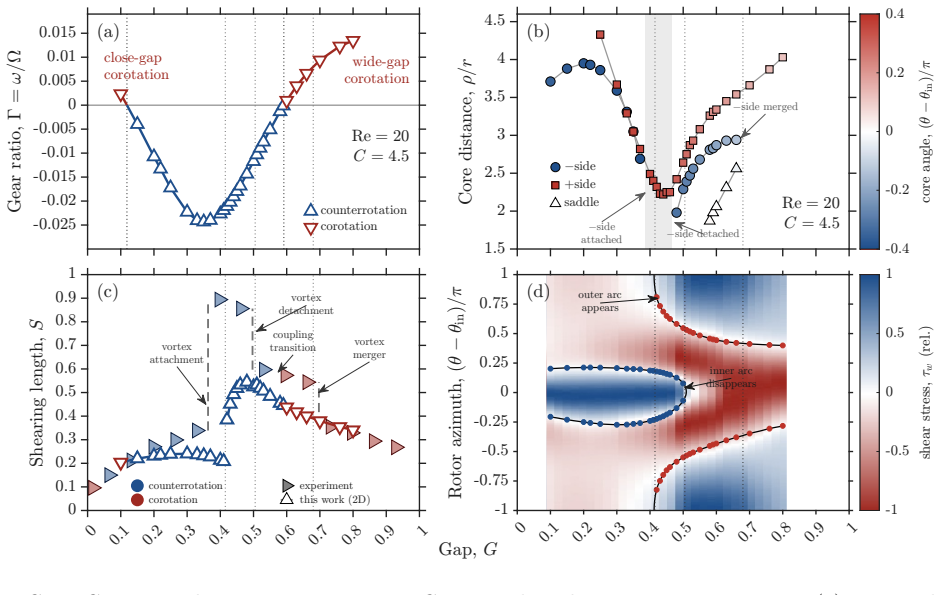
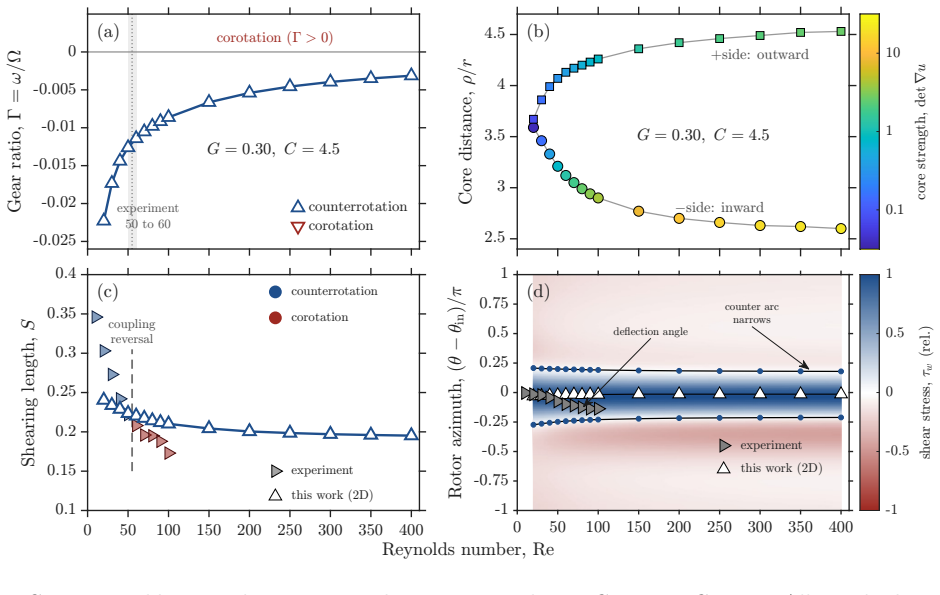
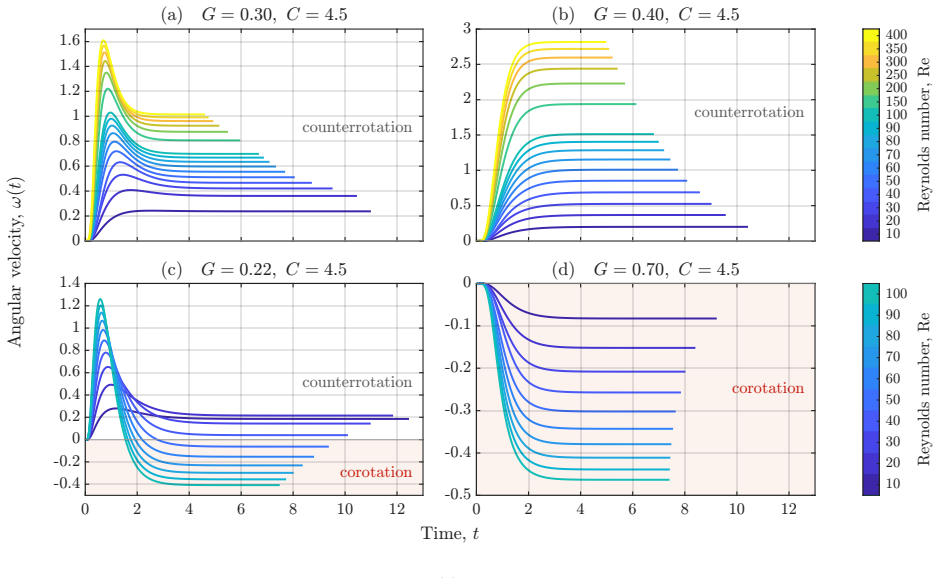
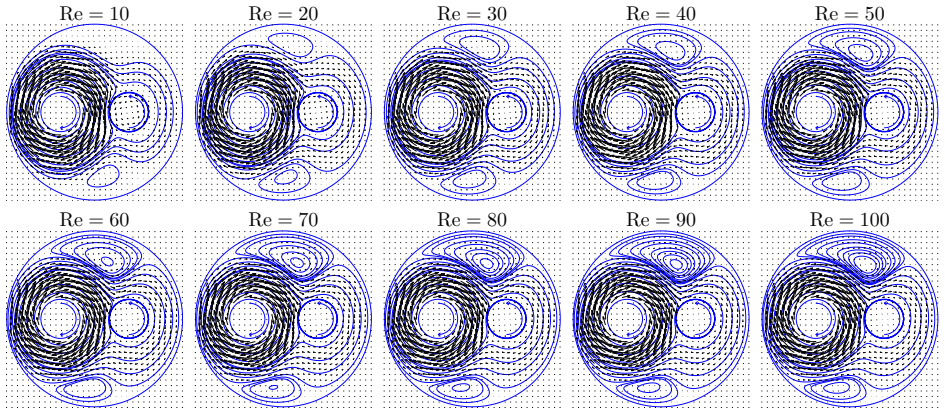
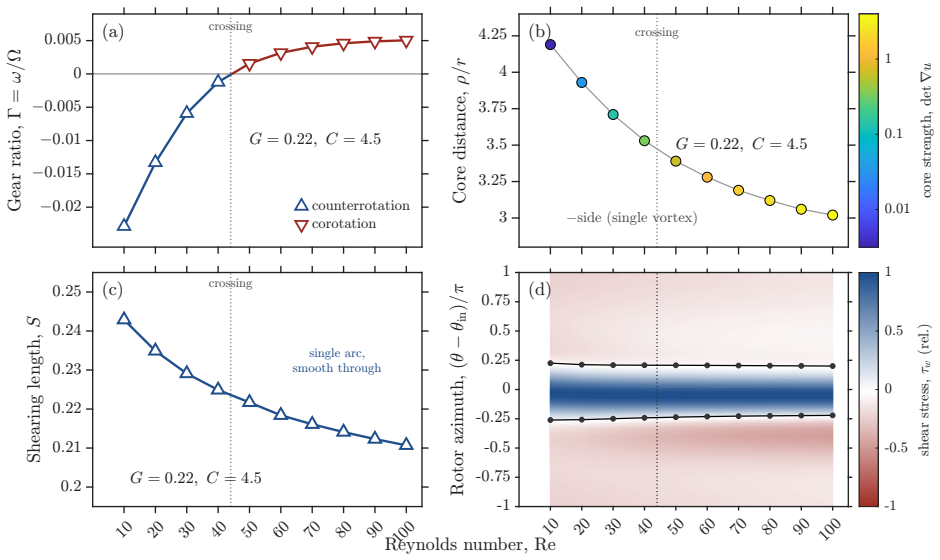
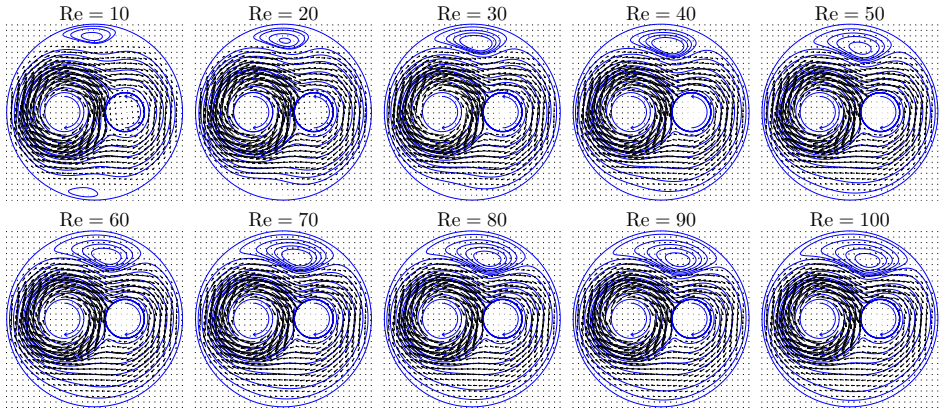
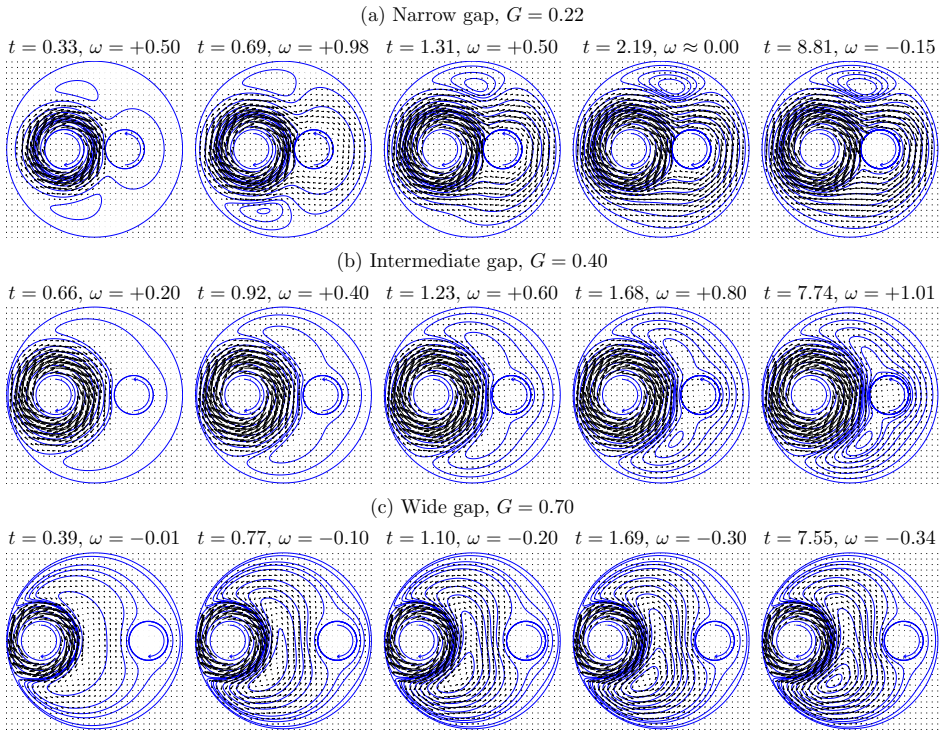
Using a DLM/FD method, the strictly planar model recovers the benchmark gap route at Re=20 including an intermediate counterrotation band, a wide-gap transition to corotation, gear-ratio magnitudes of order 10^{-2}, and the observed sequence of vortex attachment, detachment, and merger. It produces a reentrant-like gap structure with a small-gap corotation region. At the experimental mid-gap the planar gear ratio approaches zero from the counterrotating side but does not cross through Re=400; at narrower gap reversal occurs near Re=44 by redistribution of integrated planar torque rather than the experimental shear-competition mechanism. The strictly planar model therefore captures the broad
What carries the argument
The signed gear ratio Gamma equals passive-rotor angular velocity divided by active-rotor angular velocity, computed from torque balance on the passive rotor in 2D DNS; it distinguishes corotation from counterrotation and supplies the phase diagram in gap G and Reynolds number Re.
If this is right
- The broad gap-route architecture and existence of a Reynolds-driven spin boundary are intrinsic to planar hydrodynamics.
- Gear ratios remain of order 10^{-2} and follow the sequence of vortex attachment, detachment, and merger at moderate Re.
- A reentrant small-gap corotation region appears in the planar phase diagram.
- At mid-gap the gear ratio stays counterrotating up to Re=400 while narrower gaps reverse near Re=44 by integrated torque redistribution.
- The surface-stress mechanism in the planar model differs from the experimental shear-competition route.
Where Pith is reading between the lines
- Finite-depth secondary flows are likely required to produce the experimental shear-competition torque balance.
- End-wall stresses or specific apparatus geometry may shift the observed reversal boundary without changing the underlying planar coupling.
- Weak three-dimensional extensions of the present model could be tested by adding small out-of-plane velocity components while keeping the in-plane geometry fixed.
- The same 2D framework applied to other rotor spacings or corral shapes might expose additional universal features of hydrodynamic gear ratios.
Load-bearing premise
Discrepancies between the 2D simulation and the quasi-2D experiment can be attributed primarily to finite-depth secondary motion, end-wall stresses, and apparatus geometry rather than to numerical artifacts or incomplete parameter coverage in the planar runs.
What would settle it
A strictly planar experiment or simulation that reproduces the experimental high-Re reversal location together with collapse or deflection of the gap-facing counterrotating arc would falsify the attribution of the mismatch to three-dimensional effects.
Figures


read the original abstract
We study hydrodynamic spin coupling in a two-rotor corral using DNS of 2D incompressible viscous fluid flow. An active rotor is driven at angular velocity W, and a nearby torque-free passive rotor selects an angular velocity w through hydrodynamic torque balance. The signed gear ratio Gamma=w/W distinguishes corotation from counterrotation, with Reynolds number Re=|\Omega|r^2/\nu. Motivated by a recent quasi-two-dimensional experiment, we use a DLM/FD method to compute planar phase diagrams of $\Gamma(G,Re)$ at corral sizes C=3, 4.5, and 6. The planar model recovers the benchmark gap route at Re=20: an intermediate counterrotation band, a wide-gap transition to corotation, gear-ratio magnitudes of order 10^{-2}, and the observed sequence of vortex attachment, detachment, and merger. It also produces a reentrant-like gap structure with a small-gap corotation region whose relation to the experimental close-range geometric state remains unresolved. The main discrepancy is the high-Re boundary. At the experimental mid-gap transect G about 0.3, the planar gear ratio approaches zero from the counterrotating side but does not cross through Re=400; at the narrower gap G=0.22, by contrast, the planar terminal spin reverses near Re=44. Wall-traction diagnostics show that this crossing is not the experimental shear-competition mechanism: the gap-facing counterrotating arc narrows but does not collapse or deflect as in the experiment, and the reversal at G=0.22 occurs by redistribution of the integrated planar torque. The strictly planar model therefore captures the broad gap-route architecture and the existence of a Reynolds-driven spin boundary, but displaces that boundary in gap and alters its surface-stress mechanism. The remaining mismatch points to finite-depth secondary motion, end-wall stresses, and apparatus geometry as plausible contributors to the experimental shear balance.
Editorial analysis
A structured set of objections, weighed in public.
Referee Report
Summary. The manuscript reports two-dimensional direct numerical simulations of hydrodynamic spin coupling between an active rotor driven at angular velocity W and a torque-free passive rotor in a corral, using the DLM/FD method for moving boundaries. Phase diagrams of the signed gear ratio Γ(G, Re) are computed for corral sizes C=3, 4.5 and 6. The planar model recovers the low-Re benchmark gap route (intermediate counterrotation band, wide-gap transition to corotation, |Γ| ~ 10^{-2}, and the sequence of vortex attachment/detachment/merger) but produces a displaced high-Re spin boundary and a different surface-stress mechanism (redistribution of integrated planar torque rather than collapse of the gap-facing counterrotating arc). The authors conclude that the strictly planar model captures the broad gap-route architecture and existence of a Re-driven boundary but displaces the boundary in G and alters its mechanism, pointing to finite-depth secondary flows and end-wall effects as plausible contributors to the experimental behavior.
Significance. If the results hold, the work supplies a clean, parameter-free demonstration of what a strictly planar Navier-Stokes model produces for this geometry, including direct outputs of gear-ratio sign changes and torque integrals. This benchmark is useful for assessing the range of validity of 2D approximations in quasi-2D rotor experiments and for guiding future 3D studies of secondary motion. The recovery of the low-Re vortex diagnostics and the explicit wall-traction diagnostics at the cited (G, Re) points strengthen the internal consistency of the planar findings.
minor comments (3)
- [Abstract] Abstract, final paragraph: the statement that the reversal at G=0.22 'occurs by redistribution of the integrated planar torque' would benefit from a brief quantitative illustration (e.g., the fractional contribution of the gap-facing arc to the total torque before and after the crossing) to make the mechanism distinction fully transparent.
- The manuscript should state the grid resolution and time-step criteria used at the highest Re values (Re=400) and confirm that the reported sign changes remain unchanged under refinement; this would directly address possible numerical sensitivity at the high-Re boundary.
- Figure captions (throughout): explicitly list the three corral sizes C shown in each panel of the phase diagrams and the precise (G, Re) locations at which wall-traction diagnostics are extracted.
Simulated Author's Rebuttal
We thank the referee for the positive assessment of our manuscript and the recommendation for minor revision. The referee's summary accurately captures the scope, methods, and conclusions of the work.
Circularity Check
No significant circularity detected
full rationale
The paper reports direct numerical solutions of the 2D incompressible Navier-Stokes equations via DLM/FD on fixed grids, yielding phase diagrams of gear ratio Gamma(G,Re), vortex states, and integrated wall-traction diagnostics as primary outputs. These quantities are computed from the governing PDEs and boundary conditions without parameter fitting to the target observables or reduction to prior self-citations. The experimental comparison is presented as an external benchmark whose discrepancies are left open; the central claims about planar-model behavior (gap-route architecture, existence and displacement of the Re-driven boundary) rest solely on the simulation results themselves.
Axiom & Free-Parameter Ledger
free parameters (3)
- G (gap ratio)
- C (corral size)
- Re (Reynolds number)
axioms (2)
- standard math Incompressible 2D Navier-Stokes equations govern the flow.
- domain assumption No-slip condition on all solid surfaces including rotor boundaries.
Reference graph
Works this paper leans on
-
[1]
L. Ristroph and J. Zhang, Anomalous hydrodynamic drafting of interacting flapping flags, Phys. Rev. Lett.101, 194502 (2008)
work page 2008
-
[2]
J. W. Newbolt, J. Zhang, and L. Ristroph, Flow interactions between uncoordinated flapping swimmers give rise to group cohesion, Proc. Natl. Acad. Sci. U.S.A.116, 2419 (2019)
work page 2019
-
[3]
V. Soni, E. S. Bililign, S. Magkiriadou, S. Sacanna, D. Bartolo, M. J. Shelley, and W. T. M. Irvine, The odd free surface flows of a colloidal chiral fluid, Nat. Phys.15, 1188 (2019)
work page 2019
-
[4]
E. S. Bililign, F. Balboa Usabiaga, Y. A. Ganan, A. Poncet, V. Soni, S. Magkiriadou, M. J. Shelley, D. Bartolo, and W. T. M. Irvine, Motile dislocations knead odd crystals into whorls, Nat. Phys.18, 212 (2022)
work page 2022
-
[5]
I. D. Brownstein, N. J. Wei, and J. O. Dabiri, Aerodynamically interacting vertical-axis wind turbines: Performance enhancement and three-dimensional flow, Energies12, 2724 (2019)
work page 2019
-
[6]
P. Chen, S. Weady, S. Atis, T. Matsuzawa, M. J. Shelley, and W. T. M. Irvine, Self-propulsion, flocking and chiral active phases from particles spinning at intermediate Reynolds numbers, Nat. Phys.21, 146 (2025)
work page 2025
-
[7]
S. Kida and M. Takaoka, Vortex reconnection, Annu. Rev. Fluid Mech.26, 169 (1994)
work page 1994
-
[8]
D. G. Dritschel, A general theory for two-dimensional vortex interactions, J. Fluid Mech.293, 269 (1995)
work page 1995
-
[9]
G. I. Taylor, Stability of a viscous liquid contained between two rotating cylinders, Phil. Trans. R. Soc. A223, 289 (1923)
work page 1923
- [10]
-
[11]
S. C. Jana, G. Metcalfe, and J. M. Ottino, Experimental and computational studies of mixing in complex Stokes flows: the vortex mixing flow and multicellular cavity flows, J. Fluid Mech. 269, 199 (1994)
work page 1994
- [12]
-
[13]
J. E. Smith, L. Ristroph, and J. Zhang, Hydrodynamic spin-coupling of rotors, Phys. Rev. Lett.136, 024001 (2026)
work page 2026
-
[14]
H. Guo, Y. Man, and H. Zhu, Hydrodynamic bound states of rotating microcylinders in a confining geometry, Phys. Rev. Fluids9, 014102 (2024)
work page 2024
-
[15]
R. Glowinski, T.-W. Pan, T. I. Hesla, and D. D. Joseph, A distributed Lagrange multiplier/ fictitious domain method for particulate flows, Int. J. Multiphase Flow25, 755 (1999)
work page 1999
-
[16]
R. Glowinski, T.-W. Pan, T. I. Hesla, D. D. Joseph, and J. P´ eriaux, A fictitious domain approach to the direct numerical simulation of incompressible viscous flow past moving rigid 26 bodies: Application to particulate flow, J. Comput. Phys.169, 363 (2001)
work page 2001
-
[17]
T.-W. Pan, R. Glowinski, and S. C. Hou, Direct numerical simulation of pattern formation in a rotating suspension of non-Brownian settling particles in a fully filled cylinder, Comput. Struct.85, 955 (2007)
work page 2007
-
[18]
S. C. Hou, T.-W. Pan, and R. Glowinski, Circular band formation for incompressible viscous fluid–rigid-particle mixtures in a rotating cylinder, Phys. Rev. E89, 023013 (2014)
work page 2014
- [19]
- [20]
-
[21]
R. Glowinski,Finite Element Methods for Incompressible Viscous Flow, Handbook of Numer- ical Analysis, Vol. IX, edited by P. G. Ciarlet and J. L. Lions (North-Holland, Amsterdam, 2003), pp. 3–1176
work page 2003
-
[22]
E. J. Dean and R. Glowinski, A wave equation approach to the numerical solution of the Navier-Stokes equations for incompressible viscous flow, C. R. Acad. Sci. Paris, S´ er. I325, 783 (1997)
work page 1997
-
[23]
A. J. Chorin, T. J. R. Hughes, M. F. McCracken, and J. E. Marsden, Product formulas and numerical algorithms, Commun. Pure Appl. Math.31, 205 (1978)
work page 1978
-
[24]
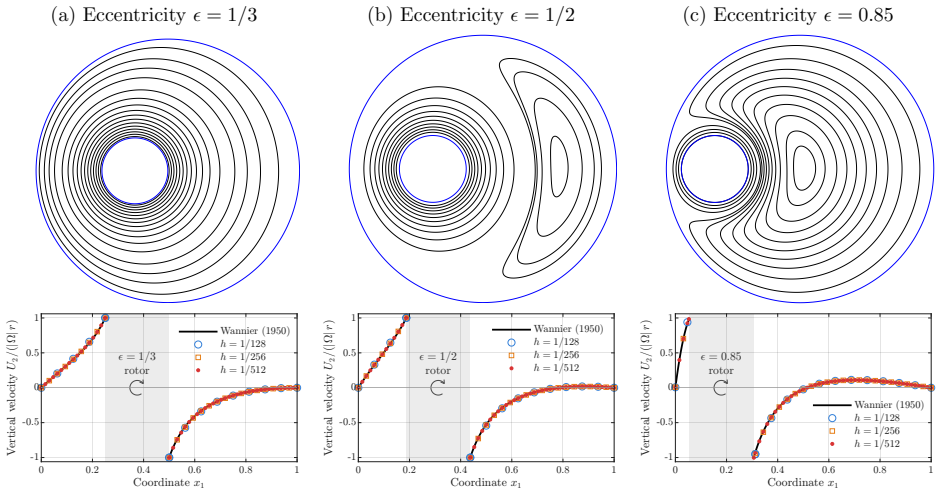
G. H. Wannier, A contribution to the hydrodynamics of lubrication, Q. Appl. Math.8, 1 (1950). 27
work page 1950
discussion (0)
Sign in with ORCID, Apple, or X to comment. Anyone can read and Pith papers without signing in.