Birkhoff conjecture and finite energy foliations in Hill's lunar problem
Pith reviewed 2026-06-27 05:25 UTC · model grok-4.3
The pith
The retrograde orbit bounds a disk-like global surface of section for all energies below the critical value in Hill's lunar problem.
A machine-rendered reading of the paper's core claim, the machinery that carries it, and where it could break.
Core claim
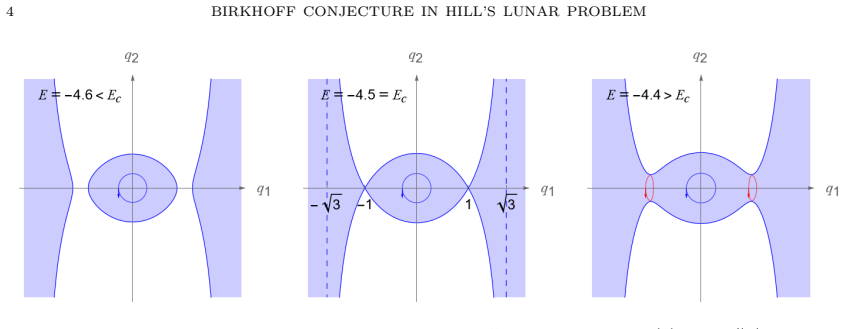
We prove Birkhoff's retrograde orbit conjecture in Hill's lunar problem by showing that the retrograde orbit bounds a disk-like global surface of section for every energy below the critical value. We also obtain a global description of the dynamics through the critical energy level by constructing finite energy foliations for energies slightly above it. The binding of these foliations consists of the retrograde orbit together with the Lyapunov orbits near the critical points. The proof combines pseudo-holomorphic curve techniques with a new convexity theorem for Hill's lunar problem.
What carries the argument
An explicit global symplectic change of coordinates under which the bounded regularized component becomes strictly convex up to the critical energy level, enabling application of Hofer-Wysocki-Zehnder theory of finite energy foliations.
If this is right
- The retrograde orbit bounds a disk-like global surface of section for every energy below the critical value.
- Finite energy foliations exist for energies slightly above the critical level, with binding consisting of the retrograde orbit and nearby Lyapunov orbits.
- There exist infinitely many periodic orbits.
- There exist infinitely many trajectories asymptotic to the Lyapunov orbits.
- All periodic orbits satisfy explicit lower bounds on their Conley-Zehnder indices.
Where Pith is reading between the lines
- The same coordinate change may yield convexity in related regularized three-body problems at comparable energy ranges.
- The resulting disk-like surfaces of section make it possible to reduce the flow to an area-preserving return map on the disk.
- The 2-3-2 foliations above the critical energy suggest a mechanism for tracking how orbits transition between different families as energy increases.
Load-bearing premise
The bounded regularized component of Hill's lunar problem admits an explicit global symplectic change of coordinates that makes it strictly convex up to the critical energy level.
What would settle it
A direct computation showing that the regularized component cannot be made strictly convex by any global symplectic change of coordinates, or the discovery of a periodic orbit below the critical energy whose Conley-Zehnder index falls below the lower bound required by a disk-like global surface of section.
Figures


read the original abstract
We prove Birkhoff's retrograde orbit conjecture in Hill's lunar problem by showing that the retrograde orbit bounds a disk-like global surface of section for every energy below the critical value. We also obtain a global description of the dynamics through the critical energy level by constructing finite energy foliations for energies slightly above it. The binding of these foliations consists of the retrograde orbit together with the Lyapunov orbits near the critical points. As a consequence, there exist infinitely many periodic orbits and infinitely many trajectories asymptotic to the Lyapunov orbits. The proof combines pseudo-holomorphic curve techniques with a new convexity theorem for Hill's lunar problem. More precisely, we construct an explicit global symplectic change of coordinates under which the bounded regularized component becomes strictly convex up to the critical energy level. This convexity implies strong dynamical consequences, including lower bounds for the Conley-Zehnder indices of periodic orbits, and allows the application of the Hofer-Wysocki-Zehnder theory of finite energy foliations. As a result, we obtain disk-like global surfaces of section below the critical level and $2-3-2$ foliations for energies slightly above it.
Editorial analysis
A structured set of objections, weighed in public.
Referee Report
Summary. The manuscript proves Birkhoff's retrograde orbit conjecture in Hill's lunar problem by showing that the retrograde orbit bounds a disk-like global surface of section for every energy below the critical value. This is achieved via an explicit global symplectic coordinate change rendering the bounded regularized component strictly convex up to the critical energy, which supplies the Conley-Zehnder index bounds needed to apply Hofer-Wysocki-Zehnder finite-energy foliation theory. The paper also constructs 2-3-2 finite energy foliations for energies slightly above the critical level, with binding consisting of the retrograde orbit and nearby Lyapunov orbits, yielding infinitely many periodic orbits and trajectories asymptotic to the Lyapunov orbits.
Significance. If the new convexity theorem holds with the claimed explicit coordinate change, the result would provide a rigorous global dynamical description of Hill's lunar problem through the critical energy using modern symplectic techniques, confirming a classical conjecture in a concrete celestial mechanics model and extending HWZ theory to this setting. The explicit (rather than abstract) nature of the coordinate transformation is a potential strength for reproducibility.
major comments (2)
- [Convexity theorem / coordinate change construction] The central convexity theorem (invoked throughout to obtain CZ index lower bounds and apply HWZ theory) asserts an explicit global symplectic change of coordinates making the regularized bounded component strictly convex for all energies below critical, but the manuscript supplies neither the explicit transformation formulas nor a direct verification that the Hessian of the transformed Hamiltonian remains positive definite on the energy surface in this range. This step is load-bearing for the index bounds and the existence of the disk-like global surface of section.
- [Sections applying HWZ theory and index estimates] The application of HWZ finite-energy foliation theory below and above the critical energy relies on the convexity-derived index bounds, yet no explicit computation of these indices (or reference to the transformed coordinates in which they are verified) is provided to confirm they meet the required thresholds for the 2-3-2 foliations or the disk-like section.
minor comments (2)
- The abstract is concise and outlines the strategy clearly, but the paper would benefit from an early dedicated section or appendix displaying the explicit coordinate transformation and at least one sample Hessian computation at a representative energy level.
- Notation for the regularized components and the critical energy level should be introduced with a brief reminder of the standard Hill's lunar problem setup to aid readers unfamiliar with the model.
Simulated Author's Rebuttal
We thank the referee for the careful reading and for recognizing the potential significance of the convexity theorem and its applications to Hill's lunar problem. We address each major comment below with references to the relevant parts of the manuscript and indicate where clarifications or expansions will be made in revision.
read point-by-point responses
-
Referee: [Convexity theorem / coordinate change construction] The central convexity theorem (invoked throughout to obtain CZ index lower bounds and apply HWZ theory) asserts an explicit global symplectic change of coordinates making the regularized bounded component strictly convex for all energies below critical, but the manuscript supplies neither the explicit transformation formulas nor a direct verification that the Hessian of the transformed Hamiltonian remains positive definite on the energy surface in this range. This step is load-bearing for the index bounds and the existence of the disk-like global surface of section.
Authors: The explicit global symplectic coordinate change is constructed in Section 3 via a generating function that regularizes and convexifies the bounded component of Hill's problem. The transformation formulas appear explicitly in equations (3.2)--(3.7), and symplecticity is verified by direct computation of the pullback of the standard symplectic form. Strict convexity (positive-definiteness of the Hessian of the transformed Hamiltonian on each energy surface h < h_crit) is proved in Proposition 3.5 by explicit differentiation and sign analysis of the resulting quadratic form, using the concrete expression of the Hill potential. These steps supply the CZ-index lower bounds invoked in later sections. revision: partial
-
Referee: [Sections applying HWZ theory and index estimates] The application of HWZ finite-energy foliation theory below and above the critical energy relies on the convexity-derived index bounds, yet no explicit computation of these indices (or reference to the transformed coordinates in which they are verified) is provided to confirm they meet the required thresholds for the 2-3-2 foliations or the disk-like section.
Authors: The CZ-index lower bounds are obtained in Theorem 4.1 directly from the Hessian positivity established in the transformed coordinates (Proposition 3.5). The proof invokes the standard relation between convexity and CZ indices for convex Hamiltonians. For the 2-3-2 foliations above the critical level, the indices of the retrograde orbit and the nearby Lyapunov orbits are computed explicitly in Section 5.2, again in the transformed coordinates, and shown to satisfy the hypotheses of the Hofer--Wysocki--Zehnder theorem. A short clarifying remark linking these computations back to the coordinate change will be added. revision: partial
Circularity Check
No significant circularity; derivation relies on explicit new construction
full rationale
The paper's proof chain proceeds by constructing an explicit global symplectic coordinate change that renders the regularized bounded component strictly convex up to the critical energy, then invoking external Hofer-Wysocki-Zehnder theory for the foliations and global surface of section. This convexity step is presented as a new theorem whose verification is independent of the Birkhoff conjecture itself; no self-citation is load-bearing for the central claim, no parameter is fitted and relabeled as a prediction, and no ansatz or uniqueness result is smuggled in from prior author work. The argument is therefore self-contained against external benchmarks.
Axiom & Free-Parameter Ledger
axioms (2)
- standard math Hofer-Wysocki-Zehnder theory applies to strictly convex hypersurfaces in R^4 to produce finite energy foliations with prescribed binding orbits.
- standard math Existence and properties of pseudo-holomorphic curves in symplectic manifolds with contact-type boundaries.
Reference graph
Works this paper leans on
-
[1]
Albers, U
P. Albers, U. Frauenfelder, O. van Koert and G. P. Paternain,Contact Geometry of the Restricted there-body problem, Communication on Pure and Applied Mathematics, LXV(2012), pp: 0229-0263
2012
-
[2]
Albers, J
P. Albers, J. Fish, U. Frauenfelder, H. Hofer and O. van Koert,Global surfaces of section in the planar restricted3-body problem.Archive for Rational Mechanics and Analysis, 204(2012), 273–284
2012
-
[3]
Aydin,The Conley-Zehnder indices of the spatial Hill three-body problem, Celestial Mechanics and Dynam- ical Astronomy 135 (2023), Article 29
C. Aydin,The Conley-Zehnder indices of the spatial Hill three-body problem, Celestial Mechanics and Dynam- ical Astronomy 135 (2023), Article 29
2023
-
[4]
C. Aydin and A. Batkhin,Studying network of symmetric periodic orbit families of the Hill problem via symplectic invariants, arXiv:2410.21245, 2024
-
[5]
Bangert, Y
V. Bangert, Y. Long,The existence of two closed geodesics on every Finsler2-sphere,Math. Ann.346(2010), 335-366
2010
-
[6]
Birkhoff,The restricted problem of three bodies, Rend
G. Birkhoff,The restricted problem of three bodies, Rend. Circ. Matem. Palermo, 39(1915), 265C334
1915
-
[7]
Brown,An introductory treatise on the lunar theory, Cambridge University Press (1896)
E. Brown,An introductory treatise on the lunar theory, Cambridge University Press (1896)
-
[8]
Conley.Twist mappings, linking, analyticity, and periodic solutions which pass close to an unstable periodic solution.Topological dynamics, (1968), 129–153
C. Conley.Twist mappings, linking, analyticity, and periodic solutions which pass close to an unstable periodic solution.Topological dynamics, (1968), 129–153
1968
-
[9]
N. V. de Paulo and Pedro A. S. Salom˜ ao,Systems of transversal sections near critical energy levels of Hamil- tonian systems inR 4, Memoirs of the Amer. Math. Soc., 252(2018), no. 1202, 1–105
2018
-
[10]
N. V. de Paulo and Pedro A. S. Salom˜ ao,On the multiplicity of periodic orbits and homoclinics near critical energy levels of Hamiltonian systems inR 4, Transactions of the Amer. Math. Soc., 372(2019), no. 2, 859–887
2019
-
[11]
N. V. de Paulo and Pedro A. S. Salom˜ ao.Reeb flows, pseudo-holomorphic curves and transverse foliations. S˜ ao Paulo Journal of Mathematical Sciences 16, no. 1 (2022): 314–339
2022
-
[12]
de Paulo, U
N. de Paulo, U. Hryniewicz, S. Kim and Pedro A. S. Salom˜ ao.Genus zero transverse foliations for weakly convex Reeb flows on the tight3-sphere, to appear in Advances in Mathematics
-
[13]
J. W. Fish and R. Siefring.Connected sums and finite energy foliations I: Contact connected sums, J. Sym- plectic Geom. 16(2018), no. 6, 1639–1748
2018
-
[14]
Franks.Generalizations of the Poincar´ e-Birkhoff theorem.Ann
J. Franks.Generalizations of the Poincar´ e-Birkhoff theorem.Ann. of Math. 128(1988), 139–151
1988
-
[15]
Generalizations of the Poincar´ e-Birkhoff theorem
J. Franks.Erratum to “Generalizations of the Poincar´ e-Birkhoff theorem”.Ann. of Math. 164(2006), 1097– 1098
2006
-
[16]
Frauenfelder and O
U. Frauenfelder and O. van Koert.The restricted three-body problem and holomorphic curves. Springer Inter- national Publishing, 2018. BIRKHOFF CONJECTURE IN HILL’S LUNAR PROBLEM 31
2018
-
[17]
Frauenfelder, O
U. Frauenfelder, O. van Koert and L. Zhao,On the problem of convexity for the restricted three-body problem around the heavy primary,Hokkaido Math.J.51(2022), no. 2, 287–317
2022
-
[18]
Grotta-Ragazzo, and Pedro A
C. Grotta-Ragazzo, and Pedro A. S. Salom˜ ao.The ConleyCZehnder index and the saddle-center equilibrium. Journal of Differential Equations 220(2006), no. 1, 259–278
2006
-
[19]
Grotta-Ragazzo, L
C. Grotta-Ragazzo, L. Liu and Pedro A. S. Salom˜ ao,Non-resonant Hopf links near a Hamiltonian equilibrium point, to appear in Communications in Mathematical Physics
-
[20]
Hill,Researches in the lunar theory, Amer
G. Hill,Researches in the lunar theory, Amer. J. Math., 1(1878), 5-26, 129-147, 245-260
-
[21]
G. Hill,On the part of the Motion of the Lunar Perigee which is a Function of the mean motions of the Sun and the Moon,John Wilson & Son, Cambridge, Massachusetts,(1877), Reprinted in Acta 8(1886), 1-36
-
[22]
Hofer,Pseudoholomorphic curves in symplectizations with applications to the Weinstein conjecture in dimension three, Invent
H. Hofer,Pseudoholomorphic curves in symplectizations with applications to the Weinstein conjecture in dimension three, Invent. Math., 114(1993), 515–563
1993
-
[23]
Hofer, K
H. Hofer, K. Wysocki and E. Zehnder.A characterization of the tight three sphere.Duke Math. J. 81 (1995), no. 1, 159–226
1995
-
[24]
Hofer, K
H. Hofer, K. Wysocki and E. Zehnder.A characterization of the tight three sphere II.Commun. Pure Appl. Math. 55(1999), no. 9, 1139–1177
1999
-
[25]
Hofer, K
H. Hofer, K. Wysocki, E. Zehnder,Properties of pseudoholomorphic curves in symplectictisation I: Asymp- totics, Ann. Inst. Henri Poincar´ e, 13(1996), 337–379
1996
-
[26]
Hofer, K
H. Hofer, K. Wysocki, E. Zehnder,Properties of pseudoholomorphic curves in symplectictisation II: Embedding control and algebraic invariants, Geom. and Funct. Anal., 5(1995), no. 2, 270–328
1995
-
[27]
Hofer, K
H. Hofer, K. Wysocki and E. Zehnder.Properties of pseudoholomorphic curves in symplectizations III: Fred- holm theory.Topics in nonlinear analysis, Birkh¨ auser, Basel, (1999), 381–475
1999
-
[28]
Hofer, K
H. Hofer, K. Wysocki and E. Zehnder.The dynamics of strictly convex energy surfaces inR 4. Ann. of Math., 148(1998), 197–289
1998
-
[29]
Hofer, K
H. Hofer, K. Wysocki and E. Zehnder.Finite energy foliations of tight three-spheres and Hamiltonian dynamics. Ann. of Math, 157(2003), 125–255
2003
-
[30]
Hryniewicz.Systems of global surfaces of section for dynamically convex Reeb flows on the3-sphere,Journal of Symplectic Geometry, 12(2014), no
U. Hryniewicz.Systems of global surfaces of section for dynamically convex Reeb flows on the3-sphere,Journal of Symplectic Geometry, 12(2014), no. 4, 791–862
2014
-
[31]
Hryniewicz, J
U. Hryniewicz, J. Licata and Pedro A. S. Salom˜ ao.A dynamical characterization of universally tight lens spaces, Proceedings of the London Mathematical Society, 110(2014), 213–269
2014
-
[32]
Hryniewicz and Pedro A
U. Hryniewicz and Pedro A. S. Salom˜ ao.On the existence of disk-like global sections for Reeb flows on the tight3-sphere.Duke Mathematical Journal, 160(2011), no. 3, 415–465
2011
-
[33]
Hryniewicz and Pedro A
U. Hryniewicz and Pedro A. S. Salom˜ ao.Elliptic bindings for dynamically convex Reeb flows on the real projective three-space.Calc. Var. Partial Differential Equations 55 (2016), no. 2, Art. 43, 57 pp
2016
-
[34]
Hryniewicz, Pedro A
U. Hryniewicz, Pedro A. S. Salom˜ ao, and K. Wysocki.Genus zero global surfaces of section for Reeb flows and a result of Birkhoff. Journal of the European Mathematical Society, 25 (9), 2023
2023
-
[35]
X. Hu, L. Liu, Y. Ou, Pedro A. S. Salom˜ ao, G. Yu.A symplectic dynamics approach to the spatial isosceles three-body problem, to appear in Journal of the European Mathematical Society
-
[36]
2, 025015
Joung, Chankyu, and Otto van Koert.Computational symplectic topology and symmetric orbits in the re- stricted three-body problem.Nonlinearity 38(2025), no. 2, 025015
2025
-
[37]
Kim.On a convex embedding of the Euler problem of two fixed centers.Regular and Chaotic Dynamics 23 (2018), 304–324
S. Kim.On a convex embedding of the Euler problem of two fixed centers.Regular and Chaotic Dynamics 23 (2018), 304–324
2018
-
[38]
Lee,Fiberwise Convexity of Hill’s lunar problem, J
J. Lee,Fiberwise Convexity of Hill’s lunar problem, J. Topol. Anal., 9(2017), no.4, 571-630
2017
-
[39]
Ligon,Hill’s Lunar Equations, Series, Convergence, Motion of the Perigee, arXiv: 2512.08961, 2025
T. Ligon,Hill’s Lunar Equations, Series, Convergence, Motion of the Perigee, arXiv: 2512.08961, 2025
-
[40]
Finite energy foliations and global dynamics in the restricted three-body problem
L. Liu, Pedro A. S. Salom˜ ao,Finite energy foliations and global dynamics in the restricted three-body problem, arXiv:2506.17867
work page internal anchor Pith review Pith/arXiv arXiv
-
[41]
Long.Index theory for symplectic paths with applications, volume 207, Progress in Mathematics, Birkh¨ auser Verlag, Basel, 2002
Y. Long.Index theory for symplectic paths with applications, volume 207, Progress in Mathematics, Birkh¨ auser Verlag, Basel, 2002
2002
-
[42]
McGehee.Some homoclinic orbits for the restricted three-body problem, The University of Wisconsin, Ph.D
R. McGehee.Some homoclinic orbits for the restricted three-body problem, The University of Wisconsin, Ph.D. Thesis, 1969
1969
-
[43]
Meletlidou, S
E. Meletlidou, S. Ichtiaroglou, and F. J. Winterberg.Nonintegrability of Hill’s lunar problem.Celestial Me- chanics and Dynamical Astronomy 80.2 (2001): 145-156
2001
-
[44]
Morales-Ruiz, C
J. Morales-Ruiz, C. Sim, and S. Simon.Algebraic proof of the non-integrability of Hill’s problem.Ergodic Theory and Dynamical Systems 25.4 (2005): 1237–1256
2005
-
[45]
Poincar´ e.Sur un th´ eor` eme de g´ eom´ etrie.Rend
H. Poincar´ e.Sur un th´ eor` eme de g´ eom´ etrie.Rend. Circ. Mat. Palermo, 33(1912), 375–407
1912
-
[46]
Pedro A. S. Salom˜ ao,Convex energy levels of Hamiltonian systems.Qual. Theory Dyn. Syst., 4(2), 439-457, 2004. 32 BIRKHOFF CONJECTURE IN HILL’S LUNAR PROBLEM
2004
-
[47]
Pedro A. S. Salom˜ ao and U. L. Hryniewicz.Global surfaces of section for Reeb flows in dimension three and beyond. In Proceedings of the International Congress of Mathematicians—Rio de Janeiro 2018. Vol. II. Invited lectures, pages 941–967. World Sci. Publ., Hackensack, NJ, 2018
2018
-
[48]
Schneider.Global surfaces of section for dynamically convex Reeb flows on lens spaces,Transactions of the American Mathematical Society, 373(2020), no
A. Schneider.Global surfaces of section for dynamically convex Reeb flows on lens spaces,Transactions of the American Mathematical Society, 373(2020), no. 4, 2775–2803
2020
-
[49]
Sim´ o and T.J
C. Sim´ o and T.J. Stuchi,Central stable/unstable manifolds and the destruction of KAM tori in the planar Hill problem, Physica D.,140, 1-32, 2000
2000
-
[50]
Thorpe,Elementary topics in differential geometry
John A. Thorpe,Elementary topics in differential geometry. Springer Science & Business Media, 2012
2012
-
[51]
Wendl,Finite energy foliations and surgery on transverse links, Ph.D
C. Wendl,Finite energy foliations and surgery on transverse links, Ph.D. Thesis, New York University, 2005
2005
-
[52]
Wendl,Finite energy foliations on overtwisted contact manifolds
C. Wendl,Finite energy foliations on overtwisted contact manifolds. Geometry & Topology , 12(2008), no. 1, 531–616
2008
-
[53]
Wendl.Automatic transversality and orbifolds of punctured holomorphic curves in dimension four
C. Wendl.Automatic transversality and orbifolds of punctured holomorphic curves in dimension four. Com- mentarii Mathematici Helvetici, 85(2010), no. 2, 347-407
2010
-
[54]
Wendl,Compactness for embedded pseudoholomorphic curves in3-manifolds
C. Wendl,Compactness for embedded pseudoholomorphic curves in3-manifolds. Journal of the European Mathematical Society, 12(2010), no. 2, 313–342
2010
-
[55]
Wintner, ¨Uber die Konvergenzfragen der Mondtheorie, Math
A. Wintner, ¨Uber die Konvergenzfragen der Mondtheorie, Math. Z, 30(1929), no. 1, 211-227
1929
-
[56]
Wintner,The Analytical Foundations of Celestial Mechanics, Princeton University Press, (1941)
A. Wintner,The Analytical Foundations of Celestial Mechanics, Princeton University Press, (1941)
1941
discussion (0)
Sign in with ORCID, Apple, or X to comment. Anyone can read and Pith papers without signing in.