The unreasonable effectiveness of the cathetus rule in ancient and modern optics
Pith reviewed 2026-06-30 08:45 UTC · model grok-4.3
The pith
The cathetus rule holds for sagittal images and enables astigmatism assessment via meridional ray tracing alone.
A machine-rendered reading of the paper's core claim, the machinery that carries it, and where it could break.
Core claim
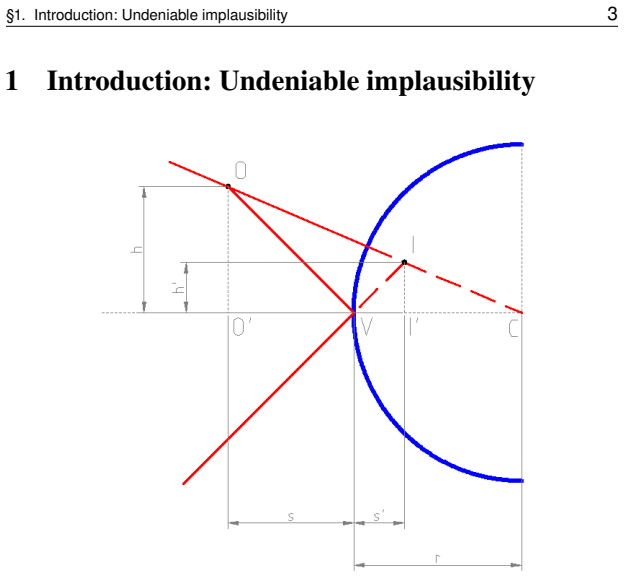
The cathetus rule is equivalent to the assumption that the image is stigmatic and the cathetus well defined. This narrow assumption is approximately true in the first-order (paraxial, Gaussian) analysis of lenses and mirrors. The validity of the rule for the sagittal image fills a critical gap in meridional ray-tracing through spherical surfaces: by tracing the chief ray from an off-axis object-point, then applying the cathetus rule to the successive surfaces, one can locate successive sagittal image-points on the chief ray (produced rectilinearly through surfaces as necessary), and hence assess astigmatism to leading order, without tracing any rays outside the meridional plane.
What carries the argument
The cathetus rule, which places the image point on the perpendicular from the object point to the surface, applied to the sagittal image in the paraxial limit.
If this is right
- Successive sagittal image points can be found on the chief ray after each reflection or refraction.
- Astigmatism can be assessed to leading order using only rays in the meridional plane.
- The rule applies to both reflection and refraction at spherical surfaces under the paraxial approximation.
- Modern Gaussian optics expositions contain unacknowledged applications of the rule.
Where Pith is reading between the lines
- Lens design software could incorporate the rule for quick initial sagittal-focus estimates before full three-dimensional tracing.
- The historical rule may offer computational shortcuts in other paraxial optical problems involving off-axis points.
- Higher-order extensions of the method would require separate handling of tangential-image deviations.
Load-bearing premise
The cathetus rule remains valid for the sagittal image formed at spherical surfaces to leading order, allowing the image point to be placed on the rectilinearly extended chief ray without additional non-meridional rays.
What would settle it
A paraxial ray-trace calculation through a spherical surface that shows the sagittal image point lying off the chief ray would falsify the claim.
Figures


read the original abstract
The "cathetus rule" in optics alleges that the image of an object-point, formed by reflection or refraction at a surface, lies on the perpendicular ("cathetus") from the object-point to or through the surface. The first known statement of the rule, attributed to Euclid, was for a plane or spherical mirror. The rule was extended to refraction by Ptolemy.... Kepler was universally credited with the first disproof-and-salvage of the cathetus rule until 2018, when Benedetti's priority was exposed by Goulding. Kepler notwithstanding, the rule was reaffirmed by Tacquet for plane and spherical mirrors, except for the case in which the rays converge toward a point behind the eye; this became known as the "Barrovian case" because it troubled Barrow, in spite of his modern concept of an image. Barrow demolished the cathetus rule for the tangential image except in the paraxial limit, and Newton salvaged it for the sagittal image. The rule then seems to fade from history. But the rule is equivalent to the assumption that the image is stigmatic and the cathetus well defined. This narrow assumption is approximately true in the first-order (paraxial, "Gaussian") analysis of lenses and mirrors; and unacknowledged applications of the ancient rule can indeed be discerned in modern expositions of that subject. Moreover, the validity of the rule for the sagittal image fills a critical gap in meridional ray-tracing through spherical surfaces: by tracing the chief ray from an off-axis object-point, then applying the cathetus rule to the successive surfaces, one can locate successive sagittal image-points on the chief ray (produced rectilinearly through surfaces as necessary), and hence assess astigmatism to leading order, without tracing any rays outside the meridional plane.
Editorial analysis
A structured set of objections, weighed in public.
Referee Report
Summary. The paper argues that the ancient 'cathetus rule' (image lies on the perpendicular from object point to surface) is equivalent to the assumption of a stigmatic image, holds approximately in the paraxial (Gaussian) limit, and was historically applied or salvaged for sagittal images (Newton) after disproof for tangential ones (Barrow). It further claims that applying the rule to successive sagittal images along a traced chief ray in meridional ray-tracing through spherical surfaces allows assessment of leading-order astigmatism without tracing non-meridional rays.
Significance. If the claimed equivalence and validity for sagittal images to leading order are established, the work offers historical insight into the development of image concepts from Euclid through Kepler, Tacquet, Barrow, and Newton, while identifying an unacknowledged shortcut in modern first-order optics. The absence of fitted parameters or invented entities strengthens the historical claims, but the modern application requires explicit linkage to standard results.
major comments (2)
- [Abstract and modern-application section] Abstract (final paragraph) and the section on modern application: the central claim that the cathetus rule 'fills a critical gap' by locating sagittal image-points on the chief ray to assess astigmatism to leading order requires an explicit derivation showing equivalence to the Coddington equations or the Seidel astigmatism term for off-axis points at spherical surfaces, even to O(field²); the manuscript asserts the validity for the sagittal image without providing the steps, error analysis, or comparison to standard formulas.
- [Section on paraxial/Gaussian analysis] The discussion of the paraxial equivalence: while the rule is stated to be 'equivalent to the assumption that the image is stigmatic and the cathetus well defined,' no explicit mapping is given between the geometric construction and the standard paraxial ray-transfer matrix or the condition for zero astigmatism in the sagittal plane.
minor comments (2)
- The historical narrative would benefit from explicit section headings or subsection numbering to separate the Euclid-to-Newton history from the modern ray-tracing claim.
- Notation for the cathetus and chief-ray extension should be defined once with a diagram or equation reference rather than relying on prose description alone.
Simulated Author's Rebuttal
We thank the referee for the careful and constructive report. The two major comments correctly identify places where the manuscript asserts key equivalences without supplying the explicit derivations or mappings requested. We will revise the paper to include these, as detailed in the point-by-point responses below.
read point-by-point responses
-
Referee: [Abstract and modern-application section] Abstract (final paragraph) and the section on modern application: the central claim that the cathetus rule 'fills a critical gap' by locating sagittal image-points on the chief ray to assess astigmatism to leading order requires an explicit derivation showing equivalence to the Coddington equations or the Seidel astigmatism term for off-axis points at spherical surfaces, even to O(field²); the manuscript asserts the validity for the sagittal image without providing the steps, error analysis, or comparison to standard formulas.
Authors: We agree that the manuscript asserts the utility of the cathetus rule for locating successive sagittal images along the chief ray without furnishing the requested derivation. In the revised version we will add a dedicated subsection that derives the sagittal image location obtained by repeated application of the cathetus construction and shows, via a small-field-angle expansion of the exact reflection/refraction law, that this location coincides with the sagittal focal length given by the Coddington equations to O(field²). The same expansion will be compared term-by-term with the Seidel astigmatism contribution for a spherical surface; an explicit remainder estimate will quantify the leading-order error. This addition directly addresses the gap noted by the referee. revision: yes
-
Referee: [Section on paraxial/Gaussian analysis] The discussion of the paraxial equivalence: while the rule is stated to be 'equivalent to the assumption that the image is stigmatic and the cathetus well defined,' no explicit mapping is given between the geometric construction and the standard paraxial ray-transfer matrix or the condition for zero astigmatism in the sagittal plane.
Authors: The referee is correct that the manuscript states the equivalence to the stigmatic-image assumption without an explicit mapping to the paraxial formalism. We will insert a short derivation that begins from the geometric definition of the cathetus (the perpendicular from object point to surface) and shows that, under the standard paraxial approximations (small angles, neglect of higher powers), this construction is identical to the condition that the sagittal ray-transfer matrix maps the object height to an image height lying on the chief ray. The same steps will demonstrate that the resulting sagittal astigmatism vanishes identically in the Gaussian limit, thereby supplying the missing link between the ancient geometric rule and the modern ray-transfer matrix. revision: yes
Circularity Check
No circularity; equivalence to paraxial assumption and modern application are independent reinterpretations
full rationale
The paper states that the cathetus rule 'is equivalent to the assumption that the image is stigmatic and the cathetus well defined' and that this 'narrow assumption is approximately true in the first-order (paraxial, "Gaussian") analysis', then observes that the rule's validity for the sagittal image 'fills a critical gap in meridional ray-tracing'. This is a historical and interpretive claim rather than a derivation chain in which any prediction reduces by construction to fitted inputs, self-citations, or renamed results. No equations are presented that force a result from the paper's own definitions, and the modern utility is obtained by applying the ancient rule to a new context without self-referential closure or load-bearing self-citation.
Axiom & Free-Parameter Ledger
axioms (1)
- domain assumption The cathetus rule holds for the sagittal image at spherical surfaces to leading order.
Reference graph
Works this paper leans on
-
[1]
120 & Figure
let, 2003, p. 120 & Figure
2003
-
[2]
true ray
It seems that Harriot immersed a vertical circular disk in water up to its center, sighted object-points on the rim using the center as the point of refraction, and noted that the image-points, when located according to the cathetus rule, lay on a smaller circle coaxial with the disk.140 It follows that the distances from the point of refraction to the ob...
1959
-
[3]
142 V ollgraff, 1936, p
1936
-
[4]
exterior or apparent
143 The case of Descartes’ co-worker Claude Mydorge is less clear. Schuster (2000, pp. 271, 275–6) is impressed by the similarity between Harriot’s diagram and My- dorge’s, for which Goulding (2022, pp. 191–6) offers a different explanation. §2. History 29 the “exterior or apparent” image, “which our fantasy represents to us some place outside far or near...
2000
-
[5]
145 Shapiro, 2008, p
2008
-
[6]
146 Shapiro, 2008, p
2008
-
[7]
147 Discussed at length by Malet (1990g). 148 Gregory’s ignorance of Descartes’ priority is one of several pieces of evidence suggesting that the propagation of the law of refraction was slow for the first twenty years after its publication by Descartes in 1637; see Dijksterhuis, 2004, p
2004
-
[8]
149 Shapiro, 2008, p
2008
-
[9]
1 (Definition 9)
150 “Imago est similitudo materiæ radiantis, orta ex divergentiâ, vel convergentiâ radiorum, singulorum materiæ radiantis punctorum, a punctis singulis, vel ad puncta singula unius superficiei.” — Gregory, 1663, p. 1 (Definition 9). 151Gregory/Bruce, 2006, Props. 28, 29, 36; Shapiro, 1990, pp. 128–30. 30 Putland, The unreasonable effectiveness of the cath...
2006
-
[10]
yow shall discerne nothinge thorowe the glasse: But like a myst, or water
154 Cf. Malet, 1990g. 155 Printed in Halliwell, 1839, pp. 32–47. “1585” is Van Helden’s dating of the treatise, whereas Dupré dates it to 1579/80 (Dupré, 2010, pp. 137–8). §2. History 31 the lens all things seen through the lens appear upright and enlarged, and the more so the closer the eye to the focus.156 Here we are chiefly interested in Malet’s point...
2010
-
[11]
[distant]
Theorem. With the rays from one point converging toward a point situated behind the eye, it is impossible to make distinct vision. For every eye is so constructed as to see distinctly either remote [points], which radiate as if in parallel, or near ones, which send out diverging rays; but in no eye is the retina distinctly painted by the converging rays (...
2003
-
[12]
158 Kepler (1859), pp. 542–7. The location of these passages was assisted by Dar- rigol (2012, pp. 34–5), Malet (2010, pp. 283–6), Shapiro (1990, p. 160 & n. 184), and translate.google.com. On Kepler’s explanation of Prop. 82, see Malet, 2003, p. 114 & Figure
2012
-
[13]
80 & 82 are used in Kepler’s subsequent explanation of the magnify- ing power of a Dutch telescope; see Malet, 2003 at p
Props. 80 & 82 are used in Kepler’s subsequent explanation of the magnify- ing power of a Dutch telescope; see Malet, 2003 at p. 122, or 2010 at p
2003
-
[14]
223, quoted in translation by Shapiro (1990, p
161Tacquet, 1669, p. 223, quoted in translation by Shapiro (1990, p. 144). 162 Tacquet, 1669, p. 223, italics in the Latin. 163 Tacquet, 1669, p
1990
-
[15]
destroys
165 Shapiro, 1990, p. 172, n. 107; italics in the Latin. 166 Rohault/Clarke, 1735, p. 278n. §2. History 33 they were not in the same plane of incidence. 167 In allowing the eyes to be asymmetrically placed in different planes of incidence, Wolff’s proviso is too permissive—as Benedetti and Kepler knew. 2.10 Barrow “destroys” the doctrine The Rev. Isaac Ba...
1990
-
[16]
4, quoted in translation by Shapiro, 1990, p
168 Lectiones I:5 (Barrow, 1669, p. 4, quoted in translation by Shapiro, 1990, p. 107). 169 Lectiones III:16 (Barrow, 1669, p. 30), cited (not translated) by Shapiro (1990, p. 166, n. 6); my italics. 170 Shapiro, 1990, pp. 106–7 (& n. 5), 124–5,
1990
-
[17]
144, 159–65
171Shapiro, 1990, pp. 144, 159–65. 172 Berkeley (1901), pp. 137–40; Rohault/Clarke, 1735, pp. 260–61n. Fay’s recent translation of all eighteen lectures (Barrow/Fay,
1990
-
[18]
the object appearing extremely near begins to vanish into mere confusion
is apparently out of print. 34 Putland, The unreasonable effectiveness of the cathetus rule. . . a finite distance, and parallel rays from an infinite distance, converging rays ought to appear to come from beyond infinity,173 whereas in fact, in the case in question, the image may seem closer than the object, and certainly seems to come closer as the rays...
1901
-
[19]
160, line
174 Shapiro (1990, p. 160, line
1990
-
[20]
175 Berkeley (1901), p
erroneously hasdivergence instead of convergence. 175 Berkeley (1901), p
1901
-
[21]
light. . . again collected in one place
176 Rohault/Clarke, 1735, p. 261n. 177 Berkeley (1901), p. 139; this statement is elided in Clarke’s translation. 178 Rohault/Clarke, 1735, p. 278n. §2. History 35 object) makes the image seem to come closer.179 Berkeley’s explanation,180 although earlier, is more modern, noting that the convergence of rays via a lens or mirror is not the only reason why ...
1901
-
[22]
194–5, with further commentary in Smith, 2017, pp
181Experiment IV .1, translated in Smith, 1996, pp. 194–5, with further commentary in Smith, 2017, pp. 104–7. 182 Theorem V .9, translated in Smith, 1996, p. 252, with commentary in Smith, 2017, p. 119 & figure 3.15. 183 Smith, 2006, p. 451 (par. 2.331) and figure 5.2.34b on p. 254 (other volume); Risner, 1572, p. 162, reprised by Witelo at his pp. 314–5....
1996
-
[23]
185 Bacon/Combach, 1614, p. 140;cf. Bacon/Burke, 1928, p
1928
-
[24]
seem to diverge
36 Putland, The unreasonable effectiveness of the cathetus rule. . . “seem to diverge” , because they converge. (That is, in modern terms, it is neither a real image nor a virtual image.) Therefore, according to Barrow’s criteria, it should not be the perceived image. But what should be? Barrow does not have an answer that passes the test of experiment. S...
1990
-
[25]
relative
188 Shapiro, 1990, pp. 130, 132–3. 189 Shapiro, 1990, pp. 133–4. §2. History 37 Air Water A B P K Z C O D X Figure 4: Isaac Barrow’s location of the tangential imageZ of an object-point A seen by an observer at O due to refraction. The tangential image is the point of tangency between the refracted ray produced back from O, and the caustic (common tangent...
1990
-
[26]
28, 74–5; Shapiro, 1990, pp
The termcaustic—but not the concept—was apparently coined in 1690 by Ehrenfried Walther von Tschirnhaus (Darrigol, 2012, pp. 28, 74–5; Shapiro, 1990, pp. 157–8 & n. 165). 193 Cf. Shapiro, 1990, p. 108, Figure
2012
-
[27]
That the former is the limit of the latter follows from the displayed equation on p
194 Barrow finds the paraxial image before he finds the tangential image. That the former is the limit of the latter follows from the displayed equation on p. 148 of Shapiro, 1990, by letting i and r approach zero, so that their cosines approach 1, yielding the paraxial equation on p
1990
-
[28]
195 Shapiro, 1990, pp
These equations are for a spherical surface, but are easily adapted for a plane surface by putting ρ → ∞. 195 Shapiro, 1990, pp. 109,
1990
-
[29]
128–30; Kepler /Donahue, 2000, pp
196 Shapiro, 1990, pp. 128–30; Kepler /Donahue, 2000, pp. 211–13 (Props. 20, 23); Gregory/Bruce, 2006, Prop
1990
-
[30]
197 Shapiro, 1990, p. 172, n
1990
-
[31]
not inelegant
§2. History 39 plane of refraction on the same side of the cathetus. It is left to his successor and former student, Isaac Newton, to point out that in consequence of the axial symmetry about the cathetus, a whole cone of refracted rays shares this property, giving a second image-point (K), which is now called the sagittal image, and which exactly satisfi...
1990
-
[32]
85–6 (Prop
199 Kepler/Donahue, 2000, pp. 85–6 (Prop. 17);cf. Darrigol, 2012, p. 74, and Shapiro, 1990, p
2000
-
[33]
Axioms and their Explications
200 Shapiro, 1990, pp. 123–4. 201 Kepler/Donahue, 2000, pp. 88–9 (Prop. 19). 202 Shapiro, 1990, pp. 134–5 & n. 89, quotingLectiones V , §22, incorrectly numbered 21 in the original printing (Barrow, 1669, p. 46). 203 Yes, I did try this at home. 204 Kepler/Donahue, 2000, pp. 86–8 (Prop. 18). 205 Tacquet, 1669, p. 222 (Prop. 19). 40 Putland, The unreasonab...
1990
-
[34]
these Rays do make the same Picture in the bottom of the Eyes as if they had come from the Object really placed ata
§2. History 41 that in the first three cases—those which involve a single surface and a single cathetus—the stated location of the focus is on the cathetus. In his next “axiom” (p. 14), Newton gives the condition under which a set of foci makes a picture; but, unlike Kepler, he implicitly acknowledges the independent existence of the foci: Ax. VII. Wherev...
1990
-
[35]
92–3 & n
211Not until 1675 was the term inflection hijacked for di ffraction by Hooke and Newton; see Darrigol, 2012, pp. 92–3 & n
2012
-
[36]
inflected
42 Putland, The unreasonable effectiveness of the cathetus rule. . . produced if necessary), passes through the same image-point. But that ray is undeviated: it is transmitted without refraction or reflected back along itself, so that the “inflected” ray and the resulting line of sight remain on the cathetus. Thus the image-point lies at the intersection ...
2006
-
[37]
89, end of Prop
215 Kepler/Donahue, 2000, p. 89, end of Prop
2000
-
[38]
131–2; the diagram is upside-down for an air-water surface
216 Shapiro, 1990, pp. 131–2; the diagram is upside-down for an air-water surface. 217 Shapiro, 1990, pp. 132–4. 218 Shapiro, 1990, p
1990
-
[39]
optical axis
219 Not to be confused with what he calls the “optical axis” , which is synonymous with his “principal ray” and passes through the center of the eye (Shapiro, 1990, pp. 137, 141, 171 n.79). 44 Putland, The unreasonable effectiveness of the cathetus rule. . . • Parallel incident rays refracted by a spherical surface, with small devia- tions, cut the axis a...
1990
-
[40]
222 Shapiro, 1990, p
1990
-
[41]
the axis itself is considered as the second light ray
§3. A cathetus by any other name. . . 45 Figure 5: Stigmatic image F2 of a virtual object-point F1, formed by reflection in a convex hyperboloidal mirror with foci F1 and F2. Rays initially directed toward F1 are reflected through F2, including the undeviated ray F2F1, which is the cathetus. Thus the image-point is the intersection of the cathetus with an...
1976
-
[42]
Gaussian formula
46 Putland, The unreasonable effectiveness of the cathetus rule. . . cases)226 and a spherical reflecting surface (p. 99; two cases)227; and in those cases where the image is at a finite distance, its assumed stigmatism is seen from the concurrence of the ray-lines, and its location is seen to be consistent with the cathetus rule. Jenkins & White (1976, p...
1976
-
[43]
Now it is clear from the symmetry that s′ is an even function of α−ϕ′
as exterior angles of triangles, we find that the remote interior angles at I and O are respectively α−ϕ′ and ϕ−α (as labeled). Now it is clear from the symmetry that s′ is an even function of α−ϕ′. This, together with the smoothness of the function (apart from the removable singularity at α−ϕ′= 0), implies that the graph of s′ vs. α−ϕ′ passes through the...
2017
-
[44]
Let the distances OP and PI be respectively σ and σ′ (as shown)
has lengthr. Let the distances OP and PI be respectively σ and σ′ (as shown). Then, by the sine rule in triangle OCP, we have r σ = sin(ϕ − α) sin α or, after expanding the sine of the difference and simplifying, r σ = sin ϕ cot α − cos ϕ . (1) Similarly, applying the sine rule in triangle ICP (and noting that the exterior angle has the same sine as its s...
1959
-
[45]
VII. Axioma
230 That he was aware of this fact as early as 1604 is shown in Kepler/Donahue, 2000, pp. 124, 127-9 (Prop. 8), & 205–6 (Prop. 15)—although he made greater use of it in his Dioptrice of 1611, where it is stated up-front as “VII. Axioma” [Kepler (1859), p. 529]. Cf. Darrigol, 2012, pp. 34–5; Dijksterhuis, 1999, p. 29; Malet, 2003, p. 109; Shapiro, 1990, pp...
2000
-
[46]
A cathetus by any other name
§3. A cathetus by any other name. . . 49 equation (3) by this ratio, in the first form for terms in sin ϕ′ and the second for terms in sin ϕ, we get n σ + n′ σ′ = n′ cos ϕ′ − n cos ϕ r . (7) For paracathetal/paraxial rays, the cosines may be replaced by 1 while σ and σ′ may be replaced by s and s′ (the fractional errors again being 2nd-order in the angles...
1976
-
[47]
two candidates
233 Shapiro, 1990, p. 147 (for refractive indices 1 andn). 234 The last two examples are also given by Hecht (2017, p. 197, Fig. 5.63), except that he does not use the term auxiliary axis, but explains the concept using “Ray-1” in his Fig. 5.62 (p. 196). 50 Putland, The unreasonable effectiveness of the cathetus rule. . . the cathetus—and there are two ca...
1990
-
[48]
If in place of ray 4 another ray were drawn throughC and parallel to ray 3,
are describing what they call the parallel-ray method; but, idiosyncratically, they mention the undeviated ray before the second parallel ray (p. 51, and again on p. 101). 236 In the corresponding case for a concave mirror (Jenkins & White, 1976, pp. 101–2, Fig. 6G), where the authors say “If in place of ray 4 another ray were drawn throughC and parallel ...
1976
-
[49]
auxiliary axis
and as the “auxiliary axis” in their Figs. 3F & 3H (pp. 51, 53). More constructions reminiscent of the cathetus rule, with the ray through the center of the lens in the role of the cathetus, can be found in their Figs. 4F, 4G, 4H (for each lens), 4I (ditto), and 7B, and in (e.g.) Figs. 5.23, 5.24, and 5.29 of Hecht (2017, pp. 172, 176). For an object-poin...
2017
-
[50]
as is often incorrectly asserted in the literature
240 Jenkins & White, 1976, p. 169, Eqs. (9p), 2nd eq. (for refraction) and p. 111, 2nd eq. (for reflection), citing Monk, 1963, pp. 424–6. 241 Conrady (1992), pp. 409–10. §4. Off-axis astigmatism 53 characteristic function.242 None of these sources uses the word cathetus or refers to the cathetus rule. Corresponding expressions for the distance of the tan...
1976
-
[51]
In our Figure 6, thesagittal plane after refraction is the plane perpendicular to the plane of the diagram and containing the ray PI
is similarly misleading; the sagittal focal lineS should be along the auxiliary axis—that is, parallel to the incoming rays (the object-point being at infinity). In our Figure 6, thesagittal plane after refraction is the plane perpendicular to the plane of the diagram and containing the ray PI. If we leave the sagittal plane fixed and rotate the point of ...
2002
-
[52]
244 Born & Wolf, 2002, p
2002
-
[53]
Earlier on the same page, Born & Wolf themselves may seem to have asserted what they now deny. But the exculpatory words are “To the first order”; for a thin pencil, if the distance between the focal lines measured along the central ray is first-order, then the obliquity of either focal line to the central ray is second-order. 54 Putland, The unreasonable...
-
[54]
Bacon, tr
8 Bibliography R. Bacon, tr. R.B. Burke, 1928,The Opus Majus of Roger Bacon (2 vols.), University of Pennsylvania Press, vol
1928
-
[55]
An essay towards a new theory of vision
R. Bacon (ed. J. Combach), 1614,Perspectiva, Frankfurt: Wolfgang Richter for Anton Humm; google.com/books?id=Cn6k7IC-yaMC. 56 Putland, The unreasonable effectiveness of the cathetus rule. . . I. Barrow, 1669,Lectiones XVIII, Cantabrigiæ in scholis publicis habitæ; in quibus opticorum phænomenωn genuinæ rationes investigantur, ac exponuntur, London: Willia...
-
[56]
Once Snell breaks down: From geometrical to physical optics in the seventeenth century
O. Darrigol, 2012, A History of Optics: From Greek Antiquity to the Nineteenth Century, Oxford. E.J. Dijksterhuis (ed.), 1955, The Principal Works of Simon Stevin, vol. 1, Amsterdam: Swets & Zeitlinger. F.J. Dijksterhuis, 1999,Lenses and Waves: Christiaan Huygens and the Mathematical Science of Optics in the Seventeenth Century (doctoral thesis), Universi...
discussion (0)
Sign in with ORCID, Apple, or X to comment. Anyone can read and Pith papers without signing in.