Staleness-Learning Rate Scaling Laws for Asynchronous RLHF
Pith reviewed 2026-07-03 21:49 UTC · model grok-4.3
The pith
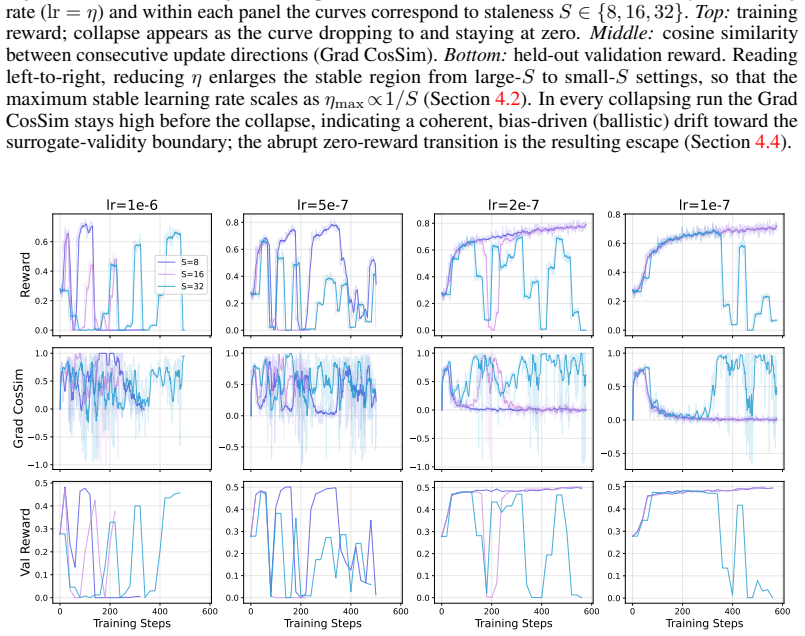
Stale rollouts in asynchronous GRPO create a per-step surrogate-gradient bias of order O(S * eta) that produces a two-constraint stability condition on the learning rate.
A machine-rendered reading of the paper's core claim, the machinery that carries it, and where it could break.
Core claim
Under assumptions of local boundedness, distributional smoothness, and behavior-policy smoothness, stale rollouts introduce a per-step surrogate-gradient bias of order O(S * eta), where S denotes the maximum rollout lag and eta denotes the learning rate. The authors further derive a conditional collapse-time scaling law: when within-cycle drift remains below a batch-level clipping radius, collapse is governed primarily by cumulative learner drift T * eta; when the stale-rollout constraint is active, stability instead depends explicitly on S * eta. This yields the two-constraint stability condition eta << min{R_batch / (S * G_upd), R_crit / (T * G_upd)}, explaining why the maximum stable lear
What carries the argument
The per-step surrogate-gradient bias of order O(S * eta) obtained by making the behavior policy explicit in the GRPO surrogate and separating the learner's surrogate mapping from the true total derivative of the distribution-dependent objective.
If this is right
- When within-cycle drift stays below the batch clipping radius, collapse time is set mainly by the product T * eta.
- When the stale-rollout constraint binds, the allowable eta shrinks proportionally to 1/S.
- The two-term minimum supplies an explicit upper bound on eta that incorporates both staleness and total update count.
- In the horizon-limited regime the bound can make the maximum stable eta appear only weakly dependent on S.
Where Pith is reading between the lines
- The same bias-order analysis could be applied to other surrogate objectives that separate rollout and learner policies to test whether O(S * eta) is generic.
- If the smoothness conditions are only approximately satisfied, the leading bias term might acquire higher-order corrections that alter the precise form of the stability bound.
- The scaling law suggests a practical design choice: keep S small enough that the S-dependent term does not dominate the T-dependent term for the target horizon.
Load-bearing premise
The GRPO surrogate satisfies local boundedness together with distributional and behavior-policy smoothness so that the bias order O(S * eta) follows from the lag analysis.
What would settle it
A controlled experiment that measures the actual surrogate gradient bias at fixed eta while varying the maximum rollout lag S and checks whether the observed bias grows linearly with S.
Figures



read the original abstract
High-throughput RLHF systems often decouple rollout generation from policy optimization, leading to the use of stale rollouts during learner updates. In this work, we study the effect of such staleness in asynchronous GRPO. We make the behavior policy explicit in the GRPO surrogate objective and distinguish between the surrogate-gradient mapping used by the learner and the true total derivative of a distribution-dependent population objective. Under assumptions of local boundedness, distributional smoothness, and behavior-policy smoothness, we show that stale rollouts introduce a per-step surrogate-gradient bias of order O(S * eta), where S denotes the maximum rollout lag and eta denotes the learning rate. We further derive a conditional collapse-time scaling law: when within-cycle drift remains below a batch-level clipping radius, collapse is governed primarily by cumulative learner drift T * eta; when the stale-rollout constraint is active, stability instead depends explicitly on S * eta. This yields a two-constraint stability condition eta << min{R_batch / (S * G_upd), R_crit / (T * G_upd)}, explaining why the maximum stable learning rate may appear weakly dependent on staleness in the horizon-limited regime.
Editorial analysis
A structured set of objections, weighed in public.
Referee Report
Summary. The paper analyzes staleness effects in asynchronous GRPO for RLHF. It distinguishes the surrogate-gradient mapping from the true total derivative of a distribution-dependent objective and, under local boundedness, distributional smoothness, and behavior-policy smoothness, derives a per-step surrogate-gradient bias of order O(S * eta). This leads to a conditional collapse-time scaling law and the two-constraint stability condition eta << min{R_batch / (S * G_upd), R_crit / (T * G_upd)}.
Significance. If the derivation is correct and the smoothness assumptions hold for GRPO, the result supplies explicit scaling guidance for choosing learning rates in high-throughput asynchronous RLHF pipelines and clarifies why staleness may appear to have only weak effect on the maximum stable eta in horizon-limited regimes. The explicit separation of surrogate gradient from true derivative is a useful conceptual step.
major comments (2)
- [Abstract / derivation of bias term] Abstract (and main derivation): the O(S * eta) bias order and the resulting two-constraint stability condition are obtained only after invoking distributional smoothness and behavior-policy smoothness; the manuscript states these assumptions but supplies neither a verification that they hold for the GRPO surrogate (with its importance-ratio clipping and token-level terms) under nonzero lag S nor a counter-example check when they are violated.
- [Abstract / collapse-time scaling law] Abstract: the conditional collapse-time scaling law (within-cycle drift below batch clipping radius vs. stale-rollout constraint active) is presented as following from the three smoothness assumptions, yet no explicit error bounds, Lipschitz constants, or dependence on the clipping radius are given in the abstract; the full derivation must be checked for hidden dependence on fitted parameters.
minor comments (1)
- [Abstract] Notation: R_batch, R_crit, G_upd, and T are used in the stability condition without prior definition in the abstract; a short glossary or forward reference would improve readability.
Simulated Author's Rebuttal
We thank the referee for the careful reading and the identification of points where the assumptions and derivation details require clarification. We address each major comment below.
read point-by-point responses
-
Referee: [Abstract / derivation of bias term] the O(S * eta) bias order and the resulting two-constraint stability condition are obtained only after invoking distributional smoothness and behavior-policy smoothness; the manuscript states these assumptions but supplies neither a verification that they hold for the GRPO surrogate (with its importance-ratio clipping and token-level terms) under nonzero lag S nor a counter-example check when they are violated.
Authors: We acknowledge that the manuscript states the three smoothness assumptions without supplying an explicit verification tailored to the GRPO surrogate (including clipping and token-level terms) under nonzero lag S. The derivation is conditional on these assumptions holding; we view them as standard technical conditions that enable the O(S * eta) bias bound. Because the paper focuses on the derivation under the stated assumptions rather than on empirical or analytic verification for GRPO, we will add a short remark in the revised version clarifying the scope and noting that direct verification or counter-examples lie outside the present scope. This constitutes a partial revision. revision: partial
-
Referee: [Abstract / collapse-time scaling law] the conditional collapse-time scaling law is presented as following from the three smoothness assumptions, yet no explicit error bounds, Lipschitz constants, or dependence on the clipping radius are given in the abstract; the full derivation must be checked for hidden dependence on fitted parameters.
Authors: The abstract is a concise summary and therefore omits the explicit Lipschitz constants and error bounds, which appear in the main-text derivation (Section 3). The collapse-time scaling law follows directly from the per-step bias bound together with the definitions of R_batch and R_crit; no additional fitted parameters are introduced. The dependence on the clipping radius is explicit in the stability condition eta << R_batch / (S * G_upd). We will verify that the main text makes all constants and their origins fully transparent so that the derivation can be checked without ambiguity. No revision to the abstract itself is required. revision: no
Circularity Check
No circularity; derivation follows from explicit assumptions without reduction to inputs by construction
full rationale
The paper states assumptions (local boundedness, distributional smoothness, behavior-policy smoothness) and derives the O(S * eta) bias order plus the two-constraint stability condition eta << min{R_batch / (S * G_upd), R_crit / (T * G_upd)} by distinguishing the surrogate-gradient mapping from the true total derivative of the population objective. No equations reduce to fitted parameters renamed as predictions, no self-definitional loops, and no load-bearing self-citations or uniqueness theorems imported from prior author work. The central claim is conditional on the listed smoothness conditions and does not collapse to its own inputs.
Axiom & Free-Parameter Ledger
axioms (1)
- domain assumption local boundedness, distributional smoothness, and behavior-policy smoothness
Reference graph
Works this paper leans on
-
[1]
Advances in Neural Information Processing Systems , volume=
Training language models to follow instructions with human feedback , author=. Advances in Neural Information Processing Systems , volume=
-
[2]
Advances in Neural Information Processing Systems , volume=
Deep reinforcement learning from human preferences , author=. Advances in Neural Information Processing Systems , volume=
-
[3]
arXiv preprint arXiv:2312.14925 , year=
A survey of reinforcement learning from human feedback , author=. arXiv preprint arXiv:2312.14925 , year=
-
[4]
Proximal Policy Optimization Algorithms
Proximal policy optimization algorithms , author=. arXiv preprint arXiv:1707.06347 , year=
work page internal anchor Pith review Pith/arXiv arXiv
-
[5]
DeepSeekMath: Pushing the Limits of Mathematical Reasoning in Open Language Models
DeepSeekMath: Pushing the limits of mathematical reasoning in open language models , author=. arXiv preprint arXiv:2402.03300 , year=
work page internal anchor Pith review Pith/arXiv arXiv
-
[6]
Advances in Neural Information Processing Systems , volume=
Direct preference optimization: Your language model is secretly a reward model , author=. Advances in Neural Information Processing Systems , volume=
-
[7]
DeepSeek-R1: Incentivizing Reasoning Capability in LLMs via Reinforcement Learning
DeepSeek-R1: Incentivizing reasoning capability in LLMs via reinforcement learning , author=. arXiv preprint arXiv:2501.12948 , year=
work page internal anchor Pith review Pith/arXiv arXiv
-
[8]
Advances in Neural Information Processing Systems , volume=
Hogwild!: A lock-free approach to parallelizing stochastic gradient descent , author=. Advances in Neural Information Processing Systems , volume=
-
[9]
Advances in Neural Information Processing Systems , volume=
Distributed delayed stochastic optimization , author=. Advances in Neural Information Processing Systems , volume=
-
[10]
Advances in Neural Information Processing Systems , volume=
Asynchronous parallel stochastic gradient for nonconvex optimization , author=. Advances in Neural Information Processing Systems , volume=
-
[11]
11th USENIX Symposium on Operating Systems Design and Implementation (OSDI 14) , pages=
Scaling distributed machine learning with the parameter server , author=. 11th USENIX Symposium on Operating Systems Design and Implementation (OSDI 14) , pages=
-
[12]
International Conference on Machine Learning , pages=
Distributed asynchronous optimization with unbounded delays: How slow can you go? , author=. International Conference on Machine Learning , pages=
-
[13]
Scaling Laws for Neural Language Models
Scaling laws for neural language models , author=. arXiv preprint arXiv:2001.08361 , year=
work page internal anchor Pith review Pith/arXiv arXiv 2001
-
[14]
Training Compute-Optimal Large Language Models
Training compute-optimal large language models , author=. arXiv preprint arXiv:2203.15556 , year=
work page internal anchor Pith review Pith/arXiv arXiv
-
[15]
An Empirical Model of Large-Batch Training
An empirical model of large-batch training , author=. arXiv preprint arXiv:1812.06162 , year=
work page internal anchor Pith review Pith/arXiv arXiv
-
[16]
International Conference on Machine Learning , pages=
Trust region policy optimization , author=. International Conference on Machine Learning , pages=
-
[17]
International Conference on Machine Learning (ICML) , pages=
Asynchronous Methods for Deep Reinforcement Learning , author=. International Conference on Machine Learning (ICML) , pages=
-
[18]
Massively Parallel Methods for Deep Reinforcement Learning
Massively Parallel Methods for Deep Reinforcement Learning , author=. arXiv preprint arXiv:1507.04296 , year=
work page internal anchor Pith review Pith/arXiv arXiv
-
[19]
Espeholt, Lasse and Soyer, Hubert and Munos, Remi and Simonyan, Karen and Mnih, Vlad and Ward, Tom and Doron, Yotam and Firoiu, Vlad and Harley, Tim and Dunning, Iain and Legg, Shane and Kavukcuoglu, Koray , booktitle=
-
[20]
International Conference on Learning Representations (ICLR) , year=
Distributed Prioritized Experience Replay , author=. International Conference on Learning Representations (ICLR) , year=
-
[21]
International Conference on Learning Representations (ICLR) , year=
Espeholt, Lasse and Marinier, Rapha. International Conference on Learning Representations (ICLR) , year=
-
[22]
International Conference on Learning Representations (ICLR) , year=
DD-PPO: Learning Near-Perfect PointGoal Navigators from 2.5 Billion Frames , author=. International Conference on Learning Representations (ICLR) , year=
-
[23]
arXiv preprint arXiv:2310.00036 , year=
Cleanba: A Reproducible and Efficient Distributed Reinforcement Learning Platform , author=. arXiv preprint arXiv:2310.00036 , year=
discussion (0)
Sign in with ORCID, Apple, or X to comment. Anyone can read and Pith papers without signing in.