REVIEW 2 major objections 2 minor 67 references
Reviewed by Pith at T0; open to challenge.
T0 means a machine referee read the full paper against a public rubric. The mark states how deep the mechanical check went, never who wrote it. the ladder, T0–T4 →
T0 review · grok-4.3
The saturation intensity for rubidium's 420 nm transition is measured as 23.18 mW/cm² for 87Rb and 25.56 mW/cm² for 85Rb.
2026-07-02 20:28 UTC pith:IAQGFXLJ
load-bearing objection The paper gives the first measured saturation intensities for the 420 nm Rb transition at 23.18 and 25.56 mW/cm², matching theory, plus a temperature scan that picks an optimal cell temperature. the 2 major comments →
Precision Measurement of the Saturation Intensity in Rubidium at 420 nm
The pith
A machine-rendered reading of the paper's core claim, the machinery that carries it, and where it could break.
Core claim
The authors measure the saturation intensity of the 420 nm transition to be (23.18 ± 0.28) mW/cm² for the 87Rb F=2→F'=3 line and (25.56 ± 0.37) mW/cm² for the 85Rb F=3→F'=4 line. These results come from analyzing Lamb-dip amplitudes and linewidths as a function of laser intensity and agree closely with theoretical predictions. They additionally determine an optimal cell temperature of approximately 82°C for maximum signal-to-noise ratio and minimum linewidth, and report hyperfine constants A and B for the 6P3/2 state.
What carries the argument
Doppler-free Lamb-dip spectroscopy in a warm rubidium vapor cell, from which saturation intensity is extracted by fitting the power dependence of the dip amplitude and width.
Load-bearing premise
The fitting procedure applied to the Lamb-dip data isolates the saturation intensity without hidden bias from laser linewidth, cell geometry, or residual power broadening.
What would settle it
A separate saturation-intensity measurement performed with a different technique, such as monitoring the onset of nonlinear absorption in a thin cell or with a narrower laser, that produces values lying outside the stated uncertainty ranges.
If this is right
- The measured saturation intensities allow accurate modeling of intensity-dependent frequency shifts and broadening for any 420 nm atomic clock.
- Operation near 82°C maximizes Lamb-dip contrast while keeping the observed linewidth smallest.
- The hyperfine constants of the 6P3/2 state match earlier independent determinations.
- Laser power can now be chosen to reach a chosen fraction of saturation without introducing uncontrolled systematics.
Where Pith is reading between the lines
- Clock designs can now target a specific intensity regime that balances signal strength against power consumption and heating.
- The agreement between experiment and calculation supports using the same theoretical approach for saturation intensities of nearby transitions in other alkali atoms.
- Repeating the measurement in cells of different lengths or with frequency-stabilized lasers would test whether the reported values are geometry- or linewidth-independent.
Editorial analysis
A structured set of objections, weighed in public.
Referee Report
Summary. The manuscript reports the first experimental measurement of the saturation intensity Isat for the 5S1/2 → 6P3/2 transition in Rb at 420 nm, obtained via the power dependence of Doppler-free Lamb-dip amplitude in a 100 mm commercial vapor cell. Values are (23.18 ± 0.28) mW/cm² for the 87Rb F=2→F'=3 line and (25.56 ± 0.37) mW/cm² for the 85Rb F=3→F'=4 line, stated to agree with theory. The work also maps the temperature dependence of Lamb-dip amplitude and linewidth over 59.03 ± 0.37 °C to 91.20 ± 0.90 °C, identifies an optimum near 82.02 ± 0.73 °C, and reports hyperfine constants A and B for the 6P3/2 state that are consistent with prior values.
Significance. If the extraction of Isat is robust against unaccounted systematics, the result supplies a missing experimental benchmark for intensity-dependent effects in warm-vapor 420 nm clock designs. The temperature optimization and hyperfine data are directly usable for apparatus design. The agreement with theory, if independently verified, provides a useful cross-check between experiment and atomic-structure calculations.
major comments (2)
- [Results (saturation-intensity extraction)] The manuscript does not state the explicit functional form or fitting model used to extract Isat from the observed Lamb-dip amplitude versus incident power. Without this equation (and any convolution with measured laser linewidth or integration over the cell volume), it is impossible to confirm that the quoted uncertainties correctly isolate the saturation parameter from power broadening, beam geometry, and linewidth effects.
- [Results (temperature scan)] The temperature-dependence section identifies 82.02 ± 0.73 °C as optimal on the basis of maximum SNR and minimum linewidth, yet provides no quantitative definition of SNR, no functional form for the amplitude or linewidth versus temperature fits, and no propagation of the stated temperature uncertainties into the optimum value. These details are required to assess whether the reported optimum is robust.
minor comments (2)
- [Abstract] The abstract states 'excellent agreement with theoretical predictions' but neither cites the specific theoretical work nor tabulates the predicted Isat values for direct comparison.
- [Results (hyperfine constants)] Hyperfine constants A and B are stated to be 'consistent with previously reported values,' but the measured numerical results and their uncertainties are not given in the abstract or summary; they should appear in the main text with a comparison table.
Simulated Author's Rebuttal
We thank the referee for their careful reading of the manuscript and for the constructive comments that will improve the clarity of our methods. We address each major comment below and will revise the manuscript to incorporate the requested details on the fitting procedures.
read point-by-point responses
-
Referee: [Results (saturation-intensity extraction)] The manuscript does not state the explicit functional form or fitting model used to extract Isat from the observed Lamb-dip amplitude versus incident power. Without this equation (and any convolution with measured laser linewidth or integration over the cell volume), it is impossible to confirm that the quoted uncertainties correctly isolate the saturation parameter from power broadening, beam geometry, and linewidth effects.
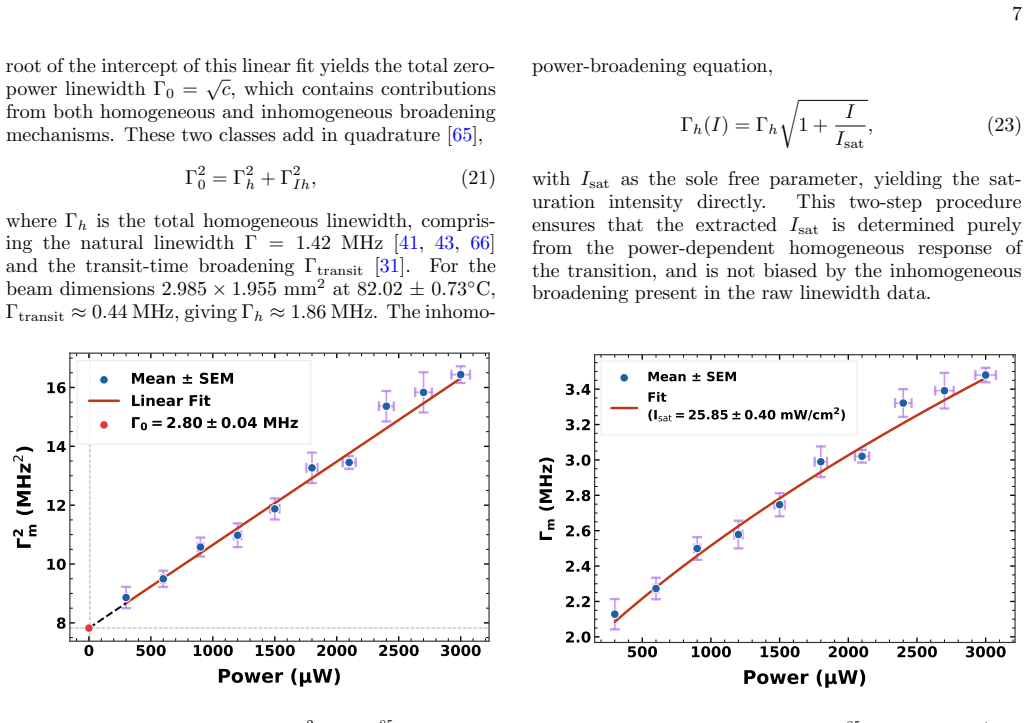
Authors: We agree that the explicit functional form must be stated for full transparency. The saturation intensity was extracted by fitting the measured Lamb-dip amplitude versus incident power to the standard two-level saturation expression A(I) = A_max * (I / (I + Isat)), where I is the on-axis intensity. The fit accounted for the Gaussian beam profile by integrating the local saturation parameter over the beam cross-section and cell volume, and incorporated the independently measured laser linewidth via convolution with a Lorentzian lineshape. Uncertainties were obtained from the covariance matrix of the nonlinear fit and augmented by systematic contributions from power calibration and beam-waist determination. In the revised manuscript we will provide the full equation, describe the convolution and integration steps, and tabulate all fit parameters. revision: yes
-
Referee: [Results (temperature scan)] The temperature-dependence section identifies 82.02 ± 0.73 °C as optimal on the basis of maximum SNR and minimum linewidth, yet provides no quantitative definition of SNR, no functional form for the amplitude or linewidth versus temperature fits, and no propagation of the stated temperature uncertainties into the optimum value. These details are required to assess whether the reported optimum is robust.
Authors: We accept that the quantitative definitions and fitting procedures for the temperature scan require explicit documentation. SNR was defined as the Lamb-dip peak amplitude divided by the root-mean-square fluctuation of the baseline recorded 100 MHz off resonance. Amplitude versus temperature was fitted to a skewed Gaussian and linewidth to a quadratic polynomial; the optimum temperature was located at the point of maximum SNR that simultaneously satisfied the linewidth minimum, with its uncertainty obtained by standard propagation of the thermocouple calibration and stability errors through the fitted coefficients. The revised manuscript will state the SNR definition, give the explicit functional forms, and detail the uncertainty propagation. revision: yes
Circularity Check
No circularity: pure experimental measurement with no derivation chain
full rationale
The paper reports direct experimental extraction of saturation intensities from observed Lamb-dip power dependence in a vapor cell, plus hyperfine constants, with values stated to agree with independent theoretical predictions. No equations, ansatze, or self-citations are used to derive the reported Isat numbers from fitted inputs; the central results are the measurements themselves. Temperature optimization and linewidth studies are likewise empirical. This matches the default case of a self-contained experimental report with no load-bearing reduction to prior fitted quantities or self-citations.
Axiom & Free-Parameter Ledger
axioms (1)
- domain assumption Standard two-level saturation model and Lamb-dip lineshape apply to the Rb 5S1/2–6P3/2 transition under the experimental conditions.
read the original abstract
The $5S_{1/2} \rightarrow 6P_{3/2}$ transition of rubidium at 420 nm is a promising candidate for a portable warm-vapor all-optical atomic clock. Despite recent precision spectroscopy studies at 420 nm in Rb, an experimental determination of the saturation intensity of this transition has not yet been reported. The saturation intensity is a fundamental parameter that influences the identification of a potential clock transition frequency in terms of optimizing various intensity-dependent parameters and connected systematics. In this work, we report the first experimental measurement of the saturation intensity of the 420 nm transition in Rb, obtaining $(23.18 \pm 0.28)$ mW/cm$^2$ for the $^{87}$Rb $F=2\rightarrow F'=3$ transition and $(25.56 \pm 0.37)$ mW/cm$^2$ for the $^{85}$Rb $F=3\rightarrow F'=4$ transition, in excellent agreement with theoretical predictions. We further investigate the temperature dependence of the Doppler-free Lamb-dip amplitude and linewidth over 59.03$~\pm~0.37$ - 91.20$~\pm~0.90^\circ$C in a 100 mm commercial vapor cell, identifying around 82.02$~\pm~ 0.73^\circ$C as the optimal operating temperature, where the signal-to-noise ratio of the Lamb-dip amplitude with temperature reaches a maximum and the observed Lamb-dip linewidth exhibits a minimum. We also present precise measurements of the magnetic-dipole ($A$) and electric-quadrupole ($B$) hyperfine constants of the $6P_{3/2}$ state for both isotopes, with the measured values being consistent with previously reported values for the hyperfine constants.
Figures




Reference graph
Works this paper leans on
-
[1]
MacAdam, A
K. MacAdam, A. Steinbach, and C. Wieman, A narrow- band tunable diode laser system with grating feedback, and a saturated absorption spectrometer for Cs and Rb, Am. J. Phys.60, 1098 (1992)
1992
-
[2]
Ovchinnikov and G
Y. Ovchinnikov and G. Marra, Accurate rubidium atomic fountain frequency standard, Metrologia48, 87 (2011)
2011
-
[3]
Q. Hao, W. Li, S. He, J. Lv, P. Wang, and G. Mei, A physics package for rubidium atomic frequency standard with a short-term stability of 2.4×10 −13τ −1/2, Rev. Sci. Instrum.87, 123111 (2016)
2016
-
[4]
Santarelli, P
G. Santarelli, P. Laurent, P. Lemonde, A. Clairon, A. G. Mann, S. Chang, A. N. Luiten, and C. Salomon, Quan- tum projection noise in an atomic fountain: A high sta- bility cesium frequency standard, Phys. Rev. Lett.82, 4619 (1999)
1999
-
[5]
Clairon, P
A. Clairon, P. Laurent, G. Santarelli, S. Ghezali, S. Lea, and M. Bahoura, A cesium fountain frequency standard: preliminary results, IEEE Trans. Instrum. Meas.44, 128 (1995)
1995
-
[6]
T. N. Bandi, Advanced space rubidium atomic frequency standard for satellite navigation, GPS Solut.26, 54 (2022)
2022
-
[7]
J. Cui, G. Ming, F. Wang, J. Li, P. Wang, S. Kang, F. Zhao, D. Zhong, and G. Mei, Realization of a rubid- ium atomic frequency standard with short-term stability in 10 −14 τ −1/2 level, IEEE Trans. Instrum. Meas.73, 1 (2024)
2024
-
[8]
M. E. Packard and B. E. Swartz, The Optically Pumped Rubidium Vapor Frequency Standard, IRE Trans. In- strum.I-11, 215 (1962)
1962
-
[9]
S. T. M¨ uller, D. V. Magalh˜ aes, R. F. Alves, and V. S. Bagnato, Compact frequency standard based on an in- tracavity sample of cold cesium atoms, J. Opt. Soc. Am. B28, 2592 (2011)
2011
-
[10]
Lewis, An introduction to frequency standards, Proc
L. Lewis, An introduction to frequency standards, Proc. IEEE79, 927 (1991)
1991
-
[11]
T. N. Bandi, A Comprehensive Overview of Atomic Clocks and their Applications, BEMS Reports9, 1 (2023)
2023
-
[12]
K. W. Martin, G. Phelps, N. D. Lemke, M. S. Bigelow, B. Stuhl, M. Wojcik, M. Holt, I. Coddington, M. W. Bishop, and J. H. Burke, Compact Optical Atomic Clock Based on a Two-Photon Transition in Rubidium, Phys. Rev. Appl.9, 014019 (2018)
2018
-
[13]
A. C. Obaze-Adeleke, B. Semon, and T. N. Bandi, A Comprehensive Review of Rubidium Two-Photon Vapor Cell Optical Clock: Long-Term Performance Limitations and Potential Improvements, Photonics12, 513 (2025)
2025
-
[14]
Hosseini, B
M. Hosseini, B. M. Sparkes, G. Campbell, P. K. Lam, and B. C. Buchler, High efficiency coherent optical mem- ory with warm rubidium vapour, Nat. Commun.2, 174 (2011)
2011
-
[15]
I. I. Ryabtsev, I. I. Beterov, D. B. Tretyakov, V. M. Entin, and E. A. Yakshina, Spectroscopy of cold rubid- ium Rydberg atoms for applications in quantum infor- mation, Phys. Usp.59, 196 (2016)
2016
-
[16]
S. R. de Echaniz, M. Koschorreck, M. Napolitano, M. Kubasik, and M. W. Mitchell, Hamiltonian design in atom-light interactions with rubidium ensembles: A quantum-information toolbox, Phys. Rev. A77, 032316 (2008)
2008
-
[17]
A. M. C. Dawes, L. Illing, S. M. Clark, and D. J. Gau- thier, All-Optical Switching in Rubidium Vapor, Science 308, 672 (2005)
2005
-
[18]
Knappe, P
S. Knappe, P. Schwindt, V. Shah, L. Hollberg, J. Kitch- ing, L. Liew, and J. Moreland, A chip-scale atomic clock based on 87Rb with improved frequency stability, Opt. Express13, 1249 (2005)
2005
-
[19]
B. L. S. Marlow and D. R. Scherer, A review of com- mercial and emerging atomic frequency standards, IEEE Trans. Ultrason. Ferroelectr. Freq. Control68, 2007 (2021)
2007
-
[20]
Zhang, W
Y. Zhang, W. Yang, S. Zhang, and J. Zhao, Rubidium chip-scale atomic clock with improved long-term stability through light intensity optimization and compensation for laser frequency detuning, J. Opt. Soc. Am. B33, 1756 (2016)
2016
-
[21]
Xiang-Hui, C
Q. Xiang-Hui, C. Wen-Lan, Y. Lin, Z. Da-Wei, Z. Tong, X. Qin, D. Jun, Z. Xiao-Ji, and C. Xu-Zong, Ultra-stable rubidium-stabilized external-cavity diode laser based on the modulation transfer spectroscopy technique, Chin. Phys. Lett.26, 044205 (2009)
2009
-
[22]
X. Guan, J. Zhang, X. Gao, Y. Wang, T. Shi, and J. Chen, A 780 nm optical frequency standard based on diffuse laser cooled 87Rb atoms, Appl. Phys. Lett.126, 031104 (2025)
2025
-
[23]
Gruet, M
F. Gruet, M. Pellaton, C. Affolderbach, T. Bandi, R. Matthey, and G. Mileti, Compact and frequency sta- bilized laser heads for rubidium atomic clocks,Interna- tional Conference on Space Optics—ICSO 2012, SPIE 10564, 756 (2017)
2012
-
[24]
Budker and M
D. Budker and M. Romalis, Optical magnetometry, Nat. phys.3, 227 (2007)
2007
-
[25]
Cheng, W.-Z
H.-D. Cheng, W.-Z. Zhang, H.-Y. Ma, L. Liu, and Y.-Z. Wang, Laser cooling of rubidium atoms from background vapor in diffuse light, Phys. Rev. A79, 023407 (2009)
2009
-
[26]
van Rens,Laser Cooling of a Rubidium Atomic Beam, Master’s thesis, Eindhoven University of Technology (2014)
J. van Rens,Laser Cooling of a Rubidium Atomic Beam, Master’s thesis, Eindhoven University of Technology (2014)
2014
-
[27]
Zhang, X
J. Zhang, X. Guan, X. Gao, J. Miao, T. Shi, and J. Chen, Active Optical Clock Signal Based on 87Rb Atoms Cooled by 780 nm Diffuse Laser, in2024 Euro- pean Frequency and Time Forum (EFTF)(IEEE, 2024) pp. 337–340
2024
-
[28]
Ludvigsen, A
H. Ludvigsen, A. ¨Aij¨ al¨ a, A. Pietil¨ ainen, H. Talvitie, and E. Ikonen, Laser cooling of rubidium atoms in a vapor cell, Phys. Scr.49, 424 (1994)
1994
-
[29]
D. A. Steck, Rubidium 87 D line data, available online at http://steck.us/alkalidata (2001), revision 2.3.4, 8 Au- gust 2025
2001
-
[30]
D. A. Steck, Rubidium 85 D line data, available online at http://steck.us/alkalidata (2001), revision 2.3.4, 8 Au- gust 2025
2001
- [31]
-
[32]
Zhang, X
S. Zhang, X. Zhang, J. Cui, Z. Jiang, H. Shang, C. Zhu, P. Chang, L. Zhang, J. Tu, and J. Chen, Compact Rb optical frequency standard with 10−15 stability, Rev. Sci. Instrum.88, 103106 (2017)
2017
-
[33]
R. C. Das, S. Khan, T. Ravi, and K. Pandey, Direct spectroscopy of Rubidium using a narrow-line transition 12 at 420 nm, Eur. Phys. J. D78, 40 (2024)
2024
-
[34]
Zhang, X
J. Zhang, X. Guan, X. Gao, Z. Wang, X. Qin, Z. Liu, H. Shi, J. Miao, T. Shi, and J. Chen, Power-stabilized 3- W blue laser locked to the 420-nm transition in rubidium, Phys. Rev. Appl.22, 034045 (2024)
2024
-
[35]
Noh and H
H.-R. Noh and H. S. Moon, Transmittance signal in real ladder-type atoms, Phys. Rev. A85, 033817 (2012)
2012
-
[36]
Zhang, Z.-Z
L.-G. Zhang, Z.-Z. Liu, Z.-M. Tao, L. Ling, and J.-B. Chen, Velocity transfer spectroscopy of Rb 420 nm tran- sition, Chin. Phys. Lett.31, 083101 (2014)
2014
- [37]
-
[38]
Vernier, S
A. Vernier, S. Franke-Arnold, E. Riis, and A. Arnold, Enhanced frequency up-conversion in Rb vapor, Opt. Ex- press18, 17020 (2010)
2010
-
[39]
Z. Xu, X. Jia, K. Qin, W. Wang, Y. Zhou, and D. Li, Tunable High-Power 420 nm Laser with External Cavity Frequency Doubling: Toward Efficient Rubidium Ryd- berg Excitation, Photonics12, 830 (2025)
2025
-
[40]
J. Navarro-Navarrete, A. D´ ıaz-Calder´ on, L. Hoyos- Campo, F. Ponciano-Ojeda, J. Flores-Mijangos, F. Ram´ ırez-Mart´ ınez, and J. Jim´ enez-Mier, Doppler-free saturation of the cascade fluorescence that follows excitation of the 5s→6ptransition in atomic rubidium, arXiv:1906.07114 (2019)
work page internal anchor Pith review Pith/arXiv arXiv 1906
-
[41]
Glaser, F
C. Glaser, F. Karlewski, J. Kluge, J. Grimmel, M. Kaiser, A. G¨ unther, H. Hattermann, M. Krutzik, and J. Fort´ agh, Absolute frequency measurement of rubidium 5S−6P transitions, Phys. Rev. A102, 012804 (2020)
2020
-
[42]
Arimondo, M
E. Arimondo, M. Inguscio, and P. Violino, Experimental determinations of the hyperfine structure in the alkali atoms, Rev. Mod. Phys.49, 31 (1977)
1977
-
[43]
M. S. Safronova and U. I. Safronova, Critically evalu- ated theoretical energies, lifetimes, hyperfine constants, and multipole polarizabilities in 87Rb, Phys. Rev. A83, 052508 (2011)
2011
-
[44]
Zhang, X.-G
S.-N. Zhang, X.-G. Zhang, J.-H. Tu, Z.-J. Jiang, H.-S. Shang, C.-W. Zhu, W. Yang, J.-Z. Cui, and J.-B. Chen, A 420 nm blue diode laser for the potential rubidium optical frequency standard, Chin. Phys. Lett.34, 074211 (2017)
2017
-
[45]
Ponciano-Ojeda, S
F. Ponciano-Ojeda, S. Hern´ andez-G´ omez, O. L´ opez- Hern´ andez, C. Mojica-Casique, R. Col´ ın-Rodr´ ıguez, F. Ram´ ırez-Mart´ ınez, J. Flores-Mijangos, D. Sahag´ un, R. J´ auregui, and J. Jim´ enez-Mier, Observation of the 5p3/2 →6p 3/2 electric-dipole-forbidden transition in atomic rubidium using optical-optical double-resonance spectroscopy, Phys. R...
2015
-
[46]
M. S. Safronova, C. J. Williams, and C. W. Clark, Rel- ativistic many-body calculations of electric-dipole ma- trix elements, lifetimes, and polarizabilities in rubidium, Phys. Rev. A69, 022509 (2004)
2004
-
[47]
P. W. Milonni and J. H. Eberly,Laser Physics(John Wiley & Sons, 2010)
2010
-
[48]
D. R. H¨ aupl, C. R. Higgins, D. Pizzey, J. D. Briscoe, S. A. Wrathmall, I. G. Hughes, R. L¨ ow, and N. Y. Joly, Modelling spectra of hot alkali vapour in the saturation regime, New J. Phys.27, 033003 (2025)
2025
-
[49]
Akulshin, V
A. Akulshin, V. Sautenkov, V. Velichansky, A. Zibrov, and M. Zverkov, Power broadening of saturation absorp- tion resonance on theD 2 line of rubidium, Opt. Commun. 77, 295 (1990)
1990
-
[50]
Zhang, W
Y. Zhang, W. Zhao, Y. Tian, Y. Zhang, S. Gu, A. Zhang, and J. Chen, Enhancement of Doppler-free saturated ab- sorption signal based on 87Rb second excited states at 420nm, Chin. Phys. B. (2025)
2025
-
[51]
S. Lee, K. Lee, and J. Ahn, Reversed peaks of saturated absorption spectra of atomic rubidium, Jpn. J. Appl. Phys.48, 032301 (2009)
2009
-
[52]
Jacques, B
V. Jacques, B. Hingant, A. Allafort, M. Pigeard, and J. Roch, Nonlinear spectroscopy of rubidium: an under- graduate experiment, Eur. J. Phys.30, 921 (2009)
2009
-
[53]
D. M. Brink and G. R. Satchler,Angular Momentum (Oxford University Press, 1994)
1994
-
[54]
J. J. Sakurai and J. Napolitano,Modern Quantum Me- chanics(Cambridge University Press, 2017)
2017
-
[55]
H. J. Metcalf and P. Van der Straten,Laser Cooling and Trapping(Springer New York, 1999)
1999
-
[56]
Siddons, C
P. Siddons, C. S. Adams, C. Ge, and I. G. Hughes, Abso- lute absorption on rubidium D lines: comparison between theory and experiment, J. Phys. B: At. Mol. Opt. Phys. 41, 155004 (2008)
2008
-
[57]
Loudon,The Quantum Theory of Light(Oxford Sci- ence Publications, 2000)
R. Loudon,The Quantum Theory of Light(Oxford Sci- ence Publications, 2000)
2000
-
[58]
G. K. Woodgate,Elementary Atomic Structure(Claren- don Press, 1980)
1980
-
[59]
C. J. Foot,Atomic Physics(Oxford University Press, 2005)
2005
-
[60]
D. W. Preston, Doppler-free saturated absorption: Laser spectroscopy, Am. J. Phys.64, 1432 (1996)
1996
-
[61]
Ricci, M
L. Ricci, M. Weidem¨ uller, T. Esslinger, A. Hemmerich, C. Zimmermann, V. Vuletic, W. K¨ onig, and T. W. H¨ ansch, A compact grating-stabilized diode laser system for atomic physics, Opt. Commun.117, 541 (1995)
1995
-
[62]
G. C. Bjorklund, Frequency-modulation spectroscopy: a new method for measuring weak absorptions and disper- sions, Opt. Lett.5, 15 (1980)
1980
-
[63]
G. C. Bjorklund, M. Levenson, W. Lenth, and C. Or- tiz, Frequency modulation (FM) spectroscopy: Theory of lineshapes and signal-to-noise analysis, Appl. Phys. B 32, 145 (1983)
1983
-
[64]
Pizzey, J
D. Pizzey, J. D. Briscoe, F. D. Logue, F. S. Ponciano- Ojeda, S. A. Wrathmall, and I. G. Hughes, Laser spec- troscopy of hot atomic vapours: from ’scope to theoreti- cal fit, New J. Phys.24, 125001 (2022)
2022
-
[65]
Demtr¨ oeder,Laser Spectroscopy: Basic Concepts and Instrumentation(Springer Berlin Heidelberg, 2013)
W. Demtr¨ oeder,Laser Spectroscopy: Basic Concepts and Instrumentation(Springer Berlin Heidelberg, 2013)
2013
-
[66]
Marek and P
J. Marek and P. Munster, Radiative lifetimes of excited states of rubidium up to quantum number n=12, J. Phys. B: Atom. Mol. Phys.13, 1731 (1980)
1980
-
[67]
J. E. Sansonetti, Wavelengths, Transition Probabilities, and Energy Levels for the Spectra of Rubidium (Rb I through Rb XXXVII), J. Phys. Chem. Ref. Data35, 301 (2006)
2006
discussion (0)
Sign in with ORCID, Apple, or X to comment. Anyone can read and Pith papers without signing in.