Topological control of third-harmonic generation in a mesoscopic quantum ring with spiral dislocation
Pith reviewed 2026-06-30 05:17 UTC · model grok-4.3
The pith
Spiral dislocation in a quantum ring preserves the dipole selection rule that blocks second-harmonic generation while permitting third-harmonic generation.
A machine-rendered reading of the paper's core claim, the machinery that carries it, and where it could break.
Core claim
The axial symmetry of the topologically deformed ring preserves the dipole selection rule Δm=±1 and therefore suppresses second-harmonic generation, while THG remains allowed through multistep transition chains. The spiral dislocation functions as a geometric parameter that tunes the nonlinear optical activity without altering the underlying Hamiltonian.
What carries the argument
Torsion-induced metric deformation that models the spiral dislocation, inserted via the minimal-coupling prescription into the radial Schrödinger problem for a ring with perpendicular magnetic field.
If this is right
- THG amplitude and spectra can be tuned continuously by varying the dislocation strength β and the magnetic field B.
- Dephasing provides an independent control knob for spectral resolution without changing the Hamiltonian.
- Waterfall plots in three dimensions map the joint dependence of the THG response on β and B.
- Channel-resolved decomposition isolates the separate transition pathways that build the total THG amplitude.
Where Pith is reading between the lines
- The same geometric knob could be applied to other ring-like mesoscopic structures to suppress or enhance selected nonlinear processes.
- The torsion-only metric deformation might be realized in engineered semiconductor or graphene rings with controlled screw dislocations.
- Extending the calculation to finite temperature or disorder would test how robust the selection-rule preservation remains under realistic conditions.
Load-bearing premise
The topological defect can be modeled by a torsion-induced deformation of the metric that introduces no curvature, and the minimal-coupling prescription in curved space applies directly to the radial Schrödinger problem.
What would settle it
Detection of a nonzero second-harmonic generation signal, or complete suppression of third-harmonic generation, when the spiral dislocation parameter is nonzero would falsify the claim that the selection rule Δm=±1 remains intact and only multistep chains contribute to THG.
Figures




read the original abstract
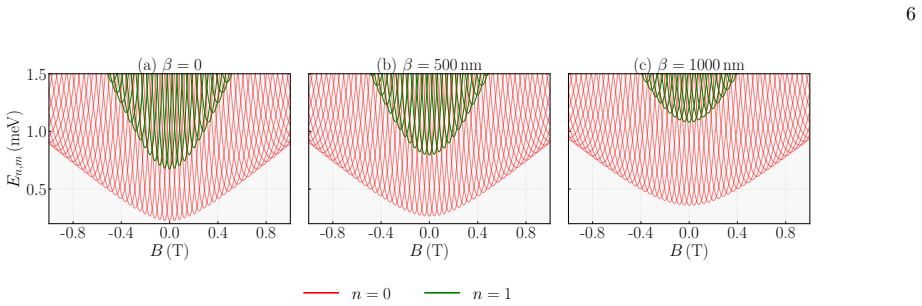
We investigate the nonlinear optical response of a two-dimensional mesoscopic quantum ring subjected to a spiral dislocation, with emphasis on third-harmonic generation (THG). The topological defect is modeled through a torsion-induced deformation of space, which modifies the effective metric without introducing curvature. By combining the minimal-coupling prescription in curved space with a radial ring confinement and a perpendicular magnetic field, we derive the effective radial Schr\"odinger problem, obtain the bound states, and evaluate the nonlinear susceptibilities within the electric-dipole approximation. We show that the axial symmetry of the topologically deformed ring preserves the dipole selection rule $\Delta m=\pm 1$ and therefore suppresses second-harmonic generation, while THG remains allowed through multistep transition chains. The study is further expanded through three complementary analyses that can be implemented without changing the Hamiltonian: a dephasing-controlled study of spectral resolution, three-dimensional waterfall spectra showing the dependence on $\beta$ and $B$, and a channel-resolved decomposition of the THG amplitude. Together, these results establish the spiral dislocation as a robust geometric knob for tuning nonlinear optical activity in mesoscopic ring-shaped nanostructures.
Editorial analysis
A structured set of objections, weighed in public.
Referee Report
Summary. The paper studies third-harmonic generation (THG) in a 2D mesoscopic quantum ring with a spiral dislocation modeled as a torsion-induced metric deformation (zero curvature). Minimal coupling in curved space plus radial confinement and perpendicular B field yields an effective radial Schrödinger problem whose bound states are used to compute nonlinear susceptibilities in the electric-dipole limit. The central claim is that axial symmetry preserves the dipole selection rule Δm=±1, suppressing second-harmonic generation while permitting THG via multistep chains. Three supplementary analyses (dephasing-controlled spectra, β-B waterfall plots, channel-resolved THG decomposition) are presented without altering the Hamiltonian.
Significance. If the effective Hamiltonian derivation is correct, the work supplies a concrete geometric control parameter (dislocation strength β) for tuning nonlinear optical activity in ring nanostructures while leaving the functional form of the Hamiltonian unchanged. The three complementary analyses strengthen the result by showing robustness under dephasing and by decomposing the THG amplitude. The significance is limited by the fact that the selection-rule argument is load-bearing and rests on an assumption about the torsion connection that is not yet verified in the manuscript.
major comments (1)
- [Derivation of effective Hamiltonian] Derivation of the effective radial Schrödinger problem (abstract and the steps combining minimal coupling with the torsion-deformed metric): the claim that eigenstates remain pure angular-momentum states (so that the electric-dipole operator enforces exactly Δm=±1) requires explicit confirmation that contorsion terms arising from the affine connection do not introduce operators that fail to commute with ∂_θ. If any such term appears with a coefficient proportional to β, the m-basis is no longer an eigenbasis and the suppression of SHG does not follow automatically. This point is load-bearing for the central claim.
minor comments (1)
- [Abstract] The abstract states that bound states and nonlinear susceptibilities are derived but does not display the resulting radial equation or the explicit form of the metric; adding the key intermediate expressions would improve traceability.
Simulated Author's Rebuttal
We thank the referee for the careful reading and for highlighting the load-bearing assumption in our derivation. We address the major comment below and will strengthen the manuscript accordingly.
read point-by-point responses
-
Referee: [Derivation of effective Hamiltonian] Derivation of the effective radial Schrödinger problem (abstract and the steps combining minimal coupling with the torsion-deformed metric): the claim that eigenstates remain pure angular-momentum states (so that the electric-dipole operator enforces exactly Δm=±1) requires explicit confirmation that contorsion terms arising from the affine connection do not introduce operators that fail to commute with ∂_θ. If any such term appears with a coefficient proportional to β, the m-basis is no longer an eigenbasis and the suppression of SHG does not follow automatically. This point is load-bearing for the central claim.
Authors: We agree that an explicit verification is required. The spiral dislocation is introduced via a torsion-induced metric deformation that is axially symmetric: all metric components g_μν(r) are independent of θ, and the resulting contorsion (from the affine connection) inherits the same θ-independence. Consequently, the minimal-coupling Hamiltonian in curved space commutes with ∂_θ. The eigenfunctions therefore remain pure angular-momentum states e^{imθ} with integer m, and the electric-dipole selection rule Δm=±1 is preserved. In the revised manuscript we will (i) display the explicit form of the effective radial Hamiltonian, (ii) compute the commutator [H_eff, ∂_θ] = 0 step by step, and (iii) confirm that no β-dependent term breaks this commutation. This addition does not alter the physical conclusions but makes the central claim fully rigorous. revision: yes
Circularity Check
No circularity: selection rules and THG amplitudes follow from imposed axial symmetry of the metric model
full rationale
The paper starts from an externally chosen torsion-induced metric (zero curvature, axial symmetry preserved) and applies the standard minimal-coupling prescription in curved space to obtain the effective radial Schrödinger equation. The eigenstates are labeled by angular momentum m because the resulting Hamiltonian commutes with ∂_θ by construction of the metric; the dipole operator then enforces Δm=±1 as a direct algebraic consequence. This is not a self-referential fit, not a renamed empirical pattern, and not justified by any self-citation chain. The subsequent THG susceptibility calculation uses the same eigenstates and matrix elements without reducing any output quantity to a fitted input. The modeling decision to omit contorsion terms is an assumption about the physical setup, not a circular step inside the derivation. The derivation chain is therefore self-contained against external benchmarks.
Axiom & Free-Parameter Ledger
free parameters (2)
- β (dislocation strength)
- B (magnetic field)
axioms (2)
- domain assumption Minimal-coupling prescription remains valid in the torsion-deformed metric without curvature.
- domain assumption Electric-dipole approximation holds for the nonlinear susceptibilities.
Reference graph
Works this paper leans on
-
[1]
Aharonov and D
Y. Aharonov and D. Bohm, Significance of electromag- netic potentials in the quantum theory, Physical Review 115, 485 (1959)
1959
-
[2]
Lorke, R
A. Lorke, R. J. Luyken, A. O. Govorov, J. M. Kot- thaus, J. M. Garcia, and P. M. Petroff, Spectroscopy of nanoscopic semiconductor rings, Physical Review Letters 84, 2223 (2000)
2000
-
[3]
Fuhrer, S
A. Fuhrer, S. L"uscher, T. Ihn, T. Heinzel, K. Ensslin, W. Wegscheider, and M. Bichler, Energy spectra of quan- tum rings, Nature413, 822 (2001)
2001
-
[4]
Olariu and I
S. Olariu and I. I. Popescu, The quantum effects of elec- tromagnetic fluxes, Rev. Mod. Phys.57, 339 (1985)
1985
-
[5]
Chandrasekhar, M
V. Chandrasekhar, M. J. Rooks, S. Wind, and D. E. Prober, Observation of aharonov-bohm electron interfer- ence effects with periodsh e and h 2e in individual micron- size, normal-metal rings, Phys. Rev. Lett.55, 1610 (1985)
1985
-
[6]
Mailly, C
D. Mailly, C. Chapelier, and A. Benoit, Experimental observation of persistent currents in gaas-algaas single loop, Phys. Rev. Lett.70, 2020 (1993)
2020
-
[7]
Y. V. Pershin and C. Piermarocchi, Persistent and radiation-induced currents in distorted quantum rings, Phys. Rev. B72, 125348 (2005)
2005
-
[8]
E.Zipper, M.Kurpas, M.Szelag, J.Dajka,andM.Szopa, Flux qubit on a mesoscopic nonsuperconducting ring, Phys. Rev. B74, 125426 (2006)
2006
-
[9]
Tan and J
W.-C. Tan and J. C. Inkson, Magnetization, persistent currents, and their relation in quantum rings and dots, Physical Review B60, 5626 (1999)
1999
-
[10]
M.Aichinger, S.A.Chin, E.Krotscheck,andE.Räsänen, Effects of geometry and impurities on quantum rings in magnetic fields, Phys. Rev. B73, 195310 (2006)
2006
-
[11]
Bruno-Alfonso and A
A. Bruno-Alfonso and A. Latgé, Quantum rings of arbi- trary shape and non-uniform width in a threading mag- netic field, Phys. Rev. B77, 205303 (2008)
2008
-
[12]
T. V. Bandos, A. Cantarero, and A. García-Cristóbal, Finite size effects on the optical transitions in quan- tum rings under a magnetic field, The European Physical Journal B53, 99 (2006)
2006
-
[13]
Liang, W
S. Liang, W. Xie, and H. Shen, Optical properties in a two-dimensional quantum ring: Confinement potential and aharonov–bohm effect, Optics Communications284, 5818 (2011)
2011
-
[14]
Khajeh Salehani, Optical absorption in concentric double quantum rings, Optical and Quantum Electronics 55, 644 (2023)
H. Khajeh Salehani, Optical absorption in concentric double quantum rings, Optical and Quantum Electronics 55, 644 (2023)
2023
-
[15]
Chang, Studies on the third-harmonic generations in a quantum ring with magnetic field, The European Phys- ical Journal Plus138, 116 (2023)
C. Chang, Studies on the third-harmonic generations in a quantum ring with magnetic field, The European Phys- ical Journal Plus138, 116 (2023)
2023
-
[16]
D. F. Lima, F. d. S. Azevedo, L. F. C. Pereira, C. Filgueiras, and E. O. Silva, Optical and electronic properties of a two-dimensional quantum ring under ro- tating effects, Annals of Physics459, 169547 (2023)
2023
-
[17]
Bejan and C
D. Bejan and C. Stan, Nonlinear optical rectification, second and third harmonic generation in quantum dot- double quantum rings: electric field and geometry effects, Optical and Quantum Electronics57, 476 (2025)
2025
-
[18]
Duque, A
C. Duque, A. Morales, M. Mora-Ramos, and C. Duque, Optical nonlinearities associated to applied electric fields in parabolic two-dimensional quantum rings, Journal of Luminescence143, 81 (2013)
2013
-
[19]
Duque, M
C. Duque, M. Mora-Ramos, and C. Duque, Quantum disc plus inverse square potential. an analytical model for two-dimensional quantum rings: Study of nonlinear optical properties, Annalen der Physik524, 327 (2012)
2012
-
[20]
S.Gumber, M.Gambhir, P.K.Jha,andM.Mohan,Opti- cal response of a two dimensional quantum ring in pres- ence of Rashba spin orbit coupling, Journal of Applied Physics119, 073101 (2016)
2016
-
[21]
Nasri, Electronic and optical properties of eccentric quantum ring under parallel magnetic field, Physica B: Condensed Matter615, 413077 (2021)
D. Nasri, Electronic and optical properties of eccentric quantum ring under parallel magnetic field, Physica B: Condensed Matter615, 413077 (2021)
2021
-
[22]
Vinasco, A
J. Vinasco, A. Radu, R. Restrepo, A. Morales, M. Mora- Ramos, and C. Duque, Magnetic field effects on intra- band transitions in elliptically polarized laser-dressed quantum rings, Optical Materials91, 309 (2019)
2019
-
[23]
J. A. Vinasco, A. Radu, E. Niculescu, M. E. Mora- Ramos, E. Feddi, V. Tulupenko, R. L. Restrepo, E. Kasa- poglu, A. L. Morales, and C. A. Duque, Electronic states in gaas-(al,ga)as eccentric quantum rings under nonreso- nant intense laser and magnetic fields, Scientific Reports 9, 1427 (2019)
2019
-
[24]
Xie, Photoionization cross section in a two- dimensional quantum ring: Aharonov–bohm effect, Su- perlattices and Microstructures58, 94 (2013)
W. Xie, Photoionization cross section in a two- dimensional quantum ring: Aharonov–bohm effect, Su- perlattices and Microstructures58, 94 (2013)
2013
-
[25]
C. M. O. Pereira, F. dos S Azevedo, L. F. C. Pereira, and E. O. Silva, Rotating effects on the photoionization cross-section of a 2d quantum ring, Communications in Theoretical Physics76, 105701 (2024)
2024
-
[26]
C. M. O. Pereira, F. d. S. Azevedo, and E. O. Silva, Remarks on the study of the electronic properties and photoionization process in rotating 2d quantum rings, Quantum Reports6, 677 (2024)
2024
-
[27]
Ahn and S
D. Ahn and S. lien Chuang, Calculation of linear and nonlinear intersubband optical absorptions in a quantum well model with an applied electric field, IEEE Journal of Quantum Electronics23, 2196 (1987)
1987
-
[28]
Rosencher and P
E. Rosencher and P. Bois, Model system for optical non- linearities: Asymmetric quantum wells, Phys. Rev. B44, 11315 (1991)
1991
-
[29]
K. Li, K. Guo, X. Jiang, and M. Hu, Effect of position- dependent effective mass on nonlinear optical properties in a quantum well, Optik132, 375 (2017)
2017
-
[30]
M. Hu, K. Guo, Z. Zhang, X. Jiang, K. Li, and D. Liu, The effect of position-dependent mass on nonlinear opti- cal absorption coefficients and refractive index changes in a quantum well, International Journal of Modern Physics 14 B31, 1750009 (2017)
2017
-
[31]
Katanaev and I
M. Katanaev and I. Volovich, Theory of defects in solids and three-dimensional gravity, Annals of Physics216, 1 (1992)
1992
-
[32]
M. O. Katanaev, Geometric theory of defects, Physics- Uspekhi48, 675 (2005)
2005
-
[33]
J. H. Harris and M. D. Semon, A review of the aharonov- carmi thought experiment concerning the inertial and electromagneticvectorpotentials,FoundationsofPhysics 10, 151 (1980)
1980
-
[34]
K. C. Valanis and V. P. Panoskaltsis, Material metric, connectivity and dislocations in continua, Acta Mechan- ica175, 77 (2005)
2005
-
[35]
Furtado and F
C. Furtado and F. Moraes, Landau levels in the pres- ence of a screw dislocation, Europhysics Letters45, 279 (1999)
1999
-
[36]
Bakke, Torsion and noninertial effects on a nonrela- tivistic dirac particle, Annals of Physics346, 51 (2014)
K. Bakke, Torsion and noninertial effects on a nonrela- tivistic dirac particle, Annals of Physics346, 51 (2014)
2014
-
[37]
Bakke and C
K. Bakke and C. Furtado, Abelian geometric phase due to the presence of an edge dislocation, Phys. Rev. A87, 012130 (2013)
2013
-
[38]
Filgueiras and E
C. Filgueiras and E. O. Silva, 2deg on a cylindrical shell with a screw dislocation, Physics Letters A379, 2110 (2015)
2015
-
[39]
Filgueiras, M
C. Filgueiras, M. Rojas, G. Aciole, and E. O. Silva, Landau quantization, aharonov–bohm effect and two- dimensional pseudoharmonic quantum dot around a screw dislocation, Physics Letters A380, 3847 (2016)
2016
-
[40]
A. V. D. M. Maia and K. Bakke, Harmonic oscillator in an elastic medium with a spiral dislocation, Physica B: Condensed Matter531, 213 (2018)
2018
-
[41]
W. C. F. da Silva and K. Bakke, Topological effects of a spiral dislocation on quantum rings, Annals of Physics 421, 168277 (2020)
2020
-
[42]
Hassanabadi, K
H. Hassanabadi, K. Guo, L. Lu, and E. O. Silva, Spiral dislocation as a tunable geometric parameter for opti- cal responses in quantum rings, Annals of Physics486, 170346 (2026)
2026
-
[43]
Maia and K
A. Maia and K. Bakke, Effects of rotation on the lan- dau levels in an elastic medium with a spiral dislocation, Annals of Physics419, 168229 (2020)
2020
-
[44]
A. V. D. M. Maia and K.Bakke, Topological androtating effects on the dirac field in the spiral dislocation space- time, The European Physical Journal C79, 551 (2019)
2019
-
[45]
Mustafa and A
O. Mustafa and A. Guvendi, On the klein–gordon scalar field oscillators in a spacetime with spiral-like disloca- tions in external magnetic fields, The European Physical Journal C85, 34 (2025)
2025
-
[46]
S. Zare, H. Hassanabadi, and A. Guvendi, Relativistic landau quantization for a composite system in the spiral dislocation spacetime, The European Physical Journal Plus137, 589 (2022)
2022
-
[47]
Guvendi, S
A. Guvendi, S. Zare, and H. Hassanabadi, Vector boson oscillator in the spiral dislocation spacetime, The Euro- pean Physical Journal A57, 192 (2021)
2021
-
[48]
A. R. P. Moreira and F. Ahmed, Shannon entropy mea- surements for quantum oscillator system in the presence of a spiral dislocation, Indian Journal of Physics98, 4827 (2024)
2024
-
[49]
Filgueiras and B
C. Filgueiras and B. de Oliveira, Electron on a cylinder with topological defects in a homogeneous magnetic field, Annalen der Physik523, 898 (2011)
2011
-
[50]
D. J. BenDaniel and C. B. Duke, Space-charge effects on electron tunneling, Phys. Rev.152, 683 (1966)
1966
-
[51]
O.vonRoos,Position-dependenteffectivemassesinsemi- conductor theory, Physical Review B27, 7547 (1983)
1983
-
[52]
Morrow, Position-dependent effective masses and band offsets, Physical Review B35, 8074 (1987)
R. Morrow, Position-dependent effective masses and band offsets, Physical Review B35, 8074 (1987)
1987
-
[53]
A. D. Alhaidari, Solutions of the nonrelativistic wave equation with position-dependent effective mass, Phys. Rev. A66, 042116 (2002)
2002
-
[54]
A. R. Plastino, A. Rigo, M. Casas, F. Garcias, and A. Plastino, Supersymmetric approach to quantum sys- tems with position-dependent effective mass, Phys. Rev. A60, 4318 (1999)
1999
-
[55]
B. S. DeWitt, Dynamical theory in curved spaces. i. a review of the classical and quantum action principles, Rev. Mod. Phys.29, 377 (1957)
1957
-
[56]
R. C. T. da Costa, Quantum mechanics of a constrained particle, Phys. Rev. A23, 1982 (1981)
1982
-
[57]
Tan and J
W.-C. Tan and J. C. Inkson, Electron states in a two- dimensionalring—anexactlysolublemodel,Semiconduc- tor Science and Technology11, 1635 (1996)
1996
-
[58]
Rezaei, M
G. Rezaei, M. Vahdani,and B. Vaseghi, Nonlinear optical properties of a hydrogenic impurity in an ellipsoidal finite potential quantum dot, Current Applied Physics11, 176 (2011)
2011
-
[59]
M. K. Bahar and P. Başer, The second, third harmonic generations and nonlinear optical rectification of the mathieu quantum dot with the external electric, mag- netic and laser field, Physica B: Condensed Matter665, 415042 (2023)
2023
discussion (0)
Sign in with ORCID, Apple, or X to comment. Anyone can read and Pith papers without signing in.