Rebuttals Move Peer-Review Scores, but Initial-Review Structure Bounds the Movement
Pith reviewed 2026-06-26 10:40 UTC · model grok-4.3
The pith
Rebuttals move peer-review scores but initial-review structure bounds how far they shift.
A machine-rendered reading of the paper's core claim, the machinery that carries it, and where it could break.
Core claim
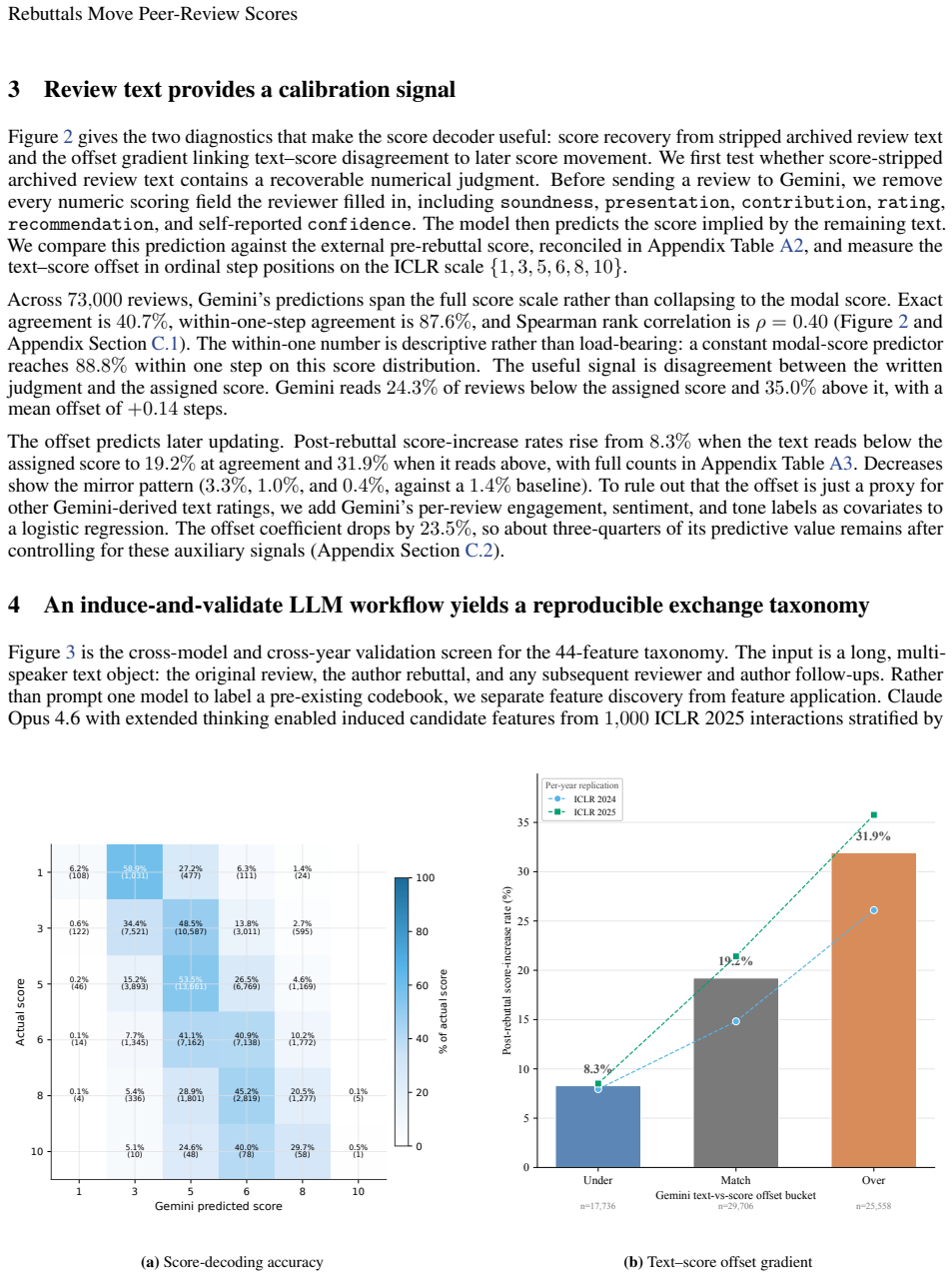
Rebuttals can move scores, but measurable movement is bounded by initial-review structure, and robust exchange signals are mostly rebuttal failure modes. In the rebuttal-engaged benchmark, initial-review structure alone predicts score movement with AUC 0.747; adding a 44-feature taxonomy of resolved exchanges raises AUC only to 0.804. Score-increase rates rise from 8.3 percent when review text reads below the assigned score to 31.9 percent when it reads above.
What carries the argument
The text-score offset obtained by prompting an LLM to predict the pre-rebuttal score implied by score-stripped review text, which then serves as a predictor of later score movement.
If this is right
- Score-increase rates vary from 8.3 percent to 31.9 percent according to whether review text reads below or above the assigned score.
- Initial-review structure alone yields an AUC of 0.747 for predicting whether scores will move.
- A 44-feature taxonomy of resolved exchanges improves that AUC to 0.804.
- Twenty-three exchange features replicate across models and a held-out year under Bonferroni correction.
- Strong, replicable exchange signals predominantly mark rebuttal failure rather than success.
Where Pith is reading between the lines
- If initial structure already forecasts most movement, then interventions aimed at clearer first-round scoring guidelines could have larger effects than changes to the rebuttal window.
- The modest added value of exchange features suggests the rebuttal phase functions more as a clarification step than as a broad opportunity to reverse initial judgments.
- The same LLM-based offset measurement could be applied to other conferences to test whether the bounding effect of initial structure generalizes.
Load-bearing premise
The assumption that LLM predictions of implied pre-rebuttal scores from score-stripped review text give a valid and unbiased measurement of the text-score offset.
What would settle it
In a fresh dataset containing recorded pre-rebuttal scores, the LLM-derived text-score offsets fail to separate score-increase rates into the reported 8.3 percent versus 31.9 percent bands.
Figures



read the original abstract
Author rebuttals are the main post-submission window in peer review, but their effect on reviewer scores remains hard to measure because score updates mix rebuttal content with initial score position, paper-level consensus, reviewer confidence, and discussion dynamics. We study ICLR 2024-2025 using 73,000 reviewer trajectories with externally archived pre- and post-rebuttal scores, and use LLMs only as measurement instruments. Gemini Flash 3.0 predicts implied pre-rebuttal scores from score-stripped review text. The resulting text-score offset predicts later movement, with score-increase rates rising from 8.3% when text reads below the assigned score to 31.9% when it reads above. Claude Opus 4.6 induces, and outcome-blinded Gemini Flash 3.0 validates, a 44-feature taxonomy of resolved reviewer-author exchanges, where 23 features replicate across model and held-out year under Bonferroni correction. In the rebuttal-engaged benchmark (n=6,705), initial-review structure already predicts much score movement (AUC=0.747, minimal AUC=0.696), while adding the resolved exchange raises AUC to 0.804. Rebuttals can move scores, but measurable movement is bounded by initial-review structure, and robust exchange signals are mostly rebuttal failure modes.
Editorial analysis
A structured set of objections, weighed in public.
Referee Report
Summary. The paper analyzes 73,000 reviewer trajectories from ICLR 2024-2025 with pre- and post-rebuttal scores. It uses Gemini Flash 3.0 to predict implied pre-rebuttal scores from score-stripped review text, derives a text-score offset that predicts score increases (8.3% below to 31.9% above), and induces a 44-feature taxonomy of resolved exchanges via Claude Opus 4.6 with outcome-blinded validation and cross-year replication of 23 features. In the rebuttal-engaged subset (n=6,705), initial-review structure alone yields AUC 0.747 for score movement while adding resolved exchanges raises it to 0.804. The central claim is that rebuttals move scores but measurable movement is bounded by initial-review structure, with robust exchange signals mostly indicating rebuttal failure modes.
Significance. If the LLM-based measurement instruments hold, the work supplies large-scale, replicable evidence on rebuttal dynamics that quantifies both the potential for score change and its structural limits. Strengths include the 73,000-trajectory dataset, outcome-blinded cross-model validation of the taxonomy, and held-out-year replication under Bonferroni correction. These elements allow falsifiable claims about the relative predictive power of initial structure versus post-rebuttal exchanges.
major comments (2)
- [Abstract / implied-score prediction] Abstract and implied-score prediction section: Gemini Flash 3.0 is used to produce the text-score offset that drives the headline movement rates (8.3% → 31.9%) and the AUC results, yet the manuscript reports no human-rated ground-truth set, calibration procedure, or inter-annotator agreement for this regression task. The only cross-model step described is for the separate 44-feature taxonomy. This measurement step is load-bearing for both the offset-movement correlation and the claim that robust signals are mostly failure modes.
- [Results (AUC analysis)] Results, rebuttal-engaged benchmark (n=6,705): The AUC=0.747 for initial-review structure is presented as already bounding most movement, but the manuscript provides no explicit controls or robustness checks for reviewer confidence, paper-level consensus, or discussion dynamics that the abstract itself identifies as confounders. Without these, it is unclear whether the reported bound is an artifact of unmodeled variables.
minor comments (1)
- [Taxonomy construction] The 44-feature taxonomy is described as capturing 'main resolved reviewer-author exchanges,' but the inducing model (Claude) and validation model (Gemini) are not compared on the same held-out set for the taxonomy itself; only replication across years is reported.
Simulated Author's Rebuttal
We thank the referee for the constructive and detailed comments. We address each major point below and indicate planned revisions to strengthen the measurement validity and robustness of the reported bounds.
read point-by-point responses
-
Referee: [Abstract / implied-score prediction] Abstract and implied-score prediction section: Gemini Flash 3.0 is used to produce the text-score offset that drives the headline movement rates (8.3% → 31.9%) and the AUC results, yet the manuscript reports no human-rated ground-truth set, calibration procedure, or inter-annotator agreement for this regression task. The only cross-model step described is for the separate 44-feature taxonomy. This measurement step is load-bearing for both the offset-movement correlation and the claim that robust signals are mostly failure modes.
Authors: We agree this is a substantive limitation. The implied-score regression is central to the offset-movement results and the failure-mode interpretation. The original manuscript relied on cross-year replication and downstream predictive validity rather than direct human ground truth for this task. In revision we will add a human validation study: a random sample of 300 score-stripped reviews will be independently rated by two domain experts for implied pre-rebuttal score; we will report calibration curves, mean absolute error, and inter-annotator agreement (Cohen’s κ and ICC). This directly addresses the load-bearing measurement concern while preserving the existing cross-model and replication evidence. revision: yes
-
Referee: [Results (AUC analysis)] Results, rebuttal-engaged benchmark (n=6,705): The AUC=0.747 for initial-review structure is presented as already bounding most movement, but the manuscript provides no explicit controls or robustness checks for reviewer confidence, paper-level consensus, or discussion dynamics that the abstract itself identifies as confounders. Without these, it is unclear whether the reported bound is an artifact of unmodeled variables.
Authors: The referee correctly notes that the abstract flags these as potential confounders yet the reported models do not include dedicated robustness checks. Initial-review structure features already encode some consensus information (e.g., score variance) and reviewer metadata, but explicit controls were omitted. In the revision we will re-estimate the AUC models with additional covariates for (i) average reviewer confidence, (ii) paper-level score dispersion, and (iii) presence of discussion threads; we will report both the change in AUC and the incremental contribution of the resolved-exchange features after these controls. This will clarify whether the structural bound remains after accounting for the identified confounders. revision: yes
Circularity Check
No significant circularity detected
full rationale
The paper extracts a text-score offset via LLM inference on score-stripped reviews and then correlates that offset with externally observed pre/post-rebuttal score changes; the central statistical claims (AUC values, movement rates) are computed from held-out trajectories and cross-model validation rather than reducing to any fitted parameter or self-defined quantity by construction. No equations, self-citations, or ansatzes are shown that would make the reported predictions equivalent to their inputs. The measurement instrument is treated as external and is outcome-blinded, satisfying the criteria for an independent derivation chain.
Axiom & Free-Parameter Ledger
axioms (2)
- domain assumption LLMs can extract a reliable implied pre-rebuttal score from score-stripped review text that is independent of the assigned numerical score
- ad hoc to paper The 44-feature taxonomy captures the main resolved reviewer-author exchanges and is not an artifact of the inducing model
invented entities (1)
-
44-feature taxonomy of resolved reviewer-author exchanges
no independent evidence
Reference graph
Works this paper leans on
-
[1]
ICLR 2026 statistics
PaperCopilot. ICLR 2026 statistics. Paper Copilot statistics page, 2026
2026
-
[2]
The global burden of journal peer review in the biomedical literature: Strong imbalance in the collective enterprise.PLOS ONE, 11(11):e0166387, 11 2016
Michail Kovanis, Raphaël Porcher, Philippe Ravaud, and Ludovic Trinquart. The global burden of journal peer review in the biomedical literature: Strong imbalance in the collective enterprise.PLOS ONE, 11(11):e0166387, 11 2016
2016
-
[3]
Andrew Tomkins, Min Zhang, and William D. Heavlin. Reviewer bias in single- versus double-blind peer review. Proceedings of the National Academy of Sciences, 114(48):12708–12713, 2017
2017
-
[4]
On the determinants of journal rejection rates: evidence from the journal of financial economics.Financial Innovation, 12(1):52, 2026
Karel Hrazdil, Pavel Král, Jiri Novak, and Nattavut Suwanyangyuan. On the determinants of journal rejection rates: evidence from the journal of financial economics.Financial Innovation, 12(1):52, 2026
2026
-
[5]
Lawrence
Neil D. Lawrence. The NIPS experiment. Blog post, 2014
2014
-
[6]
Dauphin, Percy Liang, and Jennifer Wortman Vaughan
Alina Beygelzimer, Yann N. Dauphin, Percy Liang, and Jennifer Wortman Vaughan. Has the machine learning review process become more arbitrary as the field has grown? the NeurIPS 2021 consistency experiment, 2023
2021
-
[7]
Valtchanov, Keshav R
David Tran, Alexander V . Valtchanov, Keshav R. Ganapathy, Raymond Feng, Eric Victor Slud, Micah Goldblum, and Tom Goldstein. An open review of openreview: A critical analysis of the machine learning conference review process. ICLR 2021 submission, 2020
2021
-
[8]
Alexander Goldberg, Ivan Stelmakh, Kyunghyun Cho, Alice Oh, Alekh Agarwal, Danielle Belgrave, and Ni- har B. Shah. Peer reviews of peer reviews: A randomized controlled trial and other experiments.PLOS ONE, 20(4):e0320444, 2025
2025
-
[9]
Bartlett, Suyog H
Sebastian Musslick, Laura K. Bartlett, Suyog H. Chandramouli, Marina Dubova, Fernand Gobet, Thomas L. Griffiths, Jessica Hullman, Ross D. King, J. Nathan Kutz, Christopher G. Lucas, Suhas Mahesh, Franco Pestilli, Sabina J. Sloman, and William R. Holmes. Automating the practice of science: Opportunities, challenges, and implications.Proceedings of the Nati...
2025
-
[10]
Zhehui Liao, Maria Antoniak, Inyoung Cheong, Evie Yu-Yen Cheng, Ai-Heng Lee, Kyle Lo, Joseph Chee Chang, and Amy X. Zhang. LLMs as research tools: A large scale survey of researchers’ usage and perceptions, 2024
2024
-
[11]
Scientific production in the era of large language models.Science, 390(6779):1240–1243, 2025
Keigo Kusumegi, Xinyu Yang, Paul Ginsparg, Mathijs de Vaan, Toby Stuart, and Yian Yin. Scientific production in the era of large language models.Science, 390(6779):1240–1243, 2025
2025
-
[12]
Can llms generate novel research ideas? a large-scale human study with 100+ nlp researchers
Chenglei Si, Diyi Yang, and Tatsunori Hashimoto. Can llms generate novel research ideas? a large-scale human study with 100+ nlp researchers. InInternational Conference on Learning Representations, volume 2025, pages 94003–94092, 2025
2025
-
[13]
Researchagent: Iterative research idea generation over scientific literature with large language models
Jinheon Baek, Sujay Kumar Jauhar, Silviu Cucerzan, and Sung Ju Hwang. Researchagent: Iterative research idea generation over scientific literature with large language models. InProceedings of the 2025 Conference of the Nations of the Americas Chapter of the Association for Computational Linguistics: Human Language Technologies (V olume 1: Long Papers), pa...
2025
-
[14]
Agent laboratory: Using LLM agents as research assistants
Samuel Schmidgall, Yusheng Su, Ze Wang, Ximeng Sun, Jialian Wu, Xiaodong Yu, Jiang Liu, Michael Moor, Zicheng Liu, and Emad Barsoum. Agent laboratory: Using LLM agents as research assistants. InFindings of the Association for Computational Linguistics: EMNLP 2025, pages 5977–6043, Suzhou, China, November 2025. Association for Computational Linguistics
2025
-
[15]
Autonomous chemical research with large language models.Nature, 624(7992):570–578, 2023
Daniil A Boiko, Robert MacKnight, Ben Kline, and Gabe Gomes. Autonomous chemical research with large language models.Nature, 624(7992):570–578, 2023
2023
-
[16]
The virtual lab of ai agents designs new sars-cov-2 nanobodies.Nature, 646(8085):716–723, 2025
Kyle Swanson, Wesley Wu, Nash L Bulaong, John E Pak, and James Zou. The virtual lab of ai agents designs new sars-cov-2 nanobodies.Nature, 646(8085):716–723, 2025
2025
-
[17]
Towards end-to-end automation of AI research.Nature, 651(8107):914–919, 2026
Chris Lu, Cong Lu, Robert Tjarko Lange, Yutaro Yamada, Shengran Hu, Jakob Foerster, David Ha, and Jeff Clune. Towards end-to-end automation of AI research.Nature, 651(8107):914–919, 2026
2026
-
[18]
Why most published research findings are false.PLoS medicine, 2(8):e124, 2005
John PA Ioannidis. Why most published research findings are false.PLoS medicine, 2(8):e124, 2005
2005
-
[19]
Estimating the reproducibility of psychological science.Science, 349(6251):aac4716, 2015
Open Science Collaboration. Estimating the reproducibility of psychological science.Science, 349(6251):aac4716, 2015
2015
-
[20]
Evaluating replicability of laboratory experiments in economics.Science, 351(6280):1433–1436, 2016
Colin F Camerer, Anna Dreber, Eskil Forsell, Teck-Hua Ho, Jürgen Huber, Magnus Johannesson, Michael Kirchler, Johan Almenberg, Adam Altmejd, Taizan Chan, et al. Evaluating replicability of laboratory experiments in economics.Science, 351(6280):1433–1436, 2016. 10 Rebuttals Move Peer-Review Scores
2016
-
[21]
Science of science.Science, 359(6379):eaao0185, 2018
Santo Fortunato, Carl T Bergstrom, Katy Börner, James A Evans, Dirk Helbing, Staša Milojevi´c, Alexander M Petersen, Filippo Radicchi, Roberta Sinatra, Brian Uzzi, et al. Science of science.Science, 359(6379):eaao0185, 2018
2018
-
[22]
A dataset of peer reviews (PeerRead): Collection, insights and NLP applications
Dongyeop Kang, Waleed Ammar, Bhavana Dalvi, Madeleine van Zuylen, Sebastian Kohlmeier, Eduard Hovy, and Roy Schwartz. A dataset of peer reviews (PeerRead): Collection, insights and NLP applications. In Marilyn Walker, Heng Ji, and Amanda Stent, editors,Proceedings of the 2018 Conference of the North American Chapter of the Association for Computational Li...
2018
-
[23]
Argument mining for understanding peer reviews
Xinyu Hua, Mitko Nikolov, Nikhil Badugu, and Lu Wang. Argument mining for understanding peer reviews. In Jill Burstein, Christy Doran, and Thamar Solorio, editors,Proceedings of the 2019 Conference of the North American Chapter of the Association for Computational Linguistics: Human Language Technologies, V olume 1 (Long and Short Papers), pages 2131–2137...
2019
-
[24]
NLPeer: A unified resource for the computational study of peer review
Nils Dycke, Ilia Kuznetsov, and Iryna Gurevych. NLPeer: A unified resource for the computational study of peer review. In Anna Rogers, Jordan Boyd-Graber, and Naoaki Okazaki, editors,Proceedings of the 61st Annual Meeting of the Association for Computational Linguistics (V olume 1: Long Papers), pages 5049–5073, Toronto, Canada, July 2023. Association for...
2023
-
[25]
Kummerfeld, Anne Lauscher, Kevin Leyton-Brown, Sheng Lu, Mausam, Margot Mieskes, Aurélie Névéol, Danish Pruthi, Lizhen Qu, Roy Schwartz, Noah A
Ilia Kuznetsov, Osama Mohammed Afzal, Koen Dercksen, Nils Dycke, Alexander Goldberg, Tom Hope, Dirk Hovy, Jonathan K. Kummerfeld, Anne Lauscher, Kevin Leyton-Brown, Sheng Lu, Mausam, Margot Mieskes, Aurélie Névéol, Danish Pruthi, Lizhen Qu, Roy Schwartz, Noah A. Smith, Thamar Solorio, Jingyan Wang, Xiaodan Zhu, Anna Rogers, Nihar B. Shah, and Iryna Gurevy...
2024
-
[26]
DISAPERE: A dataset for discourse structure in peer review discussions
Neha Nayak Kennard, Tim O’Gorman, Rajarshi Das, Akshay Sharma, Chhandak Bagchi, Matthew Clinton, Pranay Kumar Yelugam, Hamed Zamani, and Andrew McCallum. DISAPERE: A dataset for discourse structure in peer review discussions. In Marine Carpuat, Marie-Catherine de Marneffe, and Ivan Vladimir Meza Ruiz, editors,Proceedings of the 2022 Conference of the Nort...
2022
-
[27]
Re2: A consistency-ensured dataset for full-stage peer review and multi-turn rebuttal discussions, 2025
Daoze Zhang, Zhijian Bao, Sihang Du, Zhiyi Zhao, Kuangling Zhang, Dezheng Bao, and Yang Yang. Re2: A consistency-ensured dataset for full-stage peer review and multi-turn rebuttal discussions, 2025
2025
-
[28]
Does my rebuttal matter? insights from a major NLP conference
Yang Gao, Steffen Eger, Ilia Kuznetsov, Iryna Gurevych, and Yusuke Miyao. Does my rebuttal matter? insights from a major NLP conference. In Jill Burstein, Christy Doran, and Thamar Solorio, editors,Proceedings of the 2019 Conference of the North American Chapter of the Association for Computational Linguistics: Human Language Technologies, V olume 1 (Long...
2019
-
[29]
Association for Computational Linguistics
-
[30]
What makes a successful rebuttal in computer science conferences?: A perspective on social interaction.Journal of Informetrics, 17(3):101427, 2023
Junjie Huang, Win-bin Huang, Yi Bu, Qi Cao, Huawei Shen, and Xueqi Cheng. What makes a successful rebuttal in computer science conferences?: A perspective on social interaction.Journal of Informetrics, 17(3):101427, 2023
2023
-
[31]
What drives paper acceptance? a process-centric analysis of modern peer review, 2025
Sangkeun Jung, Goun Pyeon, Inbum Heo, and Hyungjin Ahn. What drives paper acceptance? a process-centric analysis of modern peer review, 2025
2025
-
[32]
Insights from the iclr peer review and rebuttal process, 2025
Amir Hossein Kargaran, Nafiseh Nikeghbal, Jing Yang, and Nedjma Ousidhoum. Insights from the iclr peer review and rebuttal process, 2025
2025
-
[33]
How effective is your rebuttal? identifying causal models from the OpenReview system
Loka Li, Ibrahim Aldarmaki, Minghao Fu, Wong Yu Kang, Yunlong Deng, Qiang Huang, Jing Yang, Jin Tian, Guangyi Chen, and Kun Zhang. How effective is your rebuttal? identifying causal models from the OpenReview system. InNeurIPS 2025 Workshop CauScien: Uncovering Causality in Science, 2025
2025
-
[34]
Paper copilot: Tracking the evolution of peer review in AI conferences
Jing Yang, Qiyao Wei, and Jiaxin Pei. Paper copilot: Tracking the evolution of peer review in AI conferences. ICLR 2026 poster, 2026
2026
-
[35]
Decoupling scores and text: The politeness principle in peer review, 2026
Yingxuan Wen. Decoupling scores and text: The politeness principle in peer review, 2026
2026
-
[36]
Is your paper being reviewed by an LLM? benchmarking AI text detection in peer review
Sungduk Yu, Man Luo, Avinash Madasu, Vasudev Lal, and Phillip Howard. Is your paper being reviewed by an LLM? benchmarking AI text detection in peer review. ICLR 2026 poster, 2026
2026
-
[37]
Can large language models provide useful feedback on research papers? a large-scale empirical analysis.NEJM AI, 1(8):AIoa2400196, 2024
Weixin Liang, Yuhui Zhang, Hancheng Cao, Binglu Wang, Daisy Ding, Xinyu Yang, Kailas V odrahalli, Siyu He, Daniel Smith, Yian Yin, Daniel McFarland, and James Zou. Can large language models provide useful feedback on research papers? a large-scale empirical analysis.NEJM AI, 1(8):AIoa2400196, 2024. 11 Rebuttals Move Peer-Review Scores
2024
-
[38]
A large-scale randomized study of large language model feedback in peer review.Nature Machine Intelligence, 8(3):326–336, 2026
Nitya Thakkar, Mert Yuksekgonul, Jake Silberg, Animesh Garg, Nanyun Peng, Fei Sha, Rose Yu, Carl V ondrick, and James Zou. A large-scale randomized study of large language model feedback in peer review.Nature Machine Intelligence, 8(3):326–336, 2026
2026
-
[39]
The ai review lottery: Widespread ai-assisted peer reviews boost paper scores and acceptance rates.Proc
Giuseppe Russo, Manoel Horta Ribeiro, Tim Ruben Davidson, Veniamin Veselovsky, and Robert West. The ai review lottery: Widespread ai-assisted peer reviews boost paper scores and acceptance rates.Proc. ACM Hum.-Comput. Interact., 9(7):1–28, October 2025
2025
-
[40]
Wagstaff, Matthew E
Joydeep Biswas, Sheila Schoepp, Gautham Vasan, Anthony Opipari, Arthur Zhang, Zichao Hu, Sebastian Joseph, Matthew Lease, Junyi Jessy Li, Peter Stone, Kiri L. Wagstaff, Matthew E. Taylor, and Odest Chadwicke Jenkins. AI-assisted peer review at scale: The AAAI-26 AI review pilot, 2026
2026
-
[41]
Scholarpeer: A context-aware multi-agent framework for automated peer review, 2026
Palash Goyal, Mihir Parmar, Yiwen Song, Hamid Palangi, Tomas Pfister, and Jinsung Yoon. Scholarpeer: A context-aware multi-agent framework for automated peer review, 2026
2026
-
[42]
DRPG (decompose, retrieve, plan, generate): An agentic framework for academic rebuttal, 2026
Peixuan Han, Yingjie Yu, Jingjun Xu, and Jiaxuan You. DRPG (decompose, retrieve, plan, generate): An agentic framework for academic rebuttal, 2026
2026
-
[43]
Defend: Automated rebuttals for peer review with minimal author guidance, 2026
Jyotsana Khatri and Manasi Patwardhan. Defend: Automated rebuttals for peer review with minimal author guidance, 2026
2026
-
[44]
Stop automating peer review without rigorous evaluation
Joachim Baumann, Jiaxin Pei, Sanmi Koyejo, and Dirk Hovy. Stop automating peer review without rigorous evaluation. InPost-AGI Science and Society Workshop, 2026
2026
-
[45]
Yu, and Wenpeng Yin
Jiangshu Du, Yibo Wang, Wenting Zhao, Zhongfen Deng, Shuaiqi Liu, Renze Lou, Henry Peng Zou, Pranav Narayanan Venkit, Nan Zhang, Mukund Srinath, Haoran Ranran Zhang, Vipul Gupta, Yinghui Li, Tao Li, Fei Wang, Qin Liu, Tianlin Liu, Pengzhi Gao, Congying Xia, Chen Xing, Cheng Jiayang, Zhaowei Wang, Ying Su, Raj Sanjay Shah, Ruohao Guo, Jing Gu, Haoran Li, K...
2024
-
[46]
Seungone Kim, Dongkeun Yoon, Kiril Gashteovski, Juyoung Suk, Jinheon Baek, Pranjal Aggarwal, Ian Wu, Viktor Zaverkin, Spase Petkoski, Daniel R Schrider, et al. On the limits and opportunities of ai reviewers: Reviewing the reviews of nature-family papers with 45 expert scientists.arXiv preprint arXiv:2605.20668, 2026
work page internal anchor Pith review Pith/arXiv arXiv 2026
-
[47]
Datasheets for datasets.Communications of the ACM, 64(12):86–92, 2021
Timnit Gebru, Jamie Morgenstern, Briana Vecchione, Jennifer Wortman Vaughan, Hanna Wallach, Hal Daumé III, and Kate Crawford. Datasheets for datasets.Communications of the ACM, 64(12):86–92, 2021
2021
-
[48]
Data cards: Purposeful and transparent dataset documentation for responsible AI
Mahima Pushkarna, Andrew Zaldivar, and Oddur Kjartansson. Data cards: Purposeful and transparent dataset documentation for responsible AI. InProceedings of the 2022 ACM Conference on Fairness, Accountability, and Transparency, pages 1776–1826, 2022
2022
-
[49]
Croissant: A metadata format for ML-ready datasets
Mubashara Akhtar, Omar Benjelloun, Costanza Conforti, Pieter Gijsbers, Joan Giner-Miguelez, Nitisha Jain, Michael Kuchnik, Quentin Lhoest, Pierre Marcenac, Manil Maskey, Peter Mattson, Luis Oala, Pierre Ruyssen, Rajat Shinde, Elena Simperl, Goeffry Thomas, Slava Tykhonov, Joaquin Vanschoren, Jos van der Velde, Steffen V ogler, and Carole-Jean Wu. Croissan...
2024
-
[50]
Terms of use
OpenReview. Terms of use. https://openreview.net/legal/terms, 2024. Comment licence CC-BY-4.0; metadata licence CC0; article licence per submission
2024
-
[51]
ICLR 2026 response to security incident
ICLR 2026 Program Chairs. ICLR 2026 response to security incident. ICLR Blog, 2025
2026
-
[52]
A retrospective on the ICLR 2026 review process
ICLR 2026 Program Chairs. A retrospective on the ICLR 2026 review process. ICLR Blog, 2026
2026
-
[53]
A simple sequentially rejective multiple test procedure.Scandinavian Journal of Statistics, 6(2):65–70, 1979
Sture Holm. A simple sequentially rejective multiple test procedure.Scandinavian Journal of Statistics, 6(2):65–70, 1979
1979
-
[54]
With scores
Yoav Benjamini and Yosef Hochberg. Controlling the false discovery rate: A practical and powerful approach to multiple testing.Journal of the Royal Statistical Society: Series B (Methodological), 57(1):289–300, 1995. 12 Rebuttals Move Peer-Review Scores A Data and Code Availability The analysis code is available on GitHub at https://github.com/Integrated-...
1995
-
[55]
the H0 feature set contains none of the column names from the H1- or H2-only buckets
-
[56]
the H0-minimal matrix contains only the six provenance-minimal features listed in Appendix Table A6
-
[57]
synthetic perturbation: changing any ext_rating_after value leaves paper_initial_mean unchanged, ruling out accidental use of post-rebuttal scores in the paper-level summary
-
[58]
balanced
no individual feature has|r| ≥0.99with the binary outcome at any horizon (outcome-leak tripwire). All four tests pass at the time of writing. Models.Logistic regression: ℓ2-regularised, class_weight="balanced", max_iter= 2000 , features standard- ised at fit time. Random forest: 500 trees, min_samples_leaf= 20 , class_weight="balanced_subsample", n_jobs=−...
2000
discussion (0)
Sign in with ORCID, Apple, or X to comment. Anyone can read and Pith papers without signing in.