Who Earns the Safety? Intervention-Aware Quantum Predictive Control with Safety Attribution
Pith reviewed 2026-06-27 16:20 UTC · model grok-4.3
The pith
Training quantum controllers with an explicit penalty on filter interventions makes the policy itself responsible for safety rather than downstream guards.
A machine-rendered reading of the paper's core claim, the machinery that carries it, and where it could break.
Core claim
Intervention-Aware Variational Quantum Differentiable Predictive Control trains a compact VQC policy under a primal-dual budget that penalizes CBF-projection interventions and is scored by a safety-attribution protocol that isolates policy versus runtime-guard corrections; on BOPTEST emulators this yields significantly lower raw pre-filter violations and safety-layer reliance (p < 10^-4) with no energy regression, and the quantum policy is safer and more comfortable than a matched classical policy at equal parameter budget.
What carries the argument
Intervention-aware training under a primal-dual intervention budget combined with a safety-attribution protocol that decomposes trajectory corrections into CBF term and runtime-guard term.
If this is right
- The policy can be deployed with reduced or removed runtime guards while still meeting constraints.
- Safety credit can be assigned to the learned controller rather than the protective wrapper.
- Quantum policies can be compared directly to classical ones on safety earned rather than safety filtered.
- The same attribution protocol can be applied to non-quantum learned controllers in other domains.
Where Pith is reading between the lines
- The protocol may allow designers to trade off filter complexity against policy complexity during training.
- Negative result on the energy head suggests that distribution-aware guards remain necessary even after intervention-aware training.
- Similar attribution could be used to audit other safety-filtered learning pipelines beyond building control.
Load-bearing premise
The primal-dual budget and attribution protocol correctly measure policy-level safety gains without the differentiable projection or guard introducing hidden biases in the closed-loop tests.
What would settle it
A replication in which guard-off evaluation shows the same violation rates as guard-on evaluation after intervention-aware training, or in which classical and quantum policies exhibit statistically indistinguishable safety metrics at equal parameter count.
Figures



read the original abstract
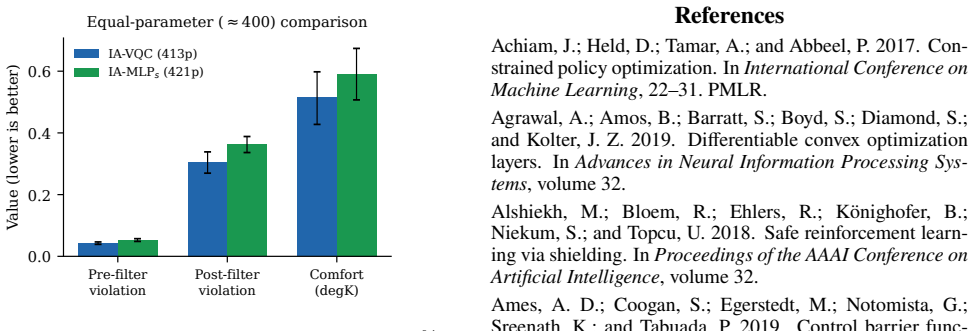
Hard safety filters are increasingly placed downstream of learned controllers to guarantee constraint satisfaction at run time. Yet a filtered controller that never violates a constraint may still have learned nothing about safety: the filter can silently repair an incompetent upstream policy, so that post-filter success measures the filter, not the policy. We argue that safe policy learning should ask who earns the safety - the policy or its protective layers - and we make this question measurable. We introduce Intervention-Aware Variational Quantum Differentiable Predictive Control (IA-VQC-DPC), which (i) trains a compact variational quantum circuit (VQC) policy under a primal-dual intervention budget that penalizes reliance on a differentiable Control-Barrier-Function (CBF) projection, and (ii) is evaluated with a safety-attribution protocol that decomposes the executed-trajectory correction into a CBF term and a deployment runtime-guard term, and stress-tests the policy with guard-off evaluation. On closed-loop, high-fidelity BOPTEST building-control emulators (5 seeds, 60 episodes per method), intervention-aware training significantly lowers the quantum policy's raw pre-filter violation and total safety-layer reliance (both p < 10^-4) with no significant energy regression; at an equal approximately 400-parameter budget the quantum policy is significantly safer and more comfortable than a matched classical policy. Guard-off evaluation confirms the improvement is policy-level and exposes a valuable negative result: a learned differentiable energy head is only safe when paired with a distribution-aware runtime guard. The attribution protocol is general beyond quantum policies and buildings.
Editorial analysis
A structured set of objections, weighed in public.
Referee Report
Summary. The paper introduces Intervention-Aware Variational Quantum Differentiable Predictive Control (IA-VQC-DPC), which trains a compact VQC policy for building control under a primal-dual intervention budget that penalizes reliance on a differentiable Control-Barrier-Function (CBF) projection. It further proposes a safety-attribution protocol that decomposes trajectory corrections into CBF and runtime-guard terms and uses guard-off evaluation. On BOPTEST emulators (5 seeds, 60 episodes), the authors claim intervention-aware training yields significantly lower raw pre-filter violations and safety-layer reliance (both p < 10^{-4}) with no energy regression, that the quantum policy outperforms a matched classical policy at ~400 parameters, and that guard-off evaluation confirms the gains are policy-intrinsic rather than filter-dependent.
Significance. If the attribution protocol and isolation of policy-level safety hold, the work supplies a concrete, measurable criterion for determining whether safety in filtered learned controllers originates in the policy itself. This is relevant for reliable deployment of ML controllers in constrained systems. The fixed-parameter quantum-vs-classical comparison and the negative result on the learned energy head provide useful benchmarks. The protocol is presented as domain-general. The use of closed-loop high-fidelity emulators and reported statistical tests are positive features, though the absence of full statistical details limits immediate impact.
major comments (3)
- [Methods (IA-VQC-DPC training and primal-dual budget)] Methods, IA-VQC-DPC training procedure: the primal-dual intervention budget penalizes post-projection interventions, yet the differentiable CBF projection remains inside the gradient loop. The manuscript provides no explicit statement, computational graph, or detachment operation showing that policy gradients are prevented from routing through the projection's corrective term. Because the post-hoc attribution protocol operates only on executed trajectories, it cannot retroactively correct for training-time exploitation of the projection; this directly threatens the central claim that guard-off evaluation isolates policy-level safety improvements.
- [Abstract and Results section] Abstract and Results (empirical claims): the reported p < 10^{-4} values for violation reduction and safety-layer reliance rest on 5 seeds and 60 episodes but supply neither error bars, confidence intervals, exact statistical test description, nor verification that the attribution decomposition was applied consistently across guard-on/guard-off conditions. Without these, the quantitative support for "significantly safer" and "policy-level" cannot be assessed.
- [Evaluation and guard-off protocol] Evaluation protocol: the claim that guard-off evaluation confirms intrinsic policy safety assumes the runtime guard is the only external corrective mechanism, yet the differentiable CBF projection used at training time may have already shaped the policy parameters. A concrete test (e.g., ablation removing the projection entirely from the training graph) is needed to substantiate that the observed guard-off improvement is not an artifact of gradient leakage.
minor comments (2)
- [Safety-attribution protocol] Notation for the safety-attribution decomposition should be introduced with an explicit equation rather than prose description to allow readers to verify the CBF versus guard term split.
- [Methods] The manuscript should state the precise form of the primal-dual Lagrangian and the update rules for the dual variable to make the intervention budget reproducible.
Simulated Author's Rebuttal
We thank the referee for the constructive comments that help clarify the training procedure, statistical reporting, and evaluation protocol. We address each major comment below and commit to revisions that strengthen the manuscript without altering its core claims.
read point-by-point responses
-
Referee: Methods (IA-VQC-DPC training and primal-dual budget): the primal-dual intervention budget penalizes post-projection interventions, yet the differentiable CBF projection remains inside the gradient loop. The manuscript provides no explicit statement, computational graph, or detachment operation showing that policy gradients are prevented from routing through the projection's corrective term. Because the post-hoc attribution protocol operates only on executed trajectories, it cannot retroactively correct for training-time exploitation of the projection; this directly threatens the central claim that guard-off evaluation isolates policy-level safety improvements.
Authors: We agree that an explicit description of the computational graph is required. In the revised Methods, we will add a figure and text specifying that the CBF projection's corrective term is detached via stop-gradient before the policy loss is computed; only the post-projection intervention magnitude enters the primal-dual budget. This prevents gradient flow through the correction while still penalizing reliance, ensuring the policy cannot exploit the projection during training. The guard-off protocol then evaluates the resulting policy parameters on trajectories without any runtime guard. revision: yes
-
Referee: Abstract and Results (empirical claims): the reported p < 10^{-4} values for violation reduction and safety-layer reliance rest on 5 seeds and 60 episodes but supply neither error bars, confidence intervals, exact statistical test description, nor verification that the attribution decomposition was applied consistently across guard-on/guard-off conditions. Without these, the quantitative support for "significantly safer" and "policy-level" cannot be assessed.
Authors: We accept this point. The revision will report mean ± standard deviation across the 5 seeds, 95% confidence intervals, the exact test (two-sided paired t-test on per-episode metrics), and confirmation that the attribution decomposition (CBF term vs. runtime-guard term) was applied identically in both guard-on and guard-off conditions. These details will be added to the Results section and supplementary material. revision: yes
-
Referee: Evaluation protocol: the claim that guard-off evaluation confirms intrinsic policy safety assumes the runtime guard is the only external corrective mechanism, yet the differentiable CBF projection used at training time may have already shaped the policy parameters. A concrete test (e.g., ablation removing the projection entirely from the training graph) is needed to substantiate that the observed guard-off improvement is not an artifact of gradient leakage.
Authors: The referee correctly identifies that an ablation removing the CBF projection from the training graph would provide direct evidence against gradient leakage. We will add this ablation experiment in the revision: we retrain the VQC policy with the projection completely excised from the graph (i.e., no differentiable CBF at training time) while retaining the primal-dual budget on raw violations, then compare guard-off performance against the original IA-VQC-DPC. Results will be reported alongside the existing guard-off curves. revision: yes
Circularity Check
Empirical evaluation on external benchmarks; no load-bearing circularity
full rationale
The paper's claims rest on closed-loop BOPTEST emulator runs (5 seeds, 60 episodes) with reported p-values, not on any derivation that reduces to its own fitted quantities or self-citations by construction. The primal-dual budget and attribution protocol are presented as methodological choices whose effects are measured post-training; no equation or protocol is shown to be definitionally equivalent to the reported safety gains. Minor self-citation may exist in the broader quantum-control literature but is not load-bearing for the central empirical result.
Axiom & Free-Parameter Ledger
Reference graph
Works this paper leans on
-
[1]
Journal of Process Control , volume=
Differentiable predictive control: Deep learning alternative to explicit model predictive control for unknown nonlinear systems , author=. Journal of Process Control , volume=. 2022 , publisher=
2022
-
[2]
Annual Reviews in Control , volume=
All you need to know about model predictive control for buildings , author=. Annual Reviews in Control , volume=. 2020 , publisher=
2020
-
[3]
2019 18th European Control Conference (ECC) , pages=
Control barrier functions: Theory and applications , author=. 2019 18th European Control Conference (ECC) , pages=. 2019 , organization=
2019
-
[4]
Automatica , volume=
A predictive safety filter for learning-based control of constrained nonlinear dynamical systems , author=. Automatica , volume=. 2021 , publisher=
2021
-
[5]
Proceedings of the AAAI Conference on Artificial Intelligence , volume=
Safe reinforcement learning via shielding , author=. Proceedings of the AAAI Conference on Artificial Intelligence , volume=
-
[6]
Proceedings of the AAAI Conference on Artificial Intelligence , volume=
End-to-end safe reinforcement learning through barrier functions for safety-critical continuous control tasks , author=. Proceedings of the AAAI Conference on Artificial Intelligence , volume=
-
[7]
International Conference on Machine Learning , pages=
Constrained policy optimization , author=. International Conference on Machine Learning , pages=. 2017 , organization=
2017
-
[8]
Safe Exploration in Continuous Action Spaces
Safe exploration in continuous action spaces , author=. arXiv preprint arXiv:1801.08757 , year=
work page internal anchor Pith review Pith/arXiv arXiv
-
[9]
Journal of Machine Learning Research , volume=
A comprehensive survey on safe reinforcement learning , author=. Journal of Machine Learning Research , volume=
-
[10]
International Conference on Machine Learning , pages=
Responsive safety in reinforcement learning by PID Lagrangian methods , author=. International Conference on Machine Learning , pages=. 2020 , organization=
2020
-
[11]
International Conference on Machine Learning , pages=
OptNet: Differentiable optimization as a layer in neural networks , author=. International Conference on Machine Learning , pages=. 2017 , organization=
2017
-
[12]
Advances in Neural Information Processing Systems , volume=
Differentiable convex optimization layers , author=. Advances in Neural Information Processing Systems , volume=
-
[13]
Physical Review A , volume=
Quantum circuit learning , author=. Physical Review A , volume=. 2018 , publisher=
2018
-
[14]
Quantum Science and Technology , volume=
Parameterized quantum circuits as machine learning models , author=. Quantum Science and Technology , volume=. 2019 , publisher=
2019
-
[15]
Physical Review A , volume=
Effect of data encoding on the expressive power of variational quantum-machine-learning models , author=. Physical Review A , volume=. 2021 , publisher=
2021
-
[16]
Advances in Neural Information Processing Systems , volume=
Parametrized quantum policies for reinforcement learning , author=. Advances in Neural Information Processing Systems , volume=
-
[17]
Quantum , volume=
Quantum agents in the gym: a variational quantum algorithm for deep Q-learning , author=. Quantum , volume=. 2022 , publisher=
2022
-
[18]
Journal of Building Performance Simulation , volume=
Building optimization testing framework (BOPTEST) for simulation-based benchmarking of control strategies in buildings , author=. Journal of Building Performance Simulation , volume=. 2021 , publisher=
2021
-
[19]
Proceedings of the 6th ACM International Conference on Systems for Energy-Efficient Buildings, Cities, and Transportation , pages=
CityLearn v1.0: An OpenAI gym environment for demand response with deep reinforcement learning , author=. Proceedings of the 6th ACM International Conference on Systems for Energy-Efficient Buildings, Cities, and Transportation , pages=
-
[20]
International Conference on Learning Representations , year=
Adam: A method for stochastic optimization , author=. International Conference on Learning Representations , year=
-
[21]
Quantum , volume=
Quantum computing in the NISQ era and beyond , author=. Quantum , volume=
discussion (0)
Sign in with ORCID, Apple, or X to comment. Anyone can read and Pith papers without signing in.