A Scaling Relation of LRDs between Broad Hα and Bolometric Luminosities: Enhanced Broad Hα Emission Relative to Low-z Type 1 AGN
Pith reviewed 2026-06-27 16:14 UTC · model grok-4.3
The pith
Little red dots at high redshift show broad Hα luminosity enhanced by a factor of ~40 relative to their bolometric luminosity compared with low-z Type 1 AGN.
A machine-rendered reading of the paper's core claim, the machinery that carries it, and where it could break.
Core claim
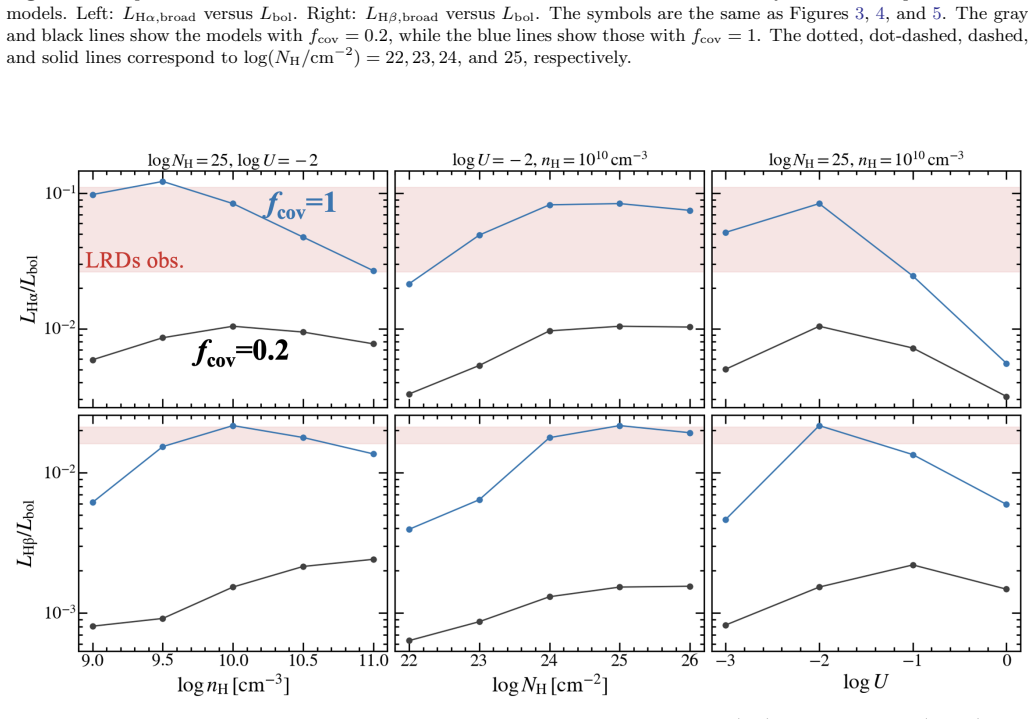
LRDs display a tight L_Hα,broad-L_bol scaling relation that is offset by a factor of ~40 in L_Hα,broad compared to low-z Type 1 AGN. This offset, along with a smaller ~10 factor for Hβ, is reproduced by Cloudy LOC models with covering factor increased to ~100%, hydrogen column density to >=10^24 cm^{-2}, and gas density ~10^{10} cm^{-3}, which also match the modified blackbody continuum. This points to a stuffed or giant broad line region.
What carries the argument
The locally optimally-emitting cloud (LOC) photoionization framework applied via Cloudy to relate broad-line luminosities to bolometric output through changes in covering factor and column density.
If this is right
- The broad-line and continuum emissions in LRDs are powered primarily by the central engine.
- The broad line region reaches a covering factor near 100 percent.
- Gas column densities in the broad line region exceed 10^24 cm^{-2}.
- A gas density near 10^10 cm^{-3} is required to match both lines and continuum.
- The geometry corresponds to either a stuffed or giant broad line region.
Where Pith is reading between the lines
- If the high covering factor is confirmed, black-hole mass estimates that rely on line widths may need recalibration for this population.
- The same modeling approach could be applied to other high-redshift emission-line diagnostics to check consistency.
- The relation offers a way to estimate L_bol from Hα alone for fainter LRDs where continuum fitting is difficult.
- Similar offsets might appear in other lines once grating spectra become available for larger samples.
Load-bearing premise
Bolometric luminosity is correctly measured from the modified blackbody fit without significant host galaxy contamination, and the standard LOC photoionization model applies directly to LRD conditions.
What would settle it
A measurement showing that host-galaxy light contributes more than a few tens of percent to the near-infrared continuum used to derive L_bol, or a spectrum where line ratios cannot be reproduced by the proposed Cloudy parameters even at full covering factor.
Figures




read the original abstract
We investigate the demography of little red dots (LRDs) using 37 objects at $z\sim3$-$7$ with JWST/NIRSpec PRISM and grating spectra compiled from various JWST programs. We focus on spectroscopic quantities of the broad H$\alpha$ luminosity $L_\mathrm{H\alpha,broad}$ (and the broad H$\beta$ luminosity $L_\mathrm{H\beta,broad}$ where available) and the bolometric luminosity $L_\mathrm{bol}$ represented by modified blackbody emission, avoiding quantities contaminated by host-galaxy emission (e.g., total H$\alpha$ luminosity). We identifiy a tight scaling relation between $L_\mathrm{H\alpha,broad}$ and $L_\mathrm{bol}$, supporting the interpretation that these emissions are primarily powered by the central engine. Interestingly, the $L_\mathrm{H\alpha,broad}$-$L_\mathrm{bol}$ scaling relation of LRDs is enhanced by a factor of $\sim40$ in $L_\mathrm{H\alpha,broad}$ relative to that of low-$z$ Type 1 AGN. A similar trend is found in the $L_\mathrm{H\beta,broad}$-$L_\mathrm{bol}$ relation, although the enhancement in $L_\mathrm{H\beta,broad}$ is smaller, only by a factor of $\sim10$. We explore the physical origin of these enhancements and find that \textsc{Cloudy} photoionization modeling within the classic locally optimally-emitting cloud (LOC) framework can explain them through an increase in the covering factor from $\sim20$\% (Type 1 AGN) to $\sim100$\% (LRDs), together with an increase in the hydrogen column density from $N_\mathrm{H}\sim10^{23}\,\mathrm{cm}^{-2}$ to $\gtrsim10^{24}\,\mathrm{cm}^{-2}$, with a preferred gas density of $\sim10^{10}\,\mathrm{cm}^{-3}$, successfully reproducing the modified blackbody emission. Such a nearly unity covering factor without requiring a gas density increase may result from a significant increase in the BLR filling factor or size, corresponding to a ``stuffed BLR" or ``giant BLR," respectively.
Editorial analysis
A structured set of objections, weighed in public.
Referee Report
Summary. The manuscript compiles JWST/NIRSpec spectra for 37 little red dots (LRDs) at z~3-7 and reports a tight scaling relation between broad Hα luminosity (L_Hα,broad) and bolometric luminosity (L_bol, derived from modified blackbody fits chosen to minimize host contamination). This relation is offset by a factor of ~40 in L_Hα,broad relative to the corresponding relation for low-z Type 1 AGN (with a smaller ~10x offset for broad Hβ). The authors attribute the enhancement to an increase in BLR covering factor from ~20% to ~100%, hydrogen column density from ~10^23 to ≳10^24 cm^-2, and gas density ~10^10 cm^-3 within the classic LOC framework of Cloudy photoionization models, interpreting this as evidence for a 'stuffed BLR' or 'giant BLR'.
Significance. If the L_bol values are shown to be directly comparable, the result would indicate systematically different BLR properties in high-redshift LRDs, with implications for early supermassive black hole growth and AGN demographics. The compilation of 37 objects with both PRISM and grating spectra, together with the explicit focus on broad-line luminosities to avoid host contamination, constitutes a clear observational strength.
major comments (2)
- [Abstract; L_bol definition and scaling-relation section] The factor-of-~40 enhancement claim (abstract) is load-bearing on the assumption that L_bol for the LRD sample (modified blackbody) is on the same scale as the low-z Type 1 AGN reference relation. The manuscript does not state the bolometric correction method or continuum luminosity used for the low-z comparison sample; if the low-z L_bol incorporates standard corrections (e.g., from 5100 Å or 2-10 keV) that differ systematically from the modified-blackbody definition, the apparent offset is not necessarily physical.
- [Cloudy LOC modeling paragraph] The LOC modeling (abstract) reproduces the observed enhancement only after tuning covering factor, N_H, and n_H to the data. No independent prior constraints on these parameters from LRD host or outflow properties are provided, so the physical explanation is post-hoc rather than predictive; this circularity directly affects the strength of the 'stuffed BLR' interpretation.
minor comments (1)
- [Introduction or methods] Notation for L_bol should be clarified when first introduced to distinguish the modified-blackbody definition from any continuum-based alternatives.
Simulated Author's Rebuttal
We thank the referee for their constructive comments. We address each major comment below, providing clarifications and indicating revisions where appropriate.
read point-by-point responses
-
Referee: [Abstract; L_bol definition and scaling-relation section] The factor-of-~40 enhancement claim (abstract) is load-bearing on the assumption that L_bol for the LRD sample (modified blackbody) is on the same scale as the low-z Type 1 AGN reference relation. The manuscript does not state the bolometric correction method or continuum luminosity used for the low-z comparison sample; if the low-z L_bol incorporates standard corrections (e.g., from 5100 Å or 2-10 keV) that differ systematically from the modified-blackbody definition, the apparent offset is not necessarily physical.
Authors: We agree that the manuscript should explicitly document the L_bol definition for the low-z Type 1 AGN reference sample to allow direct comparison. The reference relation is taken from the standard literature (typically using 5100 Å continuum luminosity with established bolometric corrections). In the revised manuscript we will add a paragraph in the scaling-relation section stating the exact method used for the comparison sample and discussing possible systematic differences arising from the distinct SED shapes. We maintain that the offset remains physical because the modified-blackbody L_bol for LRDs is deliberately constructed to isolate the central-engine contribution while minimizing host contamination, consistent with the red, AGN-dominated spectra of the sample. revision: yes
-
Referee: [Cloudy LOC modeling paragraph] The LOC modeling (abstract) reproduces the observed enhancement only after tuning covering factor, N_H, and n_H to the data. No independent prior constraints on these parameters from LRD host or outflow properties are provided, so the physical explanation is post-hoc rather than predictive; this circularity directly affects the strength of the 'stuffed BLR' interpretation.
Authors: The LOC modeling is presented as an exploratory exercise within the standard framework to test whether plausible parameter adjustments can reproduce both the enhanced line luminosities and the modified-blackbody continuum. The near-unity covering factor and high column density are motivated by independent LRD observables (red colors implying heavy obscuration and minimal host-galaxy signatures). We acknowledge that the modeling is not fully predictive and will revise the relevant section to (i) state the physical motivations drawn from LRD demographics more explicitly and (ii) add a caveat on the exploratory nature of the parameter search. No additional independent priors on BLR gas density are currently available in the literature for LRDs, but future multi-wavelength constraints can be incorporated. revision: partial
Circularity Check
No significant circularity; empirical relation and modeling are independent
full rationale
The paper measures the L_Hα,broad-L_bol scaling directly from JWST spectra of 37 LRDs (with L_bol from modified blackbody fits) and compares the offset to an external low-z Type 1 AGN sample. The Cloudy LOC modeling is then used post hoc to identify parameter values (covering factor, N_H, n_H) that can reproduce the observed offset and continuum shape. This is standard explanatory modeling rather than a derivation that reduces to its own inputs by construction. No self-definitional equations, fitted parameters renamed as predictions, or load-bearing self-citations appear in the abstract or described chain. The result remains falsifiable against the external AGN benchmark.
Axiom & Free-Parameter Ledger
free parameters (3)
- covering factor =
~100%
- hydrogen column density =
>=10^24 cm^-2
- gas density =
~10^10 cm^-3
axioms (1)
- domain assumption Cloudy photoionization modeling in the LOC framework applies directly to LRDs
invented entities (1)
-
stuffed BLR or giant BLR
no independent evidence
Forward citations
Cited by 2 Pith papers
-
Little Red Dots as Intermediate Mass, Super-Eddington Engines: Insights from Type IIn Supernovae and The 1837-1856 Great Eruption of $\eta$ Carinae
LRDs are reinterpreted as intermediate-mass super-Eddington systems with wind-driven pseudo-photospheres that explain their spectra and imply engine masses below 10^5 solar masses rather than overmassive black holes.
-
Little Red and Blue Dots: AGN-excited narrow lines, Lyman-$\alpha$ emission, and resemblance to standard quasars
JWST data on LRDs and LBDs show AGN-like excitation, strong Lyα with broad components, and X-ray weakness, implying clumpy or equatorial geometries around growing black holes rather than complete gas envelopes.
Reference graph
Works this paper leans on
-
[1]
Akins, H. B., Casey, C. M., Lambrides, E., et al. 2025, ApJ, 991, 37, doi: 10.3847/1538-4357/ade984
-
[2]
Ananna, T. T., Bogd´ an,´A., Kov´ acs, O. E., Natarajan, P., & Hickox, R. C. 2024, ApJL, 969, L18, doi: 10.3847/2041-8213/ad5669
-
[3]
Ando, M., Harikane, Y., Katz, H., Inayoshi, K., & Tanaka, T. S. 2026, arXiv e-prints, arXiv:2606.03522. https://arxiv.org/abs/2606.03522 Astropy Collaboration, Robitaille, T. P., Tollerud, E. J., et al. 2013, A&A, 558, A33, doi: 10.1051/0004-6361/201322068 Scaling Relation of LRDs15 Astropy Collaboration, Price-Whelan, A. M., Sip˝ ocz, B. M., et al. 2018,...
work page internal anchor Pith review Pith/arXiv arXiv doi:10.1051/0004-6361/201322068 2026
-
[4]
Baldwin, J., Ferland, G., Korista, K., & Verner, D. 1995, ApJL, 455, L119, doi: 10.1086/309827
-
[5]
The Low-Luminosity End of the Radius-Luminosity Relationship for Active Galactic Nuclei
Bentz, M. C., Denney, K. D., Grier, C. J., et al. 2013, ApJ, 767, 149, doi: 10.1088/0004-637X/767/2/149
work page internal anchor Pith review doi:10.1088/0004-637x/767/2/149 2013
-
[6]
Brammer, Grizli (2023), doi:10.5281/zenodo.1146904
Brammer, G. 2023a, grizli, 1.9.11 Zenodo, doi: 10.5281/zenodo.1146904
-
[7]
doi:10.5281/zenodo.8370018 , version =
Brammer, G. 2023b, grizli, 1.9.11 Zenodo, doi: 10.5281/zenodo.8370018
-
[8]
J., Stone, Z., Shen, Y., & Jiang, Y.-F
Burke, C. J., Stone, Z., Shen, Y., & Jiang, Y.-F. 2025, arXiv e-prints, arXiv:2511.16082, doi: 10.48550/arXiv.2511.16082
-
[9]
Cloonan, A. P., Whitaker, K. E., Manning, S. M., et al. 2026, arXiv e-prints, arXiv:2603.24700, doi: 10.48550/arXiv.2603.24700
-
[10]
Davidson, K., & Netzer, H. 1979, Reviews of Modern Physics, 51, 715, doi: 10.1103/RevModPhys.51.715 de Graaff, A., Brammer, G., Weibel, A., et al. 2025a, A&A, 697, A189, doi: 10.1051/0004-6361/202452186 de Graaff, A., Hviding, R. E., Naidu, R. P., et al. 2025b, arXiv e-prints, arXiv:2511.21820, doi: 10.48550/arXiv.2511.21820 de Graaff, A., Rix, H.-W., Nai...
-
[11]
J., Willott, C., Alberts, S., et al
Eisenstein, D. J., Willott, C., Alberts, S., et al. 2026, ApJS, 283, 6, doi: 10.3847/1538-4365/ae3163
-
[12]
Finkelstein, S. L., Bagley, M. B., Arrabal Haro, P., et al. 2022, ApJL, 940, L55, doi: 10.3847/2041-8213/ac966e
-
[13]
Foreman-Mackey, D., Hogg, D. W., Lang, D., & Goodman, J. 2013, PASP, 125, 306, doi: 10.1086/670067
-
[14]
Furtak, L. J., Zitrin, A., Weaver, J. R., et al. 2023, MNRAS, 523, 4568, doi: 10.1093/mnras/stad1627
-
[15]
Galavis, M. E., Mendoza, C., & Zeippen, C. J. 1997, A&AS, 123, 159, doi: 10.1051/aas:1997344
-
[16]
Gloudemans, A. J., Duncan, K. J., Eilers, A.-C., et al. 2025, ApJ, 986, 130, doi: 10.3847/1538-4357/adddb9
-
[17]
Estimating Black Hole Masses in Active Galaxies Using the Halpha Emission Line
Greene, J. E., & Ho, L. C. 2005, ApJ, 630, 122, doi: 10.1086/431897
work page internal anchor Pith review doi:10.1086/431897 2005
-
[18]
Greene, J. E., Labbe, I., Goulding, A. D., et al. 2024, ApJ, 964, 39, doi: 10.3847/1538-4357/ad1e5f
-
[19]
Greene, J. E., Setton, D. J., Furtak, L. J., et al. 2025, arXiv e-prints, arXiv:2509.05434, doi: 10.48550/arXiv.2509.05434
-
[20]
Ferland, G. J. 2023, Research Notes of the American Astronomical Society, 7, 246, doi: 10.3847/2515-5172/ad0e75
-
[21]
Harikane, Y., Zhang, Y., Nakajima, K., et al. 2023, ApJ, 959, 39, doi: 10.3847/1538-4357/ad029e
-
[22]
Harris, C. R., Millman, K. J., van der Walt, S. J., et al. 2020, Nature, 585, 357, doi: 10.1038/s41586-020-2649-2
-
[23]
Heintz, K. E., Watson, D., Brammer, G., et al. 2024, Science, 384, 890, doi: 10.1126/science.adj0343
-
[24]
Hunter, J. D. 2007, Computing in Science and Engineering, 9, 90, doi: 10.1109/MCSE.2007.55
-
[25]
Inayoshi, K., & Ho, L. C. 2025, arXiv e-prints, arXiv:2512.03130, doi: 10.48550/arXiv.2512.03130
-
[26]
Inayoshi, K., & Maiolino, R. 2025, ApJL, 980, L27, doi: 10.3847/2041-8213/adaebd
-
[27]
Inayoshi, K., Murase, K., & Kashiyama, K. 2025, arXiv e-prints, arXiv:2509.19422, doi: 10.48550/arXiv.2509.19422
work page internal anchor Pith review Pith/arXiv arXiv doi:10.48550/arxiv.2509.19422 2025
-
[28]
Isobe, Y., Ouchi, M., Nakajima, K., et al. 2023, ApJ, 956, 139, doi: 10.3847/1538-4357/acf376
-
[29]
Ji, X., Maiolino, R., ¨Ubler, H., et al. 2025, MNRAS, 544, 3900, doi: 10.1093/mnras/staf1867
-
[30]
Kaspi, S., Smith, P. S., Netzer, H., et al. 2000, ApJ, 533, 631, doi: 10.1086/308704
-
[31]
Kido, D., Ioka, K., Hotokezaka, K., Inayoshi, K., & Irwin, C. M. 2025, MNRAS, 544, 3407, doi: 10.1093/mnras/staf1898
-
[32]
Kiyota, T., Ouchi, M., Xu, Y., et al. 2025, ApJ, 995, 150, doi: 10.3847/1538-4357/ae1cc3
-
[33]
Kocevski, D. D., Onoue, M., Inayoshi, K., et al. 2023, ApJL, 954, L4, doi: 10.3847/2041-8213/ace5a0
-
[34]
Kocevski, D. D., Finkelstein, S. L., Barro, G., et al. 2025, ApJ, 986, 126, doi: 10.3847/1538-4357/adbc7d
-
[35]
Kokubo, M., & Harikane, Y. 2025, ApJ, 995, 24, doi: 10.3847/1538-4357/ae119e
-
[36]
1997, ApJS, 108, 401, doi: 10.1086/312966
Korista, K., Baldwin, J., Ferland, G., & Verner, D. 1997, ApJS, 108, 401, doi: 10.1086/312966
-
[37]
Korista, K. T., & Goad, M. R. 2004, ApJ, 606, 749, doi: 10.1086/383193
-
[38]
doi:10.48550/arXiv.2412.04557 , keywords =
Labbe, I., Greene, J. E., Matthee, J., et al. 2024, arXiv e-prints, arXiv:2412.04557, doi: 10.48550/arXiv.2412.04557
-
[39]
Labbe, I., Greene, J. E., Bezanson, R., et al. 2025, ApJ, 978, 92, doi: 10.3847/1538-4357/ad3551
-
[40]
(LRDs)$^2$: The Low-ReDshift Little Red Dots Survey. II. DESI DR1 Sample
Lin, X., Fan, X., Cai, Z., et al. 2026, arXiv e-prints, arXiv:2605.21574, doi: 10.48550/arXiv.2605.21574
work page internal anchor Pith review Pith/arXiv arXiv doi:10.48550/arxiv.2605.21574 2026
-
[41]
How I Wonder What You Are -- JWST's Little Red Dots do not TWINKLE
Liu, Z., Naidu, R. P., Secunda, A., et al. 2026, arXiv e-prints, arXiv:2604.13000, doi: 10.48550/arXiv.2604.13000 16
work page internal anchor Pith review Pith/arXiv arXiv doi:10.48550/arxiv.2604.13000 2026
-
[42]
Maiolino, R., Scholtz, J., Curtis-Lake, E., et al. 2024, A&A, 691, A145, doi: 10.1051/0004-6361/202347640
-
[43]
Maiolino, R., Risaliti, G., Signorini, M., et al. 2025, MNRAS, 538, 1921, doi: 10.1093/mnras/staf359
-
[44]
Matthee, J., Naidu, R. P., Brammer, G., et al. 2024, ApJ, 963, 129, doi: 10.3847/1538-4357/ad2345
-
[45]
2026, arXiv e-prints, arXiv:2603.17667
Matthee, J., Torralba, A., Pezzulli, G., et al. 2026, arXiv e-prints, arXiv:2603.17667, doi: 10.48550/arXiv.2603.17667
-
[46]
A "Black Hole Star" Reveals the Remarkable Gas-Enshrouded Hearts of the Little Red Dots
Naidu, R. P., Matthee, J., Katz, H., et al. 2025, arXiv e-prints, arXiv:2503.16596, doi: 10.48550/arXiv.2503.16596
work page internal anchor Pith review Pith/arXiv arXiv doi:10.48550/arxiv.2503.16596 2025
-
[47]
Osterbrock, D. E. 1991, Reports on Progress in Physics, 54, 579, doi: 10.1088/0034-4885/54/4/002
-
[48]
E., & Ferland, G
Osterbrock, D. E., & Ferland, G. J. 2006, Astrophysics of gaseous nebulae and active galactic nuclei
2006
-
[49]
Pang, Y., Wang, X., Cheng, C., et al. 2026, arXiv e-prints, arXiv:2602.12548, doi: 10.48550/arXiv.2602.12548
work page internal anchor Pith review Pith/arXiv arXiv doi:10.48550/arxiv.2602.12548 2026
-
[50]
Peterson, B. M. 2006, in Physics of Active Galactic Nuclei at all Scales, ed. D. Alloin, Vol. 693, 77, doi: 10.1007/3-540-34621-X 3
-
[51]
Peterson, B. M., Ferrarese, L., Gilbert, K. M., et al. 2004, ApJ, 613, 682, doi: 10.1086/423269 Planck Collaboration, Aghanim, N., Akrami, Y., et al. 2020, A&A, 641, A6, doi: 10.1051/0004-6361/201833910
work page internal anchor Pith review doi:10.1086/423269 2004
-
[52]
Price, S. H., Bezanson, R., Labbe, I., et al. 2025, ApJ, 982, 51, doi: 10.3847/1538-4357/adaec1
-
[53]
Rinaldi, P., Bonaventura, N., Rieke, G. H., et al. 2025, ApJ, 992, 71, doi: 10.3847/1538-4357/adfa10
-
[54]
Rinaldi, P., Hainline, K., D’Eugenio, F., et al. 2026, arXiv e-prints, arXiv:2604.07138, doi: 10.48550/arXiv.2604.07138
work page internal anchor Pith review Pith/arXiv arXiv doi:10.48550/arxiv.2604.07138 2026
-
[55]
Rusakov, V., Watson, D., Nikopoulos, G. P., et al. 2026, Nature, 649, 574, doi: 10.1038/s41586-025-08643-8
-
[56]
2025, ApJL, 989, L30, doi: 10.3847/2041-8213/adf5c8
Sacchi, A., & Bogd´ an,´A. 2025, ApJL, 989, L30, doi: 10.3847/2041-8213/adf5c8
-
[57]
2026, arXiv e-prints, arXiv:2603.22277
Scholtz, J., D’Eugenio, F., Maiolino, R., et al. 2026, arXiv e-prints, arXiv:2603.22277, doi: 10.48550/arXiv.2603.22277
-
[58]
Secunda, A., Somerville, R. S., Jiang, Y.-F., et al. 2026, ApJ, 996, 6, doi: 10.3847/1538-4357/ae1f08
-
[59]
Setton, D. J., Greene, J. E., Spilker, J. S., et al. 2025, ApJL, 991, L10, doi: 10.3847/2041-8213/ade78b
-
[60]
2012, ApJ, 753, 125, doi: 10.1088/0004-637X/753/2/125
Shen, Y., & Liu, X. 2012, ApJ, 753, 125, doi: 10.1088/0004-637X/753/2/125
-
[61]
Snedden, S. A., & Gaskell, C. M. 1999, ApJL, 521, L91, doi: 10.1086/312188
-
[62]
Paschen Jumps in Little Red Dots: Evidence for Nebular Continua
Sneppen, A., Matthews, J. H., Watson, D., et al. 2026a, arXiv e-prints, arXiv:2604.09399, doi: 10.48550/arXiv.2604.09399
work page internal anchor Pith review Pith/arXiv arXiv doi:10.48550/arxiv.2604.09399
-
[63]
Sneppen, A., Watson, D., Matthews, J. H., et al. 2026b, arXiv e-prints, arXiv:2601.18864, doi: 10.48550/arXiv.2601.18864
-
[64]
Stern, J., & Laor, A. 2012, Monthly Notices of the Royal Astronomical Society, 423, 600, doi: 10.1111/j.1365-2966.2012.20901.x
-
[65]
2025, arXiv e-prints, arXiv:2509.19585
Stone, Z., Shen, Y., Zhuang, M.-Y., et al. 2025, arXiv e-prints, arXiv:2509.19585, doi: 10.48550/arXiv.2509.19585
-
[66]
Suess, K. A., Weaver, J. R., Price, S. H., et al. 2024, ApJ, 976, 101, doi: 10.3847/1538-4357/ad75fe
-
[67]
Tanaka, T. S., Akins, H. B., Harikane, Y., et al. 2025, ApJ, 995, 21, doi: 10.3847/1538-4357/ae145f
-
[68]
Tee, W. L., Fan, X., Wang, F., & Yang, J. 2025, ApJL, 983, L26, doi: 10.3847/2041-8213/adc5e3
-
[69]
BlackTHUNDER: Evidence of three massive black holes in a z~5 galaxy
Torralba, A., Matthee, J., Pezzulli, G., et al. 2026, A&A, 707, A75, doi: 10.1051/0004-6361/202557537 ¨Ubler, H., Mazzolari, G., Maiolino, R., et al. 2025, arXiv e-prints, arXiv:2509.21575, doi: 10.48550/arXiv.2509.21575
work page internal anchor Pith review Pith/arXiv arXiv doi:10.1051/0004-6361/202557537 2026
-
[70]
Umeda, H., Inayoshi, K., Harikane, Y., & Murase, K. 2025, arXiv e-prints, arXiv:2512.04208, doi: 10.48550/arXiv.2512.04208
-
[71]
Valentino, F., Brammer, G., Gould, K. M. L., et al. 2023, ApJ, 947, 20, doi: 10.3847/1538-4357/acbefa
-
[72]
Valentino, F., Heintz, K. E., Brammer, G., et al. 2025, A&A, 699, A358, doi: 10.1051/0004-6361/202553908
-
[73]
Weaver, J. R., Cutler, S. E., Pan, R., et al. 2024, ApJS, 270, 7, doi: 10.3847/1538-4365/ad07e0
-
[74]
Wu, Q., & Shen, Y. 2022, ApJS, 263, 42, doi: 10.3847/1538-4365/ac9ead
-
[75]
The Astrophysical Journal Letters , abstract =
Yue, M., Eilers, A.-C., Ananna, T. T., et al. 2024, ApJL, 974, L26, doi: 10.3847/2041-8213/ad7eba
-
[76]
Zhang, Z., Jiang, L., Liu, W., & Ho, L. C. 2025, ApJ, 985, 119, doi: 10.3847/1538-4357/adcb3e
discussion (0)
Sign in with ORCID, Apple, or X to comment. Anyone can read and Pith papers without signing in.