Margin-Adaptive Confidence Ranking for Reliable LLM Judgement
Pith reviewed 2026-06-30 20:59 UTC · model grok-4.3
The pith
A margin-adaptive confidence estimator trained on simulated annotator diversity improves ranking accuracy and agreement success rates in LLM fixed-sequence testing.
A machine-rendered reading of the paper's core claim, the machinery that carries it, and where it could break.
Core claim
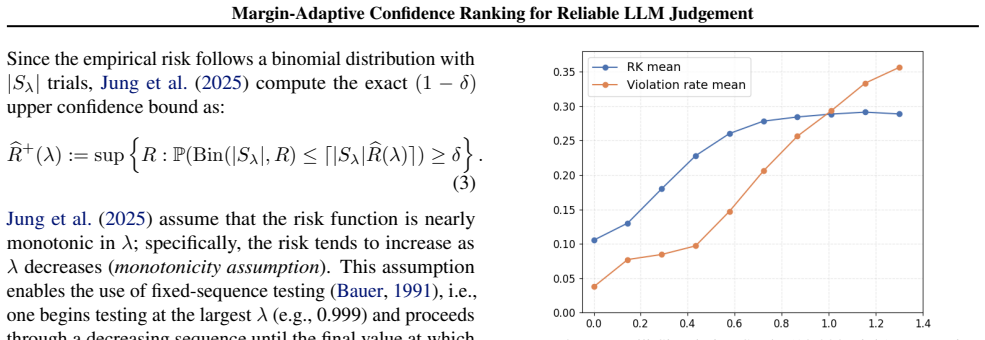
The paper claims that a dedicated confidence estimator learned via margin-based ranking on simulated annotator diversity, together with its margin-dependent generalization guarantees and adaptive training procedure, replaces heuristic signals, improves ranking accuracy, strengthens the observed monotonic link between and disagreement risk, and raises success rates for target agreement levels inside fixed-sequence testing across datasets and models.
What carries the argument
Margin-based ranking formulation that explicitly models an LLM's in separating human-agreement cases from human-disagreement cases.
If this is right
- The learned estimator yields higher ranking accuracy than heuristic baselines.
- Empirical monotonicity between and disagreement risk is strengthened.
- Fixed-sequence testing achieves higher success rates at target agreement levels.
- The margin-dependent trade-off informs an adaptive training procedure that balances estimator quality.
- Performance gains hold across multiple datasets and judge models.
Where Pith is reading between the lines
- If simulated diversity proves insufficient, the method could be extended by incorporating small amounts of real human labels into the ranking loss.
- The same margin-adaptive ranking idea could be tested on other monotonicity assumptions common in LLM evaluation pipelines.
- The derived generalization bounds might be tightened further by incorporating dataset-specific disagreement statistics.
Load-bearing premise
Simulated annotator diversity is representative enough of real human disagreement distributions that the learned estimator's generalization bounds transfer.
What would settle it
Direct evaluation of the learned estimator on fresh real-human disagreement labels from held-out domains to check whether its ranking advantage and monotonicity gains disappear.
Figures



read the original abstract
Jung et al. (2025) introduce a hypothesis testing framework for guaranteeing agreement between large language models (LLMs) and human judgments, relying on the assumption that the model's estimated confidence is monotonic with respect to human-disagreement risk. In practice, however, this assumption may be violated, and the generalization behavior of the confidence estimator is not explicitly analyzed. We mitigate these issues by learning a dedicated confidence estimator instead of relying on heuristic confidence signals. Our approach leverages simulated annotator diversity and a margin-based ranking formulation to explicitly model how confidently an LLM distinguishes between human-agreement and human-disagreement cases. We further derive generalization guarantees for this estimator, revealing a margin-dependent trade-off that informs the design of an adaptive estimator training procedure. When integrated into fixed-sequence testing, the learned confidence estimator yields improved ranking accuracy and empirically strengthens the monotonic relationship between confidence and disagreement risk, leading to higher success rates in satisfying target agreement levels across multiple datasets and judge models.
Editorial analysis
A structured set of objections, weighed in public.
Referee Report
Summary. The paper proposes learning a dedicated margin-adaptive confidence estimator for LLMs, trained via simulated annotator diversity and a margin-based ranking loss, to replace heuristic signals in a hypothesis-testing framework for LLM-human agreement. It derives margin-dependent generalization bounds for the estimator and reports that, when plugged into fixed-sequence testing, the estimator improves ranking accuracy, strengthens the monotonicity between confidence and disagreement risk, and raises success rates in meeting target agreement levels across datasets and judge models.
Significance. If the transfer from simulated to real disagreement distributions holds and the bounds are non-vacuous, the work would supply a practical, theoretically supported method for tightening confidence-based guarantees in LLM judgment pipelines, addressing a key practical failure mode of prior monotonicity assumptions.
major comments (2)
- [Abstract / Approach] The central empirical claims (improved ranking accuracy, strengthened monotonicity, higher success rates) rest on the learned estimator transferring from training on simulated annotator diversity to real human disagreement distributions, yet the provided text supplies no experiment, statistic, or analysis that directly validates this transfer or compares simulated vs. real disagreement statistics.
- [Abstract] Abstract states that generalization guarantees are derived and empirical improvements are observed, but supplies no equations, proof sketches, dataset details, or statistical evidence, leaving the central claims unsupported at the level of the provided text.
minor comments (1)
- [Abstract] The citation 'Jung et al. (2025)' appears without a full reference entry or arXiv identifier.
Simulated Author's Rebuttal
We thank the referee for the detailed feedback. We address each major comment below, clarifying the support provided in the full manuscript while agreeing to strengthen certain aspects in revision.
read point-by-point responses
-
Referee: [Abstract / Approach] The central empirical claims (improved ranking accuracy, strengthened monotonicity, higher success rates) rest on the learned estimator transferring from training on simulated annotator diversity to real human disagreement distributions, yet the provided text supplies no experiment, statistic, or analysis that directly validates this transfer or compares simulated vs. real disagreement statistics.
Authors: The full manuscript evaluates the estimator (trained on simulated annotator diversity) on multiple real human judgment datasets, reporting consistent gains in ranking accuracy, strengthened monotonicity, and higher success rates in meeting target agreement levels. These results on real data provide empirical support for effective transfer. We agree that an explicit comparison of simulated versus real disagreement statistics would further strengthen the presentation and will add this analysis in the revised version. revision: yes
-
Referee: [Abstract] Abstract states that generalization guarantees are derived and empirical improvements are observed, but supplies no equations, proof sketches, dataset details, or statistical evidence, leaving the central claims unsupported at the level of the provided text.
Authors: Abstracts are intentionally concise high-level summaries and do not contain equations, proofs, or detailed statistics, per standard practice. The margin-dependent generalization bounds are derived in Section 3 with proof sketches in the appendix; dataset details appear in Section 4; and statistical evidence for the empirical results is reported in Section 5. We can add brief section references to the abstract if the editor prefers. revision: partial
Circularity Check
No significant circularity; derivation remains self-contained
full rationale
The paper's chain begins with a cited hypothesis-testing framework from Jung et al. (2025), then introduces an independent learned confidence estimator trained on simulated annotator diversity, derives margin-dependent generalization bounds for that estimator, and reports empirical improvements in ranking accuracy and fixed-sequence testing success rates on multiple datasets. None of these steps reduce by construction to the inputs: the bounds are derived rather than fitted, the empirical results are measured outcomes rather than renamed training quantities, and the Jung citation supplies only the baseline assumption being mitigated rather than a load-bearing uniqueness theorem. No self-definitional, fitted-prediction, or self-citation-chain reductions appear.
Axiom & Free-Parameter Ledger
Reference graph
Works this paper leans on
-
[1]
Proceedings, pp. 203–215. Springer, 2003. McAllester, D. A. Pac-bayesian model averaging. InCOLT, 1999. Min, S., Krishna, K., Lyu, X., Lewis, M., Yih, W.-t., Koh, P. W., Iyyer, M., Zettlemoyer, L., and Hajishirzi, H. Factscore: Fine-grained atomic evaluation of factual precision in long form text generation.arXiv preprint arXiv:2305.14251, 2023. Mohri, C....
-
[2]
By the definition of ˜Q, we have: max s |Cθ+ ˜u(s)−C θ(s)|< γ 4 .(17) Therefore, with probability at least1−δover training datasetS pair, we have: RK(θ)≤E ˜u∼ ˜QRK γ 2 (θ+ ˜u)(18) ≤E ˜u∼ ˜Q dRK γ 2 (θ+ ˜u) + s KL(θ+ ˜u∥P) + ln mp δ′ 2(mp −1) (19) ≤dRKγ(θ) + s KL(θ+ ˜u∥P) + ln mp δ′ 2(mp −1) (20) ≤dRKγ(θ) + s KL(θ+u∥P) + ln 3mp δ′ mp −1 (21) Hence, proved....
discussion (0)
Sign in with ORCID, Apple, or X to comment. Anyone can read and Pith papers without signing in.