Q-Flow: Stable and Expressive Reinforcement Learning with Flow-Based Policy
Pith reviewed 2026-06-30 21:32 UTC · model grok-4.3
The pith
Q-Flow enables stable optimization of expressive flow-based policies in reinforcement learning by propagating values along flow dynamics without solver unrolling.
A machine-rendered reading of the paper's core claim, the machinery that carries it, and where it could break.
Core claim
Q-Flow is a framework that leverages the deterministic nature of flow dynamics to explicitly propagate terminal trajectory value to intermediate latent states along the policy-induced flow. This enables stable policy optimization using intermediate value gradients without unrolling the numerical solver, bridging the gap between stability and expressivity in flow-based RL policies.
What carries the argument
The explicit value propagation mechanism along the deterministic flow paths from terminal states to intermediate latent states.
If this is right
- Flow-based policies can be used at full expressivity without optimization instability.
- The same framework supports both offline learning and stable online adaptation.
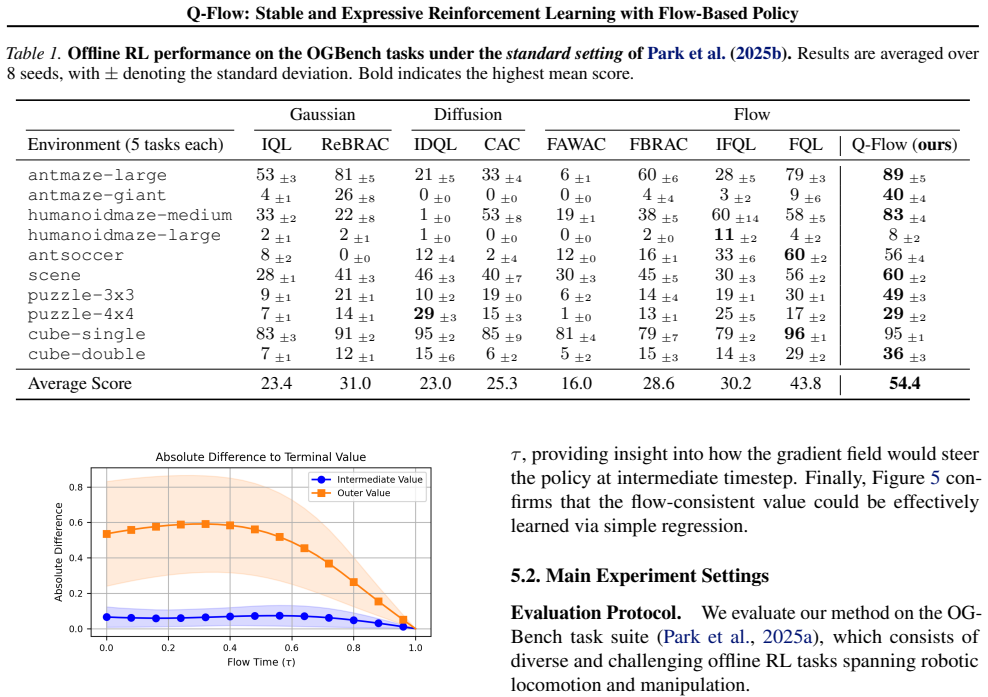
- Consistent outperformance on challenging offline RL benchmarks by 10.6 percentage points on average.
Where Pith is reading between the lines
- This value propagation idea could extend to other generative policy models that have deterministic dynamics.
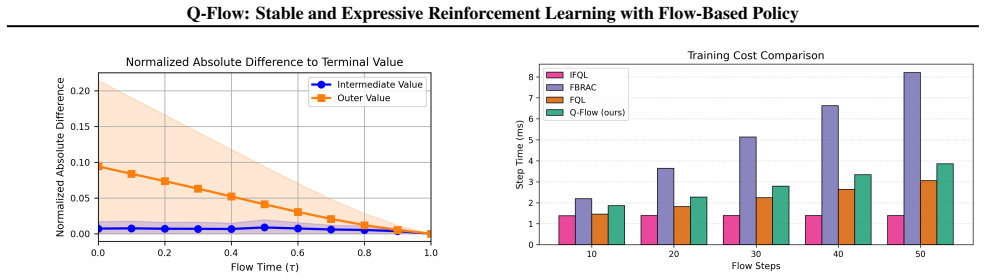
- It may reduce computational cost in training by avoiding solver unrolling.
- Could improve sample efficiency in online RL settings.
Load-bearing premise
The deterministic nature of the flow dynamics permits explicit and stable propagation of terminal values to intermediate states without requiring solver unrolling or introducing new instabilities.
What would settle it
Training curves or performance metrics where Q-Flow exhibits instability comparable to or worse than methods that unroll the solver on the OGBench tasks.
Figures






read the original abstract
There is growing interest in utilizing flow-based models as decision-making policies in reinforcement learning due to their high expressive capacity. However, effectively leveraging this expressivity for value maximization remains challenging, as naive gradient-based optimization requires backpropagating through numerical solvers and often leads to instability. Existing approaches typically address this issue by restricting the expressive capacity of flow-based policies, resulting in a trade-off between optimization stability and representational flexibility. To resolve this, we introduce Q-Flow, a framework that leverages the deterministic nature of flow dynamics to explicitly propagate terminal trajectory value to intermediate latent states along the policy-induced flow. This formulation enables stable policy optimization using intermediate value gradients without unrolling the numerical solver, effectively bridging the gap between stability and expressivity. We evaluate Q-Flow in the offline learning setting on the challenging OGBench suite, where it consistently outperforms state-of-the-art baselines by an average of 10.6 percentage points, while also enabling stable online adaptation within the same framework.
Editorial analysis
A structured set of objections, weighed in public.
Referee Report
Summary. The paper introduces Q-Flow, a framework for reinforcement learning with flow-based policies. It claims that the deterministic nature of flow dynamics permits explicit propagation of terminal trajectory value to intermediate latent states along the policy-induced flow. This enables stable policy optimization via intermediate value gradients without unrolling the numerical solver, resolving the stability-expressivity trade-off. Empirical evaluation in the offline setting on OGBench shows consistent outperformance of state-of-the-art baselines by an average of 10.6 percentage points, with the same framework supporting stable online adaptation.
Significance. If the propagation mechanism and empirical results hold, the work is significant for enabling expressive flow-based policies in RL without the instability of solver backpropagation. This addresses a core practical barrier in applying generative models to decision-making and could facilitate broader adoption in offline RL. The reported gains on OGBench and the dual offline/online capability add to its potential impact.
minor comments (2)
- [Abstract] Abstract: the reported 10.6 percentage point average improvement should specify the underlying metric (e.g., normalized return) and indicate whether results include multiple runs or error bars.
- [Abstract] Abstract: the phrase 'challenging OGBench suite' would benefit from a brief parenthetical description of the benchmark's scale or difficulty, or a citation to the original OGBench reference.
Simulated Author's Rebuttal
We thank the referee for their positive assessment of Q-Flow, the recognition of its significance in addressing the stability-expressivity trade-off for flow-based policies, and the recommendation for minor revision. We are pleased that the propagation mechanism and OGBench results are viewed as potentially impactful.
Circularity Check
No significant circularity in derivation chain
full rationale
The paper presents Q-Flow as a new framework that exploits deterministic flow dynamics to propagate terminal values explicitly to intermediate states, enabling stable gradients without solver unrolling. No equations, fitted parameters renamed as predictions, or self-citation chains are visible in the provided abstract or description that would reduce the central claim to its own inputs by construction. The performance claims are framed as empirical evaluation on OGBench rather than as the derivation itself. The method is introduced as resolving a stated trade-off via a novel formulation, with no load-bearing steps that collapse to self-definition or prior author results invoked as uniqueness theorems. This is the most common honest finding for a methods paper whose core contribution is a new algorithmic formulation rather than a closed mathematical identity.
Axiom & Free-Parameter Ledger
Reference graph
Works this paper leans on
-
[1]
Frans, K., Park, S., Abbeel, P., and Levine, S. Diffusion guidance is a controllable policy improvement operator. arXiv preprint arXiv:2505.23458,
-
[2]
D4RL: Datasets for Deep Data-Driven Reinforcement Learning
Fu, J., Kumar, A., Nachum, O., Tucker, G., and Levine, S. D4rl: Datasets for deep data-driven reinforcement learning.arXiv preprint arXiv:2004.07219,
work page internal anchor Pith review Pith/arXiv arXiv 2004
-
[3]
IDQL: Implicit Q-Learning as an Actor-Critic Method with Diffusion Policies
Hansen-Estruch, P., Kostrikov, I., Janner, M., Kuba, J. G., and Levine, S. Idql: Implicit q-learning as an actor- critic method with diffusion policies.arXiv preprint arXiv:2304.10573,
work page internal anchor Pith review Pith/arXiv arXiv
-
[4]
He, L., Shen, L., and Wang, X. Aligniql: Policy alignment in implicit q-learning through constrained optimization. arXiv preprint arXiv:2405.18187,
-
[5]
Gaussian Error Linear Units (GELUs)
Hendrycks, D. and Gimpel, K. Gaussian error linear units (gelus).arXiv preprint arXiv:1606.08415,
work page internal anchor Pith review Pith/arXiv arXiv
-
[6]
Offline Reinforcement Learning: Tutorial, Review, and Perspectives on Open Problems
Levine, S., Kumar, A., Tucker, G., and Fu, J. Offline rein- forcement learning: Tutorial, review, and perspectives on open problems.arXiv preprint arXiv:2005.01643,
work page internal anchor Pith review Pith/arXiv arXiv 2005
-
[7]
Reinforcement learning with action chunking
Li, Q., Zhou, Z., and Levine, S. Reinforcement learning with action chunking. InAdvances in Neural Information Processing Systems, volume 38, pp. 55518–55553, 2025a. Li, Y ., Shao, X., Zhang, J., Wang, H., Brunswic, L. M., Zhou, K., Dong, J., Guo, K., Li, X., Chen, Z., Wang, J., and Hao, J. Generative models in decision making: A survey.arXiv preprint arX...
-
[8]
Playing Atari with Deep Reinforcement Learning
Mnih, V ., Kavukcuoglu, K., Silver, D., Graves, A., Antonoglou, I., Wierstra, D., and Riedmiller, M. Playing atari with deep reinforcement learning.arXiv preprint arXiv:1312.5602,
work page internal anchor Pith review Pith/arXiv arXiv
-
[9]
AWAC: Accelerating Online Reinforcement Learning with Offline Datasets
Nair, A., Gupta, A., Dalal, M., and Levine, S. Awac: Accel- erating online reinforcement learning with offline datasets. arXiv preprint arXiv:2006.09359,
work page internal anchor Pith review Pith/arXiv arXiv 2006
-
[10]
Advantage-Weighted Regression: Simple and Scalable Off-Policy Reinforcement Learning
Park, S., Frans, K., Eysenbach, B., and Levine, S. Ogbench: Benchmarking offline goal-conditioned rl. InInterna- tional Conference on Learning Representations, 2025a. Park, S., Li, Q., and Levine, S. Flow q-learning. InProceed- ings of the 42nd International Conference on Machine Learning, volume 267, pp. 48104–48127, 2025b. 11 Q-Flow: Stable and Expressi...
work page internal anchor Pith review Pith/arXiv arXiv 1910
-
[11]
Behavior Regularized Offline Reinforcement Learning
Wu, Y ., Tucker, G., and Nachum, O. Behavior regu- larized offline reinforcement learning.arXiv preprint arXiv:1911.11361,
work page internal anchor Pith review Pith/arXiv arXiv 1911
-
[12]
Related Work Offline RL.In offline RL, the primary objective is to maximize the expected return while staying close to the state-action distribution defined by the offline dataset
12 Q-Flow: Stable and Expressive Reinforcement Learning with Flow-Based Policy A. Related Work Offline RL.In offline RL, the primary objective is to maximize the expected return while staying close to the state-action distribution defined by the offline dataset. This is achieved by training the critic to minimize the Bellman error, and Q- learning is perh...
2019
-
[13]
More approaches include sequence modeling (Chen et al., 2021; Janner et al.,
or via pessimistic value learning (Kumar et al., 2020). More approaches include sequence modeling (Chen et al., 2021; Janner et al.,
2020
-
[14]
and model-based methods (Janner et al., 2019; Kidambi et al., 2020). Diffusion and Flow-based RL.The application of expressive generative models, such as diffusion and flow models, to RL can be categorized by policy optimization strategies:weighted regression(Peters & Schaal, 2007; Peng et al., 2019; Nair et al., 2020),rejection sampling(Chen et al., 2023...
2019
-
[15]
Rejection sampling-based methods often decouple the value learning and policy extraction
and QIPO (Zhang et al., 2025). Rejection sampling-based methods often decouple the value learning and policy extraction. When the dataset is provided as in offline RL, they perform in-sample value maximization, such as Implicit Q-learning (IQL; Kostrikov et al. 2021), and use the learned value function to determine the action to be executed: aπ = argmax a...
2025
-
[16]
and IDQL (Hansen-Estruch et al., 2023). While the above two paradigms enjoy the simplicity of application to expressive generative models, they are limited by their reliance on scalar value signals from the critic (Park et al., 2024; Frans et al., 2025). Reparameterized gradient-based methods directly maximize the value of the action generated by the mode...
2023
-
[17]
let the gradient flow through a diffusion process. Since the gradient backpropagation leads to noisy and unstable policy optimization, FQL(Park et al., 2025b) distills the behavioral information of the full flow-based policy to a one-step policy and performs value maximization w.r.t. the one-step policy. While FQL utilizes the reparameterized gradient inf...
2023
-
[18]
However, the fundamental distinction lies in the generative policy class, which dictates optimization complexity and intermediate value construction
explicitly learns the intermediate value via contrastive energy prediction and is the most similar approach to Q-Flow. However, the fundamental distinction lies in the generative policy class, which dictates optimization complexity and intermediate value construction. Specifically, CEP is built on diffusion policy, i.e., an 13 Q-Flow: Stable and Expressiv...
2025
-
[19]
In contrast, the sparse reward definition used in *-sparse tasks does not award the subtask completion reward and provides the full reward only upon the full completion
In contrast, manipulation tasks typically involve multiple sequential subtasks (e.g., opening a drawer or toggling a button), resulting in rewards bounded between -Ntask and 0, where Ntask denotes the number of subtasks (up to 16 in the environments tested in this work). In contrast, the sparse reward definition used in *-sparse tasks does not award the s...
2021
-
[20]
It uses a Gaussian policy and serves as the competitive baseline that has been considered state-of-the-art before the adoption of expressive generative models as policies
is a robust actor-critic baseline that improves upon behavior regularization techniques, such as TD3+BC (Fujimoto & Gu, 2021), through architectural and hyperparameter optimization. It uses a Gaussian policy and serves as the competitive baseline that has been considered state-of-the-art before the adoption of expressive generative models as policies. We ...
2021
-
[21]
Both approaches fall into the class of guidance-based methods, where policy improvement relies on evaluating the outer critic at intermediate latent actions
is a diffusion-based RL method that aligns the generative model updates with the action-gradient of the critic. Both approaches fall into the class of guidance-based methods, where policy improvement relies on evaluating the outer critic at intermediate latent actions. While these guidance-based methods avoid costly BPTT by directly matching the model pre...
2023
-
[22]
For the policy network, we use Fourier embedding for the flow time embedding
For policy, we use the Euler method of 10 steps across all tasks. For the policy network, we use Fourier embedding for the flow time embedding. We take the mean of Q ensembles as the default aggregation strategy, or take the minimum for some tasks in thestandard settingas FQL. The aggregation is consistent in the algorithm, i.e., we use the same aggregati...
2026
-
[23]
(∗) denotes the default task per environment
18 Q-Flow: Stable and Expressive Reinforcement Learning with Flow-Based Policy Table 3.Full offline RL results in OGBench understandard setting.Q-Flow performs comparably or superior to the baselines on most tasks. (∗) denotes the default task per environment. We also include the results of other flow-based RL methods, borrowed from Park et al. (2025b), f...
2026
-
[24]
Here, the results are averaged over 12 seeds following the evaluation protocol considered by Li & Levine (2026). D.2. Additional Ablation Studies We conduct additional ablation studies in the default task of selected OGBench environments understandard setting. The results are averaged over 8 seeds. Flow Steps.Figure 16a compares performance across differe...
2026
-
[25]
For D4RL antmaze evaluation, we borrow the numbers from Lu et al
for extensive empirical validation of its effectiveness in diverse benchmarks. For D4RL antmaze evaluation, we borrow the numbers from Lu et al. (2023) and Zhang et al. (2025). As in the OGBench experiment, of offline RL experiments, we take 1M offline training steps with a batch size of 256 and report the evaluation result at the last step. For offline-t...
2023
-
[26]
Q-Flow achieves the best overall performance, outperforming prior flow-based methods and remaining competitive with strong diffusion-based baselines
and QIPO (Zhang et al., 2025), as well as flow-based approaches such as FQL. Q-Flow achieves the best overall performance, outperforming prior flow-based methods and remaining competitive with strong diffusion-based baselines. In particular, Q-Flow matches or exceeds the performance of QGPO and QIPO on several tasks, while demonstrating clear improvements...
2025
discussion (0)
Sign in with ORCID, Apple, or X to comment. Anyone can read and Pith papers without signing in.