Federated Language Models Under Bandwidth Budgets: Distillation Rates and Conformal Coverage
Pith reviewed 2026-06-30 22:50 UTC · model grok-4.3
The pith
Federated language models achieve explicit high-probability KL-consistency and marginal-coverage bounds that treat bandwidth as a statistical parameter.
A machine-rendered reading of the paper's core claim, the machinery that carries it, and where it could break.
Core claim
Federated Probe-Logit Distillation admits an explicit high-probability KL-consistency rate whose dependence on bandwidth appears only through an exponentially vanishing quantization term, while Federated Conformal RAG admits a distribution-free marginal-coverage bound whose novel slack term treats per-node retrieval bandwidth as a first-class statistical parameter that improves as K to the minus one-half when per-node budgets are uniform; a Pinsker-type corollary composes the two into an end-to-end coverage guarantee.
What carries the argument
The retrieval-bandwidth slack term that aggregates per-node bandwidth contributions into the coverage bound, together with the quantization term that enters the distillation rate.
If this is right
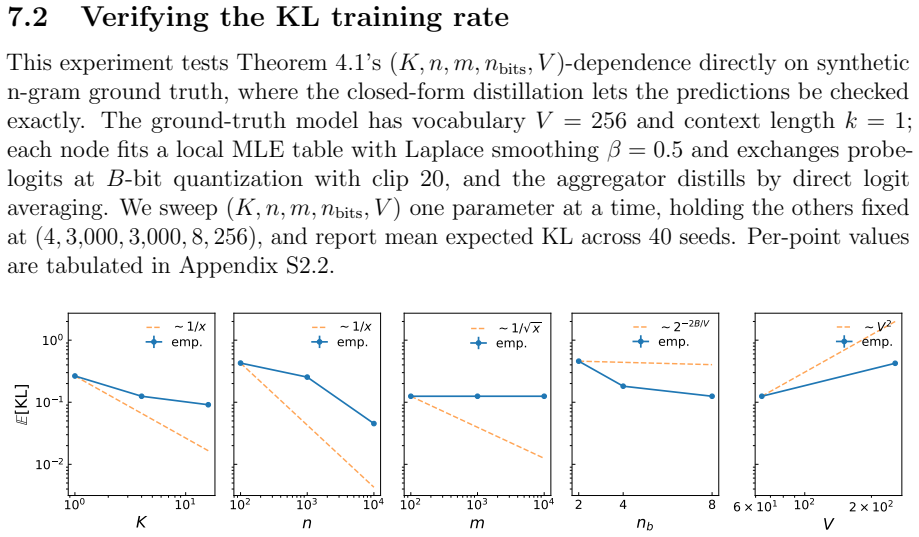
- KL consistency for the distilled model scales explicitly with node count K, per-node sample size n, probe-set size m, vocabulary size V, and the quantization budget B.
- Marginal coverage for the conformal predictor improves with the square root of the number of nodes when retrieval bandwidth is allocated uniformly across nodes.
- The retrieval slack aggregates arithmetic contributions from each node's bandwidth allocation rather than requiring a single global budget.
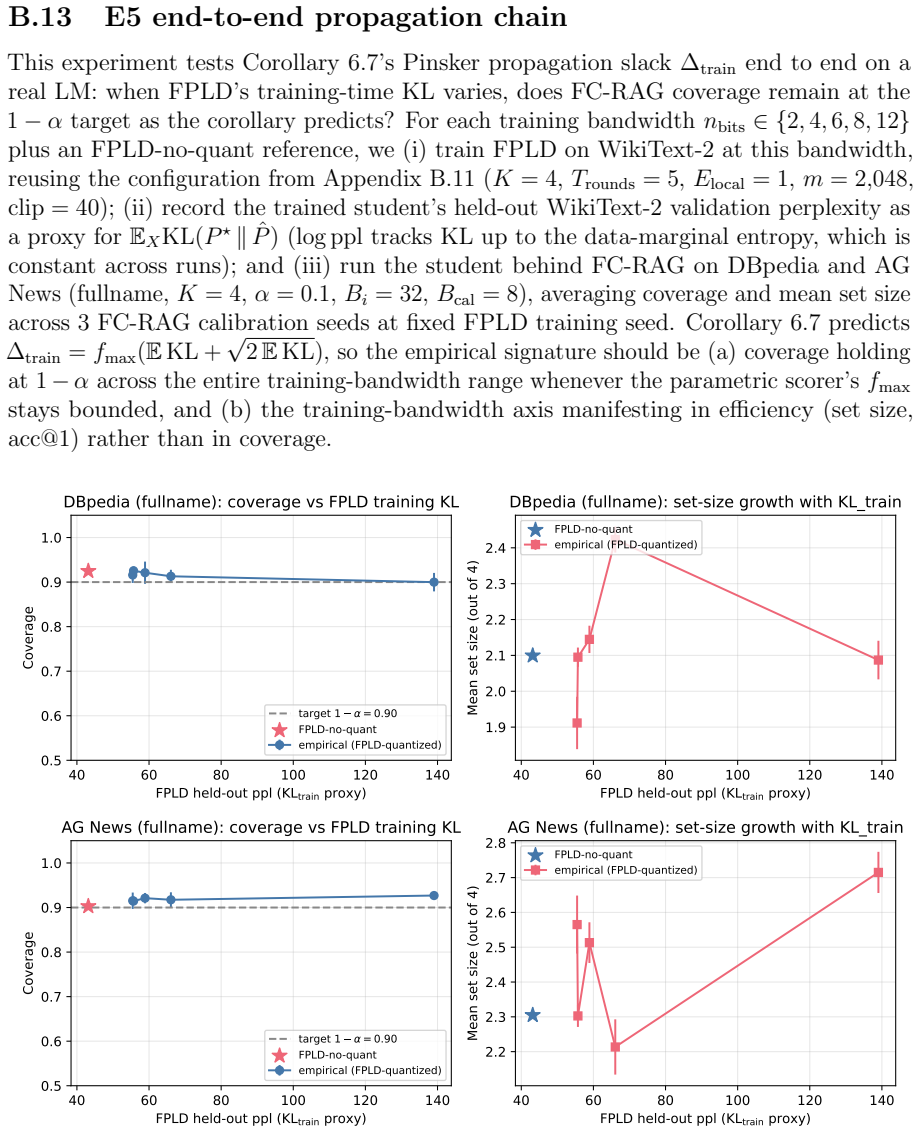
- An end-to-end coverage guarantee follows directly from composing the training consistency bound with the inference coverage bound via Pinsker's inequality.
Where Pith is reading between the lines
- Bandwidth allocation across nodes can be chosen to meet a target consistency or coverage level without moving raw data to a central server.
- The same slack-construction technique may apply to other federated inference tasks where retrieval or communication budgets differ across nodes.
- If the exponentially vanishing quantization term dominates only at extremely low bandwidth, practical systems could improve rates more efficiently by increasing probe-set size than by increasing raw bit budget.
- The framework supplies a quantitative language for trading communication cost against statistical error in any distributed prediction setting that admits a Pinsker-type link between divergence and coverage.
Load-bearing premise
The proposed protocols can be realized so that the regularity conditions needed for the high-probability bounds and the Pinsker composition hold simultaneously for the data-generating process.
What would settle it
A controlled experiment that fixes K, n, m, V and varies only the per-node bandwidth B while measuring whether the observed KL divergence or the coverage failure rate deviates from the scaling predicted by the quantization term and the retrieval slack.
Figures




read the original abstract
Training a language model on data scattered across bandwidth-limited nodes that cannot be centralized is a setting that arises in clinical networks, enterprise knowledge bases, and scientific consortia. We study the regime in which data must remain distributed across nodes, and ask what statistical guarantees are in principle achievable under explicit bandwidth budgets; we aim to characterize what is provably possible, not to demonstrate a deployment-ready system. Existing theory treats either training-time consistency or inference-time calibration in isolation, and no prior work makes bandwidth a first-class statistical parameter. We analyze two protocols, Federated Probe-Logit Distillation (FPLD) for training and Federated Conformal RAG (FC-RAG) for inference, as the analytical vehicles for our results. Our first main result is an explicit high-probability KL-consistency rate for FPLD with simultaneous dependence on node count $K$, per-node sample size $n$, quantization budget $B$, probe-set size $m$, and vocabulary size $V$; bandwidth enters only through an exponentially vanishing quantization term. Our second main result is a distribution-free marginal-coverage bound for FC-RAG, whose novel retrieval-bandwidth slack $\Delta_{\mathrm{RAG}} = f_{\max}\sqrt{K^{-2}\sum_i v(B_i)}$ makes per-node retrieval bandwidth a first-class statistical parameter, with arithmetic aggregation across $K$ nodes shrinking the slack as $K^{-1/2}$ in the per-node-uniform regime. A Pinsker-type corollary composes the two bounds into an end-to-end coverage guarantee. Synthetic experiments verify the predicted scaling along the bounds' parameters; small-scale experiments on a GPT-2 testbed illustrate that the qualitative bandwidth-accuracy tradeoff survives on a real language model. A deployment-scale empirical evaluation is out of scope.
Editorial analysis
A structured set of objections, weighed in public.
Referee Report
Summary. The manuscript introduces Federated Probe-Logit Distillation (FPLD) for training and Federated Conformal RAG (FC-RAG) for inference in bandwidth-constrained federated language model settings. It derives an explicit high-probability KL-consistency rate for FPLD that depends simultaneously on node count K, per-node sample size n, quantization budget B, probe-set size m, and vocabulary size V (with bandwidth entering only via an exponentially vanishing quantization term), a distribution-free marginal-coverage bound for FC-RAG featuring the novel retrieval-bandwidth slack Δ_RAG = f_max √(K^{-2} ∑_i v(B_i)), and a Pinsker-type corollary that composes the two into an end-to-end coverage guarantee. Synthetic experiments are said to verify the predicted scaling, while small-scale GPT-2 experiments illustrate the qualitative bandwidth-accuracy tradeoff.
Significance. If the derivations and realizability conditions hold, the work supplies the first explicit incorporation of bandwidth budgets as first-class statistical parameters in federated LM analysis, with concrete rates, novel slack aggregation that improves as K^{-1/2}, and a composition result. The explicit multi-parameter dependence and the verification of scaling on synthetics are strengths.
major comments (2)
- [Abstract] Abstract: The high-probability KL-consistency rate for FPLD is asserted to hold with the stated simultaneous dependence on K, n, B, m, V and an exponentially vanishing quantization term, but the manuscript does not establish that the quantization operator interacts with the tail behavior of per-node empirical logit measures arising in language models in a manner that automatically produces this vanishing; the regularity conditions required for the bound are not shown to be satisfied by typical LM distributions.
- [Abstract] Abstract: The distribution-free marginal-coverage bound for FC-RAG and the subsequent Pinsker-type corollary are stated to apply under the proposed protocols, yet the analysis assumes without demonstration that FPLD and FC-RAG can be realized so that the data-generating process satisfies the joint regularity conditions needed for the high-probability KL statement, the coverage statement, and their composition to hold simultaneously; this realizability for actual language-model logit and retrieval distributions is load-bearing for the central claims.
Simulated Author's Rebuttal
We thank the referee for the careful reading and for identifying the load-bearing assumptions in the abstract. We address each major comment below. Our responses focus on clarifying the conditional nature of the results without overstating realizability for language-model distributions.
read point-by-point responses
-
Referee: [Abstract] Abstract: The high-probability KL-consistency rate for FPLD is asserted to hold with the stated simultaneous dependence on K, n, B, m, V and an exponentially vanishing quantization term, but the manuscript does not establish that the quantization operator interacts with the tail behavior of per-node empirical logit measures arising in language models in a manner that automatically produces this vanishing; the regularity conditions required for the bound are not shown to be satisfied by typical LM distributions.
Authors: We agree that the derivation assumes regularity conditions on the tail behavior of the (quantized) per-node empirical logit measures and does not prove that these conditions are automatically satisfied by typical language-model distributions. The explicit rate is obtained under those conditions, with bandwidth entering only through the quantization term once the conditions are met. We will revise the abstract to state the required regularity conditions explicitly and to note that their verification for concrete LM logit distributions lies outside the scope of the present theoretical analysis. revision: partial
-
Referee: [Abstract] Abstract: The distribution-free marginal-coverage bound for FC-RAG and the subsequent Pinsker-type corollary are stated to apply under the proposed protocols, yet the analysis assumes without demonstration that FPLD and FC-RAG can be realized so that the data-generating process satisfies the joint regularity conditions needed for the high-probability KL statement, the coverage statement, and their composition to hold simultaneously; this realizability for actual language-model logit and retrieval distributions is load-bearing for the central claims.
Authors: The protocols are constructed so that the stated bounds hold whenever the joint regularity conditions are satisfied by the data-generating process. The manuscript does not claim that these conditions are automatically met by arbitrary LM logit or retrieval distributions, nor does it provide a demonstration of realizability at deployment scale. We will revise the abstract to emphasize that the end-to-end guarantee is conditional on the regularity assumptions and that empirical verification of those assumptions for large-scale LMs is left for future work. revision: partial
Circularity Check
No circularity: bounds derived from standard inequalities with bandwidth as explicit parameter
full rationale
The paper presents explicit high-probability KL-consistency rates for FPLD and distribution-free marginal coverage bounds for FC-RAG, with bandwidth entering via quantization and retrieval slack terms. These are derived using concentration inequalities and conformal prediction under stated regularity conditions, without any reduction of outputs to fitted inputs by construction, self-definitional loops, or load-bearing self-citations. Experiments verify predicted scaling on synthetic and GPT-2 data, confirming the derivation chain is self-contained and independent of the target results. The realizability assumption is external to the mathematical steps and does not create circularity.
Axiom & Free-Parameter Ledger
Reference graph
Works this paper leans on
-
[1]
Yaniv Romano, Evan Patterson, and Emmanuel Candes
URL https://proceedings.neurips.cc/paper_files/paper/2020/file/ 18df51b97ccd68128e994804f3eccc87-Paper.pdf. Yaniv Romano, Evan Patterson, and Emmanuel Candes. Conformalized quantile regression. In H. Wallach, H. Larochelle, A. Beygelzimer, F. d'Alch´ e-Buc, E. Fox, and R. Garnett, editors,Advances in Neural Information Processing Systems, volume 32. Curra...
-
[2]
Federated Large Language Models: Current Progress and Future Directions
URLhttps://arxiv.org/abs/2409.15723. Yuchen Zhang, John C. Duchi, and Martin J. Wainwright. Communication-efficient algorithms for statistical optimization.J. Mach. Learn. Res., 14(104):3321–3363, November 2013. ISSN 1532-4435. 21 Supplementary Material This supplement contains proofs of all theoretical results stated in the main paper – the training-time...
work page internal anchor Pith review Pith/arXiv arXiv 2013
-
[3]
ideal-teacher piece + quantization piece + distillation piece
Since pv ∈ [0, 1] for all v, we have p2 v ≤p v, hence ∥p∥2 2 =P v p2 v ≤P v pv = 1. Equality in ∥p∥2 2 ≤ 1 holds iff pv ∈ {0, 1} for every v, i.e. p is one-hot. The trace identity therefore satisfies 0≤tr(H soft(p))≤1, with the upper bound attained at one-hotp.□ 22 S1.2 Proof of Theorem 4.1 The proof decomposes the target KL using the aggregated teacher ¯...
2000
-
[4]
All four indices are distinct:E[ ¯ξa ¯ξb ¯ξc ¯ξd] =Q j∈{a,b,c,d} E[¯ξj] = 0 by mean-zero
-
[5]
a = b with c and d both distinct from a: E[¯ξ2 a ¯ξc ¯ξd] = E[¯ξ2 a]E[ ¯ξc]E[ ¯ξd] = 0 by mean-zero on ¯ξc and ¯ξd
Exactly one repeated pair, e.g. a = b with c and d both distinct from a: E[¯ξ2 a ¯ξc ¯ξd] = E[¯ξ2 a]E[ ¯ξc]E[ ¯ξd] = 0 by mean-zero on ¯ξc and ¯ξd
-
[6]
Two disjoint pairs, e.g.a=b, c=d, a̸=c:E[ ¯ξ2 a ¯ξ2 c ] =E[ ¯ξ2 a]E[ ¯ξ2 c ]≤σ 2 ·σ 2 =σ 4. 26
-
[7]
Lipschitz CDF
All four indices coincide, a = b = c = d: E[¯ξ4 a] is the fourth raw moment of the K-fold average. For independent zero-mean summands with per-summand variance σ2 i,1 ≤C q 2−2B/V , a direct expansion using P i̸=j as ordered pairs (K(K− 1) terms) and the 4 2 /2 = 3 orderless groupings of four factors into two pairs yields E PK i=1 ξi,v 4 =P i E[ξ4 i,v]+3P ...
2002
discussion (0)
Sign in with ORCID, Apple, or X to comment. Anyone can read and Pith papers without signing in.