Cornerstones or Stumbling Blocks? Deciphering the Rock Tokens in On-Policy Distillation
Pith reviewed 2026-07-02 23:32 UTC · model grok-4.3
The pith
Rock Tokens persist with high loss after on-policy distillation saturates yet add negligible value to reasoning.
A machine-rendered reading of the paper's core claim, the machinery that carries it, and where it could break.
Core claim
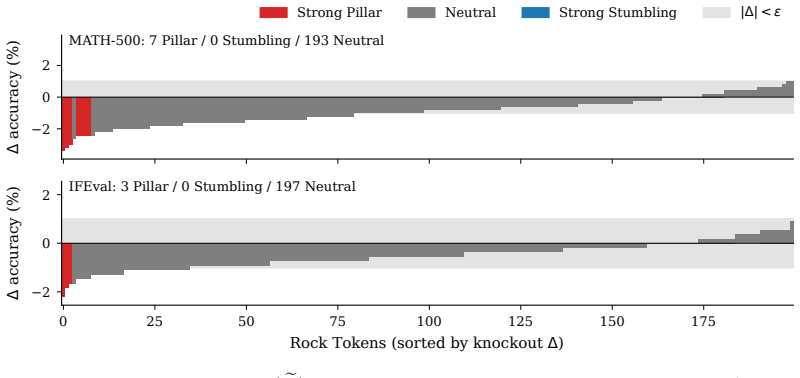
Even after OPD training reaches apparent saturation, a substantial subset of tokens continues to exhibit persistently high loss; these tokens, which we term Rock Tokens, can account for up to 18% of the tokens in generated outputs. Rock Tokens provide a disproportionately large share of total gradient norms yet remain stagnant throughout training, resisting teacher-driven corrections. Through causal intervention, these tokens provide negligible functional contribution to the model's actual reasoning performance.
What carries the argument
Rock Tokens: the subset of tokens that maintain persistently high per-token loss under the KL objective in on-policy distillation, resist correction, and show negligible causal impact on reasoning.
If this is right
- A large share of gradient updates is directed at structural and discourse residuals the student model cannot or need not internalize.
- Strategically bypassing Rock Tokens can streamline the alignment process.
- Uniform token weighting is not required for effective distillation.
- Large-scale model distillation can adopt a more efficient paradigm by de-emphasizing non-functional tokens.
Where Pith is reading between the lines
- The same high-loss non-functional tokens may appear in reinforcement learning with verifiable rewards and other alignment methods.
- Training objectives could be redesigned to down-weight or ignore Rock Tokens from the start.
- Inference-time filtering of Rock Tokens might reduce output length without harming task performance.
Load-bearing premise
Causal interventions that measure the functional contribution of Rock Tokens do so without altering other tokens or overall model dynamics.
What would settle it
Selectively masking or replacing only Rock Tokens during generation and observing a measurable drop in reasoning accuracy on held-out tasks would falsify the negligible-contribution claim.
Figures




read the original abstract
While recent work in Reinforcement Learning with Verifiable Rewards (RLVR) has shown that a small subset of critical tokens disproportionately drives reasoning gains, an analogous token-level understanding of On-Policy Distillation (OPD) remains largely unexplored. In this work, we investigate high-loss tokens, a token type that--as the most direct signal of student-teacher mismatch under OPD's per-token KL objective--should progressively diminish as training converges according to existing studies; however, our empirical analysis shows otherwise. Even after OPD training reaches apparent saturation, a substantial subset of tokens continues to exhibit persistently high loss; these tokens, which we term Rock Tokens, can account for up to 18\% of the tokens in generated outputs. Our investigation reveals two startling paradoxes. First, despite their high occurrence frequency providing a disproportionately large share of total gradient norms, Rock Tokens themselves remain stagnant throughout training, resisting teacher-driven corrections. Second, through causal intervention, we find that these tokens provide negligible functional contribution to the model's actual reasoning performance. These findings suggest that a vast amount of optimization bandwidth is spent on structural and discourse residuals that the student model cannot or need not internalize. By deconstructing these dynamics, we demonstrate that strategically bypassing these ``stumbling blocks'' can significantly streamline the alignment process, challenging the necessity of uniform token weighting and offering a more efficient paradigm for large-scale model distillation.
Editorial analysis
A structured set of objections, weighed in public.
Referee Report
Summary. The paper examines token-level dynamics in On-Policy Distillation (OPD), identifying a persistent subset of high-loss tokens termed 'Rock Tokens' that continue to exhibit elevated loss after apparent training saturation. These tokens are reported to comprise up to 18% of generated outputs, account for a disproportionate share of gradient norms, yet causal interventions indicate they contribute negligibly to downstream reasoning performance. The authors conclude that standard OPD wastes optimization effort on these structural residuals and that selectively bypassing them can improve distillation efficiency.
Significance. If the empirical observations and intervention results hold under rigorous controls, the work identifies a concrete inefficiency in current OPD practice and supplies a practical lever for reducing unnecessary gradient computation. The strength lies in the combination of observational statistics with targeted interventions; however, the absence of reported dataset sizes, run counts, or explicit checks for intervention side-effects limits the immediate actionability of the efficiency claim.
major comments (3)
- [§4.2] §4.2 (Causal Intervention Protocol): the description of the masking/forced-logit interventions does not report any quantitative verification that non-rock token losses, next-token probabilities, or overall sequence-level KL divergence remain unchanged after the intervention; without such checks the claim of 'negligible functional contribution' rests on an untested isolation assumption.
- [§5.1, Table 3] §5.1 and Table 3: the reported 18% occurrence figure and gradient-norm share are presented without accompanying standard errors, number of evaluation runs, or dataset cardinality; this makes it impossible to assess whether the 'up to 18%' figure is stable or sensitive to post-hoc token selection criteria.
- [§4.3] §4.3 (Reasoning Performance Metrics): the performance comparison after rock-token intervention lacks an explicit control condition in which an equal number of randomly chosen tokens (matched for position or frequency) are altered; without this baseline it is unclear whether the observed lack of degradation is specific to rock tokens or an artifact of any token-level perturbation.
minor comments (2)
- [Abstract / §3] The abstract states that rock tokens 'resist teacher-driven corrections' but provides no explicit definition or equation for the per-token loss threshold used to classify them; a short formal definition in §3 would improve reproducibility.
- [Figure 2] Figure 2 caption refers to 'gradient norm share' without clarifying whether the plotted quantity is normalized per sequence or globally; adding this detail would prevent misinterpretation.
Simulated Author's Rebuttal
We thank the referee for the constructive feedback. We address each major comment point-by-point below and indicate planned revisions to improve clarity and rigor.
read point-by-point responses
-
Referee: [§4.2] §4.2 (Causal Intervention Protocol): the description of the masking/forced-logit interventions does not report any quantitative verification that non-rock token losses, next-token probabilities, or overall sequence-level KL divergence remain unchanged after the intervention; without such checks the claim of 'negligible functional contribution' rests on an untested isolation assumption.
Authors: We acknowledge that the original manuscript did not include explicit post-intervention statistics confirming invariance for non-rock tokens. The protocol targeted only rock-token positions, but we agree that quantitative verification is needed to substantiate the isolation claim. In the revised version we will add measurements of non-rock token losses, next-token probabilities, and sequence-level KL divergence before and after intervention. revision: yes
-
Referee: [§5.1, Table 3] §5.1 and Table 3: the reported 18% occurrence figure and gradient-norm share are presented without accompanying standard errors, number of evaluation runs, or dataset cardinality; this makes it impossible to assess whether the 'up to 18%' figure is stable or sensitive to post-hoc token selection criteria.
Authors: The 18% figure is the maximum observed value across our primary evaluation sets. We agree that reporting dataset cardinality, number of runs, and standard errors would allow better assessment of stability. The revision will specify the evaluation dataset sizes, run counts, and include error bars or ranges for the occurrence and gradient-norm statistics in §5.1 and Table 3. revision: yes
-
Referee: [§4.3] §4.3 (Reasoning Performance Metrics): the performance comparison after rock-token intervention lacks an explicit control condition in which an equal number of randomly chosen tokens (matched for position or frequency) are altered; without this baseline it is unclear whether the observed lack of degradation is specific to rock tokens or an artifact of any token-level perturbation.
Authors: We agree that a matched random-token control is necessary to establish specificity. The revised manuscript will include an additional control experiment in which an equal number of randomly selected tokens (matched for position or frequency) receive the same intervention, allowing direct comparison of performance impact. revision: yes
Circularity Check
No circularity: purely empirical categorization and intervention study
full rationale
The manuscript contains no derivation chain, equations, fitted parameters renamed as predictions, or load-bearing self-citations. Rock Tokens are introduced as an empirical label for persistently high-loss tokens observed after OPD saturation; their frequency (up to 18%), gradient-norm share, and negligible functional contribution are measured directly via data inspection and causal interventions. These steps are externally falsifiable and do not reduce to the paper's own inputs by construction. The work is therefore self-contained against external benchmarks.
Axiom & Free-Parameter Ledger
axioms (1)
- domain assumption High-loss tokens should progressively diminish as OPD training converges, per existing studies
invented entities (1)
-
Rock Tokens
no independent evidence
Forward citations
Cited by 6 Pith papers
-
When Safe Skills Collide: Measuring Compositional Risk in Agent Skill Ecosystems
About 18.2% of structurally flagged skill pairs represent genuine compositional safety risks in agent skill registries, with exploitation gated by host model behavior.
-
Bridging Reasoning Trajectories in On-Policy Distillation via Near-Future Guidance
TOPD augments on-policy distillation by using near-future trajectory signals to suppress non-divergent high-loss tokens and distribute guidance, raising average accuracy from 47.8% to 52.2% on reasoning benchmarks.
-
Bridging Reasoning Trajectories in On-Policy Distillation via Near-Future Guidance
TOPD improves on-policy distillation for LLM reasoning by using near-future guidance to identify divergent states, raising average accuracy from 47.8% to 52.2% on math benchmarks including AIME24 and AIME25.
-
A Formula-Driven Survey and Research Agenda for On-Policy Distillation
A survey creates a taxonomy for on-policy distillation in LLMs that separates temporal credit assignment from vocabulary-level probability routing.
-
RankVR: Low-Rank Structure Perception and Value Recalibration for Robust Composed Image Retrieval
RankVR introduces GSCP and ASVC modules to improve CIR robustness by decoupling clean samples via low-rank structure and dynamically scoring triplet value in noisy datasets.
-
IMAGINE: Adaptive Schema-Imagery Enhanced Composition for Composed Video Retrieval
IMAGINE uses adaptive schema-imagery via dynamic multimodal prototypes to incorporate implicit semantics into composed video retrieval, claiming SOTA results on CVR and CIR benchmarks.
Reference graph
Works this paper leans on
-
[1]
Agarwal, N
R. Agarwal, N. Vieillard, Y . Zhou, P. Stanczyk, S. R. Garea, M. Geist, and O. Bachem. On-policy distillation of language models: Learning from self-generated mistakes. InThe twelfth international conference on learning representations, 2024
2024
-
[2]
Al Nazi, S
Z. Al Nazi, S. R. Dipta, and S. Kar. † dagger: Distractor-aware graph generation for executable reasoning in math problems.arXiv e-prints, pages arXiv–2601, 2026
2026
- [3]
- [4]
-
[5]
Y . Chen, P. Qian, S. Wang, S. Zhang, H. Xu, S. Lin, and X. Wei. Does rag know when retrieval is wrong? diagnosing context compliance under knowledge conflict, 2026. URL https://arxiv.org/abs/2605. 14473
2026
-
[6]
Cheng, S
D. Cheng, S. Huang, X. Zhu, B. Dai, X. Zhao, Z. Zhang, and F. Wei. Reasoning with exploration: An entropy perspective. InProceedings of the AAAI Conference on Artificial Intelligence, 2026
2026
-
[7]
Cheng, X
K. Cheng, X. Qi, Z. Cheng, and L. Lai. V olatility persistence and model choice in cross-market volatility forecasting.Available at SSRN 6610278, 2026. 12
2026
-
[8]
K. Cheng, X. Qi, Z. Cheng, L. Lai, and X. Liu. Regime-dependent volatility dynamics: Evidence from time-series analysis. InProceedings of the 2026 3rd International Conference on Applied Economics, Management Science and Social Development (AEMSS 2026), pages 179–189. Atlantis Press, 2026. ISBN 978-94-6239-672-2. doi: 10.2991/978-94-6239-672-2_18. URL htt...
-
[9]
Z. Cheng, L. Lai, and Y . Liu. Resolving the robustness-precision trade-off in financial rag through hybrid document-routed retrieval, 2026. URLhttps://arxiv.org/abs/2603.26815
work page internal anchor Pith review Pith/arXiv arXiv 2026
-
[10]
Cheng, L
Z. Cheng, L. Lai, Y . Liu, K. Cheng, and X. Qi. Enhancing financial report question-answering: A retrieval- augmented generation system with reranking analysis, 2026. URL https://arxiv.org/abs/2603. 16877
2026
-
[11]
Cheng, L
Z. Cheng, L. Lai, Y . Liu, and Y . Sun. Toward sustainable on-device intelligence: A survey on energy- efficient rag systems with small language models.Available at SSRN 6698538, 2026
2026
-
[12]
Y . Dai, M. Chen, and Z. Zuo. Neighbors in space: Satellite imagery and chinese b-share discount.China Economic Review, 82:102063, 2023
2023
-
[13]
Deepseek-v4: Towards highly efficient million-token context intelligence.Technical Report, 2026
DeepSeek-AI. Deepseek-v4: Towards highly efficient million-token context intelligence.Technical Report, 2026
2026
-
[14]
Dekoninck, N
J. Dekoninck, N. Jovanovi’c, T. Gehrunger, K. Rognvalddson, I. Petrov, C. Sun, and M. T. Vechev. Beyond benchmarks: Matharena as an evaluation platform for mathematics with llms. 2026
2026
- [15]
-
[16]
S. R. Dipta, K. Mahbub, and N. Najjar. Ganitllm: Difficulty-aware bengali mathematical reasoning through curriculum-grpo.arXiv preprint arXiv:2601.06767, 2026
work page internal anchor Pith review Pith/arXiv arXiv 2026
-
[17]
Y . Fu, H. Huang, K. Jiang, Y . Zhu, and D. Zhao. Revisiting on-policy distillation: Empirical failure modes and simple fixes.ArXiv preprint, 2026
2026
-
[18]
Z. Fu, Y . Hu, Q. Yang, S. Zhang, Z. Chen, and Z. Li. Air-know: Arbiter-calibrated knowledge-internalizing robust network for composed image retrieval, 2026. URLhttps://arxiv.org/abs/2604.19386
work page internal anchor Pith review Pith/arXiv arXiv 2026
-
[19]
L. Gao, J. Tow, B. Abbasi, S. Biderman, S. Black, A. DiPofi, C. Foster, L. Golding, J. Hsu, A. Le Noac’h, H. Li, K. McDonell, N. Muennighoff, C. Ociepa, J. Phang, L. Reynolds, H. Schoelkopf, A. Skowron, L. Sutawika, E. Tang, A. Thite, B. Wang, K. Wang, and A. Zou. The language model evaluation harness, 2024
2024
-
[20]
Y . Gao, Y . Lu, Z. Zhang, J. Nie, S. Yu, and Q. Xuan. Dspc: Dual-stage progressive compression framework for efficient long-context reasoning. InICASSP 2026 - 2026 IEEE International Conference on Acoustics, Speech and Signal Processing (ICASSP), pages 19387–19391, 2026. doi: 10.1109/ICASSP55912.2026. 11460600
-
[21]
E. Guha, R. Marten, S. S. Keh, N. Raoof, G. Smyrnis, H. Bansal, M. Nezhurina, J.-P. Mercat, T. Vu, Z. Sprague, A. Suvarna, B. Feuer, L. Chen, Z. Khan, E. Frankel, S. Grover, C. Choi, N. Muennighoff, S. Su, W. Zhao, J. Yang, S. Pimpalgaonkar, K. Sharma, C. C.-J. Ji, Y . Deng, S. Pratt, V . Ramanujan, J. Saad-Falcon, J. Li, A. Dave, A. Albalak, K. Arora, B....
work page internal anchor Pith review Pith/arXiv arXiv doi:10.48550/arxiv.2506.04178 2025
-
[22]
D. Guo, D. Yang, H. Zhang, J. Song, P. Wang, Q. Zhu, R. Xu, R. Zhang, S. Ma, X. Bi, et al. Deepseek-r1: Incentivizing reasoning capability in llms via reinforcement learning.arXiv preprint arXiv:2501.12948, 2025
work page internal anchor Pith review Pith/arXiv arXiv 2025
- [23]
-
[24]
How do llms use their depth?arXiv preprint arXiv:2510.18871,
A. Gupta, J. Yeung, G. Anumanchipalli, and A. A. Ivanova. How do llms use their depth?arXiv.org, 2025. doi: 10.48550/arxiv.2510.18871
-
[25]
Hübotter, F
J. Hübotter, F. Lübeck, L. Behric, A. Baumann, M. Bagatella, D. Marta, I. Hakimi, I. Shenfeld, T. K. Buening, C. Guestrin, et al. Reinforcement learning via self-distillation.ArXiv preprint, 2026. 13
2026
-
[26]
MAGMA: A Multi-Graph based Agentic Memory Architecture for AI Agents
D. Jiang, Y . Li, G. Li, and B. Li. Magma: A multi-graph based agentic memory architecture for ai agents. arXiv preprint arXiv:2601.03236, 2026
work page internal anchor Pith review Pith/arXiv arXiv 2026
-
[27]
Anatomy of Agentic Memory: Taxonomy and Empirical Analysis of Evaluation and System Limitations
D. Jiang, Y . Li, S. Wei, J. Yang, A. Kishore, A. Zhao, D. Kang, X. Hu, F. Chen, Q. Li, et al. Anatomy of agentic memory: Taxonomy and empirical analysis of evaluation and system limitations.arXiv preprint arXiv:2602.19320, 2026
work page internal anchor Pith review Pith/arXiv arXiv 2026
-
[29]
SCRIBE: Structured Mid-Level Supervision for Tool-Using Language Models
Y . Jiang and F. Ferraro. Scribe: Structured mid-level supervision for tool-using language models, 2026. URLhttps://arxiv.org/abs/2601.03555
work page internal anchor Pith review Pith/arXiv arXiv 2026
-
[30]
Y . Jiang, D. Li, and F. Ferraro. Drp: Distilled reasoning pruning with skill-aware step decomposition for efficient large reasoning models.arXiv preprint arXiv:2505.13975, 2025
work page internal anchor Pith review Pith/arXiv arXiv 2025
-
[31]
F. Kunstner, R. Yadav, A. Milligan, M. Schmidt, and A. Bietti. Heavy-tailed class imbalance and why adam outperforms gradient descent on language models, 2024. URL https://arxiv.org/abs/2402.19449
-
[32]
L. Lai, Z. Cheng, K. Cheng, and X. Qi. Do transformers always win? an empirical study of semantic embeddings for short-text e-commerce reviews. In2026 9th International Symposium on Big Data and Applied Statistics (ISBDAS), pages 525–529, 2026. doi: 10.1109/ISBDAS69350.2026.11484350
-
[33]
Y . Lei, Y . Wang, Y . Zhang, B. Guan, D. Zhu, C. Wang, Z. Hao, and T. Shi. Sheet as token: A graph- enhanced representation for multi-sheet spreadsheet understanding, 2026. URL https://arxiv.org/ abs/2605.05811
work page internal anchor Pith review Pith/arXiv arXiv 2026
-
[34]
D. Li, Z. Tan, T. Chen, and H. Liu. Contextualization distillation from large language model for knowledge graph completion. InFindings of the Association for Computational Linguistics: EACL 2024, pages 458–477, 2024
2024
-
[35]
D. Li, B. Jiang, L. Huang, A. Beigi, C. Zhao, Z. Tan, A. Bhattacharjee, Y . Jiang, C. Chen, T. Wu, K. Shu, L. Cheng, and H. Liu. From generation to judgment: Opportunities and challenges of LLM- as-a-judge. In C. Christodoulopoulos, T. Chakraborty, C. Rose, and V . Peng, editors,Proceedings of the 2025 Conference on Empirical Methods in Natural Language P...
-
[36]
D. Li, B. Jiang, L. Huang, A. Beigi, C. Zhao, Z. Tan, A. Bhattacharjee, Y . Jiang, C. Chen, T. Wu, et al. From generation to judgment: Opportunities and challenges of llm-as-a-judge. InProceedings of the 2025 Conference on Empirical Methods in Natural Language Processing, pages 2757–2791, 2025
2025
- [37]
-
[38]
X. Li, Y . Ma, Y . Huang, X. Wang, Y . Lin, and C. Zhang. Synergized data efficiency and compression (sec) optimization for large language models. In2024 4th International Conference on Electronic Information Engineering and Computer Science (EIECS), pages 586–591, 2024. doi: 10.1109/EIECS63941.2024. 10800533
-
[39]
X. Li, Y . Ma, K. Ye, J. Cao, M. Zhou, and Y . Zhou. Hy-Facial: hybrid feature extraction by dimensionality reduction methods for enhanced facial expression classification. In W. Osten and E. Mamut, editors, Eighteenth International Conference on Machine Vision (ICMV 2025), volume 14114, page 141140R. International Society for Optics and Photonics, SPIE, ...
- [40]
- [41]
- [42]
- [43]
-
[44]
Y . Li, Q. Long, Y . Zhou, R. Zhang, Z. Ning, Z. Zhu, Y . Zhou, X. Wang, and M. Xiao. Comae: Comprehen- sive attribute exploration for zero-shot hashing.ICMR, 2025
2025
- [45]
-
[46]
Y . Li, C. Yang, H. Zeng, Z. Dong, Z. An, Y . Xu, Y . Tian, and H. Wu. Frequency-aligned knowledge distillation for lightweight spatiotemporal forecasting. InProceedings of the IEEE/CVF International Conference on Computer Vision, pages 7262–7272, 2025
2025
-
[47]
Y . Li, H. Zeng, F. Zhang, C. Yang, Y . Li, and W. Ding. Efficient Medical Image Segmentation via Rein- forcement Learning-Driven K-Space Sampling.IEEE Transactions on Emerging Topics in Computational Intelligence, 2025. ISSN 2471-285X. doi: 10.1109/TETCI.2025.3621221
-
[48]
Y . Li, K. Ding, C. Yang, S.-Y . Chen, and Y . Tian. Distilling time series foundation models for efficient forecasting. InICASSP, 2026
2026
-
[49]
Y . Li, K. Li, X. Yin, Z. Yang, Z. Dong, Z. Yao, H. Xu, Y . Tian, and Y . Lu. Sepprune: Structured pruning for efficient deep speech separation. InProceedings of the AAAI Conference on Artificial Intelligence, volume 40, pages 31861–31869, 2026
2026
-
[50]
Y . Li, S. Meng, C. Yang, W. Feng, J. Liu, Z. An, Y . Wang, and Y . Tian. A comprehensive survey of interaction techniques in 3d scene generation.Authorea Preprints, 2026
2026
-
[51]
Y . Li, Y . Zuo, B. He, J. Zhang, C. Xiao, C. Qian, T. Yu, H. Gao, W. Yang, Z. Liu, and N. Ding. Rethinking on-policy distillation of large language models: Phenomenology, mechanism, and recipe.ArXiv preprint, 2026
2026
-
[52]
Z. Li, Z. Chen, H. Wen, Z. Fu, Y . Hu, and W. Guan. Encoder: Entity mining and modification relation binding for composed image retrieval. InProceedings of the AAAI Conference on Artificial Intelligence, volume 39, pages 5101–5109, 2025
2025
- [53]
-
[54]
Z. Li, Y . Hu, Z. Chen, Q. Huang, G. Qiu, Z. Fu, and M. Liu. Retrack: Evidence-driven dual-stream directional anchor calibration network for composed video retrieval. InProceedings of the AAAI Conference on Artificial Intelligence, volume 40, pages 23373–23381, 2026
2026
-
[55]
Z. Li, Y . Hu, Z. Chen, M. Zhang, Z. Fu, and L. Nie. Conesep: Cone-based robust noise-unlearning compositional network for composed image retrieval, 2026. URL https://arxiv.org/abs/2604. 20358
2026
-
[56]
Z. Li, Y . Hu, Z. Chen, S. Zhang, Q. Huang, Z. Fu, and Y . Wei. Habit: Chrono-synergia robust progressive learning framework for composed image retrieval. InProceedings of the AAAI Conference on Artificial Intelligence, volume 40, pages 6762–6770, 2026
2026
-
[57]
Z. Li, Y . Hu, Z. Fu, Z. Chen, Y . Li, and L. Nie. Tema: Anchor the image, follow the text for multi- modification composed image retrieval, 2026. URLhttps://arxiv.org/abs/2604.21806
work page internal anchor Pith review Pith/arXiv arXiv 2026
-
[58]
Lightman, V
H. Lightman, V . Kosaraju, Y . Burda, H. Edwards, B. Baker, T. Lee, J. Leike, J. Schulman, I. Sutskever, and K. Cobbe. Let’s verify step by step. InThe Twelfth International Conference on Learning Representations, ICLR 2024, Vienna, Austria, May 7-11, 2024. OpenReview.net, 2024
2024
-
[59]
J. Liu, T. Li, S. Du, X. Luo, H. Zeng, E. Tewolde, T. S. Lee, T. Wang, C. Kingsford, and V . Conitzer. The memory curse: How expanded recall erodes cooperative intent in llm agents.arXiv preprint arXiv:2605.08060, 2026
work page internal anchor Pith review Pith/arXiv arXiv 2026
-
[60]
Y . Liu, J. Zhang, and Y . Dai. Analyst following and greenwashing decision.Finance Research Letters, 58: 104510, 2023
2023
-
[61]
Y . Liu, Z. Cheng, and L. Lai. Improving the completeness and comparability of segment disclosures: A large language model approach.Available at SSRN 6720239, 2026
2026
-
[62]
Y . Lou, H. Hu, S. Ma, Z. Zhang, L. Wang, J. Ge, and X. Tao. Drf: Llm-agent dynamic reputation filtering framework. In T. Taniguchi, C. S. A. Leung, T. Kozuno, J. Yoshimoto, M. Mahmud, M. Doborjeh, and K. Doya, editors,Neural Information Processing, pages 127–141, Singapore, 2026. Springer Nature Singapore. ISBN 978-981-95-4384-7. 15
2026
-
[63]
K. Lu and T. M. Lab. On-policy distillation.Thinking Machines Lab: Connectionism, 2025. doi: 10.64434/tml.20251026. https://thinkingmachines.ai/blog/on-policy-distillation
-
[64]
X. Luo, Y . Huang, H. Zeng, Y . Tao, X. Bao, F. Feng, A. L. Hopkirk, T. Pham, T. S. Bate, D. C. Saunders, et al. Cellink: integrating single-cell multi-omics data with weak feature linkage and imbalanced cell populations.Nucleic Acids Research, 53(22):gkaf1270, 2025
2025
-
[65]
H. Meng, K. Huang, S. Wei, C. Ma, S. Yang, X. Wang, G. Wang, B. Ding, and J. Zhou. Sparse but critical: A token-level analysis of distributional shifts in rlvr fine-tuning of llms.ArXiv preprint, 2026
2026
-
[66]
P. Qian, S. Wang, X. Wang, Y . Chen, W. Xu, Q. Yu, S. Lin, S. Zhang, J. You, and X. Wei. Relevant is not warranted: Evidence-force calibration for cited rag, 2026. URL https://arxiv.org/abs/2605.28044
work page internal anchor Pith review Pith/arXiv arXiv 2026
-
[67]
Shenfeld, M
I. Shenfeld, M. Damani, J. Hübotter, and P. Agrawal. Self-distillation enables continual learning.ArXiv preprint, 2026
2026
-
[68]
Z. Tan, D. Li, S. Wang, A. Beigi, B. Jiang, A. Bhattacharjee, M. Karami, J. Li, L. Cheng, and H. Liu. Large language models for data annotation and synthesis: A survey. InProceedings of the 2024 Conference on Empirical Methods in Natural Language Processing, pages 930–957, 2024
2024
-
[69]
Y . Tong, D. Li, S. Wang, Y . Wang, F. Teng, and J. Shang. Can llms learn from previous mistakes? investigating llms’ errors to boost for reasoning. InProceedings of the 62nd Annual Meeting of the Association for Computational Linguistics (Volume 1: Long Papers), pages 3065–3080, 2024
2024
-
[70]
S. Wang, L. Yu, C. Gao, C. Zheng, S. Liu, R. Lu, K. Dang, X.-h. Chen, J. Yang, Z. Zhang, Y . Liu, A. Yang, A. Zhao, Y . Yue, S. Song, B. Yu, G. Huang, and J. Lin. Beyond the 80/20 rule: High-entropy minority tokens drive effective reinforcement learning for llm reasoning. InarXiv.org, 2025. doi: 10.48550/arxiv.2506.01939
work page internal anchor Pith review Pith/arXiv arXiv doi:10.48550/arxiv.2506.01939 2025
-
[71]
S. Wang, L. Yu, C. Gao, C. Zheng, S. Liu, R. Lu, K. Dang, X.-H. Chen, J. Yang, Z. Zhang, et al. Beyond the 80/20 rule: High-entropy minority tokens drive effective reinforcement learning for llm reasoning. In The Thirty-ninth Annual Conference on Neural Information Processing Systems, 2025
2025
-
[72]
Y . Wang, L. Yuan, Z. Chen, W. Zhang, X. Lin, and Q. Liu. Towards efficient shortest path counting on billion-scale graphs. In2023 IEEE 39th International Conference on Data Engineering (ICDE), pages 2579–2592. IEEE, 2023
2023
-
[73]
Y . Wang, L. Yuan, W. Zhang, X. Li, Z. Chen, and Q. Liu. Simpler is more: Efficient top-k nearest neighbors search on large road networks.Proc. VLDB Endow., 17(13):4683–4695, 2024
2024
-
[74]
C.-C. Wu, Z. R. Tam, C.-Y . Lin, H.-y. Lee, and Y .-N. Chen. Mitigating forgetting in llm fine-tuning via low-perplexity token learning.ArXiv preprint, 2025
2025
- [75]
-
[76]
X. Xiao, B. Xia, B. Yang, B. Gao, B. Shen, C. Zhang, C. He, C. Lou, F. Luo, G. Wang, G. Xie, H. Zhang, H. Lv, H. Li, H. Chen, H.-M. Xu, H. Zhang, H. Liu, J. Duo, J. Wei, J. Xiao, J. Dong, J.-M. Shi, J. Hu, K. Bao, K. Zhou, L. Li, L. Zhao, L. Zhang, P. Li, Q. Chen, S.-y. Liu, S.-l. Yu, S. Cao, S. Chen, S. Yu, S. Liu, T.-Y . Zhou, W. Su, W. Wang, W. Ma, X. ...
work page internal anchor Pith review Pith/arXiv arXiv doi:10.48550/arxiv.2601.02780 2026
-
[77]
Z. Xie, C. Wang, Y . Wang, S. Cai, S. Wang, and T. Jin. Chat-driven text generation and interaction for person retrieval. InProceedings of the 2025 Conference on Empirical Methods in Natural Language Processing, pages 5259–5270, 2025
2025
- [78]
- [79]
-
[80]
N. Xu, Y . Jiang, S. R. Dipta, and Z. Hengyuan. Learning how to use tools, not just when: Pattern-aware tool-integrated reasoning.MATH-AI @ NeurIPS 2025, 2025
2025
-
[81]
Y . Xu, H. Sang, Z. Zhou, R. He, Z. Wang, and A. Geramifard. Tip: Token importance in on-policy distillation, 2026
2026
discussion (0)
Sign in with ORCID, Apple, or X to comment. Anyone can read and Pith papers without signing in.