Query-efficient model evaluation using cached responses
Pith reviewed 2026-06-30 23:26 UTC · model grok-4.3
The pith
DKPS uses cached model responses to predict benchmark scores for new models with far fewer queries while matching full-evaluation error.
A machine-rendered reading of the paper's core claim, the machinery that carries it, and where it could break.
Core claim
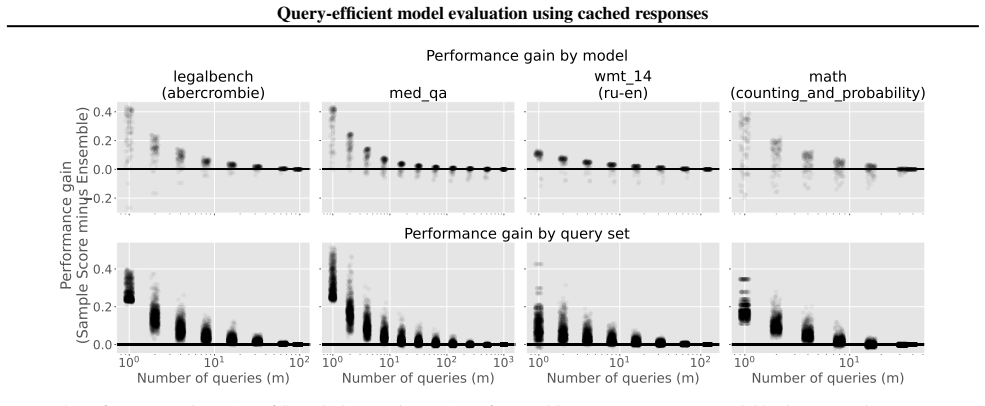
DKPS-based methods for predicting benchmark performance from cached responses achieve the same mean absolute error as full evaluation baselines while using a substantially smaller query budget, and an offline query selection procedure further improves accuracy over random selection.
What carries the argument
The Data Kernel Perspective Space (DKPS), a representation that quantifies relationships between models based solely on their responses to a set of queries in the black-box setting.
If this is right
- New models can be scored on large benchmarks at lower cost whenever prior model responses have been cached.
- Query selection can be performed once per benchmark using only reference models, without access to the new model under test.
- The offline selection procedure improves prediction accuracy relative to random query choice on the same reference set.
Where Pith is reading between the lines
- If the DKPS similarity relation is stable across different benchmarks, one cache of responses could support evaluation on multiple tasks.
- The method suggests a practical way to decide which models to evaluate fully when building a reusable cache for future use.
- Extending the same similarity measure to select which models to add to the cache next could further reduce total evaluation spend.
Load-bearing premise
The DKPS metric computed from black-box responses accurately reflects the underlying relationships between models in a manner that permits reliable prediction of performance on the remaining queries.
What would settle it
Running the new model on the full set of queries after using the DKPS predictor and finding that the actual score differs from the predicted score by more than the reported mean absolute error on the held-out queries.
Figures




read the original abstract
Evaluating a new model on an existing benchmark is often necessary to understand its behavior before deployment. For modern evaluation frameworks, generating and evaluating a response for all queries can be prohibitively expensive. In practice, responses from previously-evaluated models are often cached -- creating a potential opportunity to use this additional information to decrease the number of queries required to accurately evaluate a new model. In this paper, we introduce an approach for predicting benchmark performance that leverages cached model responses based on the Data Kernel Perspective Space (DKPS), a method for quantifying the relationship between models in the black-box setting. Theoretically, we show that DKPS-based methods are query-efficient under certain conditions. Empirically, we demonstrate that DKPS-based methods achieve the same mean absolute error as baselines with a substantially decreased query budget. We conclude by proposing an offline method for selecting a set of queries that maximizes the goodness-of-fit on reference models, improving prediction accuracy over random query selection.
Editorial analysis
A structured set of objections, weighed in public.
Referee Report
Summary. The paper introduces the Data Kernel Perspective Space (DKPS) as a black-box method for quantifying relationships between models using cached responses. It claims that DKPS-based prediction methods are query-efficient under certain (unspecified) conditions, empirically achieve equivalent mean absolute error to baselines at substantially lower query budgets, and includes an offline procedure for selecting a query set that maximizes goodness-of-fit on reference models.
Significance. If the DKPS construction and its query-efficiency guarantees hold beyond the reported benchmarks, the work addresses a practically important problem in large-scale model evaluation by reducing the number of new queries needed. The empirical demonstration of matched MAE at lower budget is a concrete strength; the offline query-selection proposal is a useful addition if it generalizes.
major comments (2)
- [Abstract] Abstract: the central empirical claim (same MAE at substantially decreased query budget) rests on DKPS-based prediction being query-efficient under stated theoretical conditions, yet those conditions are neither enumerated nor validated against the experimental setup; without them it is impossible to determine whether the reported savings are general or an artifact of the particular model collection and benchmark.
- [Abstract] Abstract / theoretical development: the DKPS metric is presented as an independent construct that captures model relationships, but no evidence is given that its definition avoids circularity with the fitted prediction quantities or that the query-efficiency result is non-vacuous (e.g., the conditions may require bounded model dissimilarity or sufficient coverage that is not checked in the experiments).
minor comments (1)
- [Abstract] The acronym DKPS is introduced without an inline gloss or pointer to its formal definition; a one-sentence characterization on first use would improve readability.
Simulated Author's Rebuttal
We thank the referee for the detailed and constructive report. The concerns raised about the abstract and theoretical conditions are addressable through targeted clarifications and additions. We respond to each major comment below.
read point-by-point responses
-
Referee: [Abstract] Abstract: the central empirical claim (same MAE at substantially decreased query budget) rests on DKPS-based prediction being query-efficient under stated theoretical conditions, yet those conditions are neither enumerated nor validated against the experimental setup; without them it is impossible to determine whether the reported savings are general or an artifact of the particular model collection and benchmark.
Authors: We agree the abstract would be strengthened by explicitly enumerating the conditions. In the revision we will add a concise list of the main conditions (bounded model dissimilarity and sufficient query-space coverage, per Theorem 1) to the abstract. We will also insert a short validation paragraph in Section 4 that reports the relevant metrics on the experimental model collections, confirming the assumptions hold and that the observed savings are consistent with the theorem rather than an artifact. revision: yes
-
Referee: [Abstract] Abstract / theoretical development: the DKPS metric is presented as an independent construct that captures model relationships, but no evidence is given that its definition avoids circularity with the fitted prediction quantities or that the query-efficiency result is non-vacuous (e.g., the conditions may require bounded model dissimilarity or sufficient coverage that is not checked in the experiments).
Authors: DKPS is defined solely from cached responses via the kernel perspective (Equation 2) before any regression coefficients are computed, so the metric itself is independent of the fitted prediction quantities and circularity is avoided by construction. The query-efficiency guarantee (Theorem 1) is non-vacuous under the explicitly stated conditions; we will add explicit checks for bounded dissimilarity and coverage in the experimental section to make this verification transparent. revision: partial
Circularity Check
No significant circularity detected; derivation is self-contained.
full rationale
The paper introduces DKPS as an independent construct for black-box model relationships, states a theoretical result on query-efficiency under (unspecified) conditions, and reports separate empirical MAE comparisons plus an offline query-selection method. No quoted equation or step reduces a claimed prediction to a fitted input by construction, nor does any load-bearing premise collapse to a self-citation chain. The central claims rest on the DKPS definition and the stated conditions rather than on renaming or tautological reuse of the target quantities themselves.
Axiom & Free-Parameter Ledger
invented entities (1)
-
Data Kernel Perspective Space (DKPS)
no independent evidence
Forward citations
Cited by 1 Pith paper
-
Jailbreak susceptibility prediction and mitigation via the behavioral geometry of models
Behavioral geometry of model populations enables high-accuracy jailbreak susceptibility prediction and defense transfer with 98% fewer evaluations.
Reference graph
Works this paper leans on
-
[1]
Acharyya, A., Agterberg, J., Park, Y ., and Priebe, C
URL https: //arxiv.org/abs/2409.17308. Acharyya, A., Agterberg, J., Park, Y ., and Priebe, C. E. Concentration bounds on response-based vector embed- dings of black-box generative models,
-
[2]
URL https://arxiv.org/abs/2511.08307. Bean, A. M. et al. Scales++: Compute efficient evaluation subset selection with cognitive scales embeddings.arXiv preprint arXiv:2510.26384,
work page internal anchor Pith review Pith/arXiv arXiv
-
[3]
Findings of the 2014 workshop on statistical machine translation
Bojar, O., Buck, C., Federmann, C., Haddow, B., Koehn, P., Leveling, J., Monz, C., Pecina, P., Post, M., Saint- Amand, H., Soricut, R., Specia, L., and Tamchyna, A. Findings of the 2014 workshop on statistical machine translation. In Bojar, O., Buck, C., Federmann, C., Haddow, B., Koehn, P., Monz, C., Post, M., and Spe- cia, L. (eds.),Proceedings of the N...
2014
-
[4]
Association for Computa- tional Linguistics. doi: 10.3115/v1/W14-3302. URL https://aclanthology.org/W14-3302/. Candes, E. J. and Recht, B. Exact matrix completion via convex optimization,
-
[5]
Exact Matrix Completion via Convex Optimization
URL https://arxiv. org/abs/0805.4471. Chen, M., Tworek, J., Jun, H., Yuan, Q., de Oliveira Pinto, H. P., Kaplan, J., Edwards, H., Burda, Y ., Joseph, N., Brockman, G., Ray, A., Puri, R., Krueger, G., Petrov, M., Khlaaf, H., Sastry, G., Mishkin, P., Chan, B., Gray, S., Ryder, N., Pavlov, M., Power, A., Kaiser, L., Bavar- ian, M., Winter, C., Tillet, P., Su...
work page internal anchor Pith review Pith/arXiv arXiv
-
[6]
Evaluating Large Language Models Trained on Code
URL https://arxiv.org/abs/ 2107.03374. Chen, N., Helm, H., Park, Y ., Priebe, C., and Villar, S. Extracting information from fine-tuned weights. In Non-Euclidean Foundation Models: Advancing AI Be- yond Euclidean Frameworks,
work page internal anchor Pith review Pith/arXiv arXiv
-
[7]
On the Measure of Intelligence
URL https://arxiv.org/abs/1911.01547. Chung, J., Pedigo, B. D., Bridgeford, E. W., Varjavand, B. K., Helm, H. S., and V ogelstein, J. T. Graspy: Graph statistics in python.Journal of Machine Learning Re- search, 20(158):1–7,
work page internal anchor Pith review Pith/arXiv arXiv 1911
- [8]
-
[9]
ISSN 1573-1405. doi: 10.1007/s11263-021-01453-z. URL http://dx. doi.org/10.1007/s11263-021-01453-z. Guha, N., Nyarko, J., Ho, D. E., R ´e, C., Chilton, A., Narayana, A., Chohlas-Wood, A., Peters, A., Waldon, B., Rockmore, D. N., Zambrano, D., Talisman, D., Hoque, E., Surani, F., Fagan, F., Sarfaty, G., Dickinson, G. M., Porat, H., Hegland, J., Wu, J., Nud...
-
[10]
URLhttps://arxiv.org/abs/2308.11462. Han, Z., Gao, C., Liu, J., Zhang, J., and Zhang, S. Q. Parameter-efficient fine-tuning for large models: A com- prehensive survey,
-
[11]
Parameter-Efficient Fine-Tuning for Large Models: A Comprehensive Survey
URL https://arxiv. org/abs/2403.14608. Helm, H., de Silva, A., V ogelstein, J. T., Priebe, C. E., and Yang, W. Approximately optimal domain adaptation with fisher’s linear discriminant.Mathematics, 12(5), 2024a. ISSN 2227-7390. doi: 10.3390/math12050746. URL https://www.mdpi.com/2227-7390/12/ 5/746. Helm, H., Duderstadt, B., Park, Y ., and Priebe, C. Trac...
work page internal anchor Pith review Pith/arXiv arXiv doi:10.3390/math12050746 2024
-
[12]
emnlp-main.90/
URL https://aclanthology.org/2024. emnlp-main.90/. Helm, H., Acharyya, A., Park, Y ., Duderstadt, B., and Priebe, C. Statistical inference on black-box generative models in the data kernel perspective space.Findings of the Association for Computational Linguistics: ACL 2025, pp. 3955–3970, July
2024
-
[13]
doi: 10.18653/v1/2025. findings-acl.204. URL https://aclanthology. org/2025.findings-acl.204/. Hendrycks, D., Burns, C., Kadavath, S., Arora, A., Basart, S., Tang, E., Song, D., and Steinhardt, J. Measuring math- ematical problem solving with the math dataset.NeurIPS,
-
[14]
We should chart an atlas of all the world’s models.arXiv preprint arXiv:2503.10633,
URLhttps://arxiv.org/abs/2503.10633. Huang, K., Duan, C., Sun, K., Xie, E., Li, Z., and Liu, X. T2i-compbench++: An enhanced and comprehen- sive benchmark for compositional text-to-image genera- tion,
-
[15]
The Platonic Representation Hypothesis
URL https: //arxiv.org/abs/2405.07987. Ilyas, A., Park, S. M., Engstrom, L., Leclerc, G., and Madry, A. Datamodels: Predicting predictions from training data. arXiv preprint arXiv:2202.00622,
work page internal anchor Pith review Pith/arXiv arXiv
-
[16]
Jin, D., Pan, E., Oufattole, N., Weng, W.-H., Fang, H., and Szolovits, P. What disease does this patient have? a large-scale open domain question answering dataset from medical exams.arXiv preprint arXiv:2009.13081,
-
[17]
Holistic Evaluation of Language Models
Liang, P., Bommasani, R., Lee, T., Tsipras, D., Soylu, D., Yasunaga, M., Zhang, Y ., Narayanan, D., Wu, Y ., Kumar, A., et al. Holistic evaluation of language models.arXiv preprint arXiv:2211.09110,
work page internal anchor Pith review Pith/arXiv arXiv
-
[18]
MTEB: Massive Text Embedding Benchmark
URL https://arxiv.org/abs/2210.07316. Perlitz, Y ., Bandel, E., Gera, A., Arviv, O., Ein-Dor, L., Shnarch, E., Slonim, N., Shmueli-Scheuer, M., and Choshen, L. Efficient benchmarking (of language mod- els). InProceedings of the 2024 Conference of the North American Chapter of the Association for Computational Linguistics, pp. 2519–2536,
work page internal anchor Pith review Pith/arXiv arXiv 2024
-
[19]
Manifold Matching: Joint Optimization of Fidelity and Commensurability
URL https://arxiv.org/abs/ 1112.5510. Recht, B., Roelofs, R., Schmidt, L., and Shankar, V . Do ImageNet classifiers generalize to ImageNet? In Chaudhuri, K. and Salakhutdinov, R. (eds.),Proceed- ings of the 36th International Conference on Machine Learning, volume 97 ofProceedings of Machine Learn- ing Research, pp. 5389–5400. PMLR, 09–15 Jun
work page internal anchor Pith review Pith/arXiv arXiv
-
[20]
A Systematic Survey of Prompt Engineering in Large Language Models: Techniques and Applications
URL https://arxiv.org/abs/ 2402.07927. Torgerson, W. S. Multidimensional scaling: I. theory and method.Psychometrika, 17(4):401–419,
work page internal anchor Pith review Pith/arXiv arXiv
-
[21]
doi: 10.18653/v1/2024.eacl-long.95
Association for Computational Linguis- tics. doi: 10.18653/v1/2024.eacl-long.95. URL https: //aclanthology.org/2024.eacl-long.95/. Zhang, S., Dong, L., Li, X., Zhang, S., Sun, X., Wang, S., Li, J., Hu, R., Zhang, T., Wu, F., and Wang, G. Instruction tuning for large language models: A survey,
-
[22]
Instruction tuning for large language models: A survey,
URL https://arxiv.org/abs/2308.10792. Zheng, L., Chiang, W.-L., Sheng, Y ., Zhuang, S., Wu, Z., Zhuang, Y ., Lin, Z., Li, Z., Li, D., Xing, E. P., Zhang, 11 Query-efficient model evaluation using cached responses H., Gonzalez, J. E., and Stoica, I. Judging llm-as-a-judge with mt-bench and chatbot arena,
-
[23]
URL https: //arxiv.org/abs/2306.05685. Zhu, M. and Ghodsi, A. Automatic dimensionality selection from the scree plot via the use of profile likelihood.Com- putational Statistics & Data Analysis, 51(2):918–930,
work page internal anchor Pith review Pith/arXiv arXiv
-
[24]
Experiment details Table 2.List of model families
12 Query-efficient model evaluation using cached responses A. Experiment details Table 2.List of model families. Family Count Models 01-ai 3 yi-34b, yi-6b, yi-large-preview AlephAlpha 3 luminous-base, luminous-extended, luminous-supreme ai21 5 j2-grande, j2-jumbo, jamba-1.5-large, jamba-1.5-mini, jamba-instruct allenai 1 olmo-7b amazon 3 nova-lite-v1, nov...
2024
-
[25]
In practice, we use ordinary least squares (OLS) due to its stronger empirical performance
establish query-efficiency for nearest neighbor regression in DKPS. In practice, we use ordinary least squares (OLS) due to its stronger empirical performance. Here we compare OLS to 1-NN and √n-NN regression across all four tasks, with n=ALL and d= 8 . Table 4 reports MAE for both the DKPS-only and Ensemble (α=m/M) variants. Table 4.MAE of DKPS and Ensem...
2024
discussion (0)
Sign in with ORCID, Apple, or X to comment. Anyone can read and Pith papers without signing in.