OGPO: Sample Efficient Full-Finetuning of Generative Control Policies
Pith reviewed 2026-07-01 00:00 UTC · model grok-4.3
The pith
OGPO finetunes generative control policies from poor starts by propagating gradients through full sampling with off-policy critics.
A machine-rendered reading of the paper's core claim, the machinery that carries it, and where it could break.
Core claim
OGPO is an off-policy algorithm for finetuning generative control policies that maintains critic networks to maximize data reuse and propagates policy gradients through the full generative sampling process via a modified PPO objective that uses the critics as terminal reward. It reaches state-of-the-art performance on multi-task manipulation, high-precision insertion, and dexterous control, and is the only method shown to fine-tune poorly initialized behavior cloning policies to near full task success with no expert data in the replay buffer and minimal hyperparameter tuning.
What carries the argument
The modified PPO objective paired with off-policy critic networks that act as terminal rewards, allowing gradient flow through the entire generative sampling chain of the policy.
If this is right
- Generative control policies can be driven from low to near-full task success using only online data and no expert demonstrations in the replay buffer.
- The same algorithm produces state-of-the-art results across multi-task, high-precision insertion, and dexterous manipulation without extensive per-task hyperparameter search.
- Stabilization techniques such as success-buffer regularization, two-sided conservative advantages, and Q-variance reduction are required to prevent critic over-exploitation in both state-based and pixel-based settings.
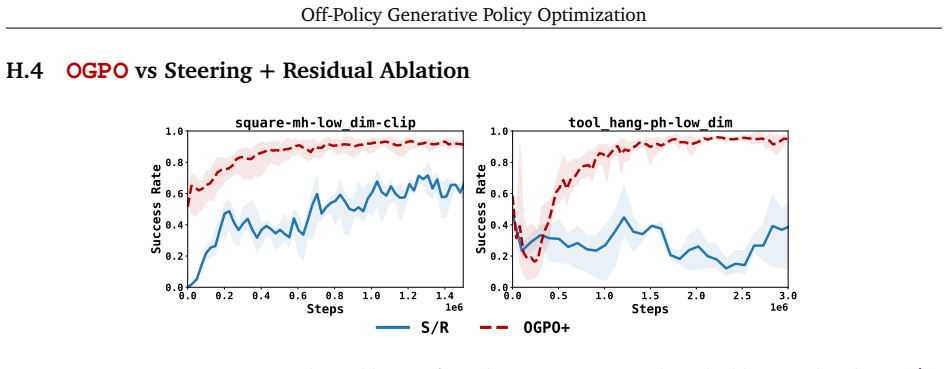
- OGPO outperforms prior alternatives specifically on the sub-problems of policy steering and learning residual corrections.
Where Pith is reading between the lines
- The same gradient-propagation idea could be tested on generative policies outside robotics, such as sequence or image generation models that must be steered by scalar rewards.
- If the critic-stability tricks generalize, they may reduce the amount of online data needed in other off-policy reinforcement-learning settings that use long-horizon generative policies.
- A natural next measurement would be how far the method can push performance when the initial behavior-cloning policy is even weaker than those tested here.
Load-bearing premise
Off-policy critic networks can be kept stable while policy gradients are back-propagated through the full generative sampling process without creating new instabilities or needing heavy per-task retuning.
What would settle it
An experiment in which a poorly initialized behavior-cloning policy fails to reach near-full task success after OGPO finetuning on a standard multi-task or insertion benchmark, or in which success rates fall below existing baselines once the listed stabilization tricks are removed.
Figures





read the original abstract
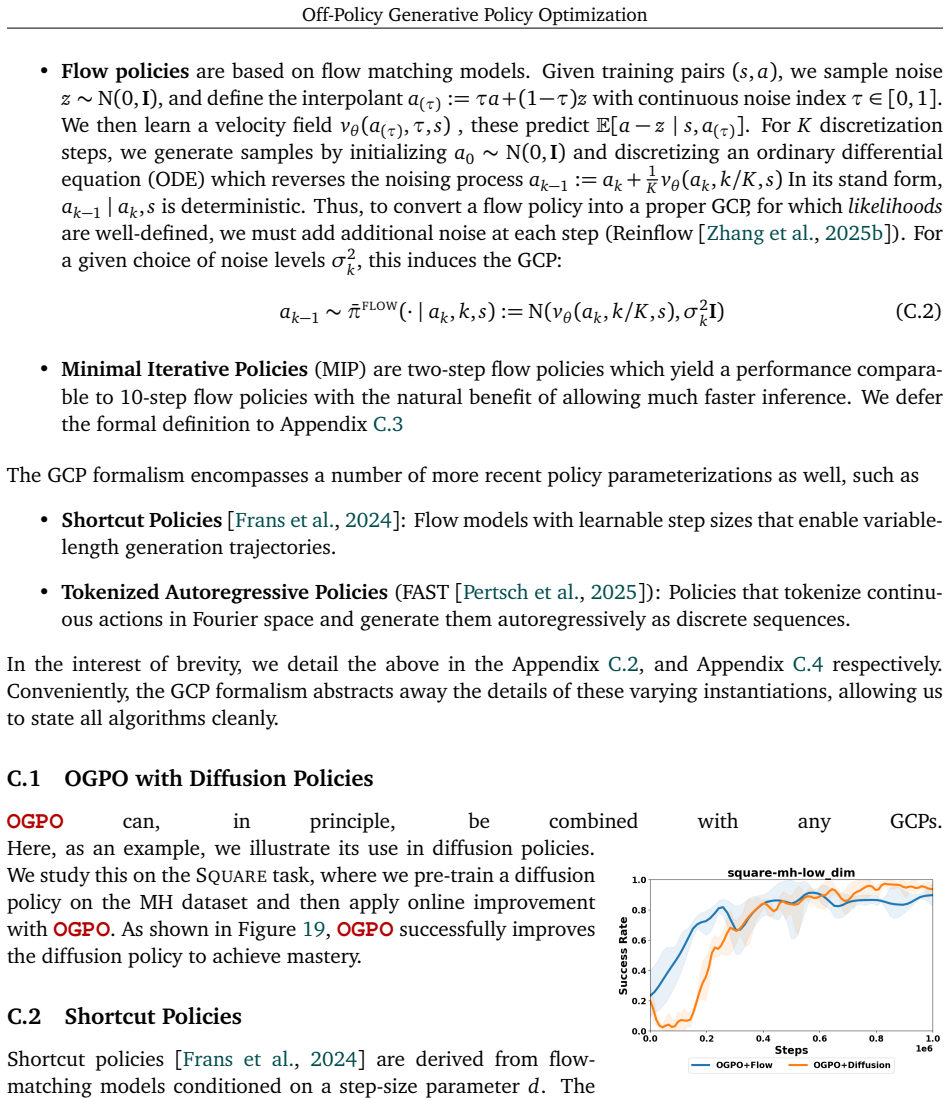
Generative control policies (GCPs), such as diffusion- and flow-based control policies, have emerged as effective parameterizations for robot learning. This work introduces Off-policy Generative Policy Optimization (OGPO), a sample-efficient algorithm for finetuning GCPs that maintains off-policy critic networks to maximize data reuse and propagate policy gradients through the full generative process of the policy via a modified PPO objective, using critics as the terminal reward. OGPO achieves state-of-the-art performance on manipulation tasks spanning multi-task settings, high-precision insertion, and dexterous control. To our knowledge, it is also the only method that can fine-tune poorly-initialized behavior cloning policies to near full task-success with no expert data in the online replay buffer, and does so with few task-specific hyperparameter tuning. Through extensive empirical investigations, we demonstrate that OGPO drastically outperforms methods alternatives on policy steering and learning residual corrections, and identify the key mechanisms behind its performance. We further introduce practical stabilization tricks, including success-buffer regularization, two-sided conservative advantages, and Q-variance reduction, to mitigate critic over-exploitation across state- and pixel-based settings. Beyond proposing OGPO, we conduct a systematic empirical study of GCP finetuning, identifying the stabilizing mechanisms and failure modes that govern successful off-policy full-policy improvement.
Editorial analysis
A structured set of objections, weighed in public.
Referee Report
Summary. The paper introduces Off-policy Generative Policy Optimization (OGPO), an algorithm for sample-efficient full fine-tuning of generative control policies (diffusion- and flow-based) in robotics. It maintains off-policy critic networks, uses a modified PPO objective with the critic as terminal reward to propagate gradients through the full generative sampling process, and introduces three stabilization heuristics (success-buffer regularization, two-sided conservative advantages, Q-variance reduction). The central empirical claims are state-of-the-art performance on multi-task manipulation, high-precision insertion, and dexterous control; the ability to recover near-full task success from poorly-initialized behavior-cloning policies with no expert data in the online replay buffer; and that this is achieved with few task-specific hyperparameter tunings. The work also includes an empirical study identifying stabilizing mechanisms and failure modes for GCP fine-tuning.
Significance. If the reported results and the sufficiency of the three heuristics hold under broader conditions, the work would be significant for advancing sample-efficient off-policy RL with expressive generative policies, especially in settings with weak initializations. The systematic empirical investigation of stabilization mechanisms provides practical value beyond the specific algorithm. The absence of any convergence analysis or Lipschitz-style argument for the heuristics, however, limits the strength of the generalizability claims.
major comments (2)
- [Abstract and stabilization heuristics description] The headline uniqueness and 'few task-specific hyperparameter tuning' claims rest on the empirical sufficiency of the three stabilization heuristics when back-propagating through the full generative chain. No section provides a sensitivity analysis, ablation on hyperparameter ranges across tasks, or argument showing why success-buffer regularization, two-sided conservative advantages, and Q-variance reduction remain sufficient when generative process length, noise schedule, or task distribution changes. This is load-bearing for both the 'only method' assertion and the low-tuning claim.
- [Empirical investigations and stabilization section] The manuscript supplies no convergence bound, Lipschitz-style argument, or even empirical monitoring of critic stability (e.g., Q-value divergence or advantage variance) when gradients flow through the entire diffusion/flow sampling process. The stress-test concern about off-policy critic over-exploitation therefore remains unaddressed at the level required to support the stability precondition for the reported results.
minor comments (1)
- The abstract states that OGPO 'drastically outperforms method alternatives on policy steering and learning residual corrections,' but the main text should include a dedicated comparison table or figure with exact baselines, number of seeds, and statistical significance to make this claim verifiable.
Simulated Author's Rebuttal
We thank the referee for the constructive review and for identifying areas where additional empirical support can strengthen the manuscript. We address each major comment below with clarifications and commitments to revisions. The work remains primarily empirical, so we focus on expanding the reported analyses rather than adding theoretical results.
read point-by-point responses
-
Referee: [Abstract and stabilization heuristics description] The headline uniqueness and 'few task-specific hyperparameter tuning' claims rest on the empirical sufficiency of the three stabilization heuristics when back-propagating through the full generative chain. No section provides a sensitivity analysis, ablation on hyperparameter ranges across tasks, or argument showing why success-buffer regularization, two-sided conservative advantages, and Q-variance reduction remain sufficient when generative process length, noise schedule, or task distribution changes. This is load-bearing for both the 'only method' assertion and the low-tuning claim.
Authors: We agree that the sufficiency of the heuristics is central and that additional sensitivity evidence would strengthen the low-tuning claim. In the revision we will add a new subsection with sensitivity analysis varying the key hyperparameters of all three heuristics (regularization coefficient, advantage clipping bounds, variance reduction scale) over wide ranges on every task. We will also report ablations under altered diffusion/flow step counts and noise schedules. These results will be used to qualify the abstract claim more precisely while retaining the observation that the same hyperparameter set succeeded across the evaluated task suite. We do not claim the heuristics are provably sufficient for arbitrary changes in generative process length or task distribution. revision: yes
-
Referee: [Empirical investigations and stabilization section] The manuscript supplies no convergence bound, Lipschitz-style argument, or even empirical monitoring of critic stability (e.g., Q-value divergence or advantage variance) when gradients flow through the entire diffusion/flow sampling process. The stress-test concern about off-policy critic over-exploitation therefore remains unaddressed at the level required to support the stability precondition for the reported results.
Authors: We acknowledge that the manuscript contains no convergence analysis or Lipschitz argument; this is a genuine limitation of the current empirical focus and we do not plan to add such theory. However, we will add new figures that explicitly monitor critic stability (Q-value histograms, advantage variance, and critic loss curves) throughout training for the main experiments, directly addressing the over-exploitation stress test. These plots will demonstrate that the three heuristics keep the critic from diverging in the reported settings. We maintain that the systematic empirical identification of failure modes already provides practical value, even absent theoretical bounds. revision: partial
- Providing a formal convergence bound or Lipschitz-style argument for the stabilization heuristics
Circularity Check
No circularity: empirical algorithm with independent experimental validation
full rationale
The paper introduces OGPO as an empirical algorithm combining off-policy critics with a modified PPO objective for generative policies. All central claims (SOTA performance, ability to fine-tune from poor BC initializations without expert data, few hyperparameter tunings) rest on reported experiments across manipulation tasks rather than any derivation that reduces to fitted inputs or self-citations by construction. Stabilization tricks are presented as practical heuristics whose sufficiency is shown via ablation studies, not assumed a priori. No equations or uniqueness theorems are invoked that collapse to the method's own outputs.
Axiom & Free-Parameter Ledger
Reference graph
Works this paper leans on
-
[1]
Stochastic Interpolants: A Unifying Framework for Flows and Diffusions
Michael S Albergo, Nicholas M Boffi, and Eric Vanden-Eijnden. Stochastic interpolants: A unifying framework for flows and diffusions. arXiv preprint arXiv:2303.08797, 2023
work page internal anchor Pith review Pith/arXiv arXiv 2023
-
[2]
Y. Bengio, P. Simard, and P. Frasconi. Learning long-term dependencies with gradient descent is difficult. IEEE Transactions on Neural Networks, 5 0 (2): 0 157--166, 1994. doi:10.1109/72.279181
-
[3]
Training Diffusion Models with Reinforcement Learning
Kevin Black, Michael Janner, Yilun Du, Ilya Kostrikov, and Sergey Levine. Training diffusion models with reinforcement learning. arXiv preprint arXiv:2305.13301, 2023
work page internal anchor Pith review Pith/arXiv arXiv 2023
-
[4]
$\pi_0$: A Vision-Language-Action Flow Model for General Robot Control
Kevin Black, Noah Brown, Danny Driess, Adnan Esmail, Michael Equi, Chelsea Finn, Niccolo Fusai, Lachy Groom, Karol Hausman, Brian Ichter, et al. pi_0 : A vision-language-action flow model for general robot control. arXiv preprint arXiv:2410.24164, 2024
work page internal anchor Pith review Pith/arXiv arXiv 2024
-
[5]
Large Language Monkeys: Scaling Inference Compute with Repeated Sampling
Bradley Brown, Jordan Juravsky, Ryan Ehrlich, Ronald Clark, Quoc V Le, Christopher R \'e , and Azalia Mirhoseini. Large language monkeys: Scaling inference compute with repeated sampling. arXiv preprint arXiv:2407.21787, 2024
work page internal anchor Pith review Pith/arXiv arXiv 2024
-
[6]
Randomized ensembled double q-learning: Learning fast without a model
Xinyue Chen, Che Wang, Zijian Zhou, and Keith Ross. Randomized ensembled double q-learning: Learning fast without a model. arXiv preprint arXiv:2101.05982, 2021
-
[7]
Diffusion Policy: Visuomotor Policy Learning via Action Diffusion
Cheng Chi, Siyuan Feng, Yilun Du, Zhenjia Xu, Eric Cousineau, Benjamin Burchfiel, and Shuran Song. Diffusion policy: Visuomotor policy learning via action diffusion. arXiv preprint arXiv:2303.04137, 2023
work page internal anchor Pith review Pith/arXiv arXiv 2023
-
[8]
EXPO: Stable Reinforcement Learning with Expressive Policies
Perry Dong, Qiyang Li, Dorsa Sadigh, and Chelsea Finn. Expo: Stable reinforcement learning with expressive policies. arXiv preprint arXiv:2507.07986, 2025
work page internal anchor Pith review Pith/arXiv arXiv 2025
-
[9]
IMPALA: Scalable Distributed Deep-RL with Importance Weighted Actor-Learner Architectures
Lasse Espeholt, Hubert Soyer, Remi Munos, Karen Simonyan, Volodymir Mnih, Tom Ward, Yotam Doron, Vlad Firoiu, Tim Harley, Iain Dunning, Shane Legg, and Koray Kavukcuoglu. Impala: Scalable distributed deep-rl with importance weighted actor-learner architectures, 2018. URL https://arxiv.org/abs/1802.01561
work page internal anchor Pith review Pith/arXiv arXiv 2018
-
[10]
Implicit reparameterization gradients
Mikhail Figurnov, Shakir Mohamed, and Andriy Mnih. Implicit reparameterization gradients. Advances in neural information processing systems, 31, 2018
2018
-
[11]
One Step Diffusion via Shortcut Models
Kevin Frans, Danijar Hafner, Sergey Levine, and Pieter Abbeel. One step diffusion via shortcut models. arXiv preprint arXiv:2410.12557, 2024
work page internal anchor Pith review Pith/arXiv arXiv 2024
-
[12]
D4RL: Datasets for Deep Data-Driven Reinforcement Learning
Justin Fu, Aviral Kumar, Ofir Nachum, George Tucker, and Sergey Levine. D4rl: Datasets for deep data-driven reinforcement learning. arXiv preprint arXiv:2004.07219, 2020
work page internal anchor Pith review Pith/arXiv arXiv 2004
-
[13]
Addressing function approximation error in actor-critic methods
Scott Fujimoto, Herke Hoof, and David Meger. Addressing function approximation error in actor-critic methods. In International conference on machine learning, pages 1587--1596. PMLR, 2018
2018
-
[14]
arXiv preprint arXiv:1910.11956 , year=
Abhishek Gupta, Vikash Kumar, Corey Lynch, Sergey Levine, and Karol Hausman. Relay policy learning: Solving long-horizon tasks via imitation and reinforcement learning. arXiv preprint arXiv:1910.11956, 2019
-
[15]
Soft actor-critic: Off-policy maximum entropy deep reinforcement learning with a stochastic actor
Tuomas Haarnoja, Aurick Zhou, Pieter Abbeel, and Sergey Levine. Soft actor-critic: Off-policy maximum entropy deep reinforcement learning with a stochastic actor. In International conference on machine learning, pages 1861--1870. Pmlr, 2018
2018
-
[16]
Denoising diffusion probabilistic models
Jonathan Ho, Ajay Jain, and Pieter Abbeel. Denoising diffusion probabilistic models. Advances in neural information processing systems, 33: 0 6840--6851, 2020
2020
-
[17]
arXiv preprint arXiv:2407.13399 , year=
Audrey Huang, Wenhao Zhan, Tengyang Xie, Jason D Lee, Wen Sun, Akshay Krishnamurthy, and Dylan J Foster. Correcting the mythos of kl-regularization: Direct alignment without overoptimization via chi-squared preference optimization. arXiv preprint arXiv:2407.13399, 2024
-
[18]
Physical Intelligence, Kevin Black, Noah Brown, James Darpinian, Karan Dhabalia, Danny Driess, Adnan Esmail, Michael Equi, Chelsea Finn, Niccolo Fusai, Manuel Y. Galliker, Dibya Ghosh, Lachy Groom, Karol Hausman, Brian Ichter, Szymon Jakubczak, Tim Jones, Liyiming Ke, Devin LeBlanc, Sergey Levine, Adrian Li-Bell, Mohith Mothukuri, Suraj Nair, Karl Pertsch...
work page internal anchor Pith review Pith/arXiv arXiv 2025
-
[19]
Auto-Encoding Variational Bayes
Diederik P Kingma and Max Welling. Auto-encoding variational bayes. arXiv preprint arXiv:1312.6114, 2013
work page internal anchor Pith review Pith/arXiv arXiv 2013
-
[20]
arXiv preprint arXiv:2510.14830 (2025)
Kun Lei, Huanyu Li, Dongjie Yu, Zhenyu Wei, Lingxiao Guo, Zhennan Jiang, Ziyu Wang, Shiyu Liang, and Huazhe Xu. Rl-100: Performant robotic manipulation with real-world reinforcement learning. arXiv preprint arXiv:2510.14830, 2025
-
[21]
Reinforcement Learning with Action Chunking
Qiyang Li, Zhiyuan Zhou, and Sergey Levine. Reinforcement learning with action chunking. arXiv preprint arXiv:2507.07969, 2025
work page internal anchor Pith review Pith/arXiv arXiv 2025
-
[22]
Flow Matching for Generative Modeling
Yaron Lipman, Ricky TQ Chen, Heli Ben-Hamu, Maximilian Nickel, and Matt Le. Flow matching for generative modeling. arXiv preprint arXiv:2210.02747, 2022
work page internal anchor Pith review Pith/arXiv arXiv 2022
-
[23]
Libero: Benchmarking knowledge transfer for lifelong robot learning
Bo Liu, Yifeng Zhu, Chongkai Gao, Yihao Feng, Qiang Liu, Yuke Zhu, and Peter Stone. Libero: Benchmarking knowledge transfer for lifelong robot learning. Advances in Neural Information Processing Systems, 36: 0 44776--44791, 2023
2023
-
[24]
Flow-GRPO: Training Flow Matching Models via Online RL
Jie Liu, Gongye Liu, Jiajun Liang, Yangguang Li, Jiaheng Liu, Xintao Wang, Pengfei Wan, Di Zhang, and Wanli Ouyang. Flow-grpo: Training flow matching models via online rl. arXiv preprint arXiv:2505.05470, 2025
work page internal anchor Pith review Pith/arXiv arXiv 2025
-
[25]
Flow Straight and Fast: Learning to Generate and Transfer Data with Rectified Flow
Xingchao Liu, Chengyue Gong, and Qiang Liu. Flow straight and fast: Learning to generate and transfer data with rectified flow. arXiv preprint arXiv:2209.03003, 2022
work page internal anchor Pith review Pith/arXiv arXiv 2022
-
[26]
What Matters in Learning from Offline Human Demonstrations for Robot Manipulation
Ajay Mandlekar, Danfei Xu, Josiah Wong, Soroush Nasiriany, Chen Wang, Rohun Kulkarni, Li Fei-Fei, Silvio Savarese, Yuke Zhu, and Roberto Mart\' i n-Mart\' i n. What matters in learning from offline human demonstrations for robot manipulation. In arXiv preprint arXiv:2108.03298, 2021
work page internal anchor Pith review Pith/arXiv arXiv 2021
-
[27]
Max Sobol Mark, Tian Gao, Georgia Gabriela Sampaio, Mohan Kumar Srirama, Archit Sharma, Chelsea Finn, and Aviral Kumar. Policy agnostic rl: Offline rl and online rl fine-tuning of any class and backbone. arXiv preprint arXiv:2412.06685, 2024
-
[28]
Flow matching policy gradients.arXiv preprint arXiv:2507.21053, 2025
David McAllister, Songwei Ge, Brent Yi, Chung Min Kim, Ethan Weber, Hongsuk Choi, Haiwen Feng, and Angjoo Kanazawa. Flow matching policy gradients. arXiv preprint arXiv:2507.21053, 2025
-
[29]
UMAP: Uniform Manifold Approximation and Projection for Dimension Reduction
Leland McInnes, John Healy, and James Melville. Umap: Uniform manifold approximation and projection for dimension reduction. arXiv preprint arXiv:1802.03426, 2018
work page internal anchor Pith review Pith/arXiv arXiv 2018
-
[30]
Steering your generalists: Improving robotic foundation models via value guidance
Mitsuhiko Nakamoto, Oier Mees, Aviral Kumar, and Sergey Levine. Steering your generalists: Improving robotic foundation models via value guidance. Conference on Robot Learning (CoRL), 2024
2024
-
[31]
Self-imitation learning
Junhyuk Oh, Yijie Guo, Satinder Singh, and Honglak Lee. Self-imitation learning. In International conference on machine learning, pages 3878--3887. PMLR, 2018
2018
-
[32]
Training language models to follow instructions with human feedback
Long Ouyang, Jeffrey Wu, Xu Jiang, Diogo Almeida, Carroll Wainwright, Pamela Mishkin, Chong Zhang, Sandhini Agarwal, Katarina Slama, Alex Ray, et al. Training language models to follow instructions with human feedback. Advances in neural information processing systems, 35: 0 27730--27744, 2022
2022
-
[33]
Much ado about noising: Dispelling the myths of generative robotic control,
Chaoyi Pan, Giri Anantharaman, Nai-Chieh Huang, Claire Jin, Daniel Pfrommer, Chenyang Yuan, Frank Permenter, Guannan Qu, Nicholas Boffi, Guanya Shi, et al. Much ado about noising: Dispelling the myths of generative robotic control. arXiv preprint arXiv:2512.01809, 2025
-
[34]
Advantage-Weighted Regression: Simple and Scalable Off-Policy Reinforcement Learning
Xue Bin Peng, Aviral Kumar, Grace Zhang, and Sergey Levine. Advantage-weighted regression: Simple and scalable off-policy reinforcement learning. arXiv preprint arXiv:1910.00177, 2019
work page internal anchor Pith review Pith/arXiv arXiv 1910
-
[35]
Film: Visual reasoning with a general conditioning layer
Ethan Perez, Florian Strub, Harm De Vries, Vincent Dumoulin, and Aaron Courville. Film: Visual reasoning with a general conditioning layer. In Proceedings of the AAAI conference on artificial intelligence, volume 32, 2018
2018
-
[36]
FAST: Efficient Action Tokenization for Vision-Language-Action Models
Karl Pertsch, Kyle Stachowicz, Brian Ichter, Danny Driess, Suraj Nair, Quan Vuong, Oier Mees, Chelsea Finn, and Sergey Levine. Fast: Efficient action tokenization for vision-language-action models. arXiv preprint arXiv:2501.09747, 2025
work page internal anchor Pith review Pith/arXiv arXiv 2025
-
[37]
Information Theory: From Coding to Learning
Yury Polyanskiy and Yihong Wu. Information Theory: From Coding to Learning. Cambridge University Press, 2025
2025
-
[38]
Diffusion Policy Policy Optimization
Allen Z Ren, Justin Lidard, Lars L Ankile, Anthony Simeonov, Pulkit Agrawal, Anirudha Majumdar, Benjamin Burchfiel, Hongkai Dai, and Max Simchowitz. Diffusion policy policy optimization. arXiv preprint arXiv:2409.00588, 2024
work page internal anchor Pith review Pith/arXiv arXiv 2024
-
[39]
High-resolution image synthesis with latent diffusion models
Robin Rombach, Andreas Blattmann, Dominik Lorenz, Patrick Esser, and Bj \"o rn Ommer. High-resolution image synthesis with latent diffusion models. In Proceedings of the IEEE/CVF conference on computer vision and pattern recognition, pages 10684--10695, 2022
2022
-
[40]
Trust region policy optimization
John Schulman, Sergey Levine, Pieter Abbeel, Michael Jordan, and Philipp Moritz. Trust region policy optimization. In International conference on machine learning, pages 1889--1897. PMLR, 2015
2015
-
[41]
Proximal Policy Optimization Algorithms
John Schulman, Filip Wolski, Prafulla Dhariwal, Alec Radford, and Oleg Klimov. Proximal policy optimization algorithms. arXiv preprint arXiv:1707.06347, 2017
work page internal anchor Pith review Pith/arXiv arXiv 2017
-
[42]
Y ., Snell, C., Greer, J., Wu, I., Smith, V ., Simchowitz, M., and Kumar, A
Amrith Setlur, Matthew YR Yang, Charlie Snell, Jeremy Greer, Ian Wu, Virginia Smith, Max Simchowitz, and Aviral Kumar. e3: Learning to explore enables extrapolation of test-time compute for llms. arXiv preprint arXiv:2506.09026, 2025
-
[43]
DeepSeekMath: Pushing the Limits of Mathematical Reasoning in Open Language Models
Zhihong Shao, Peiyi Wang, Qihao Zhu, Runxin Xu, Junxiao Song, Xiao Bi, Haowei Zhang, Mingchuan Zhang, YK Li, Yang Wu, et al. Deepseekmath: Pushing the limits of mathematical reasoning in open language models. arXiv preprint arXiv:2402.03300, 2024
work page internal anchor Pith review Pith/arXiv arXiv 2024
-
[44]
Denoising Diffusion Implicit Models
Jiaming Song, Chenlin Meng, and Stefano Ermon. Denoising diffusion implicit models. arXiv preprint arXiv:2010.02502, 2020
work page internal anchor Pith review Pith/arXiv arXiv 2010
-
[45]
Consistency models
Yang Song, Prafulla Dhariwal, Mark Chen, and Ilya Sutskever. Consistency models. 2023
2023
-
[46]
Do differentiable simulators give better policy gradients? In International Conference on Machine Learning, pages 20668--20696
Hyung Ju Suh, Max Simchowitz, Kaiqing Zhang, and Russ Tedrake. Do differentiable simulators give better policy gradients? In International Conference on Machine Learning, pages 20668--20696. PMLR, 2022
2022
-
[47]
Jump-start reinforcement learning
Ikechukwu Uchendu, Ted Xiao, Yao Lu, Banghua Zhu, Mengyuan Yan, Jos \'e phine Simon, Matthew Bennice, Chuyuan Fu, Cong Ma, Jiantao Jiao, et al. Jump-start reinforcement learning. In International Conference on Machine Learning, pages 34556--34583. PMLR, 2023
2023
-
[48]
Steering Your Diffusion Policy with Latent Space Reinforcement Learning
Andrew Wagenmaker, Mitsuhiko Nakamoto, Yunchu Zhang, Seohong Park, Waleed Yagoub, Anusha Nagabandi, Abhishek Gupta, and Sergey Levine. Steering your diffusion policy with latent space reinforcement learning. arXiv preprint arXiv:2506.15799, 2025
work page internal anchor Pith review Pith/arXiv arXiv 2025
-
[49]
Bridgedata v2: A dataset for robot learning at scale
Homer Walke, Kevin Black, Abraham Lee, Moo Jin Kim, Max Du, Chongyi Zheng, Tony Zhao, Philippe Hansen-Estruch, Quan Vuong, Andre He, Vivek Myers, Kuan Fang, Chelsea Finn, and Sergey Levine. Bridgedata v2: A dataset for robot learning at scale. In Conference on Robot Learning (CoRL), 2023
2023
-
[50]
Simple statistical gradient-following algorithms for connectionist reinforcement learning
Ronald J Williams. Simple statistical gradient-following algorithms for connectionist reinforcement learning. Machine learning, 8 0 (3): 0 229--256, 1992
1992
-
[51]
Diffusion models for robotic manipulation: A survey
Rosa Wolf, Yitian Shi, Sheng Liu, and Rania Rayyes. Diffusion models for robotic manipulation: A survey. Frontiers in Robotics and AI, 12: 0 1606247, 2025
2025
-
[52]
Multilingual Universal Sentence Encoder for Semantic Retrieval
Yinfei Yang, Daniel Cer, Amin Ahmad, Mandy Guo, Jax Law, Noah Constant, Gustavo Hernandez Abrego, Steve Yuan, Chris Tar, Yun-Hsuan Sung, Brian Strope, and Ray Kurzweil. Multilingual universal sentence encoder for semantic retrieval, 2019. URL https://arxiv.org/abs/1907.04307
work page internal anchor Pith review Pith/arXiv arXiv 2019
-
[53]
Flow policy gradients for robot control.arXiv preprint arXiv:2602.02481,
Brent Yi, Hongsuk Choi, Himanshu Gaurav Singh, Xiaoyu Huang, Takara E Truong, Carmelo Sferrazza, Yi Ma, Rocky Duan, Pieter Abbeel, Guanya Shi, et al. Flow policy gradients for robot control. arXiv preprint arXiv:2602.02481, 2026
-
[54]
Fan Zhang and Michael Gienger. Affordance-based robot manipulation with flow matching. arXiv preprint arXiv:2409.01083, 2024
-
[55]
Zhang, Daniel Pfrommer, Chaoyi Pan, Nikolai Matni, and Max Simchowitz
Thomas T Zhang, Daniel Pfrommer, Nikolai Matni, and Max Simchowitz. Imitation learning in continuous action spaces: Mitigating compounding error without interaction. arXiv preprint arXiv:2507.09061, 2025 a
-
[56]
Tonghe Zhang, Chao Yu, Sichang Su, and Yu Wang. Reinflow: Fine-tuning flow matching policy with online reinforcement learning. arXiv preprint arXiv:2505.22094, 2025 b
-
[57]
Learning Fine-Grained Bimanual Manipulation with Low-Cost Hardware
Tony Z Zhao, Vikash Kumar, Sergey Levine, and Chelsea Finn. Learning fine-grained bimanual manipulation with low-cost hardware. arXiv preprint arXiv:2304.13705, 2023
work page internal anchor Pith review Pith/arXiv arXiv 2023
-
[58]
Zhiyuan Zhou, Andy Peng, Qiyang Li, Sergey Levine, and Aviral Kumar. Efficient online reinforcement learning fine-tuning need not retain offline data. arXiv preprint arXiv:2412.07762, 2024
discussion (0)
Sign in with ORCID, Apple, or X to comment. Anyone can read and Pith papers without signing in.