Physically Grounded 3D Generative Reconstruction under Hand Occlusion using Proprioception and Multi-Contact Touch
Pith reviewed 2026-05-10 18:18 UTC · model grok-4.3
The pith
Proprioception and multi-contact touch enable metric-scale 3D object reconstruction under severe hand occlusion by constraining surfaces with physical signals.
A machine-rendered reading of the paper's core claim, the machinery that carries it, and where it could break.
Core claim
We represent object structure as a pose-aware, camera-aligned signed distance field (SDF) and learn a compact latent space with a Structure-VAE. In this latent space, we train a conditional flow-matching diffusion model, pretraining on vision-only images and finetuning on occluded manipulation scenes while conditioning on visible RGB evidence, occluder/visibility masks, the hand latent representation, and tactile information. Crucially, we incorporate physics-based objectives and differentiable decoder-guidance during finetuning and inference to reduce hand–object interpenetration and to align the reconstructed surface with contact observations.
What carries the argument
A conditional flow-matching diffusion model in the latent space of a Structure-VAE for pose-aware SDFs, conditioned on RGB, masks, hand proprioception, and multi-contact touch while guided by physics objectives for non-interpenetration and contact matching.
If this is right
- Substantially improves completion of occluded object parts compared to vision-only baselines.
- Yields physically plausible reconstructions at correct real-world scale.
- Reduces hand-object interpenetration through the added physics objectives.
- Transfers to real humanoid robots even when the end-effector differs from training data.
- Integrates directly into two-stage pipelines where a downstream module can refine geometry and predict appearance.
Where Pith is reading between the lines
- Robots could maintain object models continuously during grasping sequences without pausing for clear views.
- The same conditioning strategy might apply to other occluders if their geometry and contact data are available.
- Real-time versions could support closed-loop control by updating the object estimate as contacts change.
- Reducing dependence on external cameras could simplify workspace setups in cluttered or mobile manipulation scenarios.
Load-bearing premise
That physics-based objectives and differentiable decoder guidance during finetuning and inference will reliably reduce hand-object interpenetration and align surfaces with contacts without introducing artifacts or scale errors.
What would settle it
Reconstructed meshes that still penetrate the hand model or fail to match observed contact locations at test time, or output objects whose real-world scale deviates from ground-truth measurements on the robot.
Figures


read the original abstract
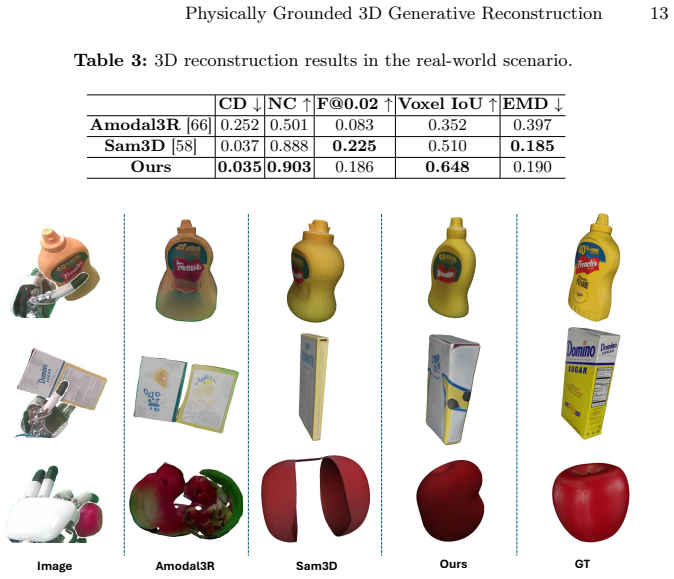
We propose a multimodal, physically grounded approach for metric-scale amodal object reconstruction and pose estimation under severe hand occlusion. Unlike prior occlusion-aware 3D generation methods that rely only on vision, we leverage physical interaction signals: proprioception provides the posed hand geometry, and multi-contact touch constrains where the object surface must lie, reducing ambiguity in occluded regions. We represent object structure as a pose-aware, camera-aligned signed distance field (SDF) and learn a compact latent space with a Structure-VAE. In this latent space, we train a conditional flow-matching diffusion model, pretraining on vision-only images and finetuning on occluded manipulation scenes while conditioning on visible RGB evidence, occluder/visibility masks, the hand latent representation, and tactile information. Crucially, we incorporate physics-based objectives and differentiable decoder-guidance during finetuning and inference to reduce hand--object interpenetration and to align the reconstructed surface with contact observations. Because our method produces a metric, physically consistent structure estimate, it integrates naturally into existing two-stage reconstruction pipelines, where a downstream module refines geometry and predicts appearance. Experiments in simulation show that adding proprioception and touch substantially improves completion under occlusion and yields physically plausible reconstructions at correct real-world scale compared to vision-only baselines; we further validate transfer by deploying the model on a real humanoid robot with an end-effector different from those used during training.
Editorial analysis
A structured set of objections, weighed in public.
Referee Report
Summary. The paper proposes a multimodal, physically grounded method for metric-scale amodal 3D object reconstruction and pose estimation under severe hand occlusion. It represents objects as pose-aware camera-aligned SDFs via a Structure-VAE, then trains a conditional flow-matching diffusion model on vision, occluder masks, hand latent representations, and tactile signals. Physics-based objectives and differentiable decoder guidance are added during finetuning and inference to enforce physical consistency. Simulation experiments claim substantial gains in occluded completion and scale accuracy over vision-only baselines, with further validation via deployment on a real humanoid robot using a novel end-effector.
Significance. If the results hold, the work meaningfully advances grounded 3D generation for robotics by showing how proprioception and multi-contact touch can resolve visual ambiguity in manipulation scenes while producing metric, non-penetrating reconstructions. The sim-to-real transfer with an unseen end-effector and the integration path into two-stage pipelines are practical strengths that could influence downstream tasks such as grasping and interaction planning.
major comments (2)
- Abstract: the central claim that proprioception and touch 'substantially improves completion under occlusion and yields physically plausible reconstructions at correct real-world scale' is presented without any quantitative metrics, error bars, ablation tables, or statistical tests in the abstract itself; this makes it impossible to judge the magnitude or reliability of the reported gains from the provided text alone.
- Method description: the physics-based objectives and differentiable decoder-guidance are described as key to reducing interpenetration and aligning surfaces with contacts, yet no explicit formulation, weighting schedule, or ablation isolating their contribution is referenced, leaving open whether they reliably avoid artifacts or scale drift as assumed.
minor comments (3)
- Abstract: expand the experimental summary to include at least one key quantitative result (e.g., IoU or Chamfer distance improvement) so readers can immediately gauge the effect size.
- Notation: confirm that 'SDF' is expanded on first use and that all conditioning signals (RGB, masks, hand latent, tactile) are consistently denoted across text and figures.
- Figures: ensure simulation and real-robot result panels are clearly labeled with baseline comparisons and scale references so the physical-consistency claim is visually verifiable.
Simulated Author's Rebuttal
We thank the referee for the positive assessment of our work and the constructive feedback. We address each major comment below and have revised the manuscript accordingly to improve clarity and completeness.
read point-by-point responses
-
Referee: Abstract: the central claim that proprioception and touch 'substantially improves completion under occlusion and yields physically plausible reconstructions at correct real-world scale' is presented without any quantitative metrics, error bars, ablation tables, or statistical tests in the abstract itself; this makes it impossible to judge the magnitude or reliability of the reported gains from the provided text alone.
Authors: We agree that the abstract would benefit from including key quantitative indicators to convey the scale of improvements. We have revised the abstract to reference representative metrics from our simulation experiments (e.g., improvements in completion IoU and scale accuracy relative to vision-only baselines) while preserving brevity, with full details, error bars, and statistical comparisons remaining in the main results section and tables. revision: yes
-
Referee: Method description: the physics-based objectives and differentiable decoder-guidance are described as key to reducing interpenetration and aligning surfaces with contacts, yet no explicit formulation, weighting schedule, or ablation isolating their contribution is referenced, leaving open whether they reliably avoid artifacts or scale drift as assumed.
Authors: The explicit mathematical formulations for the physics-based objectives (interpenetration penalty and contact alignment terms) and the differentiable decoder guidance appear in Section 3.4, with the weighting schedule and training procedure described in the implementation details. To address the concern directly, we have added cross-references to the relevant equations in the method overview and included a new ablation study in the revised manuscript that isolates the contribution of these components, confirming their role in reducing interpenetration and scale drift. revision: yes
Circularity Check
No significant circularity; derivation is self-contained
full rationale
The paper's core pipeline—Structure-VAE for latent representation of pose-aware SDFs, followed by conditional flow-matching diffusion pretrained on vision and finetuned with proprioception/touch conditioning plus physics-based losses—is built from standard generative modeling components. No equation or claim reduces the reconstructed output to a fitted input by construction, nor does any uniqueness theorem or ansatz rely on self-citation chains. Simulation gains and real-robot transfer with a novel end-effector are presented as empirical validation rather than definitional consequences. The approach therefore contains independent content and does not trigger any of the enumerated circularity patterns.
Axiom & Free-Parameter Ledger
free parameters (2)
- latent space dimension
- conditioning signal weights
axioms (2)
- domain assumption Proprioception provides accurate posed hand geometry
- domain assumption Multi-contact touch observations constrain object surface location
discussion (0)
Sign in with ORCID, Apple, or X to comment. Anyone can read and Pith papers without signing in.