REVIEW 1 major objections 2 minor
Reviewed by Pith at T0; open to challenge.
T0 means a machine referee read the full paper against a public rubric. The mark states how deep the mechanical check went, never who wrote it. the ladder, T0–T4 →
T0 review · grok-4.3
DecepGPT augments existing deception benchmarks with cue descriptions and reasoning chains, adds a large multicultural dataset, and introduces two modules to reach state-of-the-art detection that transfers across domains and cultures.
2026-05-15 01:05 UTC pith:7GJQYMWP
load-bearing objection New multicultural T4-Deception dataset and SICS/DMC modules for explainable multimodal detection, but SOTA claims rest on unshown metrics and unvalidated manual annotations. the 1 major comments →
DecepGPT: Schema-Driven Deception Detection with Multicultural Datasets and Robust Multimodal Learning
The pith
A machine-rendered reading of the paper's core claim, the machinery that carries it, and where it could break.
Core claim
By converting binary-labeled deception videos into schema-augmented datasets that contain cue descriptions and explicit reasoning chains, and by training with Stabilized Individuality-Commonality Synergy plus Distilled Modality Consistency on the new T4-Deception collection, the method produces verifiable multimodal predictions that outperform prior work in both in-domain accuracy and cross-domain generalization across cultural contexts.
What carries the argument
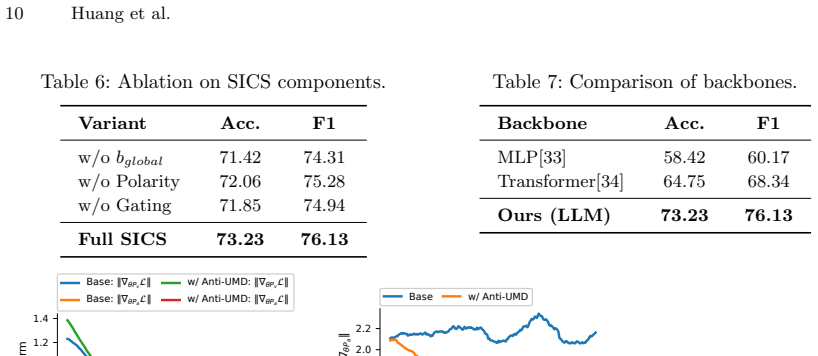
Stabilized Individuality-Commonality Synergy (SICS) that combines learnable global priors with sample-adaptive residuals followed by polarity-aware recalibration, together with Distilled Modality Consistency (DMC) that uses knowledge distillation to align unimodal and fused predictions.
Load-bearing premise
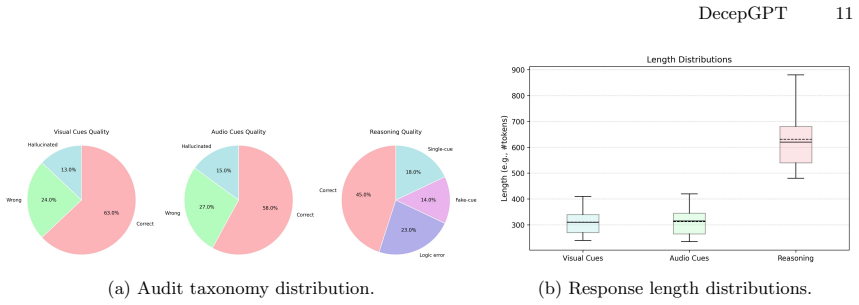
The manually supplied cue descriptions and reasoning chains added to the datasets accurately reflect real deception signals rather than annotator bias or post-hoc justification.
What would settle it
Re-train the same architecture on the original unaugmented benchmarks without the added cue descriptions and reasoning chains, then measure whether cross-domain and cross-cultural accuracy drops to the level of prior methods.
If this is right
- Models can output auditable step-by-step reports instead of opaque binary decisions in security and legal settings.
- Training on the multicultural T4-Deception set reduces reliance on culture-specific shortcuts.
- The two modules stabilize learning when labeled deception data remain scarce.
- Cross-domain transfer improves without requiring new labeled samples from every target domain.
- Knowledge-distillation alignment discourages any single modality from dominating the final prediction.
Where Pith is reading between the lines
- The same cue-augmentation pattern could be applied to other high-stakes multimodal tasks such as medical diagnosis or misinformation detection to increase explainability.
- If the reasoning chains prove robust, they could serve as supervision for smaller models in resource-constrained environments.
- Real-world deployment would still require testing on continuous video streams rather than the short clips used here.
Editorial analysis
A structured set of objections, weighed in public.
Referee Report
Summary. The paper introduces DecepGPT, a multimodal deception detection framework that augments existing benchmarks with manually constructed cue-level descriptions and reasoning chains for auditable outputs, releases the T4-Deception multicultural dataset (1695 samples across four countries in a unified 'To Tell The Truth' format), and proposes two modules—Stabilized Individuality-Commonality Synergy (SICS) for refining multimodal representations via global priors and adaptive residuals, and Distilled Modality Consistency (DMC) for aligning unimodal and fused predictions via knowledge distillation. It claims state-of-the-art in-domain and cross-domain performance with superior cultural transferability on three established benchmarks plus the new dataset.
Significance. If the manual cue annotations are shown to capture reproducible deception signals independent of annotator bias and the performance claims are supported by ablations and metrics, the work would advance verifiable, generalizable deception detection by addressing binary-label limitations and shortcut learning, while providing the largest non-laboratory multicultural dataset for the field.
major comments (1)
- [§3] §3 (Dataset Construction): The augmentation of benchmarks with structured cue-level descriptions and reasoning chains is presented as the first contribution enabling auditable reports, yet no inter-annotator agreement scores, expert validation, or ablation results (e.g., performance with vs. without the added chains on original binary labels) are reported. This is load-bearing for the SOTA and cross-cultural transfer claims, as the SICS/DMC modules and T4-Deception results may simply reproduce the annotation schema rather than independent audiovisual signals.
minor comments (2)
- [Abstract] The abstract asserts SOTA performance without any quantitative metrics, error bars, or implementation details; these should be summarized upfront even if detailed in §4.
- [§4] Notation for SICS (e.g., the polarity-aware adjustment) and DMC (distillation loss) could be clarified with explicit equations in §4 to aid reproducibility.
Simulated Author's Rebuttal
We thank the referee for the detailed and constructive feedback, particularly on the dataset construction. We address the concern point by point below and will incorporate the suggested validations in the revised manuscript.
read point-by-point responses
-
Referee: [§3] §3 (Dataset Construction): The augmentation of benchmarks with structured cue-level descriptions and reasoning chains is presented as the first contribution enabling auditable reports, yet no inter-annotator agreement scores, expert validation, or ablation results (e.g., performance with vs. without the added chains on original binary labels) are reported. This is load-bearing for the SOTA and cross-cultural transfer claims, as the SICS/DMC modules and T4-Deception results may simply reproduce the annotation schema rather than independent audiovisual signals.
Authors: We agree that the absence of reported inter-annotator agreement (IAA) scores, expert validation details, and targeted ablations weakens the substantiation of the cue-augmentation contribution. The cue-level descriptions and reasoning chains were constructed by trained annotators following a protocol derived from established deception literature (e.g., verbal and nonverbal cue taxonomies), but these details and metrics were omitted from the initial submission. In the revised manuscript we will add: (1) IAA scores (Cohen’s kappa and percentage agreement) computed across multiple annotators for both cue descriptions and reasoning chains; (2) a brief description of the annotation guidelines and any expert review performed; and (3) ablation experiments that train and evaluate the full SICS+DMC pipeline on the original binary labels versus the augmented reasoning-chain versions of the same benchmarks. These results will isolate whether performance gains derive from audiovisual signals or merely from the annotation schema, directly addressing the load-bearing concern for the reported SOTA and cross-cultural transfer claims. revision: yes
Circularity Check
No circularity; empirical claims rest on independent dataset evaluations
full rationale
The paper constructs augmented reasoning datasets via manual cue annotations and introduces SICS and DMC modules for multimodal fusion, then reports SOTA results on three benchmarks plus the new T4-Deception dataset. No equations, derivations, or fitted parameters are shown that reduce by construction to the inputs. No self-citations are invoked as load-bearing uniqueness theorems, and no ansatz or renaming of known results occurs. The central performance and transferability claims are supported by cross-dataset experiments rather than self-referential definitions, making the derivation chain self-contained against external benchmarks.
Axiom & Free-Parameter Ledger
read the original abstract
Multimodal deception detection aims to identify deceptive behavior by analyzing audiovisual cues for forensics and security. In these high-stakes settings, investigators need verifiable evidence connecting audiovisual cues to final decisions, along with reliable generalization across domains and cultural contexts. However, existing benchmarks provide only binary labels without intermediate reasoning cues. Datasets are also small with limited scenario coverage, leading to shortcut learning. We address these issues through three contributions. First, we construct reasoning datasets by augmenting existing benchmarks with structured cue-level descriptions and reasoning chains, enabling model output auditable reports. Second, we release T4-Deception, a multicultural dataset based on the unified ``To Tell The Truth'' television format implemented across four countries. With 1695 samples, it is the largest non-laboratory deception detection dataset. Third, we propose two modules for robust learning under small-data conditions. Stabilized Individuality-Commonality Synergy (SICS) refines multimodal representations by synergizing learnable global priors with sample-adaptive residuals, followed by a polarity-aware adjustment that bi-directionally recalibrates representations. Distilled Modality Consistency (DMC) aligns modality-specific predictions with the fused multimodal predictions via knowledge distillation to prevent unimodal shortcut learning. Experiments on three established benchmarks and our novel dataset demonstrate that our method achieves state-of-the-art performance in both in-domain and cross-domain scenarios, while exhibiting superior transferability across diverse cultural contexts. The datasets and codes will be released.
Figures




discussion (0)
Sign in with ORCID, Apple, or X to comment. Anyone can read and Pith papers without signing in.