Mixtral of Experts
Pith reviewed 2026-05-24 04:06 UTC · model grok-4.3
The pith
Mixtral 8x7B activates only 13B parameters yet matches or exceeds Llama 2 70B and GPT-3.5 on benchmarks.
A machine-rendered reading of the paper's core claim, the machinery that carries it, and where it could break.
Core claim
Mixtral 8x7B is a Sparse Mixture of Experts language model that shares the architecture of Mistral 7B except that every layer consists of eight feedforward expert blocks. For each token at each layer a router selects two experts to process the current state and combine their outputs. The result is a model with 47B total parameters that activates only 13B during inference, trained on a 32k token context, and that outperforms or matches Llama 2 70B and GPT-3.5 across all evaluated benchmarks, particularly on mathematics, code generation, and multilingual tasks, while the instruct version surpasses GPT-3.5 Turbo, Claude-2.1, Gemini Pro, and Llama 2 70B chat on human benchmarks.
What carries the argument
The router network that, at each layer, selects two out of eight expert feedforward blocks to process the current token state and combines their outputs.
If this is right
- Sparse expert activation allows a higher total parameter count without a proportional increase in inference computation.
- Different experts can be chosen for different tokens at each timestep, increasing effective model capacity.
- Strong gains appear on mathematics, code generation, and multilingual tasks relative to dense models of similar active size.
- Instruction fine-tuning of the base model produces a version that leads on human preference benchmarks.
- Open release under Apache 2.0 license makes the base and instruct models available for further use and study.
Where Pith is reading between the lines
- The same routing mechanism could be applied at larger scales to keep inference cost manageable while growing total capacity.
- Expert specialization might be further encouraged by training objectives that reward distinct expert behaviors.
- Combining sparse activation with other efficiency techniques such as quantization could compound resource savings.
- Performance on additional domains or longer contexts beyond the reported 32k could be tested to map the limits of the approach.
Load-bearing premise
The reported benchmark scores reflect genuine generalization rather than data contamination, evaluation protocol differences, or undisclosed training choices.
What would settle it
Independent evaluation of both models on a fresh set of benchmarks constructed to have no overlap with possible training data, showing that Mixtral no longer matches or exceeds the compared models.
Figures



read the original abstract
We introduce Mixtral 8x7B, a Sparse Mixture of Experts (SMoE) language model. Mixtral has the same architecture as Mistral 7B, with the difference that each layer is composed of 8 feedforward blocks (i.e. experts). For every token, at each layer, a router network selects two experts to process the current state and combine their outputs. Even though each token only sees two experts, the selected experts can be different at each timestep. As a result, each token has access to 47B parameters, but only uses 13B active parameters during inference. Mixtral was trained with a context size of 32k tokens and it outperforms or matches Llama 2 70B and GPT-3.5 across all evaluated benchmarks. In particular, Mixtral vastly outperforms Llama 2 70B on mathematics, code generation, and multilingual benchmarks. We also provide a model fine-tuned to follow instructions, Mixtral 8x7B - Instruct, that surpasses GPT-3.5 Turbo, Claude-2.1, Gemini Pro, and Llama 2 70B - chat model on human benchmarks. Both the base and instruct models are released under the Apache 2.0 license.
Editorial analysis
A structured set of objections, weighed in public.
Referee Report
Summary. The paper introduces Mixtral 8x7B, a sparse mixture-of-experts (SMoE) language model with the same architecture as Mistral 7B but with 8 feedforward experts per layer; a router selects 2 experts per token, yielding 47B total parameters but only 13B active during inference. The base model is claimed to match or outperform Llama 2 70B and GPT-3.5 across benchmarks (with particularly large gains on mathematics, code generation, and multilingual tasks), while the instruction-tuned variant surpasses GPT-3.5 Turbo, Claude-2.1, Gemini Pro, and Llama 2 70B chat on human preference benchmarks. Both models are released under Apache 2.0.
Significance. If the reported benchmark results prove robust, the work provides concrete evidence that sparse MoE designs can deliver competitive performance at substantially lower inference cost than dense models of comparable total size. The open-source release of both base and instruct checkpoints is a clear strength that enables independent verification and downstream research.
major comments (2)
- [Abstract] Abstract: The central claims that Mixtral 'outperforms or matches Llama 2 70B and GPT-3.5 across all evaluated benchmarks' and 'vastly outperforms Llama 2 70B on mathematics, code generation, and multilingual benchmarks' are stated without any description of the training corpus, decontamination statistics, or overlap analysis with the reported benchmarks (MMLU, HumanEval, MATH, etc.). Because these empirical head-to-head comparisons constitute the paper's primary contribution, the absence of this information renders the headline performance deltas impossible to evaluate for contamination or protocol artifacts.
- [Abstract] Abstract and evaluation sections: No information is supplied on exact prompting templates, few-shot counts, decoding parameters, or statistical significance testing for any benchmark score. The lack of error bars, multiple-run statistics, or protocol disclosure means the reported deltas cannot be assessed for reliability or reproducibility, directly undermining the strength of the outperformance assertions.
Simulated Author's Rebuttal
We thank the referee for the detailed and constructive comments. We address each major point below, focusing on the substance of the concerns regarding transparency in training and evaluation details.
read point-by-point responses
-
Referee: [Abstract] Abstract: The central claims that Mixtral 'outperforms or matches Llama 2 70B and GPT-3.5 across all evaluated benchmarks' and 'vastly outperforms Llama 2 70B on mathematics, code generation, and multilingual benchmarks' are stated without any description of the training corpus, decontamination statistics, or overlap analysis with the reported benchmarks (MMLU, HumanEval, MATH, etc.). Because these empirical head-to-head comparisons constitute the paper's primary contribution, the absence of this information renders the headline performance deltas impossible to evaluate for contamination or protocol artifacts.
Authors: We acknowledge the absence of training corpus details and decontamination statistics in the manuscript. As a commercial lab, we cannot disclose proprietary training data composition or perform public overlap analysis. Standard decontamination practices were followed during training, and the open release of model weights enables independent verification of the reported results by the community. The primary contribution remains the architectural demonstration and efficiency gains rather than exhaustive data provenance, which is consistent with prior open model releases. revision: no
-
Referee: [Abstract] Abstract and evaluation sections: No information is supplied on exact prompting templates, few-shot counts, decoding parameters, or statistical significance testing for any benchmark score. The lack of error bars, multiple-run statistics, or protocol disclosure means the reported deltas cannot be assessed for reliability or reproducibility, directly undermining the strength of the outperformance assertions.
Authors: We agree that additional protocol details would strengthen reproducibility. In the revised version we will add an evaluation appendix specifying the exact few-shot counts, prompting templates (following the original benchmark papers), decoding parameters, and noting that scores reflect single-run evaluations using standard setups, as is conventional for large-model reports. This addresses the request without altering the core claims. revision: yes
- Full disclosure of the training corpus composition, decontamination statistics, and overlap analysis, which are proprietary.
Circularity Check
No circularity: empirical benchmark claims are external comparisons
full rationale
The paper introduces an SMoE architecture and reports direct head-to-head benchmark scores against independently developed external models (Llama 2 70B, GPT-3.5, etc.). No derivation chain, equations, or fitted parameters are presented as predictions; the central claims rest on external evaluation protocols rather than self-referential reductions or self-citation load-bearing steps. This is a standard empirical model release paper whose performance assertions are falsifiable against the cited baselines.
Axiom & Free-Parameter Ledger
free parameters (2)
- number of experts =
8
- experts activated per token =
2
axioms (1)
- domain assumption A learned router can reliably select task-relevant experts without degrading overall model quality.
Forward citations
Cited by 60 Pith papers
-
UltraEP: Unleash MoE Training and Inference on Rack-Scale Nodes with Near-Optimal Load Balancing
UltraEP is the first exact-load real-time expert balancer for large-EP MoE training and serving on rack-scale nodes, reaching 94.3% of ideal throughput and 1.49x over no-balancing.
-
HodgeCover: Higher-Order Topological Coverage Drives Compression of Sparse Mixture-of-Experts
HodgeCover isolates the harmonic kernel of a simplicial Laplacian on an expert 2-complex to identify irreducible merge cycles and selects experts for aggressive compression, matching or exceeding baselines on open-wei...
-
Sieve: Dynamic Expert-Aware PIM Acceleration for Evolving Mixture-of-Experts Models
Sieve dynamically schedules MoE experts across GPU and PIM hardware to handle bimodal token distributions, achieving 1.3x to 1.6x gains in throughput and interactivity over static prior PIM systems on three large models.
-
ReLibra: Routing-Replay-Guided Load Balancing for MoE Training in Reinforcement Learning
ReLibra uses pre-known token-to-expert routing from RL rollouts to perform inter-batch expert reordering and intra-batch replication, delivering up to 1.6x higher throughput than Megatron-LM and 1.2x over oracle-equip...
-
Efficient Training on Multiple Consumer GPUs with RoundPipe
RoundPipe achieves near-zero-bubble pipeline parallelism for LLM training on consumer GPUs by dynamically dispatching computation stages round-robin, yielding 1.48-2.16x speedups and enabling 235B model fine-tuning on...
-
When Does Content-Based Routing Work? Representation Requirements for Selective Attention in Hybrid Sequence Models
Content-based routing succeeds only when models provide bidirectional context and perform pairwise comparisons, with bidirectional Mamba plus rank-1 projection reaching 99.7% precision at linear inference cost.
-
The AI Scientist: Towards Fully Automated Open-Ended Scientific Discovery
The AI Scientist framework enables LLMs to independently conduct the full scientific process from idea generation to paper writing and review, demonstrated across three ML subfields with papers costing under $15 each.
-
AgentClinic: a multimodal agent benchmark to evaluate AI in simulated clinical environments
AgentClinic is a multimodal agent benchmark demonstrating that LLM diagnostic accuracy on MedQA drops to below one-tenth in sequential clinical simulations, with Claude-3.5 leading and large tool-use differences acros...
-
OSWorld: Benchmarking Multimodal Agents for Open-Ended Tasks in Real Computer Environments
OSWorld provides the first unified real-computer benchmark for open-ended multimodal agent tasks, exposing large performance gaps between humans and state-of-the-art LLM/VLM agents.
-
RULER: What's the Real Context Size of Your Long-Context Language Models?
RULER shows most long-context LMs drop sharply in performance on complex tasks as length and difficulty increase, with only half maintaining results at 32K tokens.
-
GeMoE: Gating Entropy is All You Need for Uncertainty-aware Adaptive Routing in MoE-based Large Vision-Language Models
GeMoE adaptively sets the number of experts per token via gating entropy, retaining 99.5% of static-routing performance while raising average sparsity by 36.5%.
-
CrossPool: Efficient Multi-LLM Serving for Cold MoE Models through KV-Cache and Weight Disaggregation
CrossPool separates weights and KV-cache into distinct GPU pools plus a planner, virtualizer, and layer-wise scheduler to cut P99 time-between-tokens by up to 10.4x versus prior kvcached multi-LLM systems.
-
Toward Calibrated Mixture-of-Experts Under Distribution Shift
Expert calibration suffices for MoE calibration under distribution shifts in hard-routed models but not soft-routed ones; adversarial reweighting improves the accuracy-calibration tradeoff across models and shifts.
-
Comparing Linear Probes with Mahalanobis Cosine Similarity
For balanced Gaussian class projections, OOD AUROC is a linear function of MCS to the reference probe because both are sigmoid-shaped functions of the probe SNR on test data.
-
Quo Vadis, Visual In-Context Learning? A Unified Benchmark Across Domains and Tasks
The paper constructs the VIBE benchmark and evaluates six visual in-context learning models on 14 datasets, 12 tasks, and 106 combinations under a unified one-shot protocol, revealing limitations and failure modes.
-
DICE: Entropy-Regularized Equilibrium Selection for Stable Multi-Agent LLM Coordination
DICE formalizes multi-agent LLM coordination as discounted incomplete-information Markov games and introduces Heterogeneous Quantal Response Equilibrium (HQRE) to achieve unique stable equilibria with bounded regret, ...
-
MOSAIC: A Workload-Driven Simulation and Design-Space Exploration Framework for Heterogeneous NPUs
MOSAIC is a simulation and DSE framework for heterogeneous NPUs that finds designs achieving 46.91% mean iso-area energy savings over homogeneous baselines on 20 workloads.
-
Knowledge Index of Noah's Ark
Introduces KINA benchmark with 899 items over 261 disciplines, formal (1-1/e) coverage guarantee and bonus-on-bar tournament theorem, plus evaluations of 42 models with top score 53.17%.
-
LoopMoE: Unifying Iterative Computation with Mixture-of-Experts for Language Modeling
LoopMoE is a looped MoE language model that outperforms matched vanilla MoE on 8 of 9 downstream benchmarks at 3B scale and continues to outperform at 9B scale under strictly controlled budgets.
-
ClinicalMC: A Benchmark for Multi-Course Clinical Decision-Making with Large Language Models
ClinicalMC is a benchmark of 1,275 Chinese and 5,804 English multi-course clinical samples across four stages, evaluated via a multi-agent framework on closed-source, open-source, and medical LLMs in static and dynami...
-
ViBE: Co-Optimizing Workload Skew and Hardware Variability for MoE Serving
ViBE co-optimizes expert placement with measured GPU performance variability in MoE inference to cut execution-time imbalance, delivering 14% better SLO attainment and up to 45% lower P90 TTFT.
-
EST-PRM: Stress-Testing Process Reward Models Before They Become Load-Bearing
EST-PRM stress-tests five PRM models on 4,687 reasoning chains from MATH-500, GSM8K, and PRMBench using three label-preserving transformations and reports model-specific vulnerability patterns.
-
Next-Billion AI Index: The compass for AI utility and adoption in the global majority
Introduces nexbax, a diagnostic framework with three themes and 10 dimensions for evaluating AI economic viability, operational practicality, and societal integrity in next-billion-user contexts.
-
Model-Native Computing Architecture: Envisioning Future System Architecture Through the Lens of Computer Architecture
Proposes the Intelligent Computing Architecture (ICA) as a six-layer framework with dual probabilistic-deterministic planes and three Amdahl-style heuristics to unify design of LLM-based systems.
-
Every Act Has Its Price: Compressed Moral Composition in Frontier LLMs
Moral Trolley Arena shows frontier LLMs produce composite moral preferences that are compressed rather than additive functions of calibrated component act strengths across Moral Foundations Theory.
-
Latent Performance Profiling of Large Language Models
Introduces Latent Performance Profiling (LPP) as a task-agnostic framework deriving scalar metrics from LLM latent representations and dynamics to complement benchmark evaluations.
-
Large Language Model Selection with Limited Annotations
SELECT-LLM is the first active model selection framework for LLMs that uses expected information gain from pairwise output similarities to minimize required annotations, reporting up to 84.78% cost reduction across 23...
-
HyperParallel-MoE: Multi-Core Interleaved Scheduling for Fast MoE Training on Ascend NPUs
HyperParallel-MoE achieves up to 1.58x lower Dispatch-to-Combine MoE-FFN latency on Ascend A3 clusters via tile-level heterogeneous scheduling of AIC and AIV resources.
-
Fine-grained Claim-level RAG Benchmark for Law
ClaimRAG-LAW provides a claim-level bilingual benchmark and evaluation framework for legal RAG systems that reveals limitations in current retrieval and generation performance.
-
Fine-grained Claim-level RAG Benchmark for Law
ClaimRAG-LAW is a French-English legal RAG benchmark with claim-level granularity for experts and non-experts that reveals limitations in current retrieval and generation performance.
-
Fine-grained Claim-level RAG Benchmark for Law
ClaimRAG-LAW is a new English-French dataset with diverse question types and a claim-level evaluation framework that reveals limitations in current legal RAG systems for retrieval, generation, and analysis.
-
CaMo: Camera Motion Grounded Evaluation and Training for Vision-Language Models
Proposes Spatial Narrative Score (SNS) evaluation for VLMs' camera motion understanding and introduces CaMo model achieving consistent performance on SNS and direct QA.
-
Symmetry-Compatible Principle for Optimizer Design: Embeddings, LM Heads, SwiGLU MLPs, and MoE Routers
Proposes equivariant optimizers matched to the symmetry groups of embeddings, SwiGLU projections and MoE routers, with experiments showing consistent gains over AdamW on language model pre-training.
-
From Text to Voice: A Reproducible and Verifiable Framework for Evaluating Tool Calling LLM Agents
A dataset-agnostic framework converts text tool-calling benchmarks to paired audio versions via TTS and noise, showing model-dependent performance with small text-to-voice gaps of 1.8-4.8 points on Confetti and When2Call.
-
Routers Learn the Geometry of Their Experts: Geometric Coupling in Sparse Mixture-of-Experts
Routers in SMoE models form geometric alignments with their experts through shared gradient directions, enabling effective specialization that auxiliary load-balancing losses tend to disrupt.
-
HEBATRON: A Hebrew-Specialized Open-Weight Mixture-of-Experts Language Model
Hebatron is the first open-weight Hebrew MoE LLM adapted from Nemotron-3, reaching 73.8% on Hebrew reasoning benchmarks while activating only 3B parameters per pass and supporting 65k-token context.
-
Dooly: Configuration-Agnostic, Redundancy-Aware Profiling for LLM Inference Simulation
Dooly reduces LLM inference profiling costs by 56.4% via configuration-agnostic taint-based labeling and selective database reuse, delivering simulation accuracy within 5% MAPE for TTFT and 8% for TPOT across 12 models.
-
Unsolvability Ceiling in Multi-LLM Routing: An Empirical Study of Evaluation Artifacts
Evaluation artifacts substantially inflate the measured unsolvability ceiling in multi-LLM routing, leading to distorted router training and overstated headroom.
-
MISA: Mixture of Indexer Sparse Attention for Long-Context LLM Inference
MISA routes to a small subset of indexer heads via block statistics, matching full DSA performance on LongBench with 4-8x fewer heads and 3.82x speedup while recovering over 92% of selected tokens.
-
When Are Experts Misrouted? Counterfactual Routing Analysis in Mixture-of-Experts Language Models
Standard top-k routers in MoE language models often select suboptimal routes for difficult tokens, and updating only the final router layer raises pass@K on AIME and HMMT benchmarks across multiple models.
-
Every Feedforward Neural Network Definable in an o-Minimal Structure Has Finite Sample Complexity
Every fixed finite feedforward neural network definable in an o-minimal structure has finite sample complexity in the agnostic PAC setting.
-
Geometry-Aware State Space Model: A New Paradigm for Whole-Slide Image Representation
BatMIL uses hybrid hyperbolic-Euclidean geometry, an S4 state-space backbone, and chunk-level mixture-of-experts to outperform prior multiple-instance learning methods on seven whole-slide image datasets across six cancers.
-
Coral: Cost-Efficient Multi-LLM Serving over Heterogeneous Cloud GPUs
Coral cuts multi-LLM serving costs by up to 2.79x and raises goodput by up to 2.39x on heterogeneous GPUs through adaptive joint optimization and a lossless two-stage decomposition that solves quickly.
-
MoE-Prefill: Zero Redundancy Overheads in MoE Prefill Serving
MoE-Prefill achieves 1.35-1.59x higher throughput for prefill-only MoE serving by using asynchronous expert parallelism to overlap weight AllGather with computation and prefix-aware routing with true-FLOPs tracking.
-
DARE: Diffusion Language Model Activation Reuse for Efficient Inference
DARE reuses up to 87% of attention activations in diffusion LLMs through KV caching and output reuse, delivering 1.2x per-layer latency gains with average performance drops of 1.2-2.0%.
-
Affinity Is Not Enough: Recovering the Free Energy Principle in Mixture-of-Experts
Adding temporal memory via LIF, precision-weighted gating, and anticipatory prediction to MoE routers recovers effective expert selection at distribution transitions, with ablation confirming a super-additive beta-ant...
-
RouteProfile: Graph-Based Profiling for Cold-Start LLM Routing
RouteProfile organizes LLM profile design into organizational form, representation type, aggregation depth, and learning configuration, with evaluations showing structured profiles outperform flat ones and aid general...
-
MASCing: Configurable Mixture-of-Experts Behavior via Activation Steering Masks
MASCing uses an LSTM surrogate and optimized steering masks to enable flexible, inference-time control over MoE expert routing for safety objectives, improving jailbreak defense and content generation success rates su...
-
Machine Collective Intelligence for Explainable Scientific Discovery
Machine collective intelligence uses coordinated AI agents to evolve symbolic hypotheses and recover governing equations from observations in deterministic, stochastic, and uncharacterized systems, achieving up to six...
-
Authority Inversion in LLM-Mediated Ubiquitous Systems: When Models Trust Users Over Sensors
LLMs exhibit authority inversion by prioritizing natural-language user claims over numerical sensor data in conflicts, diagnosed with new geometric metrics and mitigated via layer-level calibration.
-
Agent-Centric Observation Adaptation for Robust Visual Control under Dynamic Perturbations
ACO-MoE employs agent-centric mixture-of-experts to decouple task-relevant features from dynamic visual perturbations in RL, recovering 95.3% of clean performance on the new VDCS benchmark.
-
Agent-Centric Observation Adaptation for Robust Visual Control under Dynamic Perturbations
ACO-MoE recovers 95.3% of clean-input performance in visual control tasks under Markov-switching corruptions by routing restoration experts and anchoring representations to clean foreground masks.
-
Incompressible Knowledge Probes: Estimating Black-Box LLM Parameter Counts via Factual Capacity
Incompressible Knowledge Probes enable log-linear estimation of LLM parameter counts from factual accuracy on obscure questions, showing continued scaling of knowledge capacity across open and closed models.
-
DPRM: A Plug-in Doob h transform-induced Token-Ordering Module for Diffusion Language Models
DPRM introduces a Doob h-transform process reward module as a plug-in for token ordering in diffusion language models, with convergence proofs and empirical gains over confidence baselines especially on hard reasoning...
-
On Bayesian Softmax-Gated Mixture-of-Experts Models
Bayesian softmax-gated mixture-of-experts models achieve posterior contraction for density estimation and parameter recovery using Voronoi losses, plus two strategies for choosing the number of experts.
-
Expert Upcycling: Shifting the Compute-Efficient Frontier of Mixture-of-Experts
Expert upcycling duplicates experts in an existing MoE checkpoint and continues pre-training to match fixed-size baseline performance with 32% less compute.
-
Multi-Domain Learning with Global Expert Mapping
GEM replaces learned routers in MoE models with a global scheduler based on linear programming relaxation and hierarchical rounding, achieving SOTA on the UODB multi-domain benchmark with gains on rare domains.
-
GTA-2: Benchmarking General Tool Agents from Atomic Tool-Use to Open-Ended Workflows
GTA-2 benchmark shows frontier models achieve below 50% on atomic tool tasks and only 14.39% success on realistic long-horizon workflows, with execution harnesses like Manus providing substantial gains.
-
SecureRouter: Encrypted Routing for Efficient Secure Inference
SecureRouter accelerates secure transformer inference by 1.95x via an encrypted router that selects input-adaptive models from an MPC-optimized pool with negligible accuracy loss.
-
Atropos: Improving Cost-Benefit Trade-off of LLM-based Agents under Self-Consistency with Early Termination and Model Hotswap
Atropos uses GCN on inference graphs for early failure prediction and hotswaps to larger LLMs, achieving 74% of large-model performance at 24% cost.
Reference graph
Works this paper leans on
-
[1]
Program Synthesis with Large Language Models
Jacob Austin, Augustus Odena, Maxwell Nye, Maarten Bosma, Henryk Michalewski, David Dohan, Ellen Jiang, Carrie Cai, Michael Terry, Quoc Le, et al. Program synthesis with large language models. arXiv preprint arXiv:2108.07732, 2021
work page internal anchor Pith review Pith/arXiv arXiv 2021
-
[2]
Llemma: An Open Language Model For Mathematics
Zhangir Azerbayev, Hailey Schoelkopf, Keiran Paster, Marco Dos Santos, Stephen McAleer, Albert Q Jiang, Jia Deng, Stella Biderman, and Sean Welleck. Llemma: An open language model for mathematics. arXiv preprint arXiv:2310.10631, 2023
work page internal anchor Pith review Pith/arXiv arXiv 2023
-
[3]
Piqa: Reasoning about phys- ical commonsense in natural language
Yonatan Bisk, Rowan Zellers, Jianfeng Gao, Yejin Choi, et al. Piqa: Reasoning about phys- ical commonsense in natural language. In Proceedings of the AAAI conference on artificial intelligence, pages 7432–7439, 2020
work page 2020
-
[4]
Evaluating Large Language Models Trained on Code
Mark Chen, Jerry Tworek, Heewoo Jun, Qiming Yuan, Henrique Ponde de Oliveira Pinto, Jared Kaplan, Harri Edwards, Yuri Burda, Nicholas Joseph, Greg Brockman, et al. Evaluating large language models trained on code. arXiv preprint arXiv:2107.03374, 2021
work page internal anchor Pith review Pith/arXiv arXiv 2021
-
[5]
QuAC : Question Answering in Context
Eunsol Choi, He He, Mohit Iyyer, Mark Yatskar, Wen-tau Yih, Yejin Choi, Percy Liang, and Luke Zettlemoyer. Quac: Question answering in context. arXiv preprint arXiv:1808.07036, 2018
work page internal anchor Pith review Pith/arXiv arXiv 2018
-
[6]
Unified scaling laws for routed language models
Aidan Clark, Diego De Las Casas, Aurelia Guy, Arthur Mensch, Michela Paganini, Jordan Hoffmann, Bogdan Damoc, Blake Hechtman, Trevor Cai, Sebastian Borgeaud, et al. Unified scaling laws for routed language models. In International Conference on Machine Learning, pages 4057–4086. PMLR, 2022
work page 2022
-
[7]
BoolQ: Exploring the Surprising Difficulty of Natural Yes/No Questions
Christopher Clark, Kenton Lee, Ming-Wei Chang, Tom Kwiatkowski, Michael Collins, and Kristina Toutanova. Boolq: Exploring the surprising difficulty of natural yes/no questions. arXiv preprint arXiv:1905.10044, 2019
work page internal anchor Pith review Pith/arXiv arXiv 1905
-
[8]
Think you have Solved Question Answering? Try ARC, the AI2 Reasoning Challenge
Peter Clark, Isaac Cowhey, Oren Etzioni, Tushar Khot, Ashish Sabharwal, Carissa Schoenick, and Oyvind Tafjord. Think you have solved question answering? try arc, the ai2 reasoning challenge. arXiv preprint arXiv:1803.05457, 2018
work page internal anchor Pith review Pith/arXiv arXiv 2018
-
[9]
Training Verifiers to Solve Math Word Problems
Karl Cobbe, Vineet Kosaraju, Mohammad Bavarian, Mark Chen, Heewoo Jun, Lukasz Kaiser, Matthias Plappert, Jerry Tworek, Jacob Hilton, Reiichiro Nakano, et al. Training verifiers to solve math word problems. arXiv preprint arXiv:2110.14168, 2021
work page internal anchor Pith review Pith/arXiv arXiv 2021
-
[10]
Bold: Dataset and metrics for measuring biases in open-ended language generation
Jwala Dhamala, Tony Sun, Varun Kumar, Satyapriya Krishna, Yada Pruksachatkun, Kai-Wei Chang, and Rahul Gupta. Bold: Dataset and metrics for measuring biases in open-ended language generation. In Proceedings of the 2021 ACM conference on fairness, accountability, and transparency, pages 862–872, 2021
work page 2021
-
[11]
arXiv preprint arXiv:2312.17238 (2023)
Artyom Eliseev and Denis Mazur. Fast inference of mixture-of-experts language models with offloading. arXiv preprint arXiv:2312.17238, 2023
-
[12]
A review of sparse expert mod- els in deep learning,
William Fedus, Jeff Dean, and Barret Zoph. A review of sparse expert models in deep learning. arXiv preprint arXiv:2209.01667, 2022
-
[13]
Megablocks: Efficient sparse training with mixture-of-experts,
Trevor Gale, Deepak Narayanan, Cliff Young, and Matei Zaharia. Megablocks: Efficient sparse training with mixture-of-experts. arXiv preprint arXiv:2211.15841, 2022
-
[14]
The Pile: An 800GB Dataset of Diverse Text for Language Modeling
Leo Gao, Stella Biderman, Sid Black, Laurence Golding, Travis Hoppe, Charles Foster, Jason Phang, Horace He, Anish Thite, Noa Nabeshima, et al. The pile: An 800gb dataset of diverse text for language modeling. arXiv preprint arXiv:2101.00027, 2020
work page internal anchor Pith review Pith/arXiv arXiv 2020
-
[15]
Hussein Hazimeh, Zhe Zhao, Aakanksha Chowdhery, Maheswaran Sathiamoorthy, Yihua Chen, Rahul Mazumder, Lichan Hong, and Ed Chi. Dselect-k: Differentiable selection in the mixture of experts with applications to multi-task learning. Advances in Neural Information Processing Systems, 34:29335–29347, 2021. 9
work page 2021
-
[16]
Measuring Massive Multitask Language Understanding
Dan Hendrycks, Collin Burns, Steven Basart, Andy Zou, Mantas Mazeika, Dawn Song, and Jacob Steinhardt. Measuring massive multitask language understanding. arXiv preprint arXiv:2009.03300, 2020
work page internal anchor Pith review Pith/arXiv arXiv 2009
-
[17]
Measuring Mathematical Problem Solving With the MATH Dataset
Dan Hendrycks, Collin Burns, Saurav Kadavath, Akul Arora, Steven Basart, Eric Tang, Dawn Song, and Jacob Steinhardt. Measuring mathematical problem solving with the math dataset. arXiv preprint arXiv:2103.03874, 2021
work page internal anchor Pith review Pith/arXiv arXiv 2021
-
[18]
Albert Q Jiang, Alexandre Sablayrolles, Arthur Mensch, Chris Bamford, Devendra Singh Chaplot, Diego de las Casas, Florian Bressand, Gianna Lengyel, Guillaume Lample, Lucile Saulnier, et al. Mistral 7b. arXiv preprint arXiv:2310.06825, 2023
work page internal anchor Pith review Pith/arXiv arXiv 2023
-
[19]
TriviaQA: A Large Scale Distantly Supervised Challenge Dataset for Reading Comprehension
Mandar Joshi, Eunsol Choi, Daniel S Weld, and Luke Zettlemoyer. Triviaqa: A large scale distantly supervised challenge dataset for reading comprehension. arXiv preprint arXiv:1705.03551, 2017
work page internal anchor Pith review Pith/arXiv arXiv 2017
-
[20]
Natural questions: a benchmark for question answering research
Tom Kwiatkowski, Jennimaria Palomaki, Olivia Redfield, Michael Collins, Ankur Parikh, Chris Alberti, Danielle Epstein, Illia Polosukhin, Jacob Devlin, Kenton Lee, et al. Natural questions: a benchmark for question answering research. Transactions of the Association for Computational Linguistics, pages 453–466, 2019
work page 2019
-
[21]
GShard: Scaling Giant Models with Conditional Computation and Automatic Sharding
Dmitry Lepikhin, HyoukJoong Lee, Yuanzhong Xu, Dehao Chen, Orhan Firat, Yanping Huang, Maxim Krikun, Noam Shazeer, and Zhifeng Chen. Gshard: Scaling giant models with condi- tional computation and automatic sharding. arXiv preprint arXiv:2006.16668, 2020
work page internal anchor Pith review Pith/arXiv arXiv 2006
-
[22]
Can a Suit of Armor Conduct Electricity? A New Dataset for Open Book Question Answering
Todor Mihaylov, Peter Clark, Tushar Khot, and Ashish Sabharwal. Can a suit of armor conduct electricity? a new dataset for open book question answering. arXiv preprint arXiv:1809.02789, 2018
work page internal anchor Pith review Pith/arXiv arXiv 2018
-
[23]
arXiv preprint arXiv:2305.16300 , year=
Amirkeivan Mohtashami and Martin Jaggi. Landmark attention: Random-access infinite context length for transformers. arXiv preprint arXiv:2305.16300, 2023
-
[24]
BBQ: A Hand-Built Bias Benchmark for Question Answering
Alicia Parrish, Angelica Chen, Nikita Nangia, Vishakh Padmakumar, Jason Phang, Jana Thomp- son, Phu Mon Htut, and Samuel R Bowman. Bbq: A hand-built bias benchmark for question answering. arXiv preprint arXiv:2110.08193, 2021
work page internal anchor Pith review Pith/arXiv arXiv 2021
-
[25]
Direct Preference Optimization: Your Language Model is Secretly a Reward Model
Rafael Rafailov, Archit Sharma, Eric Mitchell, Stefano Ermon, Christopher D Manning, and Chelsea Finn. Direct preference optimization: Your language model is secretly a reward model. arXiv preprint arXiv:2305.18290, 2023
work page internal anchor Pith review Pith/arXiv arXiv 2023
-
[26]
Winogrande: An adversarial winograd schema challenge at scale
Keisuke Sakaguchi, Ronan Le Bras, Chandra Bhagavatula, and Yejin Choi. Winogrande: An adversarial winograd schema challenge at scale. Communications of the ACM, pages 99–106, 2021
work page 2021
-
[27]
SocialIQA: Commonsense Reasoning about Social Interactions
Maarten Sap, Hannah Rashkin, Derek Chen, Ronan LeBras, and Yejin Choi. Socialiqa: Com- monsense reasoning about social interactions. arXiv preprint arXiv:1904.09728, 2019
work page internal anchor Pith review Pith/arXiv arXiv 1904
-
[28]
Outrageously Large Neural Networks: The Sparsely-Gated Mixture-of-Experts Layer
Noam Shazeer, Azalia Mirhoseini, Krzysztof Maziarz, Andy Davis, Quoc Le, Geoffrey Hinton, and Jeff Dean. Outrageously large neural networks: The sparsely-gated mixture-of-experts layer. arXiv preprint arXiv:1701.06538, 2017
work page internal anchor Pith review Pith/arXiv arXiv 2017
-
[29]
Challenging BIG-Bench Tasks and Whether Chain-of-Thought Can Solve Them
Mirac Suzgun, Nathan Scales, Nathanael Schärli, Sebastian Gehrmann, Yi Tay, Hyung Won Chung, Aakanksha Chowdhery, Quoc V Le, Ed H Chi, Denny Zhou, , and Jason Wei. Challenging big-bench tasks and whether chain-of-thought can solve them. arXiv preprint arXiv:2210.09261, 2022
work page internal anchor Pith review Pith/arXiv arXiv 2022
-
[30]
CommonsenseQA: A Question Answering Challenge Targeting Commonsense Knowledge
Alon Talmor, Jonathan Herzig, Nicholas Lourie, and Jonathan Berant. Commonsenseqa: A ques- tion answering challenge targeting commonsense knowledge. arXiv preprint arXiv:1811.00937, 2018
work page internal anchor Pith review Pith/arXiv arXiv 2018
-
[31]
Ashish Vaswani, Noam Shazeer, Niki Parmar, Jakob Uszkoreit, Llion Jones, Aidan N Gomez, Łukasz Kaiser, and Illia Polosukhin. Attention is all you need. Advances in neural information processing systems, 30, 2017
work page 2017
-
[32]
HellaSwag: Can a Machine Really Finish Your Sentence?
Rowan Zellers, Ari Holtzman, Yonatan Bisk, Ali Farhadi, and Yejin Choi. Hellaswag: Can a machine really finish your sentence? arXiv preprint arXiv:1905.07830, 2019
work page internal anchor Pith review Pith/arXiv arXiv 1905
-
[33]
Judging LLM-as-a-Judge with MT-Bench and Chatbot Arena
Lianmin Zheng, Wei-Lin Chiang, Ying Sheng, Siyuan Zhuang, Zhanghao Wu, Yonghao Zhuang, Zi Lin, Zhuohan Li, Dacheng Li, Eric Xing, et al. Judging llm-as-a-judge with mt-bench and chatbot arena. arXiv preprint arXiv:2306.05685, 2023. 10
work page internal anchor Pith review Pith/arXiv arXiv 2023
-
[34]
AGIEval: A Human-Centric Benchmark for Evaluating Foundation Models
Wanjun Zhong, Ruixiang Cui, Yiduo Guo, Yaobo Liang, Shuai Lu, Yanlin Wang, Amin Saied, Weizhu Chen, and Nan Duan. Agieval: A human-centric benchmark for evaluating foundation models. arXiv preprint arXiv:2304.06364, 2023
work page internal anchor Pith review Pith/arXiv arXiv 2023
-
[35]
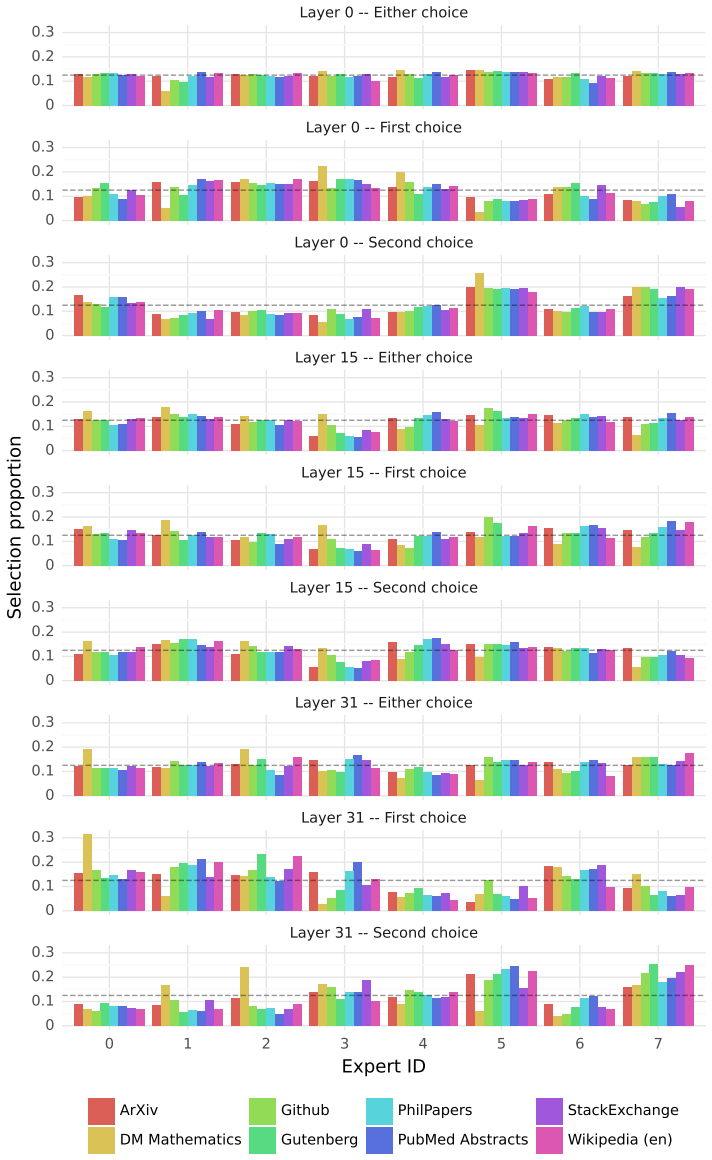
Yanqi Zhou, Tao Lei, Hanxiao Liu, Nan Du, Yanping Huang, Vincent Zhao, Andrew M Dai, Quoc V Le, James Laudon, et al. Mixture-of-experts with expert choice routing. Advances in Neural Information Processing Systems, 35:7103–7114, 2022. 11 0 0.1 0.2 0.3 Layer 0 -- Either choice 0 0.1 0.2 0.3 Layer 0 -- First choice 0 0.1 0.2 0.3 Layer 0 -- Second choice 0 0...
work page 2022
discussion (0)
Sign in with ORCID, Apple, or X to comment. Anyone can read and Pith papers without signing in.