Hybrid Two-Level Transport Method with Solution Decomposition in Macro and Micro Components
Pith reviewed 2026-07-03 19:37 UTC · model grok-4.3
The pith
The Boltzmann transport solution decomposes into macro and micro components solved iteratively in a hybrid MC/deterministic scheme.
A machine-rendered reading of the paper's core claim, the machinery that carries it, and where it could break.
Core claim
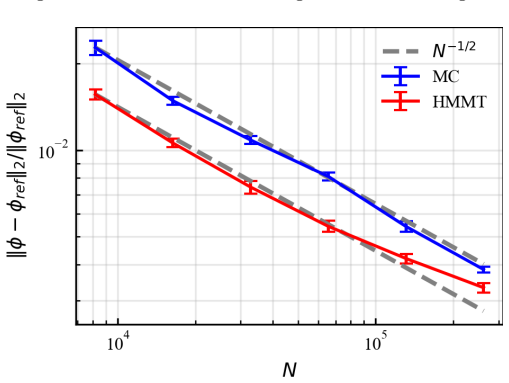
The solution of the one-group steady-state Boltzmann transport equation is decomposed into macro and micro components. The macro component is defined by the P1 approximation and obtained as the solution of hybrid low-order moment equations with exact closures. The micro component is obtained from Monte Carlo simulation. The resulting hybrid two-level system is solved by a fixed-point iteration scheme, and numerical tests confirm variance reduction together with improved efficiency.
What carries the argument
Hybrid two-level system of macro (P1) and micro (MC) equations solved by fixed-point iteration, with exact closures supplying the first two angular moments.
If this is right
- Fixed-point iteration on the coupled system converges to a hybrid solution whose Monte Carlo component has lower variance than a pure stochastic solve.
- Large-scale features handled deterministically reduce the work required for the micro component.
- Exact closures ensure the low-order equations reproduce the correct angular moments from the high-order transport solution.
- The reported numerical experiments demonstrate both variance reduction and efficiency gains for the steady-state problems tested.
Where Pith is reading between the lines
- The same macro-micro split could be tried on time-dependent or multi-group transport problems provided the P1 approximation still holds for the large scales.
- The fixed-point iteration might be replaced by other accelerators to reach convergence faster.
- Other low-order approximations besides P1 could be substituted for the macro component without changing the overall decomposition structure.
- The approach may transfer to neutron or photon transport in different geometries if the moment closures remain exact.
Load-bearing premise
The large-scale structure of the transport solution can be represented accurately enough by the P1 approximation plus exact closures for the moments.
What would settle it
Numerical tests on the same benchmark problems that show no measurable variance reduction or efficiency gain versus standard Monte Carlo would disprove the claimed benefit of the decomposition.
Figures




read the original abstract
This paper presents a new hybrid MC/deterministic method for solving the one-group steady-state Boltzmann transport equation based on decomposition of solution in macro and micro components. The macro component captures the large-scale structure of the solution. It is represented by angular moments of the high-order transport solution. The $P_1$ approximation is applied to define the macro component. The first two angular moments are obtained as a solution of hybrid low-order moment equations with exact closures. The equation for the micro component is solved using a MC simulation. The hybrid two-level system of equations for macro and micro components is solved by fixed-point iteration scheme. Numerical results are presented to demonstrate variance reduction of stochastic numerical solution and improvement in computational efficiency.
Editorial analysis
A structured set of objections, weighed in public.
Referee Report
Summary. This paper proposes a hybrid Monte Carlo/deterministic method for the one-group steady-state Boltzmann transport equation. The solution is decomposed into macro and micro components: the macro component uses the P1 approximation and is obtained from hybrid low-order moment equations with exact closures for the first two angular moments; the micro component is solved via Monte Carlo simulation. The coupled two-level system is solved by a fixed-point iteration scheme, with numerical results presented to demonstrate variance reduction in the stochastic solution and gains in computational efficiency.
Significance. If the fixed-point iteration is shown to converge reliably and the exact closures are rigorously justified, the method could advance hybrid transport solvers by combining deterministic large-scale accuracy with stochastic micro-scale detail, potentially yielding practical efficiency improvements in applications such as neutron transport or radiative transfer. The numerical demonstration of variance reduction is a positive feature, but its value depends on the iteration's stability.
major comments (1)
- [Fixed-point iteration scheme and numerical results section] The abstract states that 'the hybrid two-level system of equations for macro and micro components is solved by fixed-point iteration scheme' and that numerical results demonstrate variance reduction, yet no convergence analysis, contraction-mapping argument, spectral-radius bound, or iteration-operator properties are supplied. In transport problems the iteration can fail to contract when the scattering ratio or boundary conditions change, and Monte Carlo noise may further destabilize the coupling; without explicit conditions or counter-example verification this step is load-bearing for the claimed efficiency gains (see also the hybrid low-order moment equations with exact closures).
minor comments (1)
- The abstract refers to 'exact closures' without indicating how they are derived or verified; a brief statement in the introduction or method section would clarify this central element of the macro-component equations.
Simulated Author's Rebuttal
We thank the referee for the careful review and for identifying the need for further discussion of the fixed-point iteration. We address the major comment below.
read point-by-point responses
-
Referee: [Fixed-point iteration scheme and numerical results section] The abstract states that 'the hybrid two-level system of equations for macro and micro components is solved by fixed-point iteration scheme' and that numerical results demonstrate variance reduction, yet no convergence analysis, contraction-mapping argument, spectral-radius bound, or iteration-operator properties are supplied. In transport problems the iteration can fail to contract when the scattering ratio or boundary conditions change, and Monte Carlo noise may further destabilize the coupling; without explicit conditions or counter-example verification this step is load-bearing for the claimed efficiency gains (see also the hybrid low-order moment equations with exact closures).
Authors: We acknowledge that the manuscript does not supply a formal convergence analysis, contraction-mapping argument, or spectral-radius bound for the fixed-point iteration. The current work emphasizes the method formulation and empirical demonstration of variance reduction in the presented test cases. We will revise the paper to add a dedicated discussion of the iteration scheme, including its observed behavior under different scattering ratios and boundary conditions, the potential destabilizing effect of Monte Carlo noise, and any available conditions for reliable convergence. We will also include additional numerical experiments that explore convergence (or lack thereof) in challenging regimes and provide counter-example verification where relevant. For the hybrid low-order moment equations, the closures are exact by construction from the macro-micro decomposition of the angular moments; we will expand the derivation and justification in the revised text to make this explicit. revision: yes
Circularity Check
No significant circularity; method description is self-contained
full rationale
The abstract and description outline a hybrid MC/deterministic scheme decomposing the transport solution into macro (P1-based moments with exact closures) and micro (MC) components, solved via fixed-point iteration. No equations or steps reduce by construction to fitted inputs, self-definitions, or self-citation chains. The central claims rest on the decomposition and iteration without renaming known results or smuggling ansatzes. This is the common case of an independent methodological proposal.
Axiom & Free-Parameter Ledger
Reference graph
Works this paper leans on
-
[1]
E. W. Larsen, J. Yang, A functional Monte Carlo method for k-eigenvalue problems, Nuclear Science and Engineering 159 (2008) 107–126
work page 2008
-
[2]
E. R. Wolters, E. W. Larsen, W. R. Martin, Hybrid Monte Carlo–CMFD methods for accelerating fission source conver- gence, Nuclear Science and Engineering 174 (2013) 286–299
work page 2013
-
[3]
J. Willert, C. T. Kelley, D. A. Knoll, Hybrid deterministic/Monte Carlo neutronics, SIAM Journal on Scientific Computing 35 (5) (2013) S62–S83
work page 2013
-
[4]
J. R. Peterson, J. E. Morel, J. C. Ragusa, Exponentially-convergent monte carlo for the 1-d transport equation, in: Proc. of M&C 2013, Int. Conf. on Math. & Comp. Methods Applied to Nucl. Sci & Eng., Sun Valley, Idaho, May 5-9, 2013
work page 2013
-
[5]
M. J. Lee, H. G. Joo, D. Lee, K. Smith, Coarse mesh finite difference formulation for accelerated Monte Carlo eigenvalue calculation, Annals of Nuclear Energy 65 (2014) 101–113
work page 2014
-
[6]
V. N. Novellino, D. Y. Anistratov, Analysis of hybrid MC/deterministic methods for transport problems based on low- order equations discretized by finite volume schemes, Transactions of the American Nuclear Society 130 (2024) 408–411
work page 2024
-
[7]
M. M. Pozulp, T. S. Haut, P. S. Brantley, A hybrid second moment method for thermal radiative transfer, in: Proceedings of the International Conference on Mathematics and Computational Methods Applied to Nuclear Science and Engineering, Denver, Co, 2025, pp. 1518–1527
work page 2025
-
[8]
G. A. Radtke, J.-P. M. P´ eraud, N. G. Hadjiconstantinou, On efficient simulations of multiscale kinetic transport, Philo- sophical Transactions of the Royal Society A: Mathematical, Physical and Engineering Sciences 371 (1982) (2013) 20120182
work page 1982
-
[9]
V. Y. Gol’din, A quasi-diffusion method of solving the kinetic equation, Comp. Math. and Math. Phys. 4 (1964) 136–149
work page 1964
-
[10]
L. H. Auer, D. Mihalas, On the use of variable Eddington factors in non-LTE stellar atmospheres computations, Monthly Notices of the Royal Astronomical Society 149 (1970) 65–74
work page 1970
-
[11]
D. Y. Anistratov, V. Y. Gol’din, Nonlinear methods for solving particle transport problems, Transport Theory and Statistical Physics 22 (1993) 42–77
work page 1993
-
[12]
V. N. Novellino, Multilevel hybrid monte carlo / deterministic methods for neutral particle transport, Ph.D. thesis, North Carolina State University (May 2026)
work page 2026
discussion (0)
Sign in with ORCID, Apple, or X to comment. Anyone can read and Pith papers without signing in.