Hyperaccreting Neutron Stars inside Massive Envelopes: The Implausibility of Thorne-\.Zytkow Objects
Pith reviewed 2026-07-01 09:37 UTC · model grok-4.3
The pith
Embedded neutron stars in massive envelopes accrete hypercritically and collapse to black holes within minutes to hours rather than forming stable Thorne-Zytkow objects.
A machine-rendered reading of the paper's core claim, the machinery that carries it, and where it could break.
Core claim
Simulations of hypercritical accretion onto neutron stars embedded in massive envelopes demonstrate that neutrino cooling dominates the energy budget and prevents any sustained outflows or explosions, even though convection develops in the post-shock region. All nucleosynthetically processed material remains gravitationally bound. The neutron star therefore grows beyond the Tolman-Oppenheimer-Volkoff mass limit on timescales of minutes to hours, making these objects transient precursors to black-hole formation rather than stable Thorne-Zytkow objects.
What carries the argument
Fully coupled general relativistic hydrodynamics simulations that incorporate grey two-moment (M1) neutrino transport and an alpha-chain nuclear reaction network, applied to four distinct progenitor evolutionary stages.
If this is right
- Vigorous convection occurs in the post-shock region yet remains unable to drive an explosion because neutrino cooling balances accretion power.
- All nucleosynthetically processed material stays bound, so these systems do not contribute substantially to galactic yields through dredge-up.
- The configurations act as short-lived precursors to black-hole formation rather than long-lived stable objects.
- They may serve as central engines for high-energy transients once the neutron star collapses.
Where Pith is reading between the lines
- Population-synthesis models of binary evolution would need to replace any long-lived TZO phase with a brief hyperaccretion episode that ends in prompt black-hole formation.
- The short lifetime reduces the window during which such objects could be observed or contribute to specific classes of transients.
- Adding rotation or magnetic fields in follow-up simulations could test whether those ingredients open a pathway to stability that the present runs exclude.
Load-bearing premise
The grey two-moment neutrino transport scheme together with the alpha-chain network and the four chosen progenitor stages capture all relevant cooling, heating, and dynamical effects without missing physics that could permit explosions or long-term stability.
What would settle it
Direct observation of a Thorne-Zytkow object whose neutron-star core survives longer than a few hours, or detection of ejected material processed above 5 GK from such a system.
Figures




read the original abstract
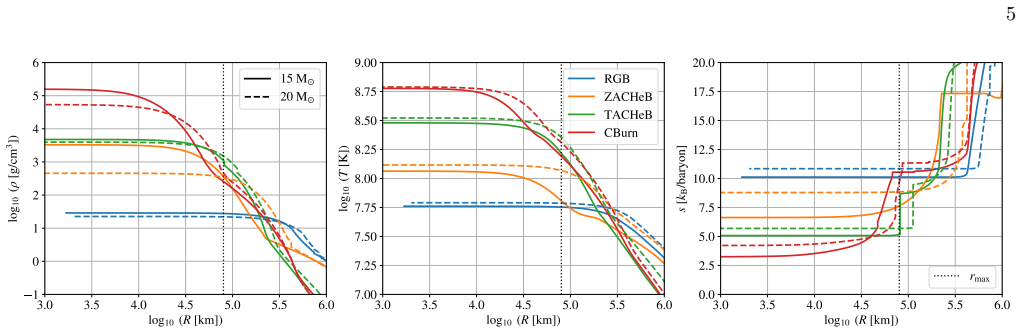
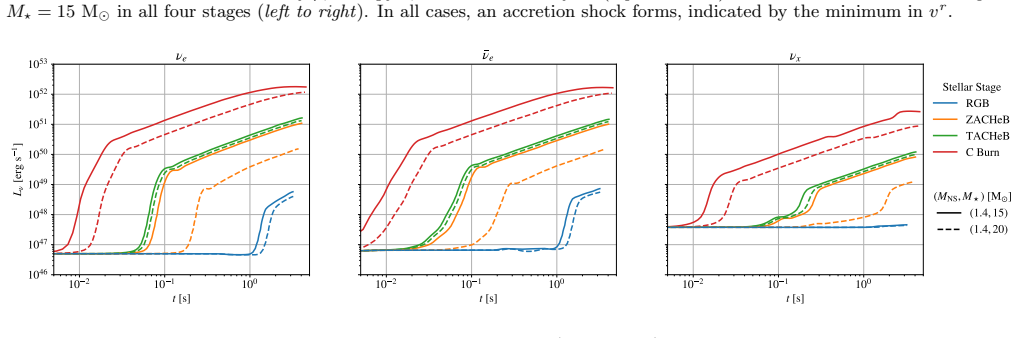
The evolution of neutron stars (NSs) embedded within massive stellar envelopes is a critical phase in binary stellar evolution, potentially leading to the formation of Thorne-\.Zytkow Objects (T\.ZOs) or catastrophic collapse. We present the first fully coupled general relativistic hydrodynamics (GRHD) simulations of hypercritical accretion onto NSs that simultaneously incorporate grey two-moment (M1) neutrino transport and an $\alpha$-chain nuclear reaction network. By investigating four distinct progenitor evolutionary stages, we resolve the complex interplay between intense neutrino cooling, multidimensional fluid dynamics, and nuclear feedback. Our results show that while vigorous convection is triggered in the post-shock region, the global energy budget is primarily governed by neutrino cooling, which effectively balances the accretion power. Crucially, even though our M1 transport scheme captures neutrino absorption and localized heating, the efficient cooling sink and high ram pressure of the infalling envelope prevent the formation of any core-collapse supernova-like explosion. We find that all nucleosynthetically processed material ($T > 5$~GK) remains strictly gravitationally bound, challenging the assumption that these systems contribute significantly to galactic nucleosynthetic yields via convective dredge-up. The lack of sustained outflows and the persistent hypercritical accretion rates suggest that embedded NSs will rapidly exceed the Tolman-Oppenheimer-Volkoff mass limit on timescales of minutes to hours. We conclude that these systems are not stable T\.ZOs, but are rather transient precursors to catastrophic black hole formation and potential central engines for high-energy transients.
Editorial analysis
A structured set of objections, weighed in public.
Referee Report
Summary. The manuscript presents the first fully coupled general relativistic hydrodynamics simulations of hypercritical accretion onto neutron stars embedded in massive stellar envelopes. Incorporating grey two-moment (M1) neutrino transport and an α-chain nuclear reaction network, the authors simulate four distinct progenitor evolutionary stages. They report that vigorous convection occurs in the post-shock region but neutrino cooling balances accretion power, preventing any core-collapse supernova-like explosions. All nucleosynthetically processed material remains gravitationally bound, and persistent hypercritical accretion causes the neutron star to exceed the Tolman-Oppenheimer-Volkoff limit on timescales of minutes to hours. The systems are concluded to be transient precursors to black hole formation rather than stable Thorne-Żytkow Objects, with potential relevance to high-energy transients.
Significance. If the reported global energy balance and absence of outflows hold under the stated numerical setup, the work would represent a notable advance in binary stellar evolution modeling by providing dynamical evidence against long-lived TZO configurations. The coupled treatment of GRHD, M1 transport, and nuclear feedback allows direct assessment of whether neutrino cooling can suppress explosions across multiple progenitors, a strength relative to prior analytic or less-coupled approaches. This could inform predictions for nucleosynthetic yields and central engines of transients, though the abstract-only access limits quantitative evaluation of the result's robustness.
major comments (1)
- [Abstract] Abstract: The central claim that hypercritical accretion persists without explosions (leading to TOV exceedance in minutes–hours) requires that neutrino cooling always dominates the global energy budget. This rests on the grey two-moment M1 scheme plus α-chain network being sufficient to capture all relevant absorption, heating, and nuclear feedback across the four progenitors. The abstract invokes this sufficiency but provides no discussion of whether multi-group transport or additional reactions could produce net heating capable of driving outflows, which would undermine the persistent-accretion premise.
minor comments (1)
- The abstract contains LaTeX rendering artifacts (e.g., 'Thorne-\.Zytkow' and 'T\.ZOs') that should be corrected for publication.
Simulated Author's Rebuttal
We thank the referee for their review. We respond to the single major comment below. Because the referee had access only to the abstract, our reply is necessarily limited to what is stated there; we note that the full manuscript contains additional methodological justification not visible in the provided text.
read point-by-point responses
-
Referee: [Abstract] Abstract: The central claim that hypercritical accretion persists without explosions (leading to TOV exceedance in minutes–hours) requires that neutrino cooling always dominates the global energy budget. This rests on the grey two-moment M1 scheme plus α-chain network being sufficient to capture all relevant absorption, heating, and nuclear feedback across the four progenitors. The abstract invokes this sufficiency but provides no discussion of whether multi-group transport or additional reactions could produce net heating capable of driving outflows, which would undermine the persistent-accretion premise.
Authors: The abstract is a concise summary of results obtained with the stated methods and does not claim that grey M1 plus the α-chain network are the only possible treatments. The central finding—that neutrino cooling balances accretion power and prevents outflows—is a direct outcome of the simulations performed. We agree that the abstract would benefit from an explicit caveat on the approximations employed. We will therefore revise the abstract to include a short clause noting that multi-group transport and extended reaction networks are computationally prohibitive for the simulated timescales but are expected to be explored in follow-up work. This revision does not alter the reported results or conclusions. revision: yes
Circularity Check
No circularity; conclusions are direct numerical outputs of the described simulations
full rationale
The paper's central claim—that embedded NSs exceed the TOV limit on short timescales because neutrino cooling dominates and prevents explosions—follows from the reported GRHD simulation results with M1 transport and α-chain network across four progenitors. No parameter is fitted to a subset and then relabeled as a prediction, no self-citation supplies a load-bearing uniqueness theorem, and no ansatz or known result is renamed. The derivation chain consists of running the coupled equations and inspecting the global energy budget and bound material; this is self-contained against external benchmarks and does not reduce to its own inputs by construction.
Axiom & Free-Parameter Ledger
axioms (2)
- domain assumption Grey two-moment (M1) neutrino transport accurately models absorption, emission, and net cooling in the post-shock region.
- domain assumption The alpha-chain nuclear reaction network sufficiently tracks nucleosynthesis for material above 5 GK.
discussion (0)
Sign in with ORCID, Apple, or X to comment. Anyone can read and Pith papers without signing in.