MOSAIC at ELT: Design and First Prototyping of Novel Robotic Optical-Relay Positioners
Pith reviewed 2026-07-02 21:51 UTC · model grok-4.3
The pith
Robotic positioners integrate relay mirrors, pupil-pointing, and per-unit ADCs to feed fixed fibers 600 mm behind the ELT focal plane.
A machine-rendered reading of the paper's core claim, the machinery that carries it, and where it could break.
Core claim
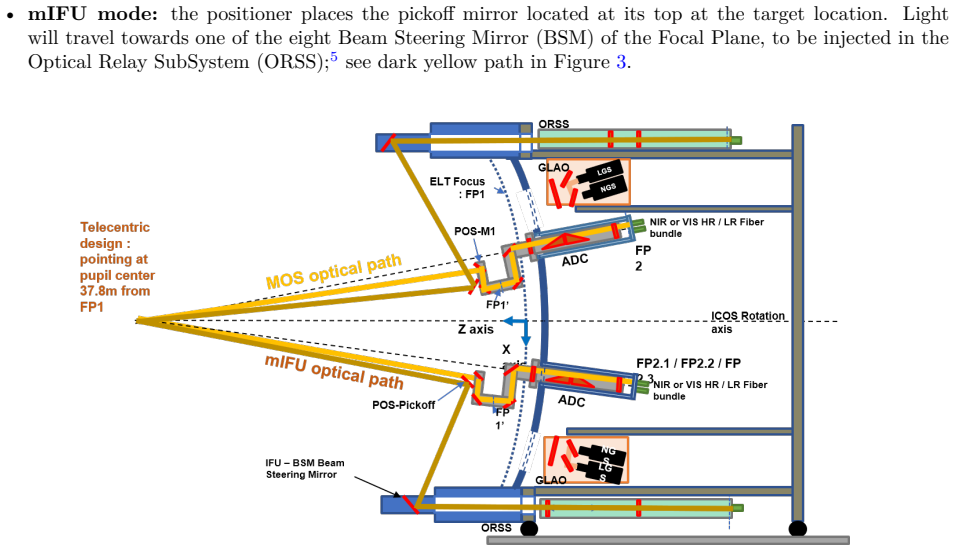
The authors describe a positioner architecture in which a relay-mirror assembly patrols the focal surface, reimages the selected sub-field onto one of two fixed fiber bundles located 600 mm behind the focal plane, continuously adjusts its orientation to the distant ELT pupil, and incorporates an individual ADC; first prototypes of this integrated unit have been built to verify basic functionality ahead of manufacturing 300 copies.
What carries the argument
The integrated robotic optical-relay positioner that combines patrol mirrors, pupil-pointing mechanism, and per-positioner ADC into a single unit.
If this is right
- Light from any point on the ELT focal surface can be directed to the NIR or VIS spectrographs via the fixed fiber bundles.
- The design removes the need for a single global ADC that would be impossible to construct at ELT scale.
- The same positioner units can be replicated to the required quantity of approximately 300 without redesigning the core optical layout.
- Each positioner can operate independently, allowing simultaneous observation of multiple targets across the full field.
Where Pith is reading between the lines
- Future extremely large telescopes may adopt similar per-positioner relay and correction modules rather than attempting monolithic correctors.
- Reliability data from the 300-unit production run could inform whether robotic pick-off systems become standard for next-generation multi-object instruments.
- The 600 mm fiber-bundle offset and 37.868 m pupil distance set concrete geometric constraints that any competing MOS design on the ELT would also have to meet.
Load-bearing premise
The three optical subsystems can be packaged together in one robotic unit while preserving the required image quality and long-term reliability when 300 copies are manufactured.
What would settle it
A completed prototype that fails to deliver the required throughput or pointing stability when its relay mirrors are driven across the patrol field while the ADC is adjusted and the unit is oriented toward the simulated 37.868 m pupil.
Figures




read the original abstract
The Extremely Large Telescope (ELT) is, to date, the most ambitious ground-based telescope under construction. MOSAIC is a multi-objects spectrograph (MOS) that aims to make full use of the largest telescope in the world. At its heart, about 300 robotic positioners will pick-off skylight from the focal surface of the ELT to feed it to its Near Infrared (NIR) and visible (VIS) spectrographs. The gigantic scale of the ELT presents three main challenges for MOSAIC positioners: (1) the light beams on the focal surface cannot be focused in a single fiber, similarly to other MOS instruments, involving a design with relay mirrors patrolling the field of view, and reimaging the sub-field on 2 fixed fiber bundles located 600 mm behind the ELT focal plane (2) The positioner needs to adapt to the local telecentricity, which means it has to point at the ELT pupil center located 37.868 m away from the focal plane (3) The Atmospheric Dispersion Corrector (ADC) needed to cover the whole focal surface of the ELT is impossible to build to this scale; hence each positioner needs its own ADC. EPFL is responsible for designing and supervising the mass manufacturing of the positioners. This paper aims to present its initial design and prototypes.
Editorial analysis
A structured set of objections, weighed in public.
Referee Report
Summary. The manuscript presents the design and initial prototypes of novel robotic optical-relay positioners for the MOSAIC multi-object spectrograph on the ELT. It identifies three scale-driven challenges: relay mirrors to reimage sub-fields onto fixed fiber bundles 600 mm behind the focal plane, per-positioner adaptation to local telecentricity by pointing at the pupil 37.868 m distant, and individual ADCs per unit because a global ADC is infeasible at ELT scale. EPFL leads design and mass manufacturing of ~300 units; the paper focuses on the conceptual integration of these functions into a single robotic positioner and shows first hardware prototypes.
Significance. If the integrated design meets image-quality and reliability targets at scale, the positioners would be enabling hardware for MOSAIC, allowing efficient exploitation of the ELT's full focal surface for multi-object spectroscopy. The work directly addresses a recognized instrumentation bottleneck for ELT-scale MOS instruments. However, the current manuscript supplies only descriptive design and prototype photographs without quantitative performance metrics, error budgets, or yield estimates, so the significance remains prospective rather than demonstrated.
major comments (2)
- [Design and Prototyping sections (overall manuscript)] The central engineering claim—that relay-mirror, pupil-pointing, and per-unit ADC functions can be integrated into one robotic unit while remaining manufacturable at the 300-unit scale—is not supported by any tolerance stack-up, Monte-Carlo yield analysis, or error budget. No section quantifies how mirror positioning repeatability, ADC prism wedge errors, and servo accuracy for the 37.868 m pupil distance combine to affect final image quality or fiber coupling efficiency.
- [Prototyping results] The abstract and introduction state that prototypes demonstrate individual functions, yet the text provides no measured performance data (e.g., positioning repeatability, ADC correction range, pupil-pointing accuracy, or throughput) that would allow assessment of whether the three subsystems can operate simultaneously within required tolerances.
minor comments (2)
- [N/A] The manuscript would benefit from a dedicated section or table that tabulates the key optical and mechanical requirements (e.g., required pointing accuracy, ADC dispersion correction range, relay magnification) alongside the achieved prototype values.
- [Figures] Figure captions and text should explicitly label which prototype hardware corresponds to which subsystem (relay, ADC, or pupil-pointing mechanism) to improve traceability.
Simulated Author's Rebuttal
We thank the referee for the constructive review. The manuscript describes the initial design and first hardware prototypes of the MOSAIC positioners, emphasizing the conceptual integration of relay optics, pupil pointing, and per-unit ADCs at ELT scale. We respond to the major comments below and note that this is an early-stage design paper rather than a performance validation study.
read point-by-point responses
-
Referee: [Design and Prototyping sections (overall manuscript)] The central engineering claim—that relay-mirror, pupil-pointing, and per-unit ADC functions can be integrated into one robotic unit while remaining manufacturable at the 300-unit scale—is not supported by any tolerance stack-up, Monte-Carlo yield analysis, or error budget. No section quantifies how mirror positioning repeatability, ADC prism wedge errors, and servo accuracy for the 37.868 m pupil distance combine to affect final image quality or fiber coupling efficiency.
Authors: The manuscript's central claim is limited to demonstrating that the three functions can be integrated into a single robotic unit at the conceptual and initial-prototype level; it does not assert that the integrated design already meets final image-quality or yield targets. No tolerance stack-up or Monte-Carlo analysis is presented because the work is at the first-prototyping stage. We will add a new subsection in the revised manuscript that outlines the principal tolerance drivers (mirror repeatability, ADC wedge, pupil-pointing servo) and the planned error-budget approach, while clearly stating that full quantitative analysis awaits more mature prototypes. revision: partial
-
Referee: [Prototyping results] The abstract and introduction state that prototypes demonstrate individual functions, yet the text provides no measured performance data (e.g., positioning repeatability, ADC correction range, pupil-pointing accuracy, or throughput) that would allow assessment of whether the three subsystems can operate simultaneously within required tolerances.
Authors: The prototypes are first hardware units built to verify mechanical integration and basic operability of the combined subsystems; they were not yet subjected to the metrology campaign needed to extract the cited performance numbers. We will revise the abstract and introduction to remove any implication that quantitative demonstration has occurred and will add a short paragraph describing the ongoing test program. Measured data will be reported in subsequent publications once testing is complete. revision: yes
- Quantitative performance metrics (repeatability, accuracy, throughput) from the current prototypes are not available because systematic testing has not been completed.
Circularity Check
No circularity: purely descriptive engineering design paper with no derivations or predictions
full rationale
The manuscript is an engineering design summary of robotic positioners for MOSAIC. It states three challenges (relay mirrors, local telecentricity pointing, per-positioner ADCs) and describes prototypes, but contains no equations, fitted parameters, predictions, or load-bearing derivations. No self-citations are invoked to justify uniqueness or ansatzes. The central claim of integration feasibility for 300 units is presented as an engineering goal without quantitative tolerance analysis or yield modeling, but this absence does not create circularity—it simply leaves the integration claim unquantified. The document is self-contained as a descriptive report.
Axiom & Free-Parameter Ledger
Reference graph
Works this paper leans on
-
[1]
Schallig, Ellen , year =
-
[2]
Cvetojevic, Nick , year =
-
[3]
Pogge, Richard W. and Derwent, Mark A. and O'Brien, Thomas P. and Jurgenson, Colby A. and Pappalardo, Daniel and Engelman, Michael and Brandon, Christopher and Brady, Julia and Clawson, Nicholas and Shover, Jon and Mason, Jerry and Kneib, Jean-Paul and Araujo, Ricardo and Bouri, Mohamed and Kronig, Luzius and Grossen, Loïc and Gillet, Denis and Macktoobia...
-
[4]
Journal of Astronomical Telescopes, Instruments, and Systems , author =
Focal. Journal of Astronomical Telescopes, Instruments, and Systems , author =. 2019 , note =. doi:10.1117/1.JATIS.5.1.014003 , abstract =
-
[5]
Mainieri, Vincenzo and Anderson, Richard I. and Brinchmann, Jarle and Cimatti, Andrea and Ellis, Richard S. and Hill, Vanessa and Kneib, Jean-Paul and McLeod, Anna F. and Opitom, Cyrielle and Roth, Martin M. and Sanchez-Saez, Paula and Smiljanic, Rodolfo and Tolstoy, Eline and Bacon, Roland and Randich, Sofia and Adamo, Angela and Annibali, Francesca and ...
-
[6]
Besuner, Robert and Dey, Arjun and Drlica-Wagner, Alex and Ebina, Haruki and Moroni, Guillermo Fernandez and Ferraro, Simone and Forero-Romero, Jaime and Honscheid, Klaus and Jelinsky, Pat and Lang, Dustin and Levi, Michael and Martini, Paul and Myers, Adam and Palanque-Delabrouille, Nathalie and Panda, Swayamtrupta and Poppett, Claire and Sailer, Noah an...
-
[7]
Science China Physics, Mechanics & Astronomy , author =
From. Science China Physics, Mechanics & Astronomy , author =. 2025 , note =. doi:10.1007/s11433-025-2725-3 , abstract =
-
[8]
, year =
Diestel, R. , year =. Graph
-
[9]
2025 , note =
Wikipedia , author =. 2025 , note =
2025
-
[10]
N., Doel, P., Gutierrez, G., et al
The. The Astronomical Journal , author =. 2024 , pages =. doi:10.3847/1538-3881/ad45fe , abstract =
-
[11]
Developing an integrated concept for the
Rodrigues, Myriam and Dalton, Gavin and Fitzsimons, Ewan and Chemla, Fanny and Morris, Tim and Hammer, Francois and Puech, Mathieu and Evans, Christopher and Jagourel, Pascal , month = aug, year =. Developing an integrated concept for the. doi:10.1117/12.2232562 , abstract =
-
[12]
Sayres, Conor and Sánchez-Gallego, José R. and Blanton, Michael R. and Engelman, Michael and Finkbeiner, Douglas P. and Hogg, David W. and Holtzman, Jon A. and Jurgenson, Colby and Pogge, Richard W. and Ramírez, Solange and Saydjari, Andrew K. and Schlafly, Edward F. and Tuttle, Sarah , month = aug, year =. Ground-based and. doi:10.1117/12.2630507 , abstract =
-
[13]
Leitner, Daniela and Aguilar, Jessica and Ameel, Jon and Besuner, Robert and Claybaugh, Todd and Heetderks, Henry and Schubnell, Michael and Kneib, Jean-Paul and Silber, Joseph and Tarlé, Gregory and Weaverdyck, Curtis and Zhang, Kai , year =. Dark. doi:10.48550/ARXIV.1807.09907 , abstract =
work page internal anchor Pith review Pith/arXiv arXiv doi:10.48550/arxiv.1807.09907
-
[14]
and Gershkovich, Irena and Hoerler, Philipp and Kneib, Jean-Paul and Heetderks, Henry D
Schubnell, Michael and Ameel, Jon and Besuner, Robert W. and Gershkovich, Irena and Hoerler, Philipp and Kneib, Jean-Paul and Heetderks, Henry D. and Silber, Joseph H. and Tarlé, Gregory and Weaverdyck, Curtis , month = aug, year =. The. Ground-based and. doi:10.1117/12.2233370 , abstract =
-
[15]
arXiv.org , author =
Dark. arXiv.org , author =
-
[16]
Prototyping of 6.2-mm-Pitch Fiber Positioner Modules for Stage-V Telescope Instrumentation
Galal, Malak and Rombach, Maxime and Wei, Jonathan and Suárez, Oliver Pineda and Araújo, Ricardo and Pernecker, Sébastien and Bault, Abby and Silber, Joseph Harry and Wenner, Nicholas and Besuner, Robert and Kirkby, David and Shourt, William Van and Caseiro, Stefane and Magnenat, Corentin and Moser, Yves and Kobayashi, Yasuyuki and Fukushima, Eri and Sono...
work page internal anchor Pith review Pith/arXiv arXiv doi:10.48550/arxiv.2508.19711
-
[17]
Fiber optic throughput performance evaluation in multi-fiber termination connectors , volume =
Farr, Emily and Tuttle, Sarah and Wilson, John and Pahuja, Rishi and Mandeville, Travis and Jurgenson, Colby and Kadlec, Kal and Wachter, Stefanie and Ramirez, Solange , month = aug, year =. Fiber optic throughput performance evaluation in multi-fiber termination connectors , volume =. Ground-based and. doi:10.1117/12.2629751 , abstract =
-
[18]
Fusion splicing: a novel approach to fiber connections for the
Fagrelius, Parker and Poppett, Claire and Edelstein, Jerry , month = aug, year =. Fusion splicing: a novel approach to fiber connections for the. Ground-based and. doi:10.1117/12.2231331 , abstract =
-
[19]
Overview of the. The Astronomical Journal , author =. 2019 , pages =. doi:10.3847/1538-3881/ab089d , abstract =
-
[20]
2024, AJ, 168, 245, doi: 10.3847/1538-3881/ad76a4
Poppett, Claire and Tyas, Luke and Aguilar, J. and Bebek, Christopher and Bramall, D. and Claybaugh, T. and Edelstein, J. and Fagrelius, P. and Heetderks, H. and Jelinsky, P. and Jelinsky, S. and Lafever, Robin and Lambert, A. and Lampton, M. and Levi, Michael E. and Martini, P. and Rockosi, C. and Schmoll, J. and Sharples, Ray M. and Sirk, Martin and Wis...
-
[21]
and Wang, Adeline and Bryant, Julia , month = aug, year =
Sathi, Zinat M. and Wang, Adeline and Bryant, Julia , month = aug, year =. Optimizing fibre connectors for high throughput and low. Advances in. doi:10.1117/12.3017730 , abstract =
-
[22]
FS.com , author =
1m (3ft). FS.com , author =
-
[23]
Schmoll, Jurgen , year =
-
[24]
Morris, Simon L. and Cuby, Jean-Gabriel and Dubbeldam, Marc and Evans, Christopher and Fusco, Thierry and Jagourel, Pascal and Myers, Richard M. and Parr-Burman, Phil and Rousset, Gerard and Schnetler, Hermine , editor =. The. 2012 , pages =. doi:10.1117/12.925889 , abstract =
-
[25]
2010 , note =
The Messenger , author =. 2010 , note =
2010
-
[26]
Gonzalez, Oscar and Cirasuolo, Michele and Taylor, William and Black, Martin and Rees, Philip and Bryson, Ian and Chittick, Stephen and Afonso, Jose and Lilly, Simon and Flores, Hector and Maiolino, Roberto and Oliva, Ernesto and Paltani, Stephane and Vanzi, Leonardo and Abreu, Manuel and Amans, Jean-Philippe and Atkinson, David and Beard, Steven and Belf...
-
[27]
Fibre assignment in next-generation wide-field spectrographs , volume =. Monthly Notices of the Royal Astronomical Society , author =. 2012 , note =. doi:10.1111/j.1365-2966.2011.19774.x , abstract =
-
[28]
Gajewski, Paul and Żurek, Dominik and Pietroń, Marcin and Faber, Kamil , month = oct, year =. Solving. doi:10.48550/arXiv.2410.06347 , abstract =
work page internal anchor Pith review Pith/arXiv arXiv doi:10.48550/arxiv.2410.06347
-
[29]
Research in Astronomy and Astrophysics , author =
Fault. Research in Astronomy and Astrophysics , author =. 2023 , pages =. doi:10.1088/1674-4527/acfd02 , abstract =
-
[30]
Advanced Intelligent Systems , author =
Long. Advanced Intelligent Systems , author =. 2024 , pages =. doi:10.1002/aisy.202300703 , abstract =
-
[31]
Swarm-. Frontiers in Robotics and AI , author =. doi:10.3389/frobt.2017.00012 , abstract =
-
[32]
Fan, Tingxiang and Long, Pinxin and Liu, Wenxi and Pan, Jia , month = aug, year =. Fully. doi:10.48550/arXiv.1808.03841 , abstract =
work page internal anchor Pith review Pith/arXiv arXiv doi:10.48550/arxiv.1808.03841
-
[33]
doi:10.48550/arXiv.2408.06656 , abstract =
Guo, Yicheng and Liu, Jiaqi and Yu, Rongjie and Hang, Peng and Sun, Jian , month = aug, year =. doi:10.48550/arXiv.2408.06656 , abstract =
-
[34]
Zhang, Kaiqing and Yang, Zhuoran and Liu, Han and Zhang, Tong and Başar, Tamer , month = feb, year =. Fully. doi:10.48550/arXiv.1802.08757 , abstract =
work page internal anchor Pith review Pith/arXiv arXiv doi:10.48550/arxiv.1802.08757
-
[35]
New York, NY: Springer New York
Liang, Jinhao and Christopher, Jacob K. and Koenig, Sven and Fioretto, Ferdinando , month = jun, year =. Simultaneous. doi:10.48550/arXiv.2502.03607 , abstract =
-
[36]
Carvalho, Joao and Le, An T. and Baierl, Mark and Koert, Dorothea and Peters, Jan , month = mar, year =. Motion. doi:10.48550/arXiv.2308.01557 , abstract =
-
[37]
Complex System Modeling and Simulation , author =
Distributed. Complex System Modeling and Simulation , author =. 2022 , pages =. doi:10.23919/CSMS.2022.0017 , abstract =
-
[38]
Hierarchical hybrid control for. IFAC-PapersOnLine , author =. 2019 , pages =. doi:10.1016/j.ifacol.2019.08.093 , abstract =
-
[39]
Introduction to Graph Neural Networks for Machine Learning Engineers
Tanis, James H. and Giannella, Chris and Mariano, Adrian V. , month = dec, year =. Introduction to. doi:10.48550/arXiv.2412.19419 , abstract =
work page internal anchor Pith review Pith/arXiv arXiv doi:10.48550/arxiv.2412.19419
-
[40]
H., Fagrelius, P., Fanning, K., et al
The. The Astronomical Journal , author =. 2023 , note =. doi:10.3847/1538-3881/ac9ab1 , abstract =
-
[41]
doi:10.48550/arXiv.2409.00134 , abstract =
Andreychuk, Anton and Yakovlev, Konstantin and Panov, Aleksandr and Skrynnik, Alexey , month = apr, year =. doi:10.48550/arXiv.2409.00134 , abstract =
-
[42]
The Astronomical Journal , author =. 2021 , note =. doi:10.3847/1538-3881/abd0f2 , abstract =
-
[43]
Goeckner, Anthony and Sui, Yueyuan and Martinet, Nicolas and Li, Xinliang and Zhu, Qi , month = mar, year =. Graph. doi:10.48550/arXiv.2403.13093 , abstract =
-
[44]
Biasi, Roberto and Gallieni, Daniele and Briguglio, Runa and Vernet, Elise and Andrighettoni, Mario and Angerer, Gerald and Pescoller, Dietrich and Manetti, Mauro and Tintori, Matteo and Mantegazza, Marco and Lazzarini, Paolo and Fumi, Pierluigi and Anaclerio, Vincenzo and Xompero, Marco and Pariani, Giorgio and Riccardi, Armando and Cayrel, Marc and Dier...
-
[45]
Tamura, Naoyuki and Yabe, Kiyoto and Koshida, Shintaro and Moritani, Yuki and Tanaka, Masayuki and Ishigaki, Miho N. and Ishizuka, Yuki and Kamata, Yukiko and Allaoui, Ali and Arai, Akira and Arnouts, Stéphane and Barette, Rudy and Barkhouser, Robert H. and Bergeron, Eddie and Blanchard, Patrick and Caplar, Neven and Carle, Michael and Chabaud, Pierre-Yve...
-
[46]
The Adaptive Mirror for the E-ELT , author =
The. The Adaptive Mirror for the E-ELT , author =. doi:10.12839/AO4ELT3.13431 , language =
-
[47]
Dark Energy Spectroscopic Instrument (DESI) Fiber Positioner Thermal and Wind Disturbance Test
Zhang, Kai and Silber, Joseph H. and Heetderks, Henry D. and Leitner, Daniela and Schubnell, Michael and Levi, Michael and Wang, Gradey and Fanning, Kevin and Fagrelius, Parker and Dobson, Carl and Aguilar, Jessica , year =. Dark. doi:10.48550/ARXIV.1807.09383 , abstract =
work page internal anchor Pith review Pith/arXiv arXiv doi:10.48550/arxiv.1807.09383
-
[48]
Schlegel, David J. and Kollmeier, Juna A. and Aldering, Greg and Bailey, Stephen and Baltay, Charles and Bebek, Christopher and BenZvi, Segev and Besuner, Robert and Blanc, Guillermo and Bolton, Adam S. and Bonaca, Ana and Bouri, Mohamed and Brooks, David and Buckley-Geer, Elizabeth and Cai, Zheng and Crane, Jeffrey and Demina, Regina and DeRose, Joseph a...
-
[49]
25,000 optical fiber positioning robots for next-generation cosmology,
Silber, Joseph H. and Schlegel, David J. and Araujo, Ricardo and Baltay, Charles and Besuner, Robert W. and Farr, Emily and Guy, Julien and Kneib, Jean-Paul and Poppett, Claire and Mandeville, Travis A. and Schubnell, Michael and Thurneysen, Markus and Tuttle, Sarah , month = dec, year =. 25,000 optical fiber positioning robots for next-generation cosmolo...
-
[50]
and Galal, Malak and Schlegel, David and Kneib, Jean-Paul , editor =
Rombach, Maxime and Xu, Xiangyu and Araujo, Ricardo and Thurneysen, Markus and Caseiro, Stefane and Magnenat, Corentin and Silber, Joseph H. and Galal, Malak and Schlegel, David and Kneib, Jean-Paul , editor =. Investigations on assembly and coverage for modular focal planes of multiplexed telescopes , url =. Ground-based and. 2024 , pages =. doi:10.1117/...
-
[51]
, month = jan, year =
Ramsey, Lawrence W. , month = jan, year =. Focal ratio degradation in optical fibers of astronomical interest. , volume =
-
[52]
Gutierrez, Pablo and Atkinson, David and Beard, Steven and Di Lieto, Nicola , editor =. Ethernet to multi-. Software and. 2020 , pages =. doi:10.1117/12.2557215 , urldate =
-
[53]
Sphinx: a massively multiplexed fiber positioner for
Smedley, Scott and Baker, Gabriella and Brown, Rebecca and Gilbert, James and Gillingham, Peter and Saunders, Will and Sheinis, Andrew and Venkatesan, Sudharshan and Waller, Lewis , editor =. Sphinx: a massively multiplexed fiber positioner for. Ground-based and. 2018 , pages =. doi:10.1117/12.2310021 , urldate =
discussion (0)
Sign in with ORCID, Apple, or X to comment. Anyone can read and Pith papers without signing in.