Hadronization of Λ_c^+ baryons from recombination model in Pb+Pb collisions at the Large Hadron Collider
Pith reviewed 2026-07-03 11:19 UTC · model grok-4.3
The pith
Recombination of quarks in the QGP accounts for the spectra, yield ratios, and flow of Λ_c⁺ baryons in Pb+Pb collisions.
A machine-rendered reading of the paper's core claim, the machinery that carries it, and where it could break.
Core claim
Within the quark recombination framework, the production of Λ_c⁺ baryons in Pb+Pb collisions at √s_NN = 5.02 TeV is described by including the energy loss of light and charm quarks inside the hot and dense medium. The model accounts for the p_T spectra, the Λ_c⁺/D⁰ ratio attributed to recombination dominance in the QGP, and the second harmonic coefficient v2 with emphasis on minijet effects on azimuthal anisotropy. Extension to 2.76 TeV provides predictions for the baryons and the ratio.
What carries the argument
Quark recombination mechanism that forms Λ_c⁺ baryons from charm and light quarks, together with quark energy loss and minijet contributions to azimuthal anisotropy.
If this is right
- The transverse momentum spectra of Λ_c⁺ baryons are reproduced by the model.
- The Λ_c⁺/D⁰ yield ratio is explained by recombination dominance in the QGP.
- The second harmonic coefficient v2 is described, with minijets affecting the anisotropy.
- Predictions are given for Λ_c⁺ production and the yield ratio in Pb+Pb collisions at 2.76 TeV.
Where Pith is reading between the lines
- The same recombination treatment may apply to other charmed hadrons if their ratios follow similar patterns.
- Minijet effects on flow could be tested with additional particles or in smaller collision systems.
- Energy loss parameters tuned here might be checked against high-p_T data in future runs.
Load-bearing premise
Recombination dominates over fragmentation and other channels for forming Λ_c⁺ at the momenta studied.
What would settle it
New data showing that the observed Λ_c⁺/D⁰ ratio or v2 cannot be reproduced simultaneously with the p_T spectra under the recombination assumptions.
Figures


read the original abstract
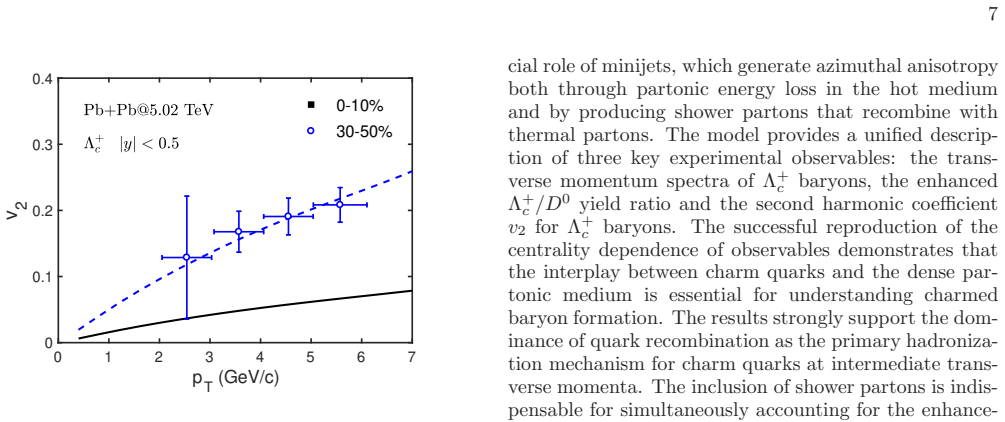
The production of $\Lambda_c^+$ baryons in Pb+Pb collisions at $\sqrt{s_{NN}} = 5.02$ TeV is investigated within the quark recombination framework, including the energy loss of light and charm quarks inside the hot and dense medium. The model simultaneously describes the transverse momentum ($p_T$) spectra of $\Lambda_c^+$ baryons, $\Lambda_c^+/D^0$ yield ratio, which is attributed to the dominance of quark recombination mechanism in the Quark-Gluon Plasma (QGP), and the second harmonic coefficient of $\Lambda_c^+$ baryons with emphasis on the effects of minijets on the azimuthal anisotropy. Furthermore, we extend the theoretical calculation to Pb+Pb collisions at $\sqrt{s_{NN}} =2.76$ TeV and make predictions for $\Lambda_c^+$ baryons and $\Lambda_c^+/D^0$ yield ratio. The simultaneous description of the yield, baryon-to-meson ratio, and azimuthal anisotropy further validates that the recombination model is an effective hadronization mechanism in heavy-ion collisions.
Editorial analysis
A structured set of objections, weighed in public.
Referee Report
Summary. The manuscript develops a quark recombination model incorporating energy loss of light and charm quarks to describe Λ_c⁺ production in Pb+Pb collisions at √s_NN = 5.02 TeV. It claims simultaneous reproduction of the p_T spectra, the Λ_c⁺/D⁰ yield ratio (attributed to recombination dominance in the QGP), and the elliptic flow v2 (with emphasis on minijet contributions to anisotropy), and extends the calculation to make predictions at √s_NN = 2.76 TeV.
Significance. If the model achieves a robust simultaneous description of the three observables with its stated parameters and if recombination can be shown to be required rather than assumed, the work would add supporting evidence that recombination is an effective hadronization mechanism for charmed baryons in heavy-ion collisions.
major comments (3)
- [Abstract] Abstract: the claim that the model 'simultaneously describes' the p_T spectra, Λ_c⁺/D⁰ ratio, and v2 provides no quantitative fit metrics (χ², error bars, or data-selection criteria), preventing assessment of whether the description is successful or merely consistent with the data.
- [Abstract] Abstract: the attribution of the Λ_c⁺/D⁰ ratio to 'dominance of quark recombination mechanism' assumes recombination dominates other channels (fragmentation, etc.) at the relevant p_T without demonstrating that alternative hadronization prescriptions fail to reproduce the same three observables under comparable parameter constraints.
- [Abstract] Abstract: the calculations at √s_NN = 2.76 TeV are presented as 'predictions,' yet the free parameters (energy-loss parameters for light and charm quarks, recombination strength parameters) are expected to be constrained by the 5.02 TeV data; without an explicit statement of which parameters are held fixed versus refitted, it is unclear whether the 2.76 TeV results constitute independent tests.
minor comments (1)
- [Abstract] The abstract refers to 'the specific treatment of minijets on the azimuthal anisotropy' but supplies no information on the implementation, normalization, or constraints of the minijet component.
Simulated Author's Rebuttal
We thank the referee for the constructive comments. We address each major comment below and indicate revisions to improve the manuscript.
read point-by-point responses
-
Referee: [Abstract] Abstract: the claim that the model 'simultaneously describes' the p_T spectra, Λ_c⁺/D⁰ ratio, and v2 provides no quantitative fit metrics (χ², error bars, or data-selection criteria), preventing assessment of whether the description is successful or merely consistent with the data.
Authors: The abstract uses 'simultaneously describes' based on the visual agreement shown in the figures of the manuscript. Quantitative metrics such as χ² are not provided because the comparison is phenomenological and the data uncertainties are dominated by systematics that are not always straightforward to incorporate into a global fit. We will revise the abstract to state that the model 'provides a consistent description' of the observables and add a brief statement in the text on the quality of agreement. revision: yes
-
Referee: [Abstract] Abstract: the attribution of the Λ_c⁺/D⁰ ratio to 'dominance of quark recombination mechanism' assumes recombination dominates other channels (fragmentation, etc.) at the relevant p_T without demonstrating that alternative hadronization prescriptions fail to reproduce the same three observables under comparable parameter constraints.
Authors: The manuscript is developed entirely within the recombination framework, where the enhanced baryon-to-meson ratio emerges naturally from the coalescence of charm and light quarks. While a direct side-by-side comparison with pure fragmentation or other hybrid models is not performed here, the simultaneous reproduction of spectra, ratio, and v₂ under a single set of parameters supports recombination as an effective mechanism. We will revise the abstract to attribute the ratio to 'the recombination mechanism within the model' rather than claiming dominance without qualification. revision: yes
-
Referee: [Abstract] Abstract: the calculations at √s_NN = 2.76 TeV are presented as 'predictions,' yet the free parameters (energy-loss parameters for light and charm quarks, recombination strength parameters) are expected to be constrained by the 5.02 TeV data; without an explicit statement of which parameters are held fixed versus refitted, it is unclear whether the 2.76 TeV results constitute independent tests.
Authors: The energy-loss and recombination parameters are fixed by the 5.02 TeV data and then applied without refitting to generate the 2.76 TeV results. We will add an explicit statement to this effect in both the abstract and the main text to clarify that the lower-energy calculations are genuine predictions. revision: yes
Circularity Check
No significant circularity detected
full rationale
The provided abstract and description show a recombination model with energy loss fitted to 5.02 TeV data for spectra, baryon-to-meson ratio, and v2, followed by extension to predictions at 2.76 TeV. No equations, self-citations, or explicit reductions are quoted that demonstrate any prediction or result being equivalent to its inputs by construction (e.g., no fitted parameter renamed as independent prediction, no self-definitional loop, no load-bearing uniqueness theorem from overlapping authors). The simultaneous description is presented as validation of the model against external data, and the derivation chain remains self-contained without meeting the strict criteria for circularity.
Axiom & Free-Parameter Ledger
free parameters (2)
- energy loss parameters for light and charm quarks
- recombination strength parameters
axioms (1)
- domain assumption Quark recombination is the dominant hadronization mechanism inside the QGP for the momenta considered
Reference graph
Works this paper leans on
-
[1]
The thermal and shower partons in various combinations are shown by different line types, which dominate at different pT re- gions
The recombination model reproduces very well the experimental data from the ALICE Collabora- tion shown by black solid squares [ 22]. The thermal and shower partons in various combinations are shown by different line types, which dominate at different pT re- gions. At low and intermediate pT , the Λ + c yield is dom- inated by the T T T component. The T T S...
-
[2]
In our earlier work [ 22], the production of D0 mesons in Pb+Pb collisions at √ sN N = 5
It should be emphasized that all parameters are fixed in our earlier work except the statistical factor gΛ + c st , whose value is equal to 0.24. In our earlier work [ 22], the production of D0 mesons in Pb+Pb collisions at √ sN N = 5. 02 TeV has been studied within the recombination model. Therefore, it is natu- ral to consider the Λ + c/D 0 yield ratio, ...
-
[3]
76 TeV, were determined in Ref
All other parameters: γ0 and q0 in γ factor, inverse slopesTq andTc, and normalization factors Cq andCc for Pb+Pb collisions at √ sN N = 2. 76 TeV, were determined in Ref. [ 22]. Therefore, we extend the investigation to√ sN N = 2. 76 TeV and present predictions for transverse momentum spectra of Λ + c baryons and Λ + c/D 0 ratio in Figs. 4 and 5, respect...
-
[4]
Busza, K
W. Busza, K. Rajagopal and W. van der Schee, Ann. Rev. Nucl. Part. Sci. 68, 339-376 (2018)
2018
-
[5]
Bazavov, T
A. Bazavov, T. Bhattacharya, M. Cheng, C. DeTar, H. T. Ding, S. Gottlieb, R. Gupta, P. Hegde, U. M. Heller and F. Karsch, et al. Phys. Rev. D 85, 054503 (2012)
2012
-
[6]
Adam et al
J. Adam et al. [STAR], Phys. Rev. Lett. 124, 172301 (2020)
2020
-
[7]
Adam et al
J. Adam et al. [STAR], Phys. Rev. C 99, 034908 (2019)
2019
-
[8]
Adamczyk et al
L. Adamczyk et al. [STAR], Phys. Rev. Lett. 118, 212301 (2017)
2017
-
[9]
Acharya et al
S. Acharya et al. [ALICE], Phys. Lett. B 839, 137796 (2023)
2023
-
[10]
Di Costanzo [ALICE], PoS EPS-HEP2025, 202 (2026)
M. Di Costanzo [ALICE], PoS EPS-HEP2025, 202 (2026)
2026
-
[11]
Acharya et al
S. Acharya et al. [ALICE], JHEP 01, 174 (2022)
2022
-
[12]
Acharya et al
S. Acharya et al. [ALICE], Phys. Lett. B 827, 136986 (2022)
2022
-
[13]
Acharya et al
S. Acharya et al. [ALICE], Phys. Lett. B 849, 138451 (2024)
2024
-
[14]
Acharya et al
S. Acharya et al. [ALICE], Phys. Lett. B 793, 212-223 (2019)
2019
-
[15]
Acharya et al
S. Acharya et al. [ALICE], Phys. Rev. C 101, 044907 (2020)
2020
-
[16]
B. B. Abelev et al. [ALICE], Phys. Rev. Lett. 111, 222301 (2013)
2013
-
[17]
S. S. Adler et al. [PHENIX], Phys. Rev. C 69, 034909 (2004)
2004
-
[18]
Andronic, P
A. Andronic, P. Braun-Munzinger, K. Redlich and J. Stachel, Nucl. Phys. A 715, 529-532 (2003)
2003
-
[19]
Andronic, P
A. Andronic, P. Braun-Munzinger, M. K. K¨ ohler, A. Mazeliauskas, K. Redlich, J. Stachel and V. Vislavi- cius, JHEP 07, 035 (2021)
2021
-
[20]
Plumari, V
S. Plumari, V. Minissale, S. K. Das, G. Coci and V. Greco, Eur. Phys. J. C 78, 348 (2018). 8
2018
-
[21]
He and R
M. He and R. Rapp, Phys. Rev. Lett. 124, 042301 (2020)
2020
-
[22]
J. Zhao, J. Aichelin, P. B. Gossiaux, A. Beraudo, S. Cao, W. Fan, M. He, V. Minissale, T. Song and I. Vitev, et al. Phys. Rev. C 109, 054912 (2024)
2024
-
[23]
Greco, C
V. Greco, C. M. Ko and R. Rapp, Phys. Lett. B 595, 202-208 (2004)
2004
-
[24]
S. Cho, K. J. Sun, C. M. Ko, S. H. Lee and Y. Oh, Phys. Rev. C 101, 024909 (2020)
2020
-
[25]
Zhang, H
J. Zhang, H. Gong, H. Zheng, W. Dai and L. Zhu, Phys. Rev. C 112, 024906 (2025)
2025
-
[26]
R. C. Hwa and C. B. Yang, Phys. Rev. C 67, 034902 (2003)
2003
-
[27]
Greco, C
V. Greco, C. M. Ko, and P. L´ evai, Phys. Rev. Lett. 90, 202302 (2003); Phys. Rev. C 68, 034904 (2003)
2003
-
[28]
R. J. Fries, B. M¨ uller, C. Nonaka, and S. A. Bass, Phys. Rev. Lett. 90, 202303 (2003); Phys. Rev. C 68, 044902 (2003)
2003
-
[29]
Y. Oh, C. M. Ko, S. H. Lee and S. Yasui, Phys. Rev. C 79, 044905 (2009)
2009
-
[30]
Zhu and R
L. Zhu and R. C. Hwa, J. Phys. G 47, 055102 (2020)
2020
-
[31]
L. Zhu, H. Zheng and R. C. Hwa, Phys. Rev. C 104, 014902 (2021)
2021
-
[32]
J. C. Anjos, J. Magnin and G. Herrera, Phys. Lett. B 523, 29-34 (2001)
2001
-
[33]
Herrera and J
G. Herrera and J. Magnin, Eur. Phys. J. C 2, 477-482 (1998)
1998
-
[34]
R. C. Hwa and C. B. Yang, Phys. Rev. C 70, 024904 (2004)
2004
-
[35]
Peng and C
R. Peng and C. B. Yang, Nucl. Phys. A 837, 54-64 (2010)
2010
-
[36]
C. B. Chiu and R. C. Hwa, Phys. Rev. C 79, 034901 (2009)
2009
-
[37]
Abelev et al
B. Abelev et al. [ALICE], Phys. Rev. C 88, 044909 (2013)
2013
-
[38]
Bierlich, S
C. Bierlich, S. Chakraborty, N. Desai, L. Gellersen, I. He- lenius, P. Ilten, L. L¨ onnblad, S. Mrenna, S. Prestel and C. T. Preuss, et al. SciPost Phys. Codeb. 2022, 8 (2022)
2022
-
[39]
D. G. d’Enterria, arXiv: nucl-ex/0302016
work page internal anchor Pith review Pith/arXiv arXiv
-
[40]
Delpasand, S
M. Delpasand, S. M. Moosavi Nejad and M. Soley- maninia, Phys. Rev. D 101, 114022 (2020)
2020
-
[41]
R. C. Hwa and L. Zhu, Phys. Rev. C 86, 024901 (2012)
2012
-
[42]
R. C. Hwa and L. Zhu, Phys. Rev. C 81, 034904 (2010)
2010
discussion (0)
Sign in with ORCID, Apple, or X to comment. Anyone can read and Pith papers without signing in.