Divide and Conquer: Decoupled Representation Alignment for Multimodal World Models
Pith reviewed 2026-07-02 23:55 UTC · model grok-4.3
The pith
Decoupling modality-specific features in diffusion representations and aligning them to separate expert foundation models improves multi-modal video generation quality and consistency.
A machine-rendered reading of the paper's core claim, the machinery that carries it, and where it could break.
Core claim
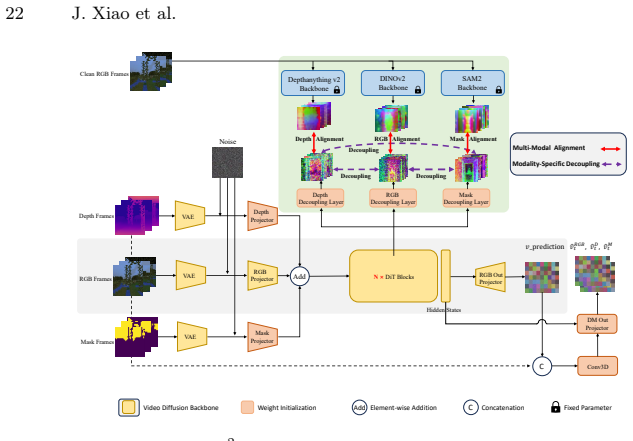
Foundation models trained on different modality spaces naturally capture distinct domain-specific priors, acting as complementary experts. By decoupling modality-specific features from the diffusion model's intermediate representations and aligning each with its corresponding expert foundation model using a multi-modal representation alignment loss and a modality-specific decoupling regularization, joint optimization fully exploits priors from multiple foundation models.
What carries the argument
Modality-specific decoupling of intermediate representations in the diffusion model followed by independent alignment to expert foundation models.
If this is right
- Joint optimization of the diffusion model becomes feasible while drawing on multiple pre-trained experts at once.
- Generated videos show higher visual quality and better long-term consistency across modalities.
- The same separation-plus-alignment pattern applies to any set of modalities for which expert foundation models exist.
- Existing single-modality foundation models can be reused without retraining them inside the world model.
Where Pith is reading between the lines
- The same decoupling step could be tested on non-diffusion generators to see whether the benefit is specific to diffusion architectures.
- If the separation remains clean, the method might scale to four or more modalities without requiring new expert models for each added channel.
- Cross-modal consistency metrics measured after long rollouts would provide a direct test of whether independent alignment preserves relations that joint training might blur.
Load-bearing premise
That the intermediate representations inside the diffusion model can be cleanly split into modality-specific components that remain informative and can be aligned independently without destructive interference or loss of cross-modal consistency.
What would settle it
Running the generation task with the proposed decoupled alignment and finding no gain or a clear drop in visual quality and consistency compared with a joint non-decoupled baseline would falsify the central claim.
Figures



read the original abstract
Emerging multi-modal world models attempt to jointly generate videos across diverse modalities (e.g., RGB, depth, and mask), yet they fail to fully exploit the rich priors of existing foundation models. We propose $M^2$-REPA, the first representation alignment method tailored for multi-modal video generation. Our key insight is that foundation models trained on different modality spaces naturally capture distinct domain-specific priors, acting as complementary "experts." Specifically, we first decouple modality-specific features from the diffusion model's intermediate representations, then align each with its corresponding expert foundation model. To this end, we design two synergistic objectives: a multi-modal representation alignment loss that enforces feature-to-expert matching, and a modality-specific decoupling regularization that encourages complementarity across different modalities. This design enables joint optimization, fully exploiting priors from multiple foundation models. Extensive experiments demonstrate that our method significantly outperforms baselines in visual quality and long-term consistency.
Editorial analysis
A structured set of objections, weighed in public.
Referee Report
Summary. The paper proposes M²-REPA, a decoupled representation alignment method for multi-modal world models that jointly generate videos across modalities such as RGB, depth, and masks. The core idea is that foundation models trained on different modalities act as complementary experts; the method extracts modality-specific features from diffusion model intermediates, aligns each to its expert via a multi-modal representation alignment loss, and applies a modality-specific decoupling regularization to promote complementarity, enabling joint optimization that exploits multiple priors. Extensive experiments are claimed to show gains in visual quality and long-term consistency over baselines.
Significance. If the decoupling and alignment can be shown to preserve cross-modal consistency while exploiting distinct priors, the approach would provide a practical way to integrate multiple foundation models into multi-modal diffusion pipelines without retraining from scratch, potentially improving sample quality in video generation tasks where single-modality experts are already strong.
major comments (2)
- [Method section (decoupling and regularization objectives)] The central claim rests on the assumption that intermediate activations in the shared U-Net backbone admit a clean, invertible separation into modality-specific components (see the description of feature decoupling in the method). No derivation or analysis is supplied showing that the chosen regularization provably avoids destructive interference or preserves joint cross-modal statistics; if the features are already entangled, independent alignment to experts could degrade the consistency the method aims to improve.
- [Experiments (ablation studies)] The multi-modal representation alignment loss and decoupling regularization are presented as synergistic, yet the manuscript supplies no ablation that isolates their individual contributions or demonstrates that the regularization term is necessary to prevent the alignment from collapsing cross-modal information.
minor comments (2)
- [Abstract and Experiments] The abstract states that experiments demonstrate outperformance but does not reference specific quantitative tables, datasets, or metrics; the full manuscript should ensure all reported gains are accompanied by standard deviations and baseline details for reproducibility.
- [Method] Notation for the expert foundation models and the feature extraction points from the diffusion U-Net should be defined consistently with equations for the alignment loss.
Simulated Author's Rebuttal
We thank the referee for the constructive feedback on M²-REPA. The comments highlight important aspects of theoretical justification and experimental validation for the decoupling and alignment components. We address each major comment below and commit to revisions where appropriate.
read point-by-point responses
-
Referee: [Method section (decoupling and regularization objectives)] The central claim rests on the assumption that intermediate activations in the shared U-Net backbone admit a clean, invertible separation into modality-specific components (see the description of feature decoupling in the method). No derivation or analysis is supplied showing that the chosen regularization provably avoids destructive interference or preserves joint cross-modal statistics; if the features are already entangled, independent alignment to experts could degrade the consistency the method aims to improve.
Authors: We agree that the manuscript lacks a formal derivation or analysis of the separation properties and potential interference. The decoupling regularization is empirically motivated to promote complementarity by penalizing shared information across modality-specific features, drawing from standard practices in disentangled representation learning. However, without a proof, the risk of degrading cross-modal consistency remains a valid concern. We will add a dedicated discussion subsection analyzing the regularization's effect on feature statistics and include a brief empirical study of cross-modal correlation before/after regularization in the revised version. revision: yes
-
Referee: [Experiments (ablation studies)] The multi-modal representation alignment loss and decoupling regularization are presented as synergistic, yet the manuscript supplies no ablation that isolates their individual contributions or demonstrates that the regularization term is necessary to prevent the alignment from collapsing cross-modal information.
Authors: The current experiments focus on overall performance gains but do not isolate the alignment loss versus the decoupling term or quantify their impact on cross-modal consistency. We will expand the ablation studies in the revision to include: (i) variants with only alignment loss, (ii) only decoupling regularization, and (iii) both, reporting metrics such as cross-modal feature correlation and generation consistency to demonstrate the necessity of the regularization term. revision: yes
Circularity Check
Proposed alignment losses and decoupling regularization form an independent training procedure with no reduction to fitted inputs or self-definitional loops.
full rationale
The paper introduces M²-REPA as a new method consisting of modality-specific feature decoupling followed by alignment losses to expert foundation models, plus a complementarity regularization term. No equations, claims, or self-citations in the provided text reduce any performance metric or architectural choice to a parameter that was itself tuned on the target quantity, nor does any step equate a derived quantity to its own definition by construction. The derivation chain consists of design choices justified by the stated insight about complementary priors, which remains externally falsifiable through experiments rather than tautological.
Axiom & Free-Parameter Ledger
axioms (1)
- domain assumption Foundation models trained on different modality spaces naturally capture distinct domain-specific priors, acting as complementary experts.
Forward citations
Cited by 1 Pith paper
-
PhysRAG: Enhancing Physics-Awareness in Video Generation via Retrieval-Augmented Generation
PhysRAG curates 7K videos from WISA-80K, builds a physical video database, and injects knowledge via learnable queries into a diffusion model to reach SOTA visual quality and physical compliance on PhyGenBench and VBench.
Reference graph
Works this paper leans on
-
[1]
Proceedings of the 3rd International Workshop on Rich Media With Generative AI, ACM (2025) 1
Agarwal, N., Ali, A., Bala, M., Balaji, Y., Barker, E., Cai, T., Chattopadhyay, P., Chen, Y., Cui, Y., Ding, Y., et al.: Cosmos world foundation model platform for physical ai. Proceedings of the 3rd International Workshop on Rich Media With Generative AI, ACM (2025) 1
2025
-
[2]
V-JEPA 2: Self-Supervised Video Models Enable Understanding, Prediction and Planning
Assran, M., Bardes, A., Fan, D., Garrido, Q., Howes, R., Muckley, M., Rizvi, A., Roberts, C., Sinha, K., Zholus, A., et al.: V-jepa 2: Self-supervised video models enable understanding, prediction and planning. arXiv preprint arXiv:2506.09985 (2025) 4
work page internal anchor Pith review Pith/arXiv arXiv 2025
-
[3]
Advances in Neural Information Processing Systems37, 24081–24125 (2024) 4, 5
Chen, B., Martí Monsó, D., Du, Y., Simchowitz, M., Tedrake, R., Sitzmann, V.: Diffusion forcing: Next-token prediction meets full-sequence diffusion. Advances in Neural Information Processing Systems37, 24081–24125 (2024) 4, 5
2024
-
[4]
arXiv preprint arXiv:2506.01103 , year=
Chen, J., Zhu, H., He, X., Wang, Y., Zhou, J., Chang, W., Zhou, Y., Li, Z., Fu, Z., Pang, J., et al.: Deepverse: 4d autoregressive video generation as a world model. arXiv preprint arXiv:2506.01103 (2025) 4
-
[5]
In: Proceedings of the Computer Vision and Pattern Recognition Conference
Chen, S., Guo, H., Zhu, S., Zhang, F., Huang, Z., Feng, J., Kang, B.: Video depth anything: Consistent depth estimation for super-long videos. In: Proceedings of the Computer Vision and Pattern Recognition Conference. pp. 22831–22840 (2025) 15
2025
-
[6]
arXiv preprint arXiv:2508.13154 (2025) 2, 4
Chen, Z., Liu, T., Zhuo, L., Ren, J., Tao, Z., Zhu, H., Hong, F., Pan, L., Liu, Z.: 4dnex: Feed-forward 4d generative modeling made easy. arXiv preprint arXiv:2508.13154 (2025) 2, 4
-
[7]
Cherian,A.,Corcodel,R.,Jain,S.,Romeres,D.:Llmphy:Complexphysicalreason- ingusinglargelanguagemodelsandworldmodels.arXivpreprintarXiv:2411.08027 (2024) 1
work page internal anchor Pith review Pith/arXiv arXiv 2024
-
[8]
URL: https://oasis-model
Decart, E., McIntyre, Q., Campbell, S., Chen, X., Wachen, R.: Oasis: A universe in a transformer. URL: https://oasis-model. github. io (2024) 4 Decoupled Representation Alignment for Multimodal World Models 17
2024
-
[9]
Everingham,M.,VanGool,L.,Williams,C.K.,Winn,J.,Zisserman,A.:Thepascal visualobjectclasses(voc)challenge.Internationaljournalofcomputervision88(2), 303–338 (2010) 11
2010
-
[10]
Advances in Neural Information Processing Systems37, 91560–91596 (2024) 1
Gao, S., Yang, J., Chen, L., Chitta, K., Qiu, Y., Geiger, A., Zhang, J., Li, H.: Vista: A generalizable driving world model with high fidelity and versatile controllability. Advances in Neural Information Processing Systems37, 91560–91596 (2024) 1
2024
-
[11]
Ha, D., Schmidhuber, J.: World models. arXiv preprint arXiv:1803.101222(3) (2018) 1
work page internal anchor Pith review Pith/arXiv arXiv 2018
-
[12]
Matrix-game 2.0: An open-source real-time and streaming interactive world model
He, X., Peng, C., Liu, Z., Wang, B., Zhang, Y., Cui, Q., Kang, F., Jiang, B., An, M., Ren, Y., et al.: Matrix-game 2.0: An open-source real-time and streaming interactive world model. arXiv preprint arXiv:2508.13009 (2025) 1, 4
work page internal anchor Pith review Pith/arXiv arXiv 2025
-
[13]
Advances in neural information processing systems33, 6840–6851 (2020) 1
Ho, J., Jain, A., Abbeel, P.: Denoising diffusion probabilistic models. Advances in neural information processing systems33, 6840–6851 (2020) 1
2020
-
[14]
In: International Conference on Machine Learning
Hoogeboom, E., Heek, J., Salimans, T.: simple diffusion: End-to-end diffusion for high resolution images. In: International Conference on Machine Learning. pp. 13213–13232. PMLR (2023) 8, 11, 15
2023
-
[15]
GAIA-1: A Generative World Model for Autonomous Driving
Hu, A., Russell, L., Yeo, H., Murez, Z., Fedoseev, G., Kendall, A., Shotton, J., Corrado, G.: Gaia-1: A generative world model for autonomous driving. arXiv preprint arXiv:2309.17080 (2023) 1
work page internal anchor Pith review Pith/arXiv arXiv 2023
-
[16]
In: Proceedings of the Computer Vision and Pattern Recognition Conference
Hu, W., Gao, X., Li, X., Zhao, S., Cun, X., Zhang, Y., Quan, L., Shan, Y.: Depthcrafter: Generating consistent long depth sequences for open-world videos. In: Proceedings of the Computer Vision and Pattern Recognition Conference. pp. 2005–2015 (2025) 11
2005
-
[17]
ACM Transactions on Graphics (TOG)44(6), 1–15 (2025) 2, 4
Huang, T., Zheng, W., Wang, T., Liu, Y., Wang, Z., Wu, J., Jiang, J., Li, H., Lau, R., Zuo, W., et al.: Voyager: Long-range and world-consistent video diffusion for explorable 3d scene generation. ACM Transactions on Graphics (TOG)44(6), 1–15 (2025) 2, 4
2025
-
[18]
Self Forcing: Bridging the Train-Test Gap in Autoregressive Video Diffusion
Huang, X., Li, Z., He, G., Zhou, M., Shechtman, E.: Self forcing: Bridging the train-test gap in autoregressive video diffusion. arXiv preprint arXiv:2506.08009 (2025) 4
work page internal anchor Pith review Pith/arXiv arXiv 2025
- [19]
-
[20]
Dino-foresight: Looking into the future with dino,
Karypidis, E., Kakogeorgiou, I., Gidaris, S., Komodakis, N.: Dino-foresight: Look- ing into the future with dino. arXiv preprint arXiv:2412.11673 (2024) 4
-
[21]
Advances in Neural Information Processing Systems37, 89834–89868 (2024) 4
Kim, J., Kang, J., Choi, J., Han, B.: Fifo-diffusion: Generating infinite videos from text without training. Advances in Neural Information Processing Systems37, 89834–89868 (2024) 4
2024
-
[22]
HunyuanVideo: A Systematic Framework For Large Video Generative Models
Kong, W., Tian, Q., Zhang, Z., Min, R., Dai, Z., Zhou, J., Xiong, J., Li, X., Wu, B., Zhang, J., et al.: Hunyuanvideo: A systematic framework for large video generative models. arXiv preprint arXiv:2412.03603 (2024) 1
work page internal anchor Pith review Pith/arXiv arXiv 2024
-
[23]
In: International conference on machine learning
Kornblith, S., Norouzi, M., Lee, H., Hinton, G.: Similarity of neural network rep- resentations revisited. In: International conference on machine learning. pp. 3519–
-
[24]
PMlR (2019) 3, 6, 9, 14, 25
2019
-
[25]
Flow Matching for Generative Modeling
Lipman, Y., Chen, R.T., Ben-Hamu, H., Nickel, M., Le, M.: Flow matching for generative modeling. arXiv preprint arXiv:2210.02747 (2022) 5
work page internal anchor Pith review Pith/arXiv arXiv 2022
-
[26]
Flow Straight and Fast: Learning to Generate and Transfer Data with Rectified Flow
Liu, X., Gong, C., Liu, Q.: Flow straight and fast: Learning to generate and transfer data with rectified flow. arXiv preprint arXiv:2209.03003 (2022) 5
work page internal anchor Pith review Pith/arXiv arXiv 2022
-
[27]
arXiv preprint arXiv:2508.15720 , year=
Liu, Z., Deng, X., Chen, S., Wang, A., Guo, Q., Han, M., Xue, Z., Chen, M., Luo, P., Yang, L.: Worldweaver: Generating long-horizon video worlds via rich perception. arXiv preprint arXiv:2508.15720 (2025) 2, 4 18 J. Xiao et al
-
[28]
arXiv preprint arXiv:2510.03104 (2025) 2, 4
Mei,Z.,Shorinwa,O.,Majumdar,A.:Geometrymeetsvision:Revisitingpretrained semantics in distilled fields. arXiv preprint arXiv:2510.03104 (2025) 2, 4
-
[29]
DINOv2: Learning Robust Visual Features without Supervision
Oquab, M., Darcet, T., Moutakanni, T., Vo, H., Szafraniec, M., Khalidov, V., Fernandez, P., Haziza, D., Massa, F., El-Nouby, A., et al.: Dinov2: Learning robust visual features without supervision. arXiv preprint arXiv:2304.07193 (2023) 2, 3, 4, 6, 7, 9, 10, 11, 12, 15
work page internal anchor Pith review Pith/arXiv arXiv 2023
-
[30]
URL: https://deepmind.google/blog/genie-3-a-new-frontier-for-world-models/ (2025) 1, 4
Parker-Holder, J., Fruchter, S., et al.: Genie 3: A new frontier for world mod- els. URL: https://deepmind.google/blog/genie-3-a-new-frontier-for-world-models/ (2025) 1, 4
2025
-
[31]
Peebles,W.,Xie,S.:Scalablediffusionmodelswithtransformers.In:Proceedingsof the IEEE/CVF international conference on computer vision. pp. 4195–4205 (2023) 11, 13, 21
2023
-
[32]
arXiv preprint arXiv:2510.07313 (2025) 2, 4
Qian, Z., Chi, X., Li, Y., Wang, S., Qin, Z., Ju, X., Han, S., Zhang, S.: Wrist- world: Generating wrist-views via 4d world models for robotic manipulation. arXiv preprint arXiv:2510.07313 (2025) 2, 4
-
[33]
Qin, Y., Shi, Z., Yu, J., Wang, X., Zhou, E., Li, L., Yin, Z., Liu, X., Sheng, L., Shao, J., et al.: Worldsimbench: Towards video generation models as world simulators. arXiv preprint arXiv:2410.18072 (2024) 1
-
[34]
In: International conference on machine learning
Radford, A., Kim, J.W., Hallacy, C., Ramesh, A., Goh, G., Agarwal, S., Sastry, G., Askell, A., Mishkin, P., Clark, J., et al.: Learning transferable visual models from natural language supervision. In: International conference on machine learning. pp. 8748–8763. PmLR (2021) 2, 4, 6
2021
-
[35]
SAM 2: Segment Anything in Images and Videos
Ravi, N., Gabeur, V., Hu, Y.T., Hu, R., Ryali, C., Ma, T., Khedr, H., Rädle, R., Rolland, C., Gustafson, L., et al.: Sam 2: Segment anything in images and videos. arXiv preprint arXiv:2408.00714 (2024) 2, 4, 7, 9, 10, 11, 12
work page internal anchor Pith review Pith/arXiv arXiv 2024
-
[36]
In: Proceedings of the IEEE/CVF conference on computer vision and pattern recognition
Rombach, R., Blattmann, A., Lorenz, D., Esser, P., Ommer, B.: High-resolution image synthesis with latent diffusion models. In: Proceedings of the IEEE/CVF conference on computer vision and pattern recognition. pp. 10684–10695 (2022) 11, 21
2022
-
[37]
GAIA-2: A Controllable Multi-View Generative World Model for Autonomous Driving
Russell, L., Hu, A., Bertoni, L., Fedoseev, G., Shotton, J., Arani, E., Corrado, G.: Gaia-2: A controllable multi-view generative world model for autonomous driving. arXiv preprint arXiv:2503.20523 (2025) 1
work page internal anchor Pith review Pith/arXiv arXiv 2025
-
[38]
Siméoni, O., Vo, H.V., Seitzer, M., Baldassarre, F., Oquab, M., Jose, C., Khali- dov, V., Szafraniec, M., Yi, S., Ramamonjisoa, M., et al.: Dinov3. arXiv preprint arXiv:2508.10104 (2025) 4
work page internal anchor Pith review Pith/arXiv arXiv 2025
-
[39]
History-Guided Video Diffusion
Song, K., Chen, B., Simchowitz, M., Du, Y., Tedrake, R., Sitzmann, V.: History- guided video diffusion. arXiv preprint arXiv:2502.06764 (2025) 4, 7, 10, 12, 21
work page internal anchor Pith review Pith/arXiv arXiv 2025
-
[40]
arXiv preprint arXiv:2503.18414 (2025) 2, 7, 15
Tian, Y., Chen, H., Zheng, M., Liang, Y., Xu, C., Wang, Y.: U-repa: Aligning diffusion u-nets to vits. arXiv preprint arXiv:2503.18414 (2025) 2, 7, 15
-
[41]
Towards Accurate Generative Models of Video: A New Metric & Challenges
Unterthiner, T., Van Steenkiste, S., Kurach, K., Marinier, R., Michalski, M., Gelly, S.: Towards accurate generative models of video: A new metric & challenges. arXiv preprint arXiv:1812.01717 (2018) 11
work page internal anchor Pith review Pith/arXiv arXiv 2018
-
[42]
Diffusion Models Are Real-Time Game Engines
Valevski, D., Leviathan, Y., Arar, M., Fruchter, S.: Diffusion models are real-time game engines. arXiv preprint arXiv:2408.14837 (2024) 1, 4
work page internal anchor Pith review Pith/arXiv arXiv 2024
-
[43]
Wan: Open and Advanced Large-Scale Video Generative Models
Wan, T., Wang, A., Ai, B., Wen, B., Mao, C., Xie, C.W., Chen, D., Yu, F., Zhao, H., Yang, J., et al.: Wan: Open and advanced large-scale video generative models. arXiv preprint arXiv:2503.20314 (2025) 1
work page internal anchor Pith review Pith/arXiv arXiv 2025
-
[44]
Zhouxia Wang, Ziyang Yuan, Xintao Wang, Tianshui Chen, Menghan Xia, Ping Luo, and Ying Shan
Wang, J., Yuan, Y., Zheng, R., Lin, Y., Gao, J., Chen, L.Z., Bao, Y., Zhang, Y., Zeng, C., Zhou, Y., et al.: Spatialvid: A large-scale video dataset with spatial annotations. arXiv preprint arXiv:2509.09676 (2025) 4 Decoupled Representation Alignment for Multimodal World Models 19
-
[45]
In: Proceedings of the Computer Vision and Pattern Recognition Conference
Wang, J., Chen, M., Karaev, N., Vedaldi, A., Rupprecht, C., Novotny, D.: Vggt: Visual geometry grounded transformer. In: Proceedings of the Computer Vision and Pattern Recognition Conference. pp. 5294–5306 (2025) 2, 4, 6
2025
-
[46]
IEEE transactions on image processing 13(4), 600–612 (2004) 11
Wang, Z., Bovik, A.C., Sheikh, H.R., Simoncelli, E.P.: Image quality assessment: from error visibility to structural similarity. IEEE transactions on image processing 13(4), 600–612 (2004) 11
2004
-
[47]
Geometry Forcing: Marrying Video Diffusion and 3D Representation for Consistent World Modeling
Wu, H., Wu, D., He, T., Guo, J., Ye, Y., Duan, Y., Bian, J.: Geometry forcing: Mar- rying video diffusion and 3d representation for consistent world modeling. arXiv preprint arXiv:2507.07982 (2025) 2, 4, 6, 7, 10, 12
work page internal anchor Pith review Pith/arXiv arXiv 2025
-
[48]
Worldmem: Long-term consistent world simulation with memory.arXiv preprint arXiv:2504.12369, 2025
Xiao, Z., Lan, Y., Zhou, Y., Ouyang, W., Yang, S., Zeng, Y., Pan, X.: Worldmem: Long-term consistent world simulation with memory. arXiv preprint arXiv:2504.12369 (2025) 4
-
[49]
Xu, G., Lin, H., Luo, H., Wang, X., Yao, J., Zhu, L., Pu, Y., Chi, C., Sun, H., Wang, B., et al.: Pixel-perfect depth with semantics-prompted diffusion transform- ers. arXiv preprint arXiv:2510.07316 (2025) 4, 6, 7
-
[50]
In: International Conference on Machine Learning
Yan, W., Hafner, D., James, S., Abbeel, P.: Temporally consistent transformers for video generation. In: International Conference on Machine Learning. pp. 39062– 39098. PMLR (2023) 11, 13, 21
2023
-
[51]
Advances in Neural Information Processing Systems37, 21875–21911 (2024) 2, 3, 4, 7, 9, 10, 11, 12, 15
Yang, L., Kang, B., Huang, Z., Zhao, Z., Xu, X., Feng, J., Zhao, H.: Depth anything v2. Advances in Neural Information Processing Systems37, 21875–21911 (2024) 2, 3, 4, 7, 9, 10, 11, 12, 15
2024
-
[52]
Learning Interactive Real-World Simulators
Yang, M., Du, Y., Ghasemipour, K., Tompson, J., Schuurmans, D., Abbeel, P.: Learning interactive real-world simulators. arXiv preprint arXiv:2310.061141(2), 6 (2023) 1
work page internal anchor Pith review Pith/arXiv arXiv 2023
-
[53]
arXiv preprint arXiv:2402.17139 (2024) 1
Yang, S., Walker, J., Parker-Holder, J., Du, Y., Bruce, J., Barreto, A., Abbeel, P., Schuurmans, D.: Video as the new language for real-world decision making. arXiv preprint arXiv:2402.17139 (2024) 1
-
[54]
CogVideoX: Text-to-Video Diffusion Models with An Expert Transformer
Yang, Z., Teng, J., Zheng, W., Ding, M., Huang, S., Xu, J., Yang, Y., Hong, W., Zhang, X., Feng, G., et al.: Cogvideox: Text-to-video diffusion models with an expert transformer. arXiv preprint arXiv:2408.06072 (2024) 1
work page internal anchor Pith review Pith/arXiv arXiv 2024
-
[55]
In: RSS 2025 Workshop: Mobile Manipulation: Emerging Opportunities{\&}Con- temporary Challenges (2025) 4
Yin, T., Mei, Z., Sun, T., Zha, L., Zhou, E., Bao, J., Yamane, M., Sho, O., Majum- dar, A.: Womap: World models for embodied open-vocabulary object localization. In: RSS 2025 Workshop: Mobile Manipulation: Emerging Opportunities{\&}Con- temporary Challenges (2025) 4
2025
-
[56]
In: CVPR (2025) 4
Yin, T., Zhang, Q., Zhang, R., Freeman, W.T., Durand, F., Shechtman, E., Huang, X.: From slow bidirectional to fast autoregressive video diffusion models. In: CVPR (2025) 4
2025
-
[57]
Yoon, H., Jung, J., Kim, J., Choi, H., Shin, H., Lim, S., An, H., Kim, C., Han, J., Kim, D., et al.: Visual representation alignment for multimodal large language models. arXiv preprint arXiv:2509.07979 (2025) 2, 4
-
[58]
arXiv preprint arXiv:2501.08325 (2025) 1
Yu, J., Qin, Y., Wang, X., Wan, P., Zhang, D., Liu, X.: Gamefactory: Creating new games with generative interactive videos. arXiv preprint arXiv:2501.08325 (2025) 1
-
[59]
Representation Alignment for Generation: Training Diffusion Transformers Is Easier Than You Think
Yu, S., Kwak, S., Jang, H., Jeong, J., Huang, J., Shin, J., Xie, S.: Representation alignment for generation: Training diffusion transformers is easier than you think. arXiv preprint arXiv:2410.06940 (2024) 2, 4, 6, 7, 15, 21, 23
work page internal anchor Pith review Pith/arXiv arXiv 2024
-
[60]
In: Proceedings of the IEEE conference on computer vision and pattern recognition
Zhang, R., Isola, P., Efros, A.A., Shechtman, E., Wang, O.: The unreasonable effectiveness of deep features as a perceptual metric. In: Proceedings of the IEEE conference on computer vision and pattern recognition. pp. 586–595 (2018) 11 20 J. Xiao et al
2018
-
[61]
arXiv preprint arXiv:2505.23656 , year=
Zhang, X., Liao, J., Zhang, S., Meng, F., Wan, X., Yan, J., Cheng, Y.: Videorepa: Learning physics for video generation through relational alignment with foundation models. arXiv preprint arXiv:2505.23656 (2025) 2, 4, 6, 7, 8
-
[62]
Tesseract: Learning 4d embodied world models, 2025.https://arxiv.org/abs/2504.20995
Zhen, H., Sun, Q., Zhang, H., Li, J., Zhou, S., Du, Y., Gan, C.: Tesseract: learning 4d embodied world models. arXiv preprint arXiv:2504.20995 (2025) 1, 2, 4, 21
-
[63]
Zhou, T., Tucker, R., Flynn, J., Fyffe, G., Snavely, N.: Stereo magnification: Learn- ingviewsynthesisusingmultiplaneimages.arXivpreprintarXiv:1805.09817(2018) 4, 10, 11, 12
work page internal anchor Pith review Pith/arXiv arXiv 2018
-
[64]
Zhou, Y., Wang, Y., Zhou, J., Chang, W., Guo, H., Li, Z., Ma, K., Li, X., Wang, Y., Zhu, H., et al.: Omniworld: A multi-domain and multi-modal dataset for 4d world modeling. arXiv preprint arXiv:2509.12201 (2025) 4
-
[65]
In: Proceedings of the IEEE/CVF International Conference on Computer Vision
Zhu, H., Wang, Y., Zhou, J., Chang, W., Zhou, Y., Li, Z., Chen, J., Shen, C., Pang, J., He, T.: Aether: Geometric-aware unified world modeling. In: Proceedings of the IEEE/CVF International Conference on Computer Vision. pp. 8535–8546 (2025) 2, 4
2025
-
[66]
Zhu, Z., Wang, X., Zhao, W., Min, C., Deng, N., Dou, M., Wang, Y., Shi, B., Wang, K., Zhang, C., et al.: Is sora a world simulator? a comprehensive survey on general world models and beyond. arXiv preprint arXiv:2405.03520 (2024) 1 Decoupled Representation Alignment for Multimodal World Models 21 Supplementary Material A Latent-Space DiT Architecture Deta...
discussion (0)
Sign in with ORCID, Apple, or X to comment. Anyone can read and Pith papers without signing in.