Ultrasonic Observation of Slowing Down of Multipole Fluctuations in Sr₂RuO₄
Pith reviewed 2026-07-03 06:22 UTC · model grok-4.3
The pith
Ultrasonic attenuation in Sr2RuO4 rises near Tc due to slowing electric hexadecapole fluctuations.
A machine-rendered reading of the paper's core claim, the machinery that carries it, and where it could break.
Core claim
Ultrasonic attenuation measurements reveal a Landau-Khalatnikov-type slowing down of fluctuations associated with multipole degrees of freedom in Sr2RuO4 near Tc; the authors propose via group theory that the electric hexadecapole plays the central role, and note that the effect persists when a magnetic field suppresses the superconducting transition.
What carries the argument
The electric hexadecapole, identified by group-theoretical considerations as the multipole degree of freedom whose fluctuations produce the observed ultrasonic relaxation.
If this is right
- The slowing down of fluctuations continues to low temperatures even when the superconducting transition is suppressed by a 10 T magnetic field.
- The relaxation process has a characteristic time of approximately 10^{-10} s.
- Group theory assigns the electric hexadecapole the leading role among multipole degrees of freedom.
- The multipole fluctuations are linked to the multi-component character of the superconducting order parameter.
Where Pith is reading between the lines
- The same ultrasonic signature could appear in other layered materials hosting multipolar fluctuations near a phase transition.
- If the hexadecapole assignment holds, symmetry-selective probes such as polarized Raman scattering could test it directly in Sr2RuO4.
- The persistence of the effect under field suppression suggests multipole dynamics are at least partly independent of the superconducting condensate itself.
Load-bearing premise
The observed increase in ultrasonic attenuation is caused by slowing multipole fluctuations rather than other electronic, magnetic, or lattice contributions.
What would settle it
If ultrasonic attenuation measured at multiple frequencies shows no shift in its temperature dependence consistent with a 10^{-10} s relaxation time, or if the increase vanishes under conditions where hexadecapole fluctuations are symmetry-forbidden but other degrees of freedom remain active.
Figures


read the original abstract
We performed ultrasonic measurements on the unconventional superconductor Sr$_2$RuO$_4$ to investigate the dynamical properties of the electronic states near its superconducting transition temperature, $T_\mathrm{c} = 1.4$ K. We observed an increase in the in-plane transverse ultrasonic attenuation coefficient as the temperature approached $T_\mathrm{c}$. The ultrasonic attenuation exhibited a Landau-Khalatnikov-type ultrasonic frequency dependence with a typical relaxation time of approximately $10^{-10}$ s. Under an applied magnetic field of 10 T, the superconducting transition was suppressed. However, the ultrasonic attenuation coefficient exhibited an increase down to low temperatures, indicating the slowing down of fluctuations associated with multipole degrees of freedom. Based on group-theoretical considerations, we propose that the electric hexadecapole plays a crucial role in the slowing down. Furthermore, we discuss the relationship between multi-component superconducting order parameters and multipole degrees of freedom.
Editorial analysis
A structured set of objections, weighed in public.
Referee Report
Summary. The manuscript reports ultrasonic measurements on Sr₂RuO₄ near its superconducting transition at Tc = 1.4 K. An increase is observed in the in-plane transverse ultrasonic attenuation coefficient that exhibits Landau-Khalatnikov frequency dependence with a relaxation time of approximately 10^{-10} s. This feature persists under a 10 T magnetic field that suppresses superconductivity, which the authors interpret as evidence for slowing multipole fluctuations. Using group-theoretical considerations, they propose that the electric hexadecapole is the relevant degree of freedom and discuss its possible connection to multi-component superconducting order parameters.
Significance. If the central interpretive claim holds, the work would provide experimental evidence linking ultrasonic attenuation to multipolar electronic fluctuations in Sr₂RuO₄ that survive above the superconducting transition. The persistence of the relaxation under fields that destroy superconductivity is a potentially useful observation for distinguishing electronic from superconducting contributions. The group-theory proposal, if developed further, could connect to ongoing discussions of the pairing symmetry in this material.
major comments (2)
- [Abstract/Discussion] Abstract and Discussion: The proposal that the electric hexadecapole plays a crucial role rests on an unspecified group-theoretical assignment. No explicit symmetry analysis, irreducible representation table, or derivation is supplied showing how the observed ultrasonic mode transforms under the point group and matches the hexadecapole; this step is load-bearing for the manuscript's main conclusion.
- [Results] Results section: The reported increase in attenuation and the Landau-Khalatnikov fit are presented without error bars on the data points, uncertainties on the extracted relaxation time, or quantitative comparison against alternative explanations (e.g., other multipole channels or residual lattice/magnetic contributions). This absence limits assessment of whether the slowing-down signal is robust enough to support the multipole interpretation.
minor comments (1)
- [Abstract] The abstract states a typical relaxation time of approximately 10^{-10} s but does not specify the ultrasonic frequencies employed or the fitting procedure; adding this information would allow readers to reproduce the time-scale extraction.
Simulated Author's Rebuttal
We thank the referee for their careful reading and constructive comments on our manuscript. We address each major comment below and will revise the manuscript accordingly.
read point-by-point responses
-
Referee: [Abstract/Discussion] Abstract and Discussion: The proposal that the electric hexadecapole plays a crucial role rests on an unspecified group-theoretical assignment. No explicit symmetry analysis, irreducible representation table, or derivation is supplied showing how the observed ultrasonic mode transforms under the point group and matches the hexadecapole; this step is load-bearing for the manuscript's main conclusion.
Authors: We agree that the group-theoretical assignment requires explicit documentation to support the central claim. The revised manuscript will include a dedicated symmetry analysis under the D4h point group of Sr2RuO4. This will specify the irreducible representations, show the transformation properties of the in-plane transverse ultrasonic strain, and derive its coupling to the electric hexadecapole, including the relevant irrep matching. revision: yes
-
Referee: [Results] Results section: The reported increase in attenuation and the Landau-Khalatnikov fit are presented without error bars on the data points, uncertainties on the extracted relaxation time, or quantitative comparison against alternative explanations (e.g., other multipole channels or residual lattice/magnetic contributions). This absence limits assessment of whether the slowing-down signal is robust enough to support the multipole interpretation.
Authors: We acknowledge that the original presentation omits error bars, fit uncertainties, and explicit comparisons to alternatives. The revised Results section will add error bars to the attenuation data, report uncertainties on the extracted relaxation time of ~10^{-10} s, and include a quantitative discussion of why other multipole channels or lattice/magnetic contributions are less consistent with the observed field-independent slowing down. revision: yes
Circularity Check
No significant circularity; experimental observation plus group-theory proposal
full rationale
The paper is an experimental report of ultrasonic attenuation data exhibiting Landau-Khalatnikov relaxation that persists under 10 T. The central interpretive step assigns the fluctuations to the electric hexadecapole via group-theoretical considerations presented explicitly as a proposal. No equations, fitted parameters, or self-citations are shown that reduce this assignment or the observed slowing to a tautology or input by construction. The derivation chain consists of direct measurement plus an external symmetry argument and does not contain any of the enumerated circular patterns.
Axiom & Free-Parameter Ledger
invented entities (1)
-
electric hexadecapole
no independent evidence
Reference graph
Works this paper leans on
-
[1]
Introduction Since its discovery, superconductivity has been the subject of intensive research in fundamental physics. Understanding the mechanism of superconductivity can lead to the discovery of new types of superconductors with high transition temper- atures.1–5) Superconductivity also plays an essential role in industrial applications, including super...
work page internal anchor Pith review Pith/arXiv arXiv 2026
-
[2]
An X-ray back-scattering method with a Laue camera was used to char- acterize the crystallographic orientations
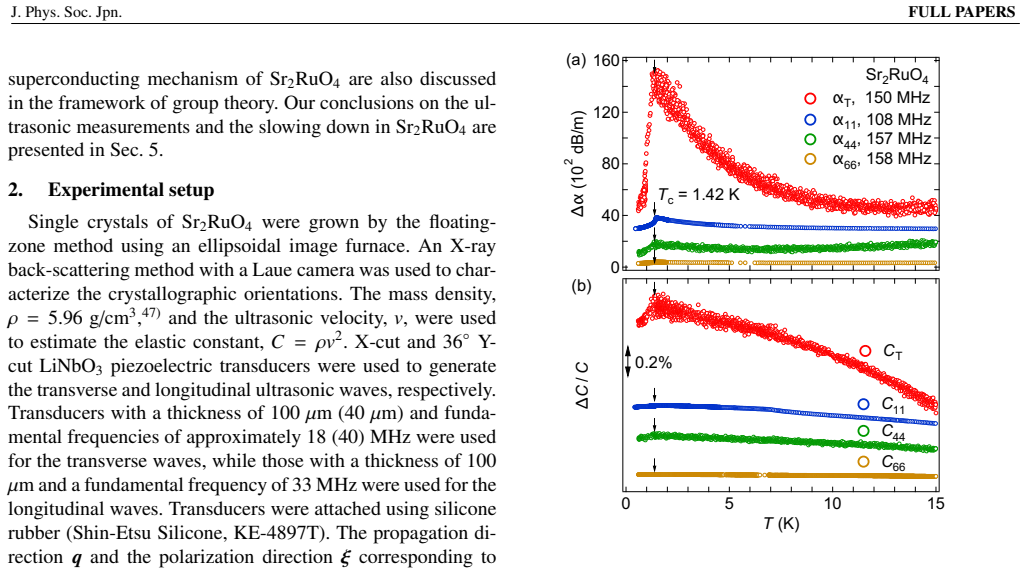
Experimental setup Single crystals of Sr 2RuO4 were grown by the floating- zone method using an ellipsoidal image furnace. An X-ray back-scattering method with a Laue camera was used to char- acterize the crystallographic orientations. The mass density, ρ=5.96 g/cm 3,47) and the ultrasonic velocity,v, were used to estimate the elastic constant,C=ρv 2. X-c...
-
[3]
We observed a significant increase in∆α T from approxi- mately 4000 dB/m at 15 K to about 16000 dB/m nearT c = 1.42 K
Results Figure 1(a) shows the temperature dependence of the change in the ultrasonic attenuation coefficients of Sr2RuO4. We observed a significant increase in∆α T from approxi- mately 4000 dB/m at 15 K to about 16000 dB/m nearT c = 1.42 K. This attenuation coefficient corresponds to the elastic constantC T = (C11 −C 12) /2, associated with in-plane trans...
-
[4]
[1 10]C T = (C11 −C 12) /2 T
-
[5]
[010]C 66 T ΔC / C 151050 T (K) 0.2%(b) C TC1 1C4 4C6 6 16012080400Δα (10 2 dB/m) α T , 150 MHz α1 1 , 108 MHz α4 4 , 157 MHz α6 6 , 158 MHzSr 2 RuO 4 Tc = 1.42 K (a) Fig. 1.(Color online) (a) Temperature dependence of the change in the ultrasonic attenuation coefficients∆αT,∆α 11,∆α 44, and∆α 66, and (b) the relative change in the elastic constants∆C T/C...
-
[6]
Equation (2) reproduces well the temperature dependence of the relaxation time aboveT c, as shown in Fig
Analysis and Discussion To analyze the temperature dependence ofτin the normal state, we employ the following phenomenological description for the relaxation time:45, 50) τ=τ 0ε−zν =τ 0 T−T 0 c T 0c −zν .(2) Here,τ 0 is a constant,ε= T−T 0 c /T 0 c is the reduced tem- perature,T 0 c is the critical temperature,νis the critical expo- nent for the correlati...
-
[7]
Conclusion and perspective In this study, we performed ultrasonic measurements on the unconventional superconductor Sr 2RuO4. We found that the ultrasonic attenuation coefficientαT for the in-plane trans- verse ultrasonic waves associated with the elastic constant CT = (C11 −C 12) /2 exhibits an anomalous increase at low temperatures, while the elastic so...
2014
-
[8]
N. W. Ashcroft: Phys. Rev. Lett.92(2004) 187002
2004
-
[9]
Drozdov, M
A. Drozdov, M. Eremets, I. Troyan, V . Ksenofontov, and S. I. Shylin: Nature525(2015) 73
2015
-
[10]
P. W. Anderson: Science235(1987) 1196
1987
-
[11]
Steglich, J
F. Steglich, J. Aarts, C. D. Bredl, W. Lieke, D. Meschede, W. Franz, and H. Sch¨afer: Phys. Rev. Lett.43(1979) 1892
1979
-
[12]
Kamihara, T
Y . Kamihara, T. Watanabe, M. Hirano, and H. Hosono: Journal of the American Chemical Society130(2008) 3296
2008
-
[13]
Maeda and Y
H. Maeda and Y . Yanagisawa: IEEE Trans. Appl. Supercond.24(2013) 1
2013
-
[14]
Y . Y . Gao, M. A. Rol, S. Touzard, and C. Wang: PRX Quantum2(2021) 040202
2021
-
[15]
Tomikawa
Y . Tomikawa. Toyota Times: Breaking Conventional Wisdom with the Superconductor×Hydrogen Engine - Two Years of Development. https://toyotatimes.jp/en/newscast/157.html. Accessed: Feb. 17, 2026
2026
-
[16]
Ishida, Y
K. Ishida, Y . Kitaoka, N. Ogata, T. Kamino, K. Asayama, J. R. Cooper, and N. Athanassopoulou: J. Phys. Soc. Jpn.62(1993) 2803
1993
-
[17]
Rossat-Mignod, L
J. Rossat-Mignod, L. Regnault, C. Vettier, P. Bourges, P. Burlet, J. Bossy, J. Henry, and G. Lapertot: Phys. C: Supercond.185-189(1991) 86
1991
-
[18]
Shishido, R
H. Shishido, R. Settai, H. Harima, and Y . ¯Onuki: J. Phys. Soc. Jpn.74 (2005) 1103
2005
-
[19]
Yoshizawa, D
M. Yoshizawa, D. Kimura, T. Chiba, S. Simayi, Y . Nakanishi, K. Kihou, C.-H. Lee, A. Iyo, H. Eisaki, M. Nakajima, and S.-i. Uchida: J. Phys. Soc. Jpn.81(2012) 024604
2012
-
[20]
Ishida, H
K. Ishida, H. Mukuda, Y . Kitaoka, K. Asayama, Z. Mao, Y . Mori, and Y . Maeno: Nature396(1998) 658
1998
-
[21]
Ghosh, A
S. Ghosh, A. Shekhter, F. Jerzembeck, N. Kikugawa, D. A. Sokolov, M. Brando, A. Mackenzie, C. W. Hicks, and B. Ramshaw: Nat. Phys. 17(2021) 199
2021
-
[22]
Benhabib, C
S. Benhabib, C. Lupien, I. Paul, L. Berges, M. Dion, M. Nardone, A. Zi- touni, Z. Mao, Y . Maeno, A. Georges, L. Taillefer, and C. Proust: Nat. Phys.17(2021) 194
2021
-
[23]
Maeno, H
Y . Maeno, H. Hashimoto, K. Yoshida, S. Nishizaki, T. Fujita, J. Bed- norz, and F. Lichtenberg: Nature372(1994) 532
1994
-
[24]
A. P. Mackenzie, R. K. W. Haselwimmer, A. W. Tyler, G. G. Lonzarich, Y . Mori, S. Nishizaki, and Y . Maeno: Phys. Rev. Lett.80(1998) 161
1998
-
[25]
Bergemann, S
C. Bergemann, S. R. Julian, A. P. Mackenzie, S. NishiZaki, and Y . Maeno: Phys. Rev. Lett.84(2000) 2662
2000
-
[26]
Oguchi: Phys
T. Oguchi: Phys. Rev. B51(1995) 1385
1995
-
[27]
Tamai, M
A. Tamai, M. Zingl, E. Rozbicki, E. Cappelli, S. Ricc `o, A. de la Torre, S. McKeown Walker, F. Y . Bruno, P. D. C. King, W. Meevasana, M. Shi, M. Radovi´c, N. C. Plumb, A. S. Gibbs, A. P. Mackenzie, C. Berthod, H. U. R. Strand, M. Kim, A. Georges, and F. Baumberger: Phys. Rev. X9(2019) 021048
2019
-
[28]
Maeno, S
Y . Maeno, S. Yonezawa, and A. Ramires: J. Phys. Soc. Jpn.93(2024) 062001
2024
-
[29]
A. P. Mackenzie, T. Scaffidi, C. W. Hicks, and Y . Maeno: npj Quant. Mater.2(2017) 40
2017
-
[30]
Pustogow, Y
A. Pustogow, Y . Luo, A. Chronister, Y .-S. Su, D. Sokolov, F. Jerzem- beck, A. P. Mackenzie, C. W. Hicks, N. Kikugawa, S. Raghu, E. D. Bauer, and S. E. Brown: Nature574(2019) 72
2019
-
[31]
Ishida, M
K. Ishida, M. Manago, K. Kinjo, and Y . Maeno: J. Phys. Soc. Jpn.89 (2020) 034712
2020
-
[32]
Maeno, A
Y . Maeno, A. Ikeda, and G. Mattoni: Nat. Phys.20(2024) 1712
2024
-
[33]
Kittaka, Y
S. Kittaka, Y . Kono, T. Sakakibara, N. Kikugawa, S. Uji, D. A. Sokolov, and K. Machida: J. Phys. Soc. Jpn.95(2026) 014704
2026
-
[34]
Matsuki, R
H. Matsuki, R. Khasanov, J. A. Krieger, T. J. Hicken, K. Yuchi, J. S. Bobowski, G. Mattoni, A. Ikeda, R. Okuma, H. Luetkens, and Y . Maeno: Phys. Rev. Lett.136(2026) 066001
2026
-
[35]
Matsui, M
H. Matsui, M. Yamaguchi, Y . Yoshida, A. Mukai, R. Settai, Y . ¯Onuki, H. Takei, and N. Toyota: J. Phys. Soc. Jpn.67(1998) 3687
1998
-
[36]
Okuda, T
N. Okuda, T. Suzuki, Z. Mao, Y . Maeno, and T. Fujita: J. Phys. Soc. Jpn.71(2002) 1134
2002
-
[37]
Lupien, W
C. Lupien, W. A. MacFarlane, C. Proust, L. Taillefer, Z. Q. Mao, and Y . Maeno: Phys. Rev. Lett.86(2001) 5986
2001
-
[38]
Lupien: PhD theris, University of Toronto (2002)
C. Lupien: PhD theris, University of Toronto (2002)
2002
-
[39]
Matsui, Y
H. Matsui, Y . Yoshida, A. Mukai, R. Settai, Y . ¯Onuki, H. Takei, N. Kimura, H. Aoki, and N. Toyota: Phys. Rev. B63(2001) 060505
2001
-
[40]
L ¨uthi:Physical Acoustics in the Solid State(Springer Series in Solid- State Sciences
B. L ¨uthi:Physical Acoustics in the Solid State(Springer Series in Solid- State Sciences. Springer Berlin Heidelberg, 2006), Springer Series in Solid-State Sciences
2006
-
[41]
Steppke, L
A. Steppke, L. Zhao, M. E. Barber, T. Scaffidi, F. Jerzembeck, H. Ros- ner, A. S. Gibbs, Y . Maeno, S. H. Simon, A. P. Mackenzie, and C. W. Hicks: Science355(2017) eaaf9398
2017
-
[42]
C. W. Hicks, D. O. Brodsky, E. A. Yelland, A. S. Gibbs, J. A. N. Bruin, M. E. Barber, S. D. Edkins, K. Nishimura, S. Yonezawa, Y . Maeno, and A. P. Mackenzie: Science344(2014) 283
2014
-
[43]
Y .-S. Li, M. Garst, J. Schmalian, S. Ghosh, N. Kikugawa, D. A. Sokolov, C. W. Hicks, F. Jerzembeck, M. S. Ikeda, Z. Hu, B. J. Ramshaw, A. W. Rost, M. Nicklas, and A. P. Mackenzie: Nature607 (2022) 276
2022
-
[44]
Mattoni, T
G. Mattoni, T. Johnson, A. Ikeda, S. Paul, J. Bobowski, M. Sigrist, and Y . Maeno: Nat. Commun.17(2025) 700
2025
-
[45]
Bardeen, L
J. Bardeen, L. N. Cooper, and J. R. Schrieffer: Phys. Rev.108(1957) 1175
1957
-
[46]
Tinkham:Introduction to Superconductivity: Second Edition(Dover Books on Physics
M. Tinkham:Introduction to Superconductivity: Second Edition(Dover Books on Physics. Dover Publications, 2004), Dover Books on Physics
2004
-
[47]
E. S. Bliss and J. A. Rayne: Phys. Rev.177(1969) 673
1969
-
[48]
Phillips: Proc
W. Phillips: Proc. R. Soc. Lond. A309(1969) 259
1969
-
[49]
D. J. Bishop, C. M. Varma, B. Batlogg, E. Bucher, Z. Fisk, and J. L. Smith: Phys. Rev. Lett.53(1984) 1009
1984
-
[50]
Batlogg, D
B. Batlogg, D. Bishop, B. Golding, C. M. Varma, Z. Fisk, J. L. Smith, and H. R. Ott: Phys. Rev. Lett.55(1985) 1319
1985
-
[51]
D. J. Bishop, P. L. Gammel, A. P. Ramirez, R. J. Cava, B. Batlogg, and E. A. Rietman: Phys. Rev. B35(1987) 8788
1987
-
[52]
Kurihara, K
R. Kurihara, K. Mitsumoto, M. Akatsu, Y . Nemoto, T. Goto, Y . Kobayashi, and M. Sato: J. Phys. Soc. Jpn.86(2017) 064706
2017
-
[53]
H. Sato, M. Akatsu, R. Kurihara, Y . Kobayashi, and Y . Nemoto: J. Phys. Soc. Jpn.92(2023) 124710
2023
-
[54]
Walz and F
L. Walz and F. Lichtenberg: Acta. Crystallogr. Sect. C49(1993) 1268
1993
-
[55]
Details of the ultrasonic measurements and de- velopment of simultaneous measurements of AC magnetic susceptibil- ity and elasticity
Supplemental Material. Details of the ultrasonic measurements and de- velopment of simultaneous measurements of AC magnetic susceptibil- ity and elasticity
-
[56]
Akima, S
T. Akima, S. NishiZaki, and Y . Maeno: J. Phys. Soc. Jpn.68(1999) 694
1999
-
[57]
Nishimori and G
H. Nishimori and G. Ortiz:Elements of Phase Transitions and Critical Phenomena(Oxford Graduate Texts. Oxford University Press, 2011), Oxford Graduate Texts
2011
-
[58]
T. Inui, Y . Tanabe, and Y . Onodera:Group Theory and Its Applications in Physics(Springer Series in Solid-State Sciences. Springer Berlin Heidelberg, 2012), Springer Series in Solid-State Sciences
2012
-
[59]
Tsuchiizu, Y
M. Tsuchiizu, Y . Yamakawa, S. Onari, Y . Ohno, and H. Kontani: Phys. Rev. B91(2015) 155103
2015
-
[60]
Kusunose and H
H. Kusunose and H. Harima: J Phys. Soc. Jpn.80(2011) 084702. 6
2011
discussion (0)
Sign in with ORCID, Apple, or X to comment. Anyone can read and Pith papers without signing in.