Two Multi--Draw Coupon Collector models with different retention rules
Pith reviewed 2026-07-03 18:25 UTC · model grok-4.3
The pith
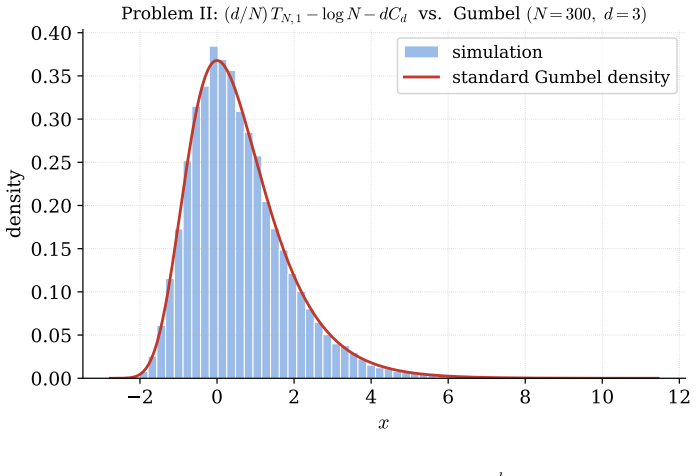
Two multi-draw coupon collector models with different retention rules admit explicit formulas for expected collection time, fourth-order asymptotics, variance scaling as π²N²/(6d²), and Gumbel limiting distributions.
A machine-rendered reading of the paper's core claim, the machinery that carries it, and where it could break.
Core claim
In both problems the expected number of trials for a complete set of N coupons is given by an explicit formula obtained from the Nørlund-Rice integral applied to the alternating binomial sum that encodes the retention rule. Full asymptotic expansions of this expectation are obtained as N tends to infinity. The variance is asymptotically π²N²/(6d²), and after appropriate normalization the distribution converges to the standard Gumbel law, with the scaling differing between the two retention rules. Problem I models exactly the coverage process in combinatorial motif-based DNA data storage, supplying closed-form estimates.
What carries the argument
Nørlund-Rice integral method applied to alternating binomial sums generated by the two retention rules in the multi-draw processes.
If this is right
- Explicit formulas exist for the mean number of trials needed to collect N types in each model.
- Asymptotic expansions up to fourth order with error term hold for both problems.
- The variance of the collection time behaves asymptotically as π²N²/(6d²) in both cases.
- The limiting distribution after normalization is standard Gumbel, with different centering and scaling for each retention rule.
- Problem I yields closed-form coverage estimates for combinatorial motif-based DNA data storage.
Where Pith is reading between the lines
- The differing normalizations between the two Gumbel limits quantify how each retention rule changes the effective rate at which new types accumulate.
- The exact match to the DNA storage coverage process allows the asymptotic expansions to predict required sequencing depth from motif parameters without simulation.
- The integral technique may extend to other batch-sampling models that incorporate selective retention.
Load-bearing premise
The retention rules are modeled exactly by the stated stochastic processes with uniformly distributed coupons, and the Nørlund-Rice integral representation correctly captures the alternating binomial sums arising from these rules.
What would settle it
Monte Carlo simulation of the collection time for large N in both models, compared directly to the explicit formulas and the predicted asymptotic variance and Gumbel distribution.
Figures


read the original abstract
In this paper we study two variants of the generalized coupon collector's problem, where our collector receives at each run d distinct coupons and keeps all the new observed coupons (Problem I), while he chooses the least--collected coupon at each run (Problem II). In both cases we derive explicit formulae for the average of the random variable denoting the number of trials for a complete set of N different types of coupons, which are uniformly distributed. In both cases we present the asymptotic expansion up to the fourth term including the corresponding error term. Then, for both problems we derive the full asymptotic expansion as N\rightarrow \infty. We further obtain the leading-order behaviour of the variance, showing that in both problems \mathrm{Var}\sim \frac{\pi^2}{6}\frac{N^2}{d^2}, and we establish a rate of convergence to the limiting law. Our analysis is based on the N{\o}rlund--Rice integral method applied to an alternating binomial sum and classical tools from asymptotic analysis. The leading asymptotic term for Problem II was obtained by W. Xu and A. K. Tang [\textit{J. Appl. Probab.} \textbf{48} (2011), 1081--1094]. Finally, for both problems, we derive the limiting distribution under the appropriate normalization. As expected, the limit is standard Gumbel; however, the normalization differs between Problems I and II. As an application, we show that Problem~I describes exactly the sequencing-coverage process in combinatorial motif-based DNA data storage, and our expansions yield closed-form coverage estimates for that setting.
Editorial analysis
A structured set of objections, weighed in public.
Referee Report
Summary. The paper analyzes two variants of the multi-draw coupon collector problem with N coupon types and draws of size d. Problem I retains all new coupons observed in a draw; Problem II retains only the least-collected coupon. Explicit formulas for the expectation of the number of trials until all types are collected are derived via the Nørlund-Rice integral applied to alternating binomial sums obtained from the underlying Markov chains. Fourth-order asymptotic expansions with error terms, the leading variance term Var ∼ π²/6 N²/d² for both problems, and convergence in distribution to a standard Gumbel law (with distinct normalizations) are obtained. The leading term for Problem II recovers a prior result of Xu and Tang. Problem I is shown to model exactly the coverage process in combinatorial motif-based DNA data storage, yielding closed-form coverage estimates.
Significance. If the integral representations and asymptotic derivations hold, the work supplies exact expressions and sharp asymptotics (including variance and limiting laws) for two natural retention rules in the multi-draw setting. The explicit fourth-order expansions and the common variance leading term are technically useful, and the DNA-storage application provides a concrete setting where the expansions give closed-form estimates. The extension of the Xu-Tang result and the use of the Nørlund-Rice method on the specific alternating sums constitute the main technical contribution.
major comments (2)
- [Section 3 (expectation formulae) and the Nørlund-Rice application paragraphs] The central claims (explicit formulae, fourth-order asymptotics, variance leading term, and Gumbel limits) all rest on the Nørlund-Rice contour integral correctly reproducing the alternating binomial sums that arise from the two retention rules. The manuscript applies the method to the sums derived from the Markov-chain expectations but does not include an explicit verification step or small-N numerical check confirming that the integral equals the sum for the binomial coefficients generated by each rule. This step is load-bearing for every subsequent result, including the DNA-storage mapping.
- [Variance section (after the expectation asymptotics)] The variance claim Var ∼ π²/6 N²/d² is stated for both problems and is consistent with the Gumbel limit under the reported normalizations, but the derivation of the variance expansion itself is not shown in detail; only the leading term is given. Because the variance enters the rate-of-convergence statement to the Gumbel law, an outline of how the second-moment calculation follows from the same integral representation would strengthen the result.
minor comments (3)
- [Abstract] The abstract states that the limit is standard Gumbel but the normalization differs; the precise centering and scaling constants for each problem should be stated explicitly in the abstract for clarity.
- [Throughout] Notation for the coupon types and draw size is introduced as N and d; ensure consistent use of these symbols in all displayed equations and in the DNA-application section.
- [Introduction and bibliography] The reference to Xu and Tang is given with journal, volume, and pages; confirm that the citation appears in the bibliography with the same details.
Simulated Author's Rebuttal
We thank the referee for the careful reading and constructive comments. We respond to each major comment below and are prepared to revise the manuscript accordingly.
read point-by-point responses
-
Referee: [Section 3 (expectation formulae) and the Nørlund-Rice application paragraphs] The central claims (explicit formulae, fourth-order asymptotics, variance leading term, and Gumbel limits) all rest on the Nørlund-Rice contour integral correctly reproducing the alternating binomial sums that arise from the two retention rules. The manuscript applies the method to the sums derived from the Markov-chain expectations but does not include an explicit verification step or small-N numerical check confirming that the integral equals the sum for the binomial coefficients generated by each rule. This step is load-bearing for every subsequent result, including the DNA-storage mapping.
Authors: We agree that an explicit verification step would strengthen the exposition. The Nørlund-Rice integral is applied to the alternating binomial sums that arise directly from the Markov-chain analysis for each retention rule; by the residue theorem underlying the method, the contour integral equals the sum exactly once the poles are accounted for. To make this transparent and to address the referee's concern, we will add a short numerical verification (for small N, e.g., N=5 and N=10) comparing the direct Markov-chain sums with numerical quadrature of the corresponding contour integrals for both problems. This addition will also serve as an independent check for the DNA-storage application. revision: yes
-
Referee: [Variance section (after the expectation asymptotics)] The variance claim Var ∼ π²/6 N²/d² is stated for both problems and is consistent with the Gumbel limit under the reported normalizations, but the derivation of the variance expansion itself is not shown in detail; only the leading term is given. Because the variance enters the rate-of-convergence statement to the Gumbel law, an outline of how the second-moment calculation follows from the same integral representation would strengthen the result.
Authors: We thank the referee for highlighting this point. The second-moment expressions are obtained from the same Markov chains by solving the appropriate linear systems for E[T(T-1)], which again produce alternating binomial sums. The Nørlund-Rice integral is then applied to these sums; the leading π²/6 N²/d² term emerges from the double-pole residues at the dominant singularities, in direct analogy with the expectation analysis. We will revise the variance section to include a concise outline of this second-moment integral representation and the extraction of the leading term, thereby clarifying its relation to the Gumbel convergence rate. Full algebraic details can be placed in an appendix. revision: yes
Circularity Check
No circularity: standard Nørlund-Rice method applied to sums derived from Markov chain model
full rationale
The paper derives alternating binomial sums directly from the Markov chain state transitions under each retention rule (keep-all vs. least-collected). It then applies the known Nørlund-Rice contour integral representation and classical asymptotic analysis to obtain explicit formulae, expansions, variance asymptotics, and Gumbel limits. These steps are independent of the target results; the integral is an external analytic tool, not defined in terms of the paper's outputs. The Xu-Tang citation is only for the leading term of one problem and is not load-bearing for the new derivations. The DNA-storage mapping is a direct equivalence of the stochastic process, not a reduction. No self-definitional loops, fitted inputs renamed as predictions, or ansatz smuggling occur. The derivation chain is self-contained against external benchmarks.
Axiom & Free-Parameter Ledger
axioms (2)
- standard math The Nørlund-Rice integral method correctly represents the expectation as an alternating binomial sum for the described coupon processes.
- standard math Classical asymptotic analysis tools yield the fourth-order expansion and error term as N→∞.
Reference graph
Works this paper leans on
-
[1]
A. Boneh and M. Hofri, The coupon collector problem revisited–A survey of engi neering problems and computational methods,Comm. Statist. Stochastic Models13(1997), no. 1, 39–66
work page 1997
-
[2]
C.M. Bender and S.A. Orszag,Advanced Mathematical Methods for Scientists and Engineers I: Asymptotic Methods and Perturbation Theory, Springer-Verlag, New York, 1999
work page 1999
-
[3]
I. Preuss, B. Galili, Z. Yakhini, and L. Anavy, Sequencing coverage analysis for combinatorial DNA-based storage systems,bioRxiv(2024), https://doi.org/10.1101/2024.01.10.574966
-
[4]
R. Sokolovskii, P. Agarwal, L.A. Croquevielle, Z. Zhou, and T. Heinis, Coding over coupon collector channels for combinatorial motif-based DNA storage,IEEE Transactions on Communications(2024), https://doi.org/10.1109/TCOMM.2024.3506913
-
[5]
L. Ceze, J. Nivala, and K. Strauss, Molecular digital data storage using DNA,Nature Reviews Genetics20 (2019), 456–466
work page 2019
-
[6]
D. Bar-Lev, O. Sabary, R. Gabrys, and E. Yaakobi, Cover your bases: how to minimize the sequencing coverage in DNA storage systems,IEEE Transactions on Information Theory71(1) (2025), 192–218
work page 2025
-
[7]
H. Abraham, R. Gabrys, and E. Yaakobi, Covering all bases: the next inning in DNA sequencing efficiency, in2024 IEEE International Symposium on Information Theory (ISIT)(2024), 464–469
work page 2024
- [8]
-
[9]
A.V. Doumas and V.G. Papanicolaou, The Coupon Collector’s Problem Revisited: Asymptotics of the Vari- ance,Adv. Appl. Prob.44(1) (2012) 166–195
work page 2012
-
[10]
A.V.DoumasandV.G.Papanicolaou,AsymptoticsoftherisingmomentsfortheCouponCollector’sProblem, Electron. J. Probab.18(Article no. 41) (2012) 1–15
work page 2012
-
[11]
A.V. Doumas and V.G. Papanicolaou The Coupon Collector’s Problem Revisited: Generalizing the Double Dixie Cup Problem of Newman and Shepp,ESAIM Probab. Stat.,20(2016) 367–399
work page 2016
-
[12]
A. V. Doumas and V. G. Papanicolaou. The siblings of the coupon collector,Theory Probab. Appl., 62(3) :444–470, 2018
work page 2018
-
[13]
A.V. Doumas and V.G. Papanicolaou, Uniform versus Zipf distribution in a mixing collection process,Stat. Probab. Lett.155(2019), https://doi.org/10.1016/j.spl.2019.108559
-
[14]
A.V. Doumas and V.G. Papanicolaou, Sampling from a mixture of different groups of coupons,Acta Math- ematica SinicaEnglish Series 3612(2020) 1357–1383, https://doi.org/10.1051/ps/2020011
- [15]
-
[16]
A.V. Doumas and V.G. Papanicolaou, The logarithmic Zipf law in a general urn problem,ESAIM Probab. Stat.,24(2020) 275–293
work page 2020
-
[17]
Doumas, Dixie Cup Problem in an Interlacing ProcessMethodol Comput Appl Probab27, 90 (2025)
A.V. Doumas, Dixie Cup Problem in an Interlacing ProcessMethodol Comput Appl Probab27, 90 (2025). https://doi.org/10.1007/s11009-025-10220-3
-
[18]
P. Flajolet, and R. Sedgewick,Mellin transforms and asymptotics: Finite differences and rice’s integrals, Theoret. Comp. Sci.,144No. 1–2, (1995) pp. 101–124
work page 1995
-
[19]
Neal,The generalised coupon collector problem, J
P. Neal,The generalised coupon collector problem, J. Appl. Probab.45, (2008) p.p. 621–629
work page 2008
-
[20]
Norris,Markov Chains, Cambridge University Press, Cambridge, 1997
J.R. Norris,Markov Chains, Cambridge University Press, Cambridge, 1997
work page 1997
-
[21]
M. Sharif and B. Hassibi,Delay considerations for opportunistic scheduling in broadcast fading channels, IEEE Transactions on Wireless Communications,6, (2007) pp. 3353–3363
work page 2007
-
[22]
P. Diaconis and S. Holmes, A Bayesian peek into Feller volume I,Sankhy¯ a, Special issue in memory of D. Basu,64Ser. A (3, part 2) (2002) 820–841
work page 2002
-
[23]
P. Erdős and A. Rényi, On a classical problem of probability theory,Magyar. Tud. Akad. Mat. Kutató Int. Közl.,6(1961), 215–220
work page 1961
-
[24]
Feller,An Introduction to Probability Theory and Its Applications, Vol
W. Feller,An Introduction to Probability Theory and Its Applications, Vol. I & II, John Wiley & Sons, Inc., New York, 1966
work page 1966
-
[25]
D.J. Newman and L. Shepp, The double Dixie cup problem,Amer. Math. Monthly67(1960) 58–61. MR0120672
work page 1960
-
[26]
X. Weiyu, and A. K. Tang, A generalized coupon collector problem,Journal of Applied Probability,48No. 4 (2011): 1081–94. http://www.jstor.org/stable/23066444. 34
discussion (0)
Sign in with ORCID, Apple, or X to comment. Anyone can read and Pith papers without signing in.