Exact analytical solutions for the piston effect in supercritical fluids under post-acoustic approximation -- Short-time asymptotics, thermal penetration depth and comparison with the Spacelab D-2 experiments
Pith reviewed 2026-06-30 04:08 UTC · model grok-4.3
The pith
Exact closed-form solutions exist for the piston effect in one-dimensional Cartesian and spherical geometries under the post-acoustic approximation.
A machine-rendered reading of the paper's core claim, the machinery that carries it, and where it could break.
Core claim
Within the linear post-acoustic regime the piston effect reduces to the heat equation augmented by a spatially homogeneous source term whose amplitude is proportional to the time derivative of the bulk pressure; the pressure evolution is in turn determined by the heat flux through the boundaries, yielding exact closed-form temperature and pressure fields for Cartesian and spherical one-dimensional domains subject to Dirichlet or Neumann boundary conditions, plus short-time expansions and penetration-depth expressions for each case.
What carries the argument
The post-acoustic approximation that replaces acoustic wave propagation with a spatially uniform but time-dependent bulk pressure, thereby turning the piston-effect problem into a diffusion equation driven by a homogeneous source fixed by the boundary heat flux.
If this is right
- The four exact solutions (Cartesian/spherical, first/second kind) give explicit short-time temperature profiles and thermal penetration depths that can be evaluated without discretization.
- Incorporation of container heat capacity produces an effective mixed boundary condition that couples wall flux directly to the time derivative of wall temperature.
- The analytical pressure histories match the Spacelab D-2 temperature records for supercritical fluids without requiring numerical integration of the full equations.
- The same reduction supplies closed-form expressions for the effective thermal response time of any near-critical fluid cell whose boundary perturbation is slow compared with sound travel.
Where Pith is reading between the lines
- The same source-term formulation could be applied to time-varying heat fluxes that are not step-like, provided the post-acoustic condition still holds.
- The explicit penetration-depth formulas offer a direct way to estimate how far the piston layer must grow before the bulk fluid begins to heat appreciably.
- Because the solutions are parameter-free once the boundary data are given, they can serve as benchmark cases for testing numerical codes that retain acoustic terms.
Load-bearing premise
The time scale of the imposed boundary temperature or flux change is much longer than the acoustic transit time across the container, so pressure equalizes instantly and remains spatially uniform.
What would settle it
A high-resolution measurement inside the fluid volume that shows measurable spatial pressure gradients persisting throughout the thermal relaxation phase would falsify the post-acoustic reduction.
Figures


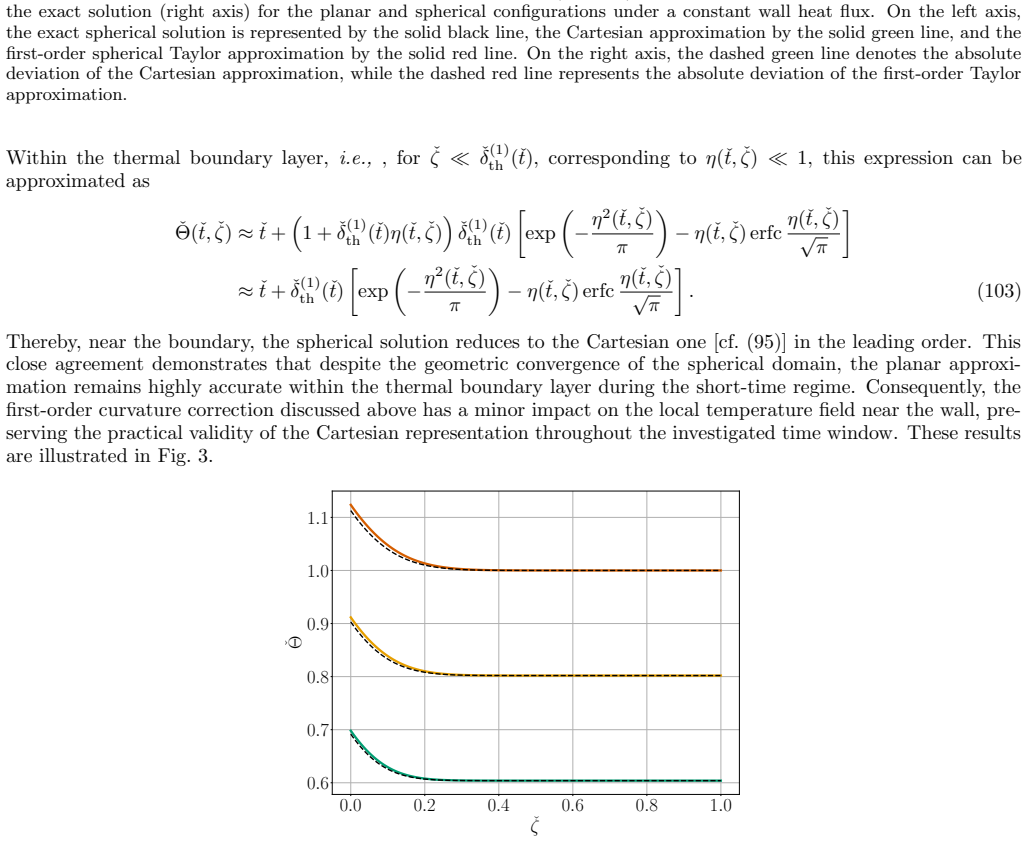


read the original abstract
Near the liquid-vapor critical point, fluids become highly compressible, giving rise to a special, strongly coupled thermo-mechanical process: the piston effect. In this phenomenon, a thin thermal boundary layer develops near a heated wall; owing to strong thermal expansion, this layer acts like a piston, compressing the bulk fluid adiabatically and resulting in a seemingly accelerated thermal response. Although the piston effect is a thermo-acoustic process, the characteristic time scale of the boundary perturbation is typically orders of magnitude larger than the acoustic time scale of the setup. Consequently, rapid acoustic propagation can be neglected, justifying a post-acoustic approximation with a spatially uniform but time-dependent bulk pressure. Within the linear regime, the temporal evolution of pressure can be directly connected to the heat flux entering through the boundaries. As a result, the problem reduces to a diffusion equation governed by a spatially homogeneous source term that depends explicitly on the boundary conditions. Exact, closed-form analytical solutions are derived for effectively one-dimensional problems in both Cartesian and spherical coordinates, considering boundary conditions of the first and second kinds. Short-time asymptotic behavior and thermal penetration depth are analyzed for all four cases. By incorporating the heat capacity of a container via a homogeneous model, an effective boundary condition coupling the wall heat flux and the time derivative of the wall temperature is derived, allowing for a direct comparison with experimental data from the Spacelab D-2 mission. The analytical predictions show good agreement with the experimental results without relying on any numerical simulations.
Editorial analysis
A structured set of objections, weighed in public.
Referee Report
Summary. The manuscript derives exact closed-form analytical solutions for the piston effect in supercritical fluids under the post-acoustic approximation. The governing equations are reduced to a linear diffusion equation with a spatially uniform but time-dependent source term fixed by global mass conservation. Closed-form solutions are obtained via eigenfunction expansions or Laplace transforms for one-dimensional Cartesian and spherical geometries subject to boundary conditions of the first and second kinds. Short-time asymptotics and thermal penetration depths are analyzed for each case. A lumped-parameter model for container heat capacity yields an effective boundary condition that couples wall temperature and flux, enabling direct comparison with Spacelab D-2 experimental data; the analytical predictions agree with the measurements without any numerical simulations.
Significance. If the derivations are correct, the work supplies parameter-free analytical expressions that can serve as benchmarks for numerical codes and provide immediate physical insight into the piston effect. The explicit short-time asymptotics and penetration-depth formulas, together with the experimental validation against independent space data, constitute a clear advance over purely numerical treatments. The absence of free parameters and the machine-checkable character of the closed-form solutions are particular strengths.
major comments (2)
- [Introduction and §2 (post-acoustic reduction)] The reduction to the diffusion equation with uniform source relies on the post-acoustic approximation; the manuscript should quantify the acoustic time scale versus the boundary-perturbation time scale for the specific Spacelab D-2 geometry and fluid conditions to confirm the approximation remains uniformly valid throughout the reported time window.
- [§4 (effective boundary condition) and §5 (solutions)] The homogeneous container-heat-capacity model produces an effective Robin-type boundary condition; the manuscript must demonstrate that this lumped closure does not introduce an additional free parameter and that the resulting eigenfunction expansions remain orthogonal and complete for both Cartesian and spherical cases.
minor comments (2)
- [§3 (short-time asymptotics)] Notation for the thermal penetration depth should be defined once and used consistently across the four cases; the current presentation mixes δ(t) and δ_thermal without a single reference definition.
- [§6 (comparison with D-2 data)] The experimental comparison would benefit from a table listing the fluid parameters, container dimensions, and measured versus predicted temperature rise at the reported times rather than relying solely on figures.
Simulated Author's Rebuttal
We thank the referee for the constructive comments and the recommendation of minor revision. The suggestions strengthen the justification of the post-acoustic approximation and the mathematical properties of the solutions. We address each major comment below.
read point-by-point responses
-
Referee: [Introduction and §2 (post-acoustic reduction)] The reduction to the diffusion equation with uniform source relies on the post-acoustic approximation; the manuscript should quantify the acoustic time scale versus the boundary-perturbation time scale for the specific Spacelab D-2 geometry and fluid conditions to confirm the approximation remains uniformly valid throughout the reported time window.
Authors: We agree that an explicit quantification strengthens the manuscript. In the revision we will add a dedicated paragraph in §2 that computes the acoustic transit time τ_ac = L/c_s (L the cell length, c_s the local speed of sound) for the Spacelab D-2 cell dimensions and the thermodynamic state of the fluid, and compares it with both the thermal diffusion time across the boundary layer and the duration of the imposed wall-temperature ramp. The resulting ratio is O(10^{-3}–10^{-2}), confirming that the post-acoustic approximation remains uniformly valid over the experimental time window. revision: yes
-
Referee: [§4 (effective boundary condition) and §5 (solutions)] The homogeneous container-heat-capacity model produces an effective Robin-type boundary condition; the manuscript must demonstrate that this lumped closure does not introduce an additional free parameter and that the resulting eigenfunction expansions remain orthogonal and complete for both Cartesian and spherical cases.
Authors: The container heat capacity C_w is a fixed material property taken directly from the Spacelab D-2 hardware documentation and is not adjusted as a free parameter. The effective boundary condition is therefore a standard Robin condition whose associated Sturm–Liouville operator remains self-adjoint on the appropriate weighted inner product. Consequently the eigenfunctions form a complete orthogonal basis for both the Cartesian slab and the spherical shell. We will insert a short appendix that recalls the self-adjointness proof and cites the standard completeness theorem for regular Sturm–Liouville problems with Robin boundary conditions. revision: yes
Circularity Check
No significant circularity identified
full rationale
The derivation reduces the piston-effect problem to a linear diffusion equation with a spatially uniform time-dependent source fixed by global mass conservation under the post-acoustic approximation; this follows directly from the governing equations and stated physical time-scale separation without redefining any quantity in terms of its own output. The four cases (Cartesian/spherical, Dirichlet/Neumann) are then solved by standard eigenfunction or Laplace-transform methods. The container heat-capacity closure is an explicit lumped-parameter modeling step that couples wall temperature and flux but does not alter internal solvability or create a self-referential loop. Experimental comparison uses independent Spacelab D-2 data and requires no fitted parameters or self-citations as load-bearing premises. The chain is therefore self-contained against external benchmarks.
Axiom & Free-Parameter Ledger
axioms (1)
- domain assumption Post-acoustic approximation: spatially uniform but time-dependent bulk pressure due to time scale separation.
Reference graph
Works this paper leans on
-
[1]
Planar geometry The resulting subproblem corresponds to classical diffusion with a boundary condition of the second kind in a semi-infinite domain, the solution of which is expressed as Θd(t, x) = ˙qw λ √ 4atierfc x√ 4at ,(61) where ierfcη= exp(−η2)√π −ηerfcηdenotes the first integral of the complementary error function, and erfcηis the stan- dard complem...
-
[2]
Spherical geometry In spherical coordinates, the governing equation can be reduced to a planar form with modified boundary conditions by employing the standard transformation Θd(t, r) = ϑ(t, r) r .(63) The corresponding spatial derivatives take the form ∂Θd ∂r =− 1 r2 ϑ+ 1 r ∂ϑ ∂r , 1 r2 ∂ ∂r r2 ∂Θd ∂r = 1 r ∂2ϑ ∂r2 .(64) Furthermore, we introduce a local...
-
[3]
The negative sign on the left-hand side of (71) originates from the outward-pointing normal vector
Planar geometry Applying the Laplace transform with respect to the time coordinate to the governing equations (50), (52) and the boundary condition yields s ˆΘd(s, x) =a ∂2 ˆΘd ∂x2 ,(70) s ˆΘb(s) =− L τp ∂ ˆΘd ∂x x=0 ,(71) ˆΘd(s,0) = Θw s − ˆΘb(s),(72) wheresdenotes the complex frequency (i.e.,the Laplace-domain variable). The negative sign on the left-ha...
-
[4]
Spherical geometry First, the governing equations (50), (52) and the associated boundary condition are converted from spherical coordinates to the localized Cartesian inward radial coordinate via (63) and (65). Then, performing the Laplace transform with respect to time yields sˆϑ(s, ζ) =a ∂2 ˆϑ ∂ζ 2 ,(79) s ˆΘb(s) =− R τp 1 R2 ˆϑ(s,0) + 1 R ∂ ˆϑ ∂ζ ζ=0 !...
-
[5]
A brief review of the thermophysical properties of supercritical fluids.The Journal of Supercritical Fluids, 53(1):2–11, 2010
Pierre Carl` es. A brief review of the thermophysical properties of supercritical fluids.The Journal of Supercritical Fluids, 53(1):2–11, 2010
2010
-
[6]
Imre, Axel Groniewsky, G´ abor Gy¨ orke, Adrienn Katona, and D´ avid Velmovszki
Attila R. Imre, Axel Groniewsky, G´ abor Gy¨ orke, Adrienn Katona, and D´ avid Velmovszki. Anomalous properties of some fluids – with high relevance in energy engineering – in their pseudo-critical (Widom) region.Periodica Polytechnica Chemical Engineering, 63(2):276–285, feb 2019
2019
-
[7]
Tak´ acs, Tam´ as F¨ ul¨ op, and Attila R
Don´ at M. Tak´ acs, Tam´ as F¨ ul¨ op, and Attila R. Imre. Leading elliptic relationship for supercritical fluids in the widom region.The Journal of Supercritical Fluids, 208:106216, 2024
2024
-
[8]
Thermoacoustic waves near the liquid-vapor critical point.Physics of Fluids, 18(12), 2006
Pierre Carl` es. Thermoacoustic waves near the liquid-vapor critical point.Physics of Fluids, 18(12), 2006
2006
-
[9]
Near-critical fluid hydrodynamics.Comptes Rendus M´ ecanique, 331(10):713–726, 2003
Bernard Zappoli. Near-critical fluid hydrodynamics.Comptes Rendus M´ ecanique, 331(10):713–726, 2003
2003
-
[10]
Springer, 2015
Bernard Zappoli, Daniel Beysens, and Yves Garrabos.Heat transfers and related effects in supercritical fluids. Springer, 2015
2015
-
[11]
Thermoacoustic transport in supercritical fluids at near-critical and near-pseudo- critical states.The Journal of Supercritical Fluids, 68:13–24, 2012
Nusair Hasan and Bakhtier Farouk. Thermoacoustic transport in supercritical fluids at near-critical and near-pseudo- critical states.The Journal of Supercritical Fluids, 68:13–24, 2012
2012
-
[12]
Thermodynamic efficiency of subcritical and transcritical power cycles utilizing selected ACZ working fluids.Energy, 254:124432, 2022
Sindu Daniarta, Attila R Imre, and Piotr Kolasi´ nski. Thermodynamic efficiency of subcritical and transcritical power cycles utilizing selected ACZ working fluids.Energy, 254:124432, 2022
2022
-
[13]
Design concepts of supercritical water-cooled reactor (SCWR) and nuclear marine vessel: A review.Progress in Nuclear Energy, 124:103320, 2020
Mohammad Mizanur Rahman, Ji Dongxu, Nusrat Jahan, Massimo Salvatores, and Jiyun Zhao. Design concepts of supercritical water-cooled reactor (SCWR) and nuclear marine vessel: A review.Progress in Nuclear Energy, 124:103320, 2020
2020
-
[14]
A review of existing SuperCritical Water reactor concepts, safety analysis codes and safety characteristics.Progress in Nuclear Energy, 153:104409, 2022
Pan Wu, Yanhao Ren, Min Feng, Jianqiang Shan, Yanping Huang, and Wen Yang. A review of existing SuperCritical Water reactor concepts, safety analysis codes and safety characteristics.Progress in Nuclear Energy, 153:104409, 2022
2022
-
[15]
Supercritical Geothermal Systems - A Review of Past Studies and Ongoing Research Activities
Patrick Dobson, Hiroshi Asanuma, Ernst Huenges, Flavio Poletto, Thomas Reinsch, and Bernard Sanjuan. Supercritical Geothermal Systems - A Review of Past Studies and Ongoing Research Activities. In42nd Workshop on Geothermal Reservoir Engineering, Proceedings ” 42nd Workshop on Geothermal Reservoir Engineering”, Stanford, CA, United States, 2017
2017
-
[16]
Utilizing supercritical geothermal systems: a review of past ventures and ongoing research activities.Geothermal Energy, 5(1):1–25, 2017
Thomas Reinsch, Patrick Dobson, Hiroshi Asanuma, Ernst Huenges, Flavio Poletto, and Bernard Sanjuan. Utilizing supercritical geothermal systems: a review of past ventures and ongoing research activities.Geothermal Energy, 5(1):1–25, 2017
2017
-
[17]
T. G. Theofanous, J. P. Tu, A. T. Dinh, and Truc-Nam Dinh. The boiling crisis phenomenon: Part I: nucleation and nucleate boiling heat transfer.Experimental Thermal and Fluid Science, 26(6–7):775–792, 2002
2002
-
[18]
T. G. Theofanous, Truc-Nam Dinh, J. P. Tu, and A. T. Dinh. The boiling crisis phenomenon: Part II: dryout dynamics and burnout.Experimental Thermal and Fluid Science, 26(6-7):793–810, 2002
2002
-
[19]
Longmire and D
N. Longmire and D. T. Banuti. Onset of heat transfer deterioration caused by pseudo-boiling in CO 2 laminar boundary layers.International Journal of Heat and Mass Transfer, 193:122957, 2022
2022
-
[20]
Fast adiabatic equilibration in a single-component fluid near the liquid- vapor critical point.Physical Review A, 41(4):2256, 1990
Akira Onuki, Hong Hao, and Richard A Ferrell. Fast adiabatic equilibration in a single-component fluid near the liquid- vapor critical point.Physical Review A, 41(4):2256, 1990
1990
-
[21]
Hac` ene Boukari, J. N. Shaumeyer, Matthew E. Briggs, and Robert W. Gammon. Critical speeding up in pure fluids. Physical Review A, 41(4):2260, 1990
1990
-
[22]
Zappoli, D
B. Zappoli, D. Bailly, Y. Garrabos, B. Le Neindre, P. Guenoun, and D. Beysens. Anomalous heat transport by the piston effect in supercritical fluids under zero gravity.Physical Review A, 41(4):2264–2267, Feb 1990
1990
-
[23]
Garrabos, M
Y. Garrabos, M. Bonetti, D. Beysens, F. Perrot, T. Fr¨ ohlich, P. Carl` es, and B. Zappoli. Relaxation of a supercritical fluid after a heat pulse in the absence of gravity effects: Theory and experiments.Physical Review E, 57(5):5665, 1998
1998
-
[24]
The process of heat and mass transport at the critical point of pure fluids.International journal of thermophysics, 16(5):1051–1058, 1995
J Straub, L Eicher, and A Haupt. The process of heat and mass transport at the critical point of pure fluids.International journal of thermophysics, 16(5):1051–1058, 1995
1995
-
[25]
Two typical time scales of the piston effect.Physical Review E—Statistical, Nonlinear, and Soft Matter Physics, 71(6):066310, 2005
Pierre Carl` es and Kokou Dadzie. Two typical time scales of the piston effect.Physical Review E—Statistical, Nonlinear, and Soft Matter Physics, 71(6):066310, 2005
2005
-
[26]
Akira Onuki. Thermoacoustic effects in supercritical fluids near the critical point: Resonance, piston effect, and acoustic emission and reflection.Physical Review E—Statistical, Nonlinear, and Soft Matter Physics, 76(6):061126, 2007. 29
2007
-
[27]
Thermoacoustic waves along the critical isochore.Physical Review E—Statistical, Nonlinear, and Soft Matter Physics, 83(1):011115, 2011
B Shen and P Zhang. Thermoacoustic waves along the critical isochore.Physical Review E—Statistical, Nonlinear, and Soft Matter Physics, 83(1):011115, 2011
2011
-
[28]
Straub, L
J. Straub, L. Eicher, and A. Haupt. Dynamic temperature propagation in a pure fluid near its critical point observed under microgravity during the German Spacelab Mission D-2.Physical Review E, 51(6):5556, 1995
1995
-
[29]
The effect of bulk viscosity on temperature relaxation near the critical point.Physics of Fluids, 10(9):2164– 2176, 1998
Pierre Carl` es. The effect of bulk viscosity on temperature relaxation near the critical point.Physics of Fluids, 10(9):2164– 2176, 1998
1998
-
[30]
Dover Publications, Amsterdam, 1962
Sybren Ruurds de Groot and Peter Mazur.Non-equilibrium thermodynamics. Dover Publications, Amsterdam, 1962
1962
-
[31]
Springer-Verlag, Berlin Heidelberg, 1970
Istv´ an Gyarmati.Non-equilibrium Thermodynamics. Springer-Verlag, Berlin Heidelberg, 1970
1970
-
[32]
Das Prinzip von Le Chatelier und Braun.International Journal of Heat and Mass Transfer, 7(1):23–31, 1964
Ulrich Grigull. Das Prinzip von Le Chatelier und Braun.International Journal of Heat and Mass Transfer, 7(1):23–31, 1964
1964
-
[33]
Akad´ emiai Kiad´ o (Publishing House of the Hungarian Academy of Sciences), Budapest, 2004
Tam´ as Matolcsi.Ordinary thermodynamics. Akad´ emiai Kiad´ o (Publishing House of the Hungarian Academy of Sciences), Budapest, 2004
2004
-
[34]
Asymptotic analysis of boundary thermal-wave process near the liquid–gas critical point.Physics of Fluids, 34(3), 2022
Lin Chen, Rui Zhang, Yuki Kanda, Dipankar N Basu, Atsuki Komiya, and Haisheng Chen. Asymptotic analysis of boundary thermal-wave process near the liquid–gas critical point.Physics of Fluids, 34(3), 2022
2022
-
[35]
Comparison study of fluid thermal boundary-bulk behaviors in the close-to-critical region under different property trends.Physics of Fluids, 35(8), 2023
Rui Zhang and Lin Chen. Comparison study of fluid thermal boundary-bulk behaviors in the close-to-critical region under different property trends.Physics of Fluids, 35(8), 2023
2023
-
[36]
Springer, 1999
Carl M Bender and Steven A Orszag.Advanced mathematical methods for scientists and engineers: Asymptotic methods and perturbation theory, volume 1. Springer, 1999
1999
-
[37]
T´ oth and M
K. T´ oth and M. Sz¨ ucs. Initial state dependence of thermo-mechanical coupling in heat conduction near the liquid-vapor critical point.Journal of Computational and Applied Mechanics, 20(2):71–92, 2025
2025
-
[38]
The piston effect in supercritical fluids investigated via a reversible–irreversible vector field splitting-based explicit time integration scheme.Physics of Fluids, 37(7), 2025
Don´ at M Tak´ acs, Tam´ as F¨ ul¨ op, R´ obert Kov´ acs, and M´ aty´ as Sz¨ ucs. The piston effect in supercritical fluids investigated via a reversible–irreversible vector field splitting-based explicit time integration scheme.Physics of Fluids, 37(7), 2025
2025
-
[39]
Clarendon Press, 2 edition, 1959
Horatio Scott Carslaw and John Conrad Jaeger.Conduction of Heat in Solids. Clarendon Press, 2 edition, 1959
1959
-
[40]
On conjugated problems of heat transfer.International Journal of Heat and Mass Transfer, 3(4):293–303, 1961
TL Perelman. On conjugated problems of heat transfer.International Journal of Heat and Mass Transfer, 3(4):293–303, 1961
1961
-
[41]
CRC Press, 2009
Abram S Dorfman.Conjugate problems in convective heat transfer. CRC Press, 2009
2009
-
[42]
Lemmon, Ian H
Eric W. Lemmon, Ian H. Bell, Marcia L. Huber, and Mark O. McLinden. Thermophysical properties of fluid systems. In P. J. Linstrom and W. G. Mallard, editors,NIST Chemistry WebBook, NIST Standard Reference Database Number 69. National Institute of Standards and Technology, Gaithersburg MD, 20899, USA, 2024. https://webbook.nist.gov/chemistry/fluid/ (retrie...
2024
discussion (0)
Sign in with ORCID, Apple, or X to comment. Anyone can read and Pith papers without signing in.