HTTP REST API Structure Learning
Pith reviewed 2026-07-03 08:26 UTC · model grok-4.3
The pith
HRAL learns REST API endpoint structures directly from network traffic to detect anomalies without documentation or rules.
A machine-rendered reading of the paper's core claim, the machinery that carries it, and where it could break.
Core claim
HRAL is a novel unsupervised anomaly detection approach that models the structure and behavior of API endpoints directly from network traffic, without relying on predefined rules or documentation, enabling robust detection of malicious activity by understanding how APIs behave and flagging deviations as potential threats. It achieves an average recall of 82.07% and an F1-score of 87.24%, significantly outperforming alternatives when API documentation is limited, and reaches 100% detection when combined with OWASP ModSecurity CRS.
What carries the argument
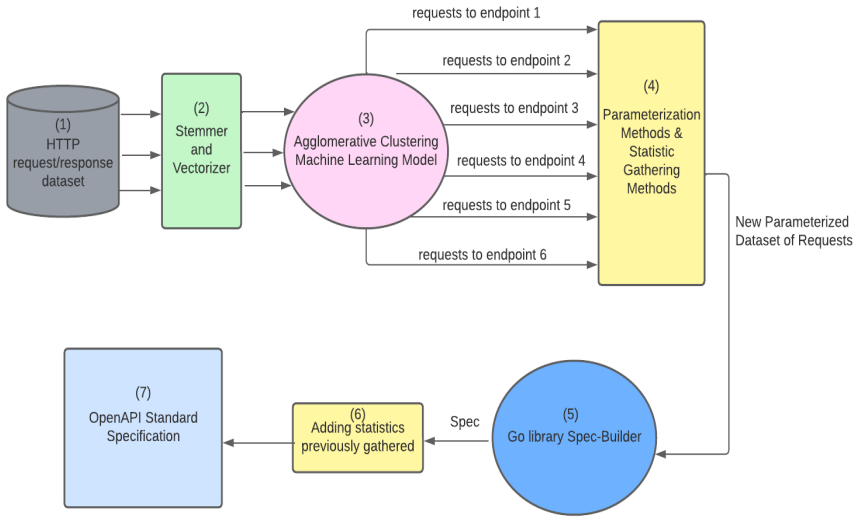
HRAL, the unsupervised model that extracts and baselines endpoint structure and behavior patterns from raw network traffic for deviation-based detection.
If this is right
- HRAL maintains high recall and F1 scores even when OpenAPI documentation is sparse or absent.
- Performance approaches that of systems given complete API definitions.
- Pairing the learned model with signature rules such as OWASP ModSecurity CRS yields complete detection coverage.
- The method supports security in real-world environments where APIs are only partially documented.
Where Pith is reading between the lines
- Layered defenses could treat traffic-derived models as a default baseline that requires no manual documentation updates.
- The same traffic-driven learning pattern could be tested on non-REST protocols or internal microservice meshes.
- If traffic patterns prove stable across versions, the approach might reduce the documentation burden on API maintainers.
Load-bearing premise
Network traffic alone contains sufficient and representative information to model normal API endpoint structure and behavior without predefined rules or documentation.
What would settle it
A controlled test on a production API where traffic logs are captured, a set of undocumented malicious requests are injected, and HRAL's detection rate falls well below the reported 82 percent recall.
Figures

read the original abstract
Application Programming Interfaces (APIs) are essential in software development, enabling web services, mobile apps, and microservices. However, their widespread use introduces significant security risks, highlighting the importance of API security. This paper presents HTTP REST API Learning (HRAL), a novel unsupervised anomaly detection approach that models the structure and behavior of API endpoints directly from network traffic, without relying on predefined rules or documentation. HRAL enables robust detection of malicious activity by understanding how APIs behave and flagging deviations as potential threats. We evaluate HRAL across varying levels of OpenAPI documentation detail and compare it with existing techniques. HRAL achieves strong performance, with an average recall of 82.07% and an F1-score of 87.24%, significantly outperforming alternatives when API documentation is limited. Moreover, our results approach the effectiveness of full API document definitions. When combined with signature-based rules such as the OWASP ModSecurity CRS, our system achieves 100% detection. These results highlight HRAL's effectiveness in real-world, partially documented API environments and its potential as a foundational layer for modern API security solutions.
Editorial analysis
A structured set of objections, weighed in public.
Referee Report
Summary. The paper presents HTTP REST API Learning (HRAL), a novel unsupervised anomaly detection approach that models the structure and behavior of REST API endpoints directly from network traffic without predefined rules or documentation. It evaluates the method across varying levels of OpenAPI documentation detail, claiming an average recall of 82.07% and F1-score of 87.24% that significantly outperforms alternatives when documentation is limited, approaches the effectiveness of full API definitions, and reaches 100% detection when combined with OWASP ModSecurity CRS.
Significance. If substantiated by rigorous evaluation, the work would represent a meaningful advance in API security by demonstrating a documentation-independent traffic-based modeling technique that can serve as a foundational layer alongside signature-based systems in partially documented environments.
major comments (1)
- [Abstract] Abstract: The central performance claims (average recall of 82.07% and F1-score of 87.24%) are stated without any description of the evaluation methodology, datasets, experimental protocol, baselines, or error analysis. This omission renders the quantitative results impossible to assess or reproduce.
Simulated Author's Rebuttal
We thank the referee for the detailed review and constructive comment on the abstract. We agree that additional context is needed there and will revise accordingly.
read point-by-point responses
-
Referee: [Abstract] Abstract: The central performance claims (average recall of 82.07% and F1-score of 87.24%) are stated without any description of the evaluation methodology, datasets, experimental protocol, baselines, or error analysis. This omission renders the quantitative results impossible to assess or reproduce.
Authors: We agree that the abstract would benefit from a concise description of the evaluation setup. In the revised version we will add a brief clause noting the use of real-world HTTP traffic traces, the protocol of testing across partial-to-full OpenAPI documentation levels, the comparison against signature-based and other unsupervised baselines, and that detailed methodology, results, and error analysis appear in Sections 4–5. This keeps the abstract within length limits while making the claims assessable. revision: yes
Circularity Check
No significant circularity identified
full rationale
The abstract and manuscript description present an unsupervised modeling approach from network traffic with reported empirical performance metrics (recall, F1-score) from comparisons to alternatives. No equations, derivations, self-citations, or fitted parameters are described that reduce any claim to its own inputs by construction. The evaluation relies on external benchmarks rather than internal definitions or self-referential predictions.
Axiom & Free-Parameter Ledger
Reference graph
Works this paper leans on
-
[1]
Research Towards Key Issues of API Security,
R. Sun, Q. Wang, and L. Guo, “Research Towards Key Issues of API Security,” inCNCERT, Beijing, China, July 20–21, 2021, pp. 179–192
2021
-
[2]
Mobile application web api reconnaissance: Web-to-mobile inconsistencies & vulnerabilities,
A. Mendoza and G. Gu, “Mobile application web api reconnaissance: Web-to-mobile inconsistencies & vulnerabilities,” inSP, 2018, pp. 756– 769
2018
-
[3]
Operation NightScout: Supply-chain at- tack targets online gaming in Asia
I. Sanmillan, “Operation NightScout: Supply-chain at- tack targets online gaming in Asia.” [On- line]. Available: https://www.welivesecurity.com/2021/02/01/ operation-nightscout-supply-chain-attack-online-gaming-asia/
2021
-
[4]
Log4j CVE-2021-44228
M. CVE, “Log4j CVE-2021-44228.” [Online]. Available: https: //cve.mitre.org/cgi-bin/cvename.cgi?name=cve-2021-44228
2021
-
[5]
Defense-In-Depth Security Strategy in Log4j Vulnerability Analysis,
S. Feng and M. Lubis, “Defense-In-Depth Security Strategy in Log4j Vulnerability Analysis,” inICADEIS, 2022, pp. 01–04
2022
-
[6]
OpenAPI Sepcification
O. Organization, “OpenAPI Sepcification.” [Online]. Available: https: //www.openapis.org/
-
[7]
Overview of machine learning processes used in improving security in api-based web applications,
E. M. Pas ,ca, R. Erdei, D. Delinschi, and O. Matei, “Overview of machine learning processes used in improving security in api-based web applications,” inArtificial Intelligence Application in Networks and Systems, R. Silhavy and P. Silhavy, Eds., 2023, pp. 367–381
2023
-
[8]
Speculator: A library for reconstructing OpenAPI specification from traffic of HTTP transactions
OpenClarity, “Speculator: A library for reconstructing OpenAPI specification from traffic of HTTP transactions.” [Online]. Available: https://github.com/openclarity/speculator
-
[9]
Analysis and mitigation of nosql injections,
A. Ron, A. Shulman-Peleg, and A. Puzanov, “Analysis and mitigation of nosql injections,”IEEE Security & Privacy, vol. 14, no. 2, pp. 30–39, 2016
2016
-
[10]
Seapp: A secure application management framework based on rest api access control in sdn-enabled cloud environment,
T. Hu, Z. Zhang, P. Yi, D. Liang, Z. Li, Q. Ren, Y . Hu, and J. Lan, “Seapp: A secure application management framework based on rest api access control in sdn-enabled cloud environment,”Journal of Parallel and Distributed Computing, vol. 147, pp. 108–123, 2021
2021
-
[11]
API Security in Large Enterprises: Leveraging Machine Learning for Anomaly Detection,
G. Baye, F. Hussain, A. Oracevic, R. Hussain, and S. Ahsan Kazmi, “API Security in Large Enterprises: Leveraging Machine Learning for Anomaly Detection,” inISNCC, 2021, pp. 1–6
2021
-
[12]
Best Practices to Secure API Implementations in Core Banking System (CBS) in Banks,
M. Ul Alam, M. A. K. Azad, and M. S. Ali, “Best Practices to Secure API Implementations in Core Banking System (CBS) in Banks,” in CCWC, 2022, pp. 0730–0735
2022
-
[13]
Machine learning for detecting fraud in an API,
A. S ´anchez Espunyes, “Machine learning for detecting fraud in an API,” 2022
2022
-
[14]
Auto-encoder lstm methods for anomaly- based web application firewallall,
A. Moradi Vartouni, S. Mehralian, M. Teshnehlab, and S. Sedighian Kashi, “Auto-encoder lstm methods for anomaly- based web application firewallall,”International Journal of Information and Communication Technology Research, vol. 11, no. 3, pp. 49–56, 2019
2019
-
[15]
Auto-threshold deep SVDD for anomaly-based web application firewall,
A. Moradi Vartouni, M. Shokri, and M. Teshnehlab, “Auto-threshold deep SVDD for anomaly-based web application firewall,” 2021
2021
-
[16]
Securing microservices with deep learning — Long Short- Term Memory Autoencoder for Anomaly Detection,
L. S. Arstila, “Securing microservices with deep learning — Long Short- Term Memory Autoencoder for Anomaly Detection,” Otakaari 24, 02150 Espoo, Finland, May 2023
2023
-
[17]
The role of anomaly detection in api security: A machine learning approach,
J. Paul, “The role of anomaly detection in api security: A machine learning approach,” 11 2024
2024
-
[18]
An algorithm for suffix stripping,
M. F. Porter, “An algorithm for suffix stripping,”Program, vol. 14, no. 3, pp. 130–137, 1980
1980
-
[19]
Scalable hierarchical agglomerative clustering,
N. Monath, K. A. Dubey, G. Guruganesh, M. Zaheer, A. Ahmed, A. McCallum, G. Mergen, M. Najork, M. Terzihan, B. Tjanakaet al., “Scalable hierarchical agglomerative clustering,” inProceedings of the 27th ACM SIGKDD Conference on Knowledge Discovery & Data Mining, 2021, pp. 1245–1255
2021
-
[20]
Ward’s hierarchical agglomerative clus- tering method: which algorithms implement Ward’s criterion?
F. Murtagh and P. Legendre, “Ward’s hierarchical agglomerative clus- tering method: which algorithms implement Ward’s criterion?”Journal of Classification, vol. 31, pp. 274–295, 2014
2014
-
[21]
HTTP DATASET CSIC 2010
Cisco, “HTTP DATASET CSIC 2010.” [Online]. Available: https: //www.tic.itefi.csic.es/dataset/
2010
-
[22]
A classification-by- retrieval framework for few-shot anomaly detection to detect api in- jection,
U. Aharon, R. Dubin, A. Dvir, and C. Hajaj, “A classification-by- retrieval framework for few-shot anomaly detection to detect api in- jection,”Computers & Security, vol. 150, p. 104249, 2025
2025
-
[23]
CVE-2021-44228,
N. I. of Standards and Technology, “CVE-2021-44228,” 2021, https: //nvd.nist.gov/vuln/detail/CVE-2021-44228
2021
-
[24]
OWSAP Log Forging,
OWSAP-Log, “OWSAP Log Forging,” 2023, https://owasp.org/ www-community/attacks/Log Injection
2023
-
[25]
OWSAP Log Injection,
OWSAP-SQL, “OWSAP Log Injection,” 2023, https://owasp.org/ www-community/attacks/SQL Injection
2023
-
[26]
OW ASP ModSecurity Core Rule Set
OW ASP, “OW ASP ModSecurity Core Rule Set.” [Online]. Available: https://owasp.org/www-project-modsecurity-core-rule-set/#: ∼:text=The%20OW ASP%20ModSecurity%20Core%20Rule,a% 20minimum%20of%20false%20alerts
discussion (0)
Sign in with ORCID, Apple, or X to comment. Anyone can read and Pith papers without signing in.