Embracing Intra-Class Heterogeneity for Semi-Supervised Medical Image Segmentation: From Diversity to Precision
Pith reviewed 2026-07-03 15:55 UTC · model grok-4.3
The pith
MPCL generates multiple intensity-aligned prototypes to model intra-class heterogeneity and improve precision in semi-supervised medical image segmentation.
A machine-rendered reading of the paper's core claim, the machinery that carries it, and where it could break.
Core claim
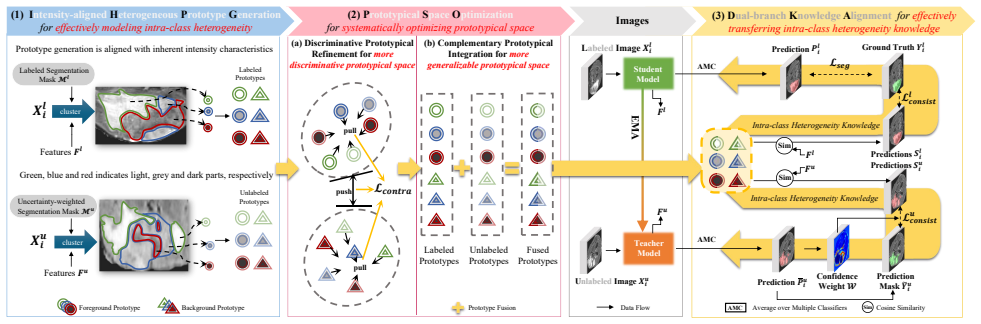
MPCL is an SSMIS framework that achieves better diversity and precision by generating multiple prototypes aligned with intensity characteristics through IHPG, systematically optimizing a more discriminative prototypical space through PSO, and promoting knowledge transfer to the segmentation network through DKA, resulting in significant outperformance over existing methods on three datasets with marked intra-class heterogeneity, particularly under extremely limited labeled data.
What carries the argument
Multiple Prototype Contrastive Learning (MPCL) framework that generates and aligns multiple intensity-based prototypes to represent heterogeneous patterns within the same class.
If this is right
- Segmentation boundaries become more accurate for structures that vary in intensity within the same class.
- Performance gains are largest when labeled data is reduced to very small fractions of the training set.
- The prototypical space becomes both more discriminative across classes and more generalizable within classes.
- Knowledge from the optimized prototypes transfers directly into higher-precision pixel predictions by the network.
Where Pith is reading between the lines
- The same prototype-generation logic could be tested on non-medical images that also contain intra-class texture or lighting variation.
- Combining MPCL with existing consistency-regularization techniques might compound the gains under label scarcity.
- If the intensity alignment step is replaced by learned feature alignment, the method might extend to modalities where intensity is less dominant.
- Deployment in clinical pipelines would require checking whether the added prototype computation increases inference latency.
Load-bearing premise
Intra-class heterogeneity appears mainly as intensity differences that multiple aligned prototypes can capture and transfer into the segmentation network without creating overfitting or boundary artifacts.
What would settle it
On the three medical image datasets, train MPCL and baseline SSMIS methods with 5 percent or fewer labeled samples and measure Dice or Hausdorff scores; if MPCL shows no consistent gain, the claim that the three components produce better precision from heterogeneity fails.
Figures




read the original abstract
Due to the scarcity of expert-annotated data, Semi-Supervised Medical Image Segmentation (SSMIS) has emerged as a promising approach. Many anatomical structures in medical images exhibit significant intra-class heterogeneity, with different regions showing heterogeneous intensity patterns within the same structure. However, existing methods inadequately exploit this intensity-manifested intra-class heterogeneity, resulting in uniform structural representations and imprecise segmentation. Furthermore, the scarcity of labeled data makes it more difficult to effectively capture such complex heterogeneity. To address this, we propose Multiple Prototype Contrastive Learning (MPCL), an SSMIS framework that possesses better diversity and better precision. It consists of three novel designs: First, we provide structural representations with better diversity and propose Intensity-aligned Heterogeneous Prototype Generation (IHPG) that effectively models intra-class heterogeneity by generating multiple prototypes aligned with intensity characteristics. Second, we further enhance more diverse structural representations and build a solid foundation for more precise segmentation through Prototypical Space Optimization (PSO) that systematically optimizes a more discriminative and generalizable prototypical space. Finally, we achieve segmentation results with better precision through Dual-branch Knowledge Alignment (DKA) that efficiently promotes intra-class heterogeneity knowledge transfer from prototypical space to the segmentation network. Extensive experiments on three medical image datasets with significant intra-class heterogeneity demonstrate that MPCL significantly outperforms existing methods, especially under extremely limited labeled data.
Editorial analysis
A structured set of objections, weighed in public.
Referee Report
Summary. The paper proposes Multiple Prototype Contrastive Learning (MPCL) for semi-supervised medical image segmentation to better exploit intra-class heterogeneity manifested in intensity patterns. The method introduces three components: Intensity-aligned Heterogeneous Prototype Generation (IHPG) to create multiple aligned prototypes, Prototypical Space Optimization (PSO) to build a more discriminative prototypical space, and Dual-branch Knowledge Alignment (DKA) to transfer heterogeneity knowledge to the segmentation head. It claims superior performance over existing methods on three medical image datasets, especially under extremely limited labeled data.
Significance. If validated with rigorous experiments, the work addresses a practically relevant challenge in medical imaging where anatomical structures show high intra-class variation and annotations are scarce. Modeling heterogeneity via multiple prototypes could lead to more precise segmentations in low-label regimes.
major comments (2)
- [Abstract] Abstract: The central claim of significant outperformance on three datasets is asserted without any quantitative results, baselines, error bars, or experimental protocol details, preventing verification of the contribution.
- [Method (PSO)] Method (PSO component): The claim that PSO produces a more discriminative and generalizable prototypical space is load-bearing for the precision gains, yet under extremely limited labels the optimization risks collapsing to sample-specific intensity modes; no regularization, temperature scheduling, or validation against overfitting is described to ensure generalization.
minor comments (1)
- [Abstract] Abstract: Phrases such as 'better diversity and better precision' are imprecise; quantitative or comparative language would improve clarity.
Simulated Author's Rebuttal
We thank the referee for the constructive feedback on our manuscript. We address each major comment point by point below and will incorporate revisions to strengthen the presentation.
read point-by-point responses
-
Referee: [Abstract] Abstract: The central claim of significant outperformance on three datasets is asserted without any quantitative results, baselines, error bars, or experimental protocol details, preventing verification of the contribution.
Authors: We agree that the abstract would be strengthened by including quantitative support for the performance claims. In the revised manuscript, we will update the abstract to report key metrics (e.g., mean Dice scores across the three datasets), reference the main baselines, and note the use of error bars along with the evaluation protocol. revision: yes
-
Referee: [Method (PSO)] Method (PSO component): The claim that PSO produces a more discriminative and generalizable prototypical space is load-bearing for the precision gains, yet under extremely limited labels the optimization risks collapsing to sample-specific intensity modes; no regularization, temperature scheduling, or validation against overfitting is described to ensure generalization.
Authors: We appreciate this observation on the PSO component. The current description emphasizes optimization for a discriminative and generalizable space but does not explicitly detail safeguards against overfitting to sample-specific modes under limited labels. We will revise the PSO subsection to include the contrastive loss formulation (with temperature parameter), any regularization applied, and evidence from ablations or validation that the space generalizes. revision: yes
Circularity Check
No circularity; derivation self-contained with no equations or self-referential reductions visible
full rationale
The abstract presents MPCL as a new framework with three components (IHPG for generating intensity-aligned prototypes, PSO for optimizing the prototypical space, and DKA for knowledge transfer) to address intra-class heterogeneity in SSMIS. No equations, parameter-fitting steps, or citations appear in the provided text. No load-bearing premise reduces to a self-definition, fitted input renamed as prediction, or self-citation chain. Claims rest on experimental results rather than a closed derivation, so no circular steps can be identified. This is the expected honest non-finding when the source contains no inspectable mathematical chain.
Axiom & Free-Parameter Ledger
Reference graph
Works this paper leans on
-
[1]
Ying Weng, Yiming Zhang, Wenxin Wang, and Tom Dening. Semi- supervised information fusion for medical image analysis: Recent progress and future perspectives.Information Fusion, 106:102263, 2024
work page 2024
-
[2]
Kai Han, Victor S Sheng, Yuqing Song, Yi Liu, Chengjian Qiu, Siqi Ma, and Zhe Liu. Deep semi-supervised learning for medical image segmentation: A review.Expert Systems with Applications, page 123052, 2024
work page 2024
-
[3]
RushiJiao,YichiZhang,LeDing,BingsenXue,JicongZhang,Rong Cai, and Cheng Jin. Learning with limited annotations: a survey on deep semi-supervised learning for medical image segmentation. Computers in Biology and Medicine, page 107840, 2023
work page 2023
-
[4]
Uncertainty-aware self-ensembling model for semi- supervised3dleftatriumsegmentation
Lequan Yu, Shujun Wang, Xiaomeng Li, Chi-Wing Fu, and Pheng- Ann Heng. Uncertainty-aware self-ensembling model for semi- supervised3dleftatriumsegmentation. InMedicalimagecomputing and computer assisted intervention–MICCAI 2019: 22nd interna- tional conference, Shenzhen, China, October 13–17, 2019, proceed- ings, part II 22, pages 605–613. Springer, 2019
work page 2019
-
[5]
Semi- supervised medical image segmentation through dual-task consis- tency
Xiangde Luo, Jieneng Chen, Tao Song, and Guotai Wang. Semi- supervised medical image segmentation through dual-task consis- tency. InProceedings of the AAAI conference on artificial intelli- gence, volume 35, pages 8801–8809, 2021
work page 2021
-
[6]
Yantao Chen, Yong Ma, Xiaoguang Mei, Lin Zhang, Zhigang Fu, and Jiayi Ma. Triple-task mutual consistency for semi-supervised 3d medical image segmentation.Computers in Biology and Medicine, 175:108506, 2024
work page 2024
-
[7]
Wenjing Lu, Jiahao Lei, Peng Qiu, Rui Sheng, Jinhua Zhou, Xinwu Lu, and Yang Yang. Upcol: uncertainty-informed prototype con- sistency learning for semi-supervised medical image segmentation. InInternational Conference on Medical Image Computing and Computer-Assisted Intervention, pages 662–672. Springer, 2023
work page 2023
-
[8]
Zhe Xu, Yixin Wang, Donghuan Lu, Lequan Yu, Jiangpeng Yan, Jie Luo,KaiMa,YefengZheng,andRaymondKai-yuTong. All-around reallabelsupervision:Cyclicprototypeconsistencylearningforsemi- supervisedmedicalimagesegmentation.IEEEJournalofBiomedical and Health Informatics, 26(7):3174–3184, 2022
work page 2022
-
[9]
Yongchao Wang, Bin Xiao, Xiuli Bi, Weisheng Li, and Xinbo Gao. Boundary-aware prototype in semi-supervised medical image seg- mentation.IEEE Transactions on Image Processing, 2024
work page 2024
-
[10]
YaliBi,EnyuChe,YinanChen,YuanpengHe,andJingweiQu.Multi- prototype-based embedding refinement for medical image segmen- tation. InICASSP 2025 - 2025 IEEE International Conference on Acoustics,SpeechandSignalProcessing(ICASSP),pages1–5,2025
work page 2025
-
[11]
Seung Yeon Shin, Thomas C Shen, and Ronald M Summers. Im- proving segmentation and detection of lesions in ct scans using intensity distribution supervision.Computerized Medical Imaging and Graphics, 108:102259, 2023
work page 2023
-
[12]
Nijad A Al-Najdawi, Ali F Al-Shawabkeh, Sara Tedmori, Ibrahim I Ikhries, and Osama Dorgham. Comprehensive evaluation of op- timization algorithms for medical image segmentation.Scientific Reports, 15(1):37190, 2025
work page 2025
-
[13]
Gaussian mixture models.Encyclopedia of biometrics, 741(659-663):3, 2009
Douglas A Reynolds et al. Gaussian mixture models.Encyclopedia of biometrics, 741(659-663):3, 2009
work page 2009
-
[14]
Hayit Greenspan, Amit Ruf, and Jacob Goldberger. Constrained gaussianmixturemodelframeworkforautomaticsegmentationofmr brain images.IEEE transactions on medical imaging, 25(9):1233– 1245, 2006
work page 2006
-
[15]
Cross-domain medicalimagetranslationbysharedlatentgaussianmixturemodel
YingyingZhu,YoubaoTang,YuxingTang,DanielCElton,Sungwon Lee, Perry J Pickhardt, and Ronald M Summers. Cross-domain medicalimagetranslationbysharedlatentgaussianmixturemodel. In Internationalconferenceonmedicalimagecomputingandcomputer- assisted intervention, pages 379–389. Springer, 2020
work page 2020
-
[16]
Shichen Sun, Yufei Chen, Xiaodong Yue, Chao Ma, and Xiahai Zhuang. Rednet: Reliable evidential discounting network for multi- modality medical image segmentation.IEEE Transactions on Medi- cal Imaging, 2025
work page 2025
-
[17]
Yufei Chen, Chang Xu, Weiping Ding, Shichen Sun, Xiaodong Yue, and Hamido Fujita. Target-aware u-net with fuzzy skip connec- tions for refined pancreas segmentation.Applied Soft Computing, 131:109818, 2022. :Preprint submitted to Elsevier Page 14 of 15
work page 2022
-
[18]
RezaAzad,EhsanKhodapanahAghdam,AmelieRauland,YiweiJia, Atlas Haddadi Avval, Afshin Bozorgpour, Sanaz Karimijafarbigloo, Joseph Paul Cohen, Ehsan Adeli, and Dorit Merhof. Medical image segmentation review: The success of u-net.IEEE Transactions on Pattern Analysis and Machine Intelligence, 2024
work page 2024
-
[19]
Wei Fu, Yufei Chen, Yuqi Liu, and Xiaodong Yue. D-edl: Differ- ential evidential deep learning for robust medical out-of-distribution detection.Medical Image Analysis, page 103888, 2025
work page 2025
-
[20]
Lu Xu, Mingyuan Liu, Boxuan Wei, Yihua He, Zhifan Gao, Hong- bin Han, and Jicong Zhang. Category-specific unlabeled data risk minimization for ultrasound semi-supervised segmentation.Medical Image Analysis, page 103773, 2025
work page 2025
-
[21]
Yichi Zhang, Bohao Lv, Le Xue, Wenbo Zhang, Yuchen Liu, Yu Fu, Yuan Cheng, and Yuan Qi. Semisam+: Rethinking semi-supervised medical image segmentation in the era of foundation models.arXiv preprint arXiv:2502.20749, 2025
-
[22]
Xiangde Luo, Guotai Wang, Wenjun Liao, Jieneng Chen, Tao Song, Yinan Chen, Shichuan Zhang, Dimitris N Metaxas, and Shaoting Zhang. Semi-supervisedmedicalimagesegmentationviauncertainty rectified pyramid consistency.Medical Image Analysis, 80:102517, 2022
work page 2022
-
[23]
InIn- ternationalConferenceonMedicalImageComputingandComputer- Assisted Intervention, pages 481–491
JinyiXiang,PengQiu,andYangYang.Fussnet:Fusingtwosourcesof uncertainty for semi-supervised medical image segmentation. InIn- ternationalConferenceonMedicalImageComputingandComputer- Assisted Intervention, pages 481–491. Springer, 2022
work page 2022
-
[24]
Temporal ensembling for semi- supervisedlearning
Samuli Laine and Timo Aila. Temporal ensembling for semi- supervisedlearning. InInternationalConferenceonLearningRepre- sentations, 2017
work page 2017
-
[25]
AnttiTarvainenandHarriValpola.Meanteachersarebetterrolemod- els: Weight-averaged consistency targets improve semi-supervised deep learning results.Advances in neural information processing systems, 30, 2017
work page 2017
-
[26]
Qi-Qi Chen, Zhao-Hui Sun, Chuan-Feng Wei, Edmond Q Wu, and Dong Ming. Semi-supervised 3d medical image segmentation based on dual-task consistent joint learning and task-level regularization. IEEE/ACMTransactionsonComputationalBiologyandBioinformat- ics, 20(4):2457–2467, 2022
work page 2022
-
[27]
Jun Lyu, Bin Sui, Chengyan Wang, Qi Dou, and Jing Qin. Adaptive feature aggregation based multi-task learning for uncertainty-guided semi-supervised medical image segmentation.Expert Systems with Applications, 232:120836, 2023
work page 2023
-
[28]
Self- supervisedcorrectionlearningforsemi-supervisedbiomedicalimage segmentation
Ruifei Zhang, Sishuo Liu, Yizhou Yu, and Guanbin Li. Self- supervisedcorrectionlearningforsemi-supervisedbiomedicalimage segmentation. InMedical Image Computing and Computer Assisted Intervention–MICCAI 2021: 24th International Conference, Stras- bourg, France, September 27–October 1, 2021, Proceedings, Part II 24, pages 134–144. Springer, 2021
work page 2021
-
[29]
Semi-supervised left atrium segmentation with mutual consistency training
YichengWu,MinfengXu,ZongyuanGe,JianfeiCai,andLeiZhang. Semi-supervised left atrium segmentation with mutual consistency training. InInternational Conference on Medical Image Computing and Computer-Assisted Intervention, volume 12902, pages 297–306. Springer, Cham, 2021
work page 2021
-
[30]
Few-shot semantic segmentation with prototype learning
Nanqing Dong and Eric P Xing. Few-shot semantic segmentation with prototype learning. InBMVC, volume 3, page 4, 2018
work page 2018
-
[31]
Hao Li, Guoheng Huang, Xiaochen Yuan, Zewen Zheng, Xuhang Chen, Guo Zhong, and Chi-Man Pun. Psanet: prototype-guided salient attention for few-shot segmentation.The Visual Computer, pages 1–15, 2024
work page 2024
-
[32]
Yuqi Liu, Yufei Chen, Wei Fu, Xiaodong Yue, and Thierry Denœux. Kp2l: Knowledge-driven pyramid prototype learning for semi- supervised medical image segmentation.Knowledge-Based Systems, 340:115662, 2026
work page 2026
-
[33]
Haiming Xu, Lingqiao Liu, Qiuchen Bian, and Zhen Yang. Semi- supervised semantic segmentation with prototype-based consistency regularization.Advances in neural information processing systems, 35:26007–26020, 2022
work page 2022
-
[34]
Adaptiveprototype learningand allocation for few-shot segmentation
Gen Li, Varun Jampani, Laura Sevilla-Lara, Deqing Sun, Jonghyun Kim,and JoongkyuKim. Adaptiveprototype learningand allocation for few-shot segmentation. InProceedings of the IEEE/CVF confer- ence on computer vision and pattern recognition, pages 8334–8343, 2021
work page 2021
-
[35]
Chunna Tian, Zhenxi Zhang, Xinbo Gao, Heng Zhou, Ran Ran, and ZhichengJiao.Animplicit-explicitprototypicalalignmentframework for semi-supervised medical image segmentation.IEEE Journal of Biomedical and Health Informatics, 28(2):929–940, 2023
work page 2023
-
[36]
Xiafan Li and Hongyan Quan. Mvpcl: multi-view prototype consis- tencylearningforsemi-supervisedmedicalimagesegmentation.The Visual Computer, pages 1–14, 2024
work page 2024
-
[37]
Focal loss for dense object detec- tion
T-YLPG Ross and GKHP Dollár. Focal loss for dense object detec- tion. Inproceedings of the IEEE conference on computer vision and pattern recognition, pages 2980–2988, 2017
work page 2017
-
[38]
V-net: Fully convolutional neural networks for volumetric medical image segmentation
Fausto Milletari, Nassir Navab, and Seyed-Ahmad Ahmadi. V-net: Fully convolutional neural networks for volumetric medical image segmentation. In2016 fourth international conference on 3D vision (3DV), pages 565–571. IEEE, 2016
work page 2016
-
[39]
Unitbox:Anadvancedobjectdetectionnetwork
JiahuiYu,YuningJiang,ZhangyangWang,ZhiminCao,andThomas Huang. Unitbox:Anadvancedobjectdetectionnetwork. InProceed- ings of the 24th ACM international conference on Multimedia, pages 516–520, 2016
work page 2016
-
[40]
Zhaohan Xiong, Qing Xia, Zhiqiang Hu, Ning Huang, Cheng Bian, Yefeng Zheng, Sulaiman Vesal, Nishant Ravikumar, Andreas Maier, Xin Yang, et al. A global benchmark of algorithms for segmenting the left atrium from late gadolinium-enhanced cardiac magnetic res- onance imaging.Medical image analysis, 67:101832, 2021
work page 2021
-
[41]
Holger R Roth, Amal Farag, E Turkbey, Le Lu, Jiamin Liu, and Ronald M Summers. Data from pancreas-ct. the cancer imaging archive.IEEE Transactions on Image Processing, 5, 2016
work page 2016
-
[42]
Bjoern H Menze, Andras Jakab, Stefan Bauer, Jayashree Kalpathy- Cramer, Keyvan Farahani, Justin Kirby, Yuliya Burren, Nicole Porz, Johannes Slotboom, Roland Wiest, et al. The multimodal brain tumor image segmentation benchmark (brats).IEEE transactions on medical imaging, 34(10):1993–2024, 2014. :Preprint submitted to Elsevier Page 15 of 15
work page 1993
discussion (0)
Sign in with ORCID, Apple, or X to comment. Anyone can read and Pith papers without signing in.