Four-channel prototype using coherent combining of ultrashort laser pulses for dipole configuration approximation
Pith reviewed 2026-07-03 07:03 UTC · model grok-4.3
The pith
Four-channel prototype stabilizes beam pointing and phase for coherent addition of ultrashort pulses into a standing-wave field.
A machine-rendered reading of the paper's core claim, the machinery that carries it, and where it could break.
Core claim
The authors establish that a stabilization system for beam pointing and relative phase enables coherent combining in a four-channel setup, producing a measurable standing-wave field at the focus that approximates the desired dipole configuration, as characterized by a subwavelength fiber probe.
What carries the argument
The stabilization system for beam pointing and relative phase of the four optical channels, which maintains coherence for the combined standing-wave field.
If this is right
- The demonstrated stabilization allows coherent addition of pulses from four channels into a single focus.
- The fiber subwavelength probe technique maps the standing-wave electromagnetic field distribution at the main focus.
- This four-channel prototype serves as a scalable building block for larger coherent combining systems.
- Geometric combining of channels provides a route to higher intensities while preserving ultrashort pulse durations.
Where Pith is reading between the lines
- If the stabilization holds at higher powers, the same approach could support channel counts well beyond four for exawatt facilities.
- The probe-based field measurement method could be applied to verify field distributions in other multi-beam laser setups.
- Successful scaling would reduce reliance on single-aperture amplifiers for reaching extreme intensities.
Load-bearing premise
The stabilization performance achieved in the four-channel prototype at current power levels will translate to the much higher powers and channel counts required for the full XCELS facility without new instabilities.
What would settle it
Observing a significant increase in phase jitter or beam pointing drift when the laser power per channel is raised by an order of magnitude or when the number of channels is increased beyond four.
Figures


read the original abstract
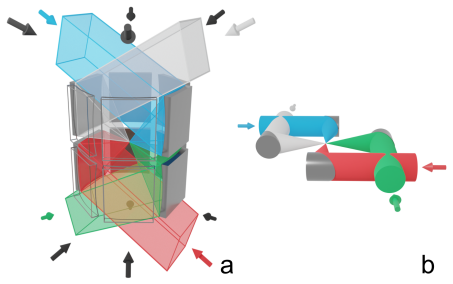
This paper presents a four-channel prototype system for the geometric combining and coherent addition of tightly focused femtosecond laser radiation into a standing-wave field configuration. A stabilization system for beam pointing and relative phase of the four optical channels has been implemented, and its performance has been experimentally demonstrated. To characterize the standing-wave electromagnetic field distribution at the main focus of the system, an original measurement technique based on a fiber subwavelength optical probe has been employed. This work has been conducted in support of the exawatt-scale XCELS project.
Editorial analysis
A structured set of objections, weighed in public.
Referee Report
Summary. The manuscript presents a four-channel prototype system for geometric combining and coherent addition of tightly focused femtosecond laser pulses to approximate a standing-wave dipole field configuration. It describes implementation of a stabilization system for beam pointing and relative phase across the four channels, claims experimental demonstration of its performance, and reports use of an original fiber subwavelength optical probe technique to characterize the electromagnetic field distribution at the main focus. The work is positioned as supporting the exawatt-scale XCELS project.
Significance. If the stabilization performance and probe-based characterization are quantitatively validated, the prototype would constitute a useful hardware demonstration of multi-channel coherent combining for high-intensity laser applications. The subwavelength probe approach offers a potentially novel diagnostic for focal field mapping. However, the low-power, low-channel-count nature of the prototype means the result provides only limited direct guidance for scaling to the full XCELS facility.
major comments (2)
- [Abstract] Abstract: the claim that 'stabilization and measurement were demonstrated' is not accompanied by any quantitative metrics (e.g., RMS pointing jitter, phase stability over time, or error bars), rendering the central experimental assertion unverifiable from the manuscript.
- [Results description] Throughout the results description: no statistical analysis, time-series data, or comparison against XCELS requirements is provided for the stabilization system, which is load-bearing for the paper's assertion of successful experimental demonstration.
Simulated Author's Rebuttal
We thank the referee for the constructive feedback on our manuscript. We address the major comments point by point below and will revise the manuscript accordingly to strengthen the presentation of our experimental results.
read point-by-point responses
-
Referee: [Abstract] Abstract: the claim that 'stabilization and measurement were demonstrated' is not accompanied by any quantitative metrics (e.g., RMS pointing jitter, phase stability over time, or error bars), rendering the central experimental assertion unverifiable from the manuscript.
Authors: We agree that the abstract would be strengthened by the inclusion of quantitative performance metrics. In the revised version we will add specific values for RMS pointing jitter, relative phase stability (including time scales), and associated uncertainties or error bars to make the demonstration claims verifiable. revision: yes
-
Referee: [Results description] Throughout the results description: no statistical analysis, time-series data, or comparison against XCELS requirements is provided for the stabilization system, which is load-bearing for the paper's assertion of successful experimental demonstration.
Authors: We acknowledge that the results section would benefit from additional statistical analysis, representative time-series traces, and explicit comparison of the achieved stability levels against the requirements of the XCELS project. We will incorporate these elements in the revised manuscript to better substantiate the performance of the stabilization system. revision: yes
Circularity Check
No circularity: experimental hardware description with no derivations or fitted predictions
full rationale
The manuscript is a report of experimental implementation and measurements for a four-channel coherent combining prototype. No equations, derivations, parameter fits, or theoretical predictions appear in the provided text or abstract. Claims rest on direct experimental demonstration of stabilization performance and subwavelength probe characterization at the tested power levels. These are independent of any self-referential inputs, self-citations that bear the central result, or renaming of known results. The scaling concern raised by the skeptic is an external validity issue, not a circularity in any derivation chain.
Axiom & Free-Parameter Ledger
Reference graph
Works this paper leans on
-
[1]
Mukhin, A
I. Mukhin, A. Soloviev, E. Perevezentsev, A. Shaykin, V. Ginzburg, I. Kuzmin, M. Mart’yanov, I. Shaikin, A. Kuzmin, S. Mironov, I. Yakovlev, and E. Khazanov, Design of the front-end system for a subexawatt laser of the xcels facility, Quantum Electronics51, 759 (2021)
2021
-
[2]
Khazanov, A
E. Khazanov, A. Shaykin, I. Kostyukov, V. Ginzburg, I. Mukhin, I. Yakovlev, A. Soloviev, I. Kuznetsov, S. Mironov, A. Korzhimanov, and et al., exawatt center for extreme light studies, High Power Laser Science and Engineering11, e78 (2023)
2023
-
[3]
A. R. Bell and J. G. Kirk, Possibility of prolific pair production with high-power lasers, Phys. Rev. Lett.101, 200403 (2008)
2008
-
[4]
A. M. Fedotov, N. B. Narozhny, G. Mourou, and G. Korn, Limitations on the attainable intensity of high power lasers, Phys. Rev. Lett.105, 080402 (2010)
2010
-
[5]
N. V. Elkina, A. M. Fedotov, I. Y. Kostyukov, M. V. Legkov, N. B. Narozhny, E. N. Nerush, and H. Ruhl, Qed cascades induced by circularly polarized laser fields, Phys. Rev. ST Accel. Beams14, 054401 (2011). 14
2011
-
[6]
Ginzburg, I
V. Ginzburg, I. Yakovlev, A. Kochetkov, A. Kuzmin, S. Mironov, I. Shaikin, A. Shaykin, and E. Khazanov, 11 fs, 1.5 pw laser with nonlinear pulse compression, Opt. Express29, 28297 (2021)
2021
-
[7]
A. A. Soloviev, K. F. Burdonov, V. N. Ginzburg, M. Y. Glyavin, R. S. Zemskov, A. V. Kotov, A. A. Kochetkov, A. A. Kuzmin, A. A. Murzanev, I. B. Mukhin, S. E. Perevalov, S. A. Pikuz, M. V. Starodubtsev, A. N. Stepanov, J. Fuchs, I. A. Shaikin, A. A. Shaikin, I. V. Yakovlev, and E. A. Khazanov, Research in plasma physics and particle acceleration using the ...
2024
-
[8]
Gonoskov, A
I. Gonoskov, A. Aiello, S. Heugel, and G. Leuchs, Dipole pulse theory: Maximizing the field amplitude from 4πfocused laser pulses, Phys. Rev. A86, 053836 (2012)
2012
-
[9]
I. Bassett, Limit to concentration by focusing, Optica Acta: International Journal of Optics 33, 279 (1986), https://doi.org/10.1080/713821943
-
[10]
S. S. Bulanov, V. D. Mur, N. B. Narozhny, J. Nees, and V. S. Popov, Multiple colliding electromagnetic pulses: A way to lower the threshold ofe +e− pair production from vacuum, Phys. Rev. Lett.104, 220404 (2010)
2010
-
[11]
Gonoskov, I
A. Gonoskov, I. Gonoskov, C. Harvey, A. Ilderton, A. Kim, M. Marklund, G. Mourou, and A. Sergeev, Probing nonperturbative qed with optimally focused laser pulses, Phys. Rev. Lett. 111, 060404 (2013)
2013
-
[12]
Sidnev, I
A. Sidnev, I. Kostyukov, M. Martyanov, O. Vais, E. Khazanov, M. Starodubtsev, and A. Soloviev, Optimization of the electric field amplitude in the collision of two counter- propagating femtosecond pulses, Journal of the Optical Society of America B42, 2015 (2025)
2015
-
[13]
E. S. Efimenko, A. V. Bashinov, S. I. Bastrakov, A. A. Gonoskov, A. A. Muraviev, I. B. Meyerov, A. V. Kim, and A. M. Sergeev, Extreme plasma states in laser-governed vacuum breakdown, Scientific Reports8, 2329 (2018)
2018
-
[14]
Gonoskov, A
A. Gonoskov, A. Bashinov, S. Bastrakov, E. Efimenko, A. Ilderton, A. Kim, M. Marklund, I. Meyerov, A. Muraviev, and A. Sergeev, Ultrabright gev photon source via controlled elec- tromagnetic cascades in laser-dipole waves, Phys. Rev. X7, 041003 (2017)
2017
-
[15]
A. V. Bashinov, E. S. Efimenko, A. A. Gonoskov, A. V. Korzhimanov, A. A. Muraviev, A. V. Kim, and A. M. Sergeev, Corrigendum: Towards attosecond-scale highly directed gev gamma-ray sources with multipetawatt-class lasers (2017 j. opt. 19 114012), Journal of Optics 20, 019502 (2017). 15
2017
-
[17]
E. S. Efimenko, A. V. Bashinov, A. A. Muraviev, E. A. Panova, V. D. Volokitin, I. B. Meyerov, A. V. Kim, and A. M. Sergeev, The source of gamma photons in multipetawatt multibeam systems of electric dipole configuration, Bulletin of the Lebedev Physics Institute50, S671 (2023)
2023
-
[18]
E. S. Efimenko, A. V. Bashinov, A. A. Gonoskov, S. I. Bastrakov, A. A. Muraviev, I. B. Meyerov, A. V. Kim, and A. M. Sergeev, Laser-driven plasma pinching ine −e+ cascade, Phys. Rev. E99, 031201 (2019)
2019
-
[19]
Soloviev, A
A. Soloviev, A. Kotov, S. Perevalov, M. Esyunin, M. Starodubtsev, A. Alexandrov, I. Galak- tionov, V. Samarkin, A. Kudryashov, V. Ginzburg, A. Korobeynikova, A. Kochetkov, A. Kuzmin, A. Shaykin, I. Yakovlev, and E. Khazanov, Adaptive system for wavefront cor- rection of the pearl laser facility, Quantum Electronics50, 1115 (2020)
2020
-
[20]
Kotov, S
A. Kotov, S. Perevalov, M. Starodubtsev, R. Zemskov, A. Alexandrov, I. Galaktionov, A. Kudryashov, V. Samarkin, and A. Soloviev, Adaptive system for correcting optical aberra- tions of high-power lasers with dynamic determination of the reference wavefront, Quantum Electronics51, 593 (2021)
2021
-
[21]
Soloviev, A
A. Soloviev, A. Kotov, M. Martyanov, S. Perevalov, R. Zemskov, M. Starodubtsev, A. Alexan- drov, I. Galaktionov, V. Samarkin, A. Kudryashov,et al., Improving focusability of post- compressed pw laser pulses using a deformable mirror, Optics Express30, 40584 (2022)
2022
-
[22]
Kotov, Y
A. Kotov, Y. Rodimkov, and A. Soloviev, Improving the accuracy of the adaptive optical wavefront correction system of high-power lasers based on convolutional neural networks, in 2024 Sixth International Conference Neurotechnologies and Neurointerfaces (CNN)(IEEE,
2024
-
[23]
J. Mu, Z. Li, F. Jing, Q. Zhu, K. Zhou, S. Wang, S. Zhou, N. Xie, J. Su, J. Zhang, X. Zeng, Y. Zuo, L. Cao, and X. Wang, Coherent combination of femtosecond pulses via non-collinear cross-correlation and far-field distribution, Opt. Lett.41, 234 (2016)
2016
-
[24]
C. Peng, X. Liang, R. Liu, W. Li, and R. Li, High-precision active synchronization control of high-power, tiled-aperture coherent beam combining, Opt. Lett.42, 3960 (2017). 16
2017
-
[25]
Klenke, M
A. Klenke, M. M¨ uller, H. Stark, A. T¨ unnermann, and J. Limpert, Sequential phase locking scheme for a filled aperture intensity coherent combination of beam arrays, Opt. Express26, 12072 (2018)
2018
-
[26]
R. Liu, C. Peng, X. Liang, and R. Li, Coherent beam combination far-field measuring method based on amplitude modulation and deep learning, Chinese Optics Letters18, 041402 (2020)
2020
-
[27]
R. Liu, C. Peng, W. Wu, X. Liang, and R. Li, Coherent beam combination of multiple beams based on near-field angle modulation, Opt. Express26, 2045 (2018)
2045
-
[28]
C. Peng, R. Liu, W. Wu, W. Li, X. Liang, and R. Li, A full-path phasing technique based on the far-field interference fringe for tiled-aperture coherent beam combining, Laser Physics Letters15, 105302 (2018)
2018
-
[29]
T. Zhou, Q. Du, T. Sano, R. Wilcox, and W. Leemans, Two-dimensional combination of eight ultrashort pulsed beams using a diffractive optic pair, Opt. Lett.43, 3269 (2018)
2018
-
[30]
Wang and Y
D. Wang and Y. Leng, Simulating a four-channel coherent beam combination system for femtosecond multi-petawatt lasers, Opt. Express27, 36137 (2019)
2019
-
[31]
C. Peng, X. Liang, R. Liu, W. Li, and R. Li, Two-beam coherent combining based on ti:sapphire chirped-pulse amplification at the repetition of 1  hz, Opt. Lett. 44, 4379 (2019)
2019
-
[32]
Chang, Q
H. Chang, Q. Chang, J. Xi, T. Hou, R. Su, P. Ma, J. Wu, C. Li, M. Jiang, Y. Ma, and P. Zhou, First experimental demonstration of coherent beam combining of more than 100 beams, Photon. Res.8, 1943 (2020)
1943
-
[33]
Fsaifes, L
I. Fsaifes, L. Daniault, S. Bellanger, M. Veinhard, J. Bourderionnet, C. Larat, E. Lallier, E. Durand, A. Brignon, and J.-C. Chanteloup, Coherent beam combining of 61 femtosecond fiber amplifiers, Opt. Express28, 20152 (2020)
2020
-
[34]
Wang and Y
D. Wang and Y. Leng, A method for aligning a femtosecond multi-petawatt coherent beam combining system, Applied Physics B127, 41 (2021)
2021
-
[35]
C. Peng, X. Li, X. Liang, and R. Li, Four-beam tiled-aperture coherent beam combining of high-power femtosecond laser with two compressors, IEEE Photonics Journal14, 1 (2022)
2022
-
[36]
K. F. Burdonov, A. A. Soloviev, R. S. Zemskov, I. I. Kuznetsov, I. B. Mukhin, A. E. Pestov, A. A. Shaikin, M. V. Starodubtsev, and E. A. Khazanov, Low-power four-channel optical scheme of coherent addition of optic pulses for the xcels project, Radiophysics and Quantum Electronics67, 920 (2025). 17
2025
-
[37]
Strickland and G
D. Strickland and G. Mourou, Compression of amplified chirped optical pulses, Optics Com- munications56, 219 (1985)
1985
-
[38]
D. W. Pohl, W. Denk, and M. Lanz, Optical stethoscopy: Image recording with reso- lutionλ/20, Applied Physics Letters44, 651 (1984), https://pubs.aip.org/aip/apl/article- pdf/44/7/651/18450953/651 1 online.pdf
1984
-
[39]
D¨ urig, D
U. D¨ urig, D. W. Pohl, and F. Rohner, Near-field optical-scanning microscopy, Journal of Applied Physics59, 3318 (1986), https://pubs.aip.org/aip/jap/article- pdf/59/10/3318/18604473/3318 1 online.pdf
1986
-
[40]
Grosjean, I
T. Grosjean, I. A. Ibrahim, M. A. Suarez, G. W. Burr, M. Mivelle, and D. Charraut, Full vectorial imaging of electromagnetic light at subwavelength scale, Opt. Express18, 5809 (2010)
2010
-
[41]
Bauer, S
T. Bauer, S. Orlov, U. Peschel, P. Banzer, and G. Leuchs, Nanointerferometric amplitude and phase reconstruction of tightly focused vector beams, Nature Photonics8, 23 (2014)
2014
-
[42]
D. Yang, H. Hu, H. Gao, J. Chen, and Q. Zhan, Mie scattering nanointerferometry for the reconstruction of tightly focused vector fields by polarization decomposition, Photonics10, 10.3390/photonics10050496 (2023)
-
[43]
D. N. Bulanov, E. A. Khazanov, A. A. Shaykin, and A. V. Korzhimanov, Numerical simulation of coherent summation of laser beams in the presence of non-idealities in the dipole focusing system, Applied Optics64, 239 (2025). 18
2025
discussion (0)
Sign in with ORCID, Apple, or X to comment. Anyone can read and Pith papers without signing in.