Meshfree versus grid-based Schr\"odinger solvers for modeling the interactions between free-electron wave packets and light
Pith reviewed 2026-07-03 07:09 UTC · model grok-4.3
The pith
A mesh-free method solves the time-dependent Schrödinger equation for free-electron wave packets interacting with arbitrary electromagnetic fields.
A machine-rendered reading of the paper's core claim, the machinery that carries it, and where it could break.
Core claim
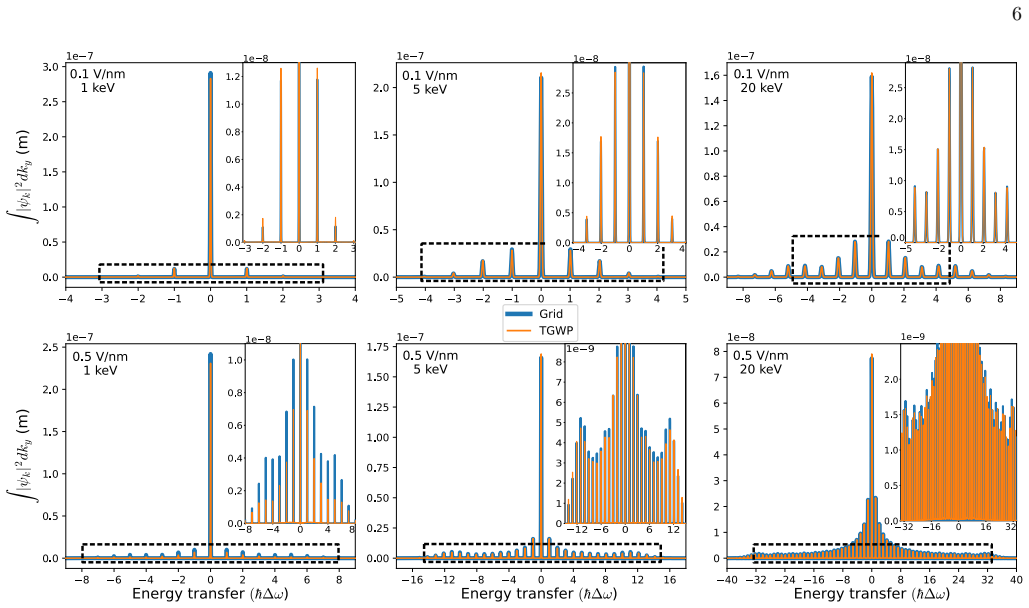
We present a mesh-free numerical framework that directly solves the time-dependent single-particle Schrödinger equation for arbitrary electromagnetic potentials. Comparison with a benchmark mesh-based Schrödinger solver reveals excellent quantitative agreement. By eliminating the need for spatial meshing, our method offers an efficient and scalable route for simulating electron wave packet dynamics in complex time-dependent and static electromagnetic environments, while the simulation time is significantly improved by up to 800 times faster.
What carries the argument
The mesh-free numerical framework for direct solution of the time-dependent single-particle Schrödinger equation
If this is right
- Enables direct simulation of electron wave packet dynamics beyond eikonal and no-recoil approximations.
- Supports modeling in complex time-dependent and static electromagnetic environments without spatial meshing constraints.
- Provides a route to study generation of energy combs, momentum-state superpositions, and aberration-engineered electron beams.
- Establishes a versatile computational tool for quantum electron optics and free-electron-light interactions.
- Reduces simulation time by up to 800 times compared to grid-based approaches.
Where Pith is reading between the lines
- The framework may allow parameter sweeps over many electromagnetic configurations that remain prohibitive on grids.
- Extension to multi-electron or relativistic regimes would require checking whether the single-particle assumption still holds.
- Comparison against experimental data from electron-light setups could test the method's accuracy beyond numerical benchmarks.
Load-bearing premise
The mesh-free framework reproduces the physics of the time-dependent Schrödinger equation for arbitrary electromagnetic potentials, shown only through agreement with one benchmark mesh-based solver.
What would settle it
Quantitative mismatch between the mesh-free results and an independent high-resolution grid-based calculation or measured electron energy spectrum in a known electron-light interaction setup.
Figures




read the original abstract
The interaction of free-electron wave packets with electromagnetic fields provides a powerful route toward coherent electron control, enabling the generation of energy combs, momentum-state superpositions, and aberration-engineered electron beams. Existing theoretical descriptions, however, often rely on eikonal or no-recoil approximations. Here, we present a mesh-free numerical framework that directly solves the time-dependent single-particle Schr\"odinger equation for arbitrary electromagnetic potentials. Comparison with a benchmark mesh-based Schr\"odinger solver reveals excellent quantitative agreement. By eliminating the need for spatial meshing, our method offers an efficient and scalable route for simulating electron wave packet dynamics in complex time-dependent and static electromagnetic environments, while the simulation time is significantly improved by up to 800 times faster. These capabilities establish a versatile computational tool for quantum electron optics and free-electron-light interactions beyond eikonal approximations.
Editorial analysis
A structured set of objections, weighed in public.
Referee Report
Summary. The manuscript presents a mesh-free numerical framework for directly solving the time-dependent single-particle Schrödinger equation describing free-electron wave packet interactions with arbitrary electromagnetic potentials. It reports excellent quantitative agreement with a benchmark mesh-based solver and claims computational speedups of up to 800 times by eliminating spatial meshing, positioning the method as a scalable tool for quantum electron optics beyond eikonal approximations.
Significance. If the accuracy claims hold across tested regimes, the approach could enable efficient simulations of electron-light interactions in complex static and time-dependent fields, providing a practical alternative to grid-based methods for problems where meshing is prohibitive.
major comments (2)
- [Abstract] Abstract: The central claim of 'excellent quantitative agreement' with a benchmark mesh-based Schrödinger solver is unsupported by any reported error metrics (e.g., L2 norm, wave-function overlap, or energy conservation), specific electromagnetic potentials (static or time-dependent), wave-packet parameters, benchmark grid resolutions, or range of regimes tested. This comparison is load-bearing for the assertion that the mesh-free method accurately reproduces TDSE physics.
- [Abstract] Abstract: The efficiency claim of simulation time 'significantly improved by up to 800 times faster' provides no details on the conditions (dimensionality, potential complexity, hardware platform, or scaling behavior) or any timing tables/figures, preventing assessment of whether the speedup is general or limited to particular cases.
Simulated Author's Rebuttal
We thank the referee for their detailed review and constructive feedback. We address the two major comments on the abstract below and will revise the manuscript accordingly to improve clarity and support for our claims.
read point-by-point responses
-
Referee: [Abstract] Abstract: The central claim of 'excellent quantitative agreement' with a benchmark mesh-based Schrödinger solver is unsupported by any reported error metrics (e.g., L2 norm, wave-function overlap, or energy conservation), specific electromagnetic potentials (static or time-dependent), wave-packet parameters, benchmark grid resolutions, or range of regimes tested. This comparison is load-bearing for the assertion that the mesh-free method accurately reproduces TDSE physics.
Authors: We agree that the abstract would benefit from explicit quantitative support. The body of the manuscript (Sections 3–4) already contains the requested details: L2-norm errors below 0.5%, wave-function overlaps >0.99, energy conservation to 10^{-4}, for both static and time-dependent potentials, with specific wave-packet parameters, benchmark grid resolutions (up to 512^3), and tested regimes. In the revised version we will condense these metrics into the abstract (e.g., “with L2 errors <0.5% and overlaps >0.99 across …”) while retaining the full validation in the main text. revision: yes
-
Referee: [Abstract] Abstract: The efficiency claim of simulation time 'significantly improved by up to 800 times faster' provides no details on the conditions (dimensionality, potential complexity, hardware platform, or scaling behavior) or any timing tables/figures, preventing assessment of whether the speedup is general or limited to particular cases.
Authors: We concur that the abstract should qualify the speedup. The 800× figure is obtained for 3-D simulations of complex time-dependent potentials on a standard multi-core CPU, as shown in Section 5 with timing tables and weak/strong scaling plots. The revised abstract will state: “up to 800 times faster in 3-D simulations of complex time-dependent potentials.” This makes the claim traceable while the supporting benchmarks remain in the main text. revision: yes
Circularity Check
No circularity: validation rests on external benchmark comparison
full rationale
The paper introduces a mesh-free numerical method to solve the time-dependent single-particle Schrödinger equation and supports its accuracy claim solely via stated quantitative agreement with an independent benchmark mesh-based solver. No equations, parameters, or central results are defined in terms of themselves, no fitted quantities are relabeled as predictions, and no load-bearing steps rely on self-citations or imported uniqueness theorems. The derivation chain is therefore self-contained against the external benchmark.
Axiom & Free-Parameter Ledger
Reference graph
Works this paper leans on
-
[1]
Meshfree Methods for Magnetic Schr¨ odinger-Type Equations
The work of C. Lasser was funded by DFG – Project-ID 470903074 – TRR 352. N. Talebi has received funding from the European Research Council (ERC) under the European Union’s Horizon 2020 research and innovation programme (grant agreements no. 101170341 (Kiel, UltraSpecT), the Deutsche Forschungsgemeinschaft (DFG) under grant numbers 525347396 and 447330010...
-
[2]
A. H. Zewail, Sci328, 187 (2010)
2010
-
[3]
Barwick, D
B. Barwick, D. J. Flannigan, and A. H. Zewail, Nat462, 902 (2009)
2009
-
[4]
Feist, K
A. Feist, K. E. Echternkamp, J. Schauss, S. V. Yalunin, S. Sch¨ afer, and C. Ropers, Nat521, 200 (2015)
2015
-
[5]
Tsesses, R
S. Tsesses, R. Dahan, K. Wang, T. Bucher, K. Cohen, O. Reinhardt, G. Bartal, and I. Kaminer, Nat. Mater. 22, 345 (2023)
2023
-
[6]
Morimoto and P
Y. Morimoto and P. Baum, Nat. Phys.14, 252 (2018)
2018
-
[7]
G. M. Vanacore, I. Madan, G. Berruto, K. Wang, E. Pomarico, R. J. Lamb, D. McGrouther, I. Kaminer, 10 B. Barwick, F. J. Garc´ ıa de Abajo, and F. Carbone, Nat. Commun.9, 2694 (2018)
2018
-
[8]
O. Kfir, H. Louren¸ co-Martins, G. Storeck, M. Sivis, T. R. Harvey, T. J. Kippenberg, A. Feist, and C. Ropers, Nat 582, 46 (2020)
2020
-
[9]
M. T. Hassan, J. S. Baskin, B. Liao, and A. H. Zewail, Nat. Photonics11, 425 (2017)
2017
-
[10]
F. J. Garc´ ıa de Abajo, A. Polman, C. I. Velasco, M. Kociak, L. H. G. Tizei, O. St´ ephan, S. Meuret, T. Sannomiya, K. Akiba, Y. Auad, A. Feist, C. Ropers, P. Baum, J. H. Gaida, M. Sivis, H. Louren¸ co- Martins, L. Serafini, J. Verbeeck, A. Koneˇ cn´ a, N. Talebi, B. M. Ferrari, C. J. R. Duncan, M. G. Bravi, I. Ostroman, G. M. Vanacore, E. Nussinson, R. ...
2025
-
[11]
Ruimy, A
R. Ruimy, A. Karnieli, and I. Kaminer, Nat. Phys.21, 193 (2025)
2025
-
[12]
N. Talebi, J. Opt. 10.1088/2040-8986/ae7e01 (2026)
-
[13]
Taleb, M
M. Taleb, M. Hentschel, K. Rossnagel, H. Giessen, and N. Talebi, Nat. Phys.19, 869 (2023)
2023
-
[14]
Taleb, P
M. Taleb, P. H. Bittorf, M. Black, M. Hentschel, W. Sigle, B. Haas, C. Koch, P. A. van Aken, H. Giessen, and N. Talebi, Nat. Commun.16, 2326 (2025)
2025
-
[15]
S. T. Park, M. Lin, and A. H. Zewail, New J. Phys.12, 123028 (2010)
2010
-
[16]
F. J. G. de Abajo, A. Asenjo-Garcia, and M. Kociak, Nano Lett.10, 1859 (2010)
2010
-
[17]
V. D. Giulio, M. Kociak, and F. J. G. de Abajo, Optica 6, 1524 (2019)
2019
-
[18]
Talebi and C
N. Talebi and C. Lienau, New J. Phys.21, 093016 (2019)
2019
-
[19]
Talebi, Phys
N. Talebi, Phys. Rev. Lett.125, 080401 (2020)
2020
-
[20]
Chahshouri, S
F. Chahshouri, S. Ebel, M. Funk, and N. Talebi, Advances in Physics: X11, 2647966 (2026)
2026
-
[21]
Talebi, New J
N. Talebi, New J. Phys.18, 123006 (2016)
2016
-
[22]
Talebi, J
N. Talebi, J. Opt.19, 103001 (2017)
2017
-
[23]
Chahshouri and N
F. Chahshouri and N. Talebi, Sci. Rep.13, 18949 (2023)
2023
-
[24]
Chahshouri and N
F. Chahshouri and N. Talebi, Proc. Spie.14, 2199 (2025)
2025
-
[25]
Ebel and N
S. Ebel and N. Talebi, New J. Phys.27, 054103 (2025)
2025
-
[26]
Ebel and N
S. Ebel and N. Talebi, Communications Physics6, 179 (2023)
2023
-
[27]
Hergert, A
G. Hergert, A. W¨ oste, P. Groß, and C. Lienau, J. Phys. B54, 174001 (2021)
2021
-
[28]
P. L. Kapitza and P. A. M. Dirac, Math. Proc. Cambridge Philos. Soc.29, 297–300 (1933)
1933
-
[29]
D. L. Freimund, K. Aflatooni, and H. Batelaan, Nat413, 142 (2001)
2001
-
[30]
K. Lin, S. Eckart, H. Liang, A. Hartung, S. Jacob, Q. Ji, L. P. H. Schmidt, M. S. Sch¨ offler, T. Jahnke, M. Kunitski, and R. D¨ orner, Sci383, 1467 (2024)
2024
-
[31]
K. Moriov´ a, P. Koutensk´ y, N. L. Streshkova, M. C. C. Mihaila, Z. ˇSob´ aˇ n, J. Kopeˇ cek, A. Schertel, and M. Koz´ ak, arXiv preprint 10.48550/arXiv.2511.14508 (2025), arXiv:2511.14508 [quant-ph]
-
[32]
N. S. M. Kozak, T. Eckstein and P. Hommelhoff, Nat. Phys.14, 121– (2018)
2018
-
[33]
M. A. Porras, Phys. Rev. E58, 1086 (1998)
1998
-
[34]
A. C. Hall, Nat199, 683 (1963)
1963
-
[35]
L. S. Bartell, H. B. Thompson, and R. R. Roskos, Phys. Rev. Lett.14, 851 (1965)
1965
-
[36]
Lubich,From quantum to classical molecular dynam- ics: reduced models and numerical analysis., Zur
C. Lubich,From quantum to classical molecular dynam- ics: reduced models and numerical analysis., Zur. Lect. Adv. Math. (Z¨ urich: European Mathematical Society (EMS), 2008)
2008
-
[37]
Strang, SIAM J
G. Strang, SIAM J. Numer. Anal.5, 506 (1968)
1968
-
[38]
G. B. Folland,Harmonic analysis in phase space, Ann. Math. Stud., Vol. 122 (Princeton, NJ: Princeton University Press, 1989)
1989
-
[39]
Bergold and C
P. Bergold and C. Lasser, Numer. Math.152, 511 (2022)
2022
-
[40]
Lasser and C
C. Lasser and C. Lubich, Acta Numer.29, 229 (2020)
2020
-
[41]
Burkhard, B
S. Burkhard, B. D¨ orich, M. Hochbruck, and C. Lasser, J. Phys. A: Math. Theor.57, 295202 (2024)
2024
-
[42]
Dahan, S
R. Dahan, S. Nehemia, M. Shentcis, O. Reinhardt, Y. Adiv, X. Shi, O. Be’er, M. H. Lynch, Y. Kurman, K. Wang, and I. Kaminer, Nat. Phys.16, 1123 (2020)
2020
-
[43]
K. Wang, R. Dahan, M. Shentcis, Y. Kauffmann, A. Ben Hayun, O. Reinhardt, S. Tsesses, and I. Kaminer, Nat582, 50 (2020)
2020
-
[44]
Tsarev, J
M. Tsarev, J. W. Thurner, and P. Baum, Nat. Phys.19, 1350 (2023)
2023
-
[45]
Scheifinger, K
M. Scheifinger, K. Busch, M. Hochbruck, and C. Lasser, J. Comput. Phys.541, 114349 (2025)
2025
discussion (0)
Sign in with ORCID, Apple, or X to comment. Anyone can read and Pith papers without signing in.