Open-Weather Robust 3D Detection via Dual-Critic Diffusion Alignment
Pith reviewed 2026-07-03 15:35 UTC · model grok-4.3
The pith
A diffusion process guided by detection and adversarial critics aligns degraded LiDAR features to clean distributions for robust 3D detection in unseen weather.
A machine-rendered reading of the paper's core claim, the machinery that carries it, and where it could break.
Core claim
DCDA recovers degraded LiDAR features toward a clean manifold via a 4D radar-conditioned diffusion process guided by a detection critic anchored in a pre-trained clean-weather model and a weather adversarial critic that enforces distributional consistency, allowing generalization to unseen weather types and severities without paired data or weather labels.
What carries the argument
Dual-Critic Guided Diffusion Alignment (DCDA), a diffusion refinement process steered by semantic discriminability from object detection and distributional consistency from adversarial learning.
If this is right
- The method generalizes to arbitrary weather without explicit modeling of degradation patterns or weather categories.
- Training requires no paired clean-adverse examples or weather labels, only access to a clean pre-trained detector.
- Refined features preserve both object localization accuracy and class discriminability through the dual constraints.
- A structured benchmark with held-out type-severity combinations can be used to measure open-weather robustness.
Where Pith is reading between the lines
- The critic-guided diffusion idea could extend to recovering features degraded by other factors such as sensor aging or calibration drift.
- Similar alignment without paired data might reduce the cost of collecting diverse training sets for perception in new geographic regions.
- The framework suggests testing whether the same critics can stabilize multi-modal fusion when one sensor degrades more than others.
- It points toward perception modules that adapt online by continuously referencing a fixed clean manifold rather than retraining.
Load-bearing premise
The pre-trained clean-weather detection model and the weather adversarial critic can reliably steer the diffusion process to produce features that remain both discriminative for detection tasks and statistically consistent with clean data for any unseen weather.
What would settle it
Detection performance on a held-out weather type-severity pair shows no meaningful gain over the non-aligned baseline or the original degraded features, indicating the critics did not produce usable alignment.
Figures


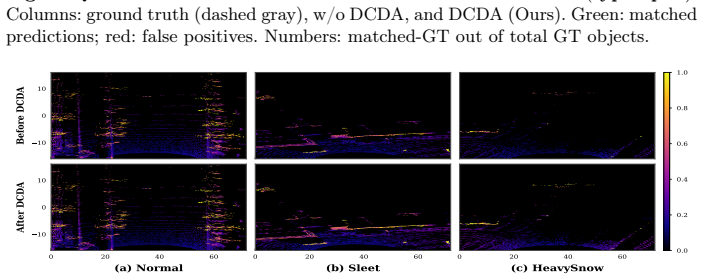
read the original abstract
Robust 3D object detection under adverse weather remains a critical hurdle for autonomous driving. Despite progress with LiDAR-4D radar fusion, most methods are constrained by a closed-world assumption, implicitly requiring training and test weather to align in both type and severity. This premise fails in practice: the open-ended nature of weather, and even variations within a single type like rain, cause dramatically different LiDAR degradation patterns, leading to significant performance drops in unseen conditions. To address this, we present Dual-Critic Guided Diffusion Alignment (DCDA), a weather-agnostic framework that learns to recover degraded LiDAR features toward a clean manifold. Rather than modeling specific weather types, DCDA employs a 4D radar-conditioned diffusion process to progressively refine features, guided by two complementary critics. (i) A detection-guided critic, anchored by a pre-trained clean-weather model, ensures that the refined features retain object-level discriminability and localization accuracy. (ii) A weather adversarial critic enforces holistic distributional consistency with clean-weather representations. By aligning features through semantic and distributional constraints rather than explicit weather modeling, DCDA generalizes effectively to unseen weather types and severities without requiring paired data or weather labels. We further introduce a structured open-weather benchmark with held-out type-severity combinations and extensive experiments verify DCDA's advantages.
Editorial analysis
A structured set of objections, weighed in public.
Referee Report
Summary. The paper proposes Dual-Critic Guided Diffusion Alignment (DCDA), a weather-agnostic framework for robust 3D object detection from LiDAR under open-ended adverse weather. It employs a 4D radar-conditioned diffusion process to refine degraded features toward a clean manifold, guided by (i) a fixed pre-trained clean-weather detection critic that preserves object discriminability and (ii) an adversarial distributional critic that enforces consistency with clean representations. The method is trained without paired weather data or labels and is evaluated on a new structured open-weather benchmark that holds out type-severity combinations.
Significance. If the empirical claims hold, the work would be significant for autonomous-driving perception: it replaces explicit weather modeling and paired-data requirements with semantic-plus-distributional alignment inside a diffusion process, offering a falsifiable route to generalization across unseen weather variations.
major comments (2)
- [Abstract and §4] Abstract and §4 (Experiments): the central performance claim that DCDA 'generalizes effectively to unseen weather types and severities' is load-bearing, yet the visible text supplies no quantitative results, error bars, baseline comparisons, or ablation numbers on the held-out splits; without these the generalization argument cannot be assessed.
- [Methods] Methods (diffusion guidance): the claim that the two critics together produce features that remain discriminative for unseen weather rests on the unexamined assumption that a fixed clean-weather detector plus an adversarial critic suffice; the paper must show, via controlled ablations, that removing either critic measurably degrades held-out performance.
minor comments (2)
- [Abstract] Abstract: the phrase 'extensive experiments verify DCDA's advantages' is vague; replace with one or two concrete metrics (e.g., mAP on held-out rain-severity-3) to give readers an immediate sense of the result.
- [Methods] Notation: the description of the 'weather adversarial critic' does not specify whether it operates on feature statistics, latent codes, or reconstructed point clouds; a short equation or diagram would clarify the distributional loss.
Simulated Author's Rebuttal
We thank the referee for the constructive feedback on our manuscript. We address the two major comments below by clarifying the experimental evidence and committing to targeted revisions that strengthen the presentation of results and ablations.
read point-by-point responses
-
Referee: [Abstract and §4] Abstract and §4 (Experiments): the central performance claim that DCDA 'generalizes effectively to unseen weather types and severities' is load-bearing, yet the visible text supplies no quantitative results, error bars, baseline comparisons, or ablation numbers on the held-out splits; without these the generalization argument cannot be assessed.
Authors: We acknowledge that the abstract, per standard practice, contains no numerical results. However, §4 of the full manuscript reports quantitative evaluations on the held-out type-severity splits, including comparisons against baselines. To address the concern directly, we will revise §4 to include a consolidated table of held-out performance metrics with standard error bars computed over multiple random seeds, plus explicit baseline numbers. This addition will make the generalization evidence immediately verifiable without altering the underlying experiments. revision: yes
-
Referee: [Methods] Methods (diffusion guidance): the claim that the two critics together produce features that remain discriminative for unseen weather rests on the unexamined assumption that a fixed clean-weather detector plus an adversarial critic suffice; the paper must show, via controlled ablations, that removing either critic measurably degrades held-out performance.
Authors: We agree that explicit ablations are required to substantiate the necessity of both critics. The current manuscript contains an ablation study, but it does not isolate the effect of each critic on the held-out splits. In the revision we will add controlled experiments that remove the detection-guided critic and the adversarial critic individually, reporting the resulting drops in mAP and other metrics on the unseen weather combinations. These new results will be presented in §4 alongside the main tables. revision: yes
Circularity Check
No significant circularity detected
full rationale
The abstract and description present a high-level framework using a pre-trained clean-weather detector as one critic and a weather adversarial critic for a radar-conditioned diffusion process. No equations, derivations, fitted parameters renamed as predictions, or load-bearing self-citations appear in the text. The generalization to unseen weather is scoped to a held-out benchmark split, which is an external falsifiable setup rather than a reduction to the method's own inputs by construction. The central claim remains independent of any self-referential loop.
Axiom & Free-Parameter Ledger
Reference graph
Works this paper leans on
-
[1]
In: Proceedings of the Com- puter Vision and Pattern Recognition Conference
Batten, B., Lomuscio, A.: Improving weather-based ood generalisation in lidar- based object detection models via adversarial training. In: Proceedings of the Com- puter Vision and Pattern Recognition Conference. pp. 4321–4329 (2025)
work page 2025
-
[2]
In: Proceedings of the IEEE/CVF conference on computer vision and pattern recognition
Bijelic, M., Gruber, T., Mannan, F., Kraus, F., Ritter, W., Dietmayer, K., Heide, F.: Seeing through fog without seeing fog: Deep multimodal sensor fusion in unseen adverse weather. In: Proceedings of the IEEE/CVF conference on computer vision and pattern recognition. pp. 11682–11692 (2020)
work page 2020
-
[3]
In: European Conference on Computer Vision
Chae, Y., Kim, H., Oh, C., Kim, M., Yoon, K.J.: Lidar-based all-weather 3d ob- ject detection via prompting and distilling 4d radar. In: European Conference on Computer Vision. pp. 368–385. Springer (2024)
work page 2024
-
[4]
In: Proceedings of the IEEE/CVF Conference on Computer Vision and Pattern Recognition
Chae, Y., Kim, H., Yoon, K.J.: Towards robust 3d object detection with lidar and 4d radar fusion in various weather conditions. In: Proceedings of the IEEE/CVF Conference on Computer Vision and Pattern Recognition. pp. 15162–15172 (2024)
work page 2024
-
[5]
In: Proceedings of the IEEE/CVF International Con- ference on Computer Vision
Chae, Y., Park, H., Kim, H., Yoon, K.J.: Doppler-aware lidar-radar fusion for weather-robust 3d detection. In: Proceedings of the IEEE/CVF International Con- ference on Computer Vision. pp. 27197–27208 (2025)
work page 2025
-
[6]
In: Proceedings of the AAAI Conference on Artificial Intelligence
Chang, G., Roh, W., Jang, S., Lee, D., Ji, D., Oh, G., Park, J., Kim, J., Kim, S.: Cmda: Cross-modal and domain adversarial adaptation for lidar-based 3d ob- ject detection. In: Proceedings of the AAAI Conference on Artificial Intelligence. vol. 38, pp. 972–980 (2024)
work page 2024
-
[7]
Advances in Neural Information Processing Systems37, 103681–103705 (2024)
Chen, X., Liu, Z., Luo, K., Datta, S., Polavaram, A., Wang, Y., You, Y., Li, B., Pavone, M., Chao, W.L.H., et al.: Diffubox: Refining 3d object detection with point diffusion. Advances in Neural Information Processing Systems37, 103681–103705 (2024)
work page 2024
-
[8]
arXiv preprint arXiv:2406.14878 (2024)
Chen, Z., Meng, J., Baktashmotlagh, M., Zhang, Y., Huang, Z., Luo, Y.: Mos: Model synergy for test-time adaptation on lidar-based 3d object detection. arXiv preprint arXiv:2406.14878 (2024)
-
[9]
In: Proceedings of the 32nd ACM International Conference on Multimedia
Chen, Z., Wang, Z., Luo, Y., Wang, S., Huang, Z.: Dpo: dual-perturbation opti- mization for test-time adaptation in 3d object detection. In: Proceedings of the 32nd ACM International Conference on Multimedia. pp. 4138–4147 (2024)
work page 2024
-
[10]
Advances in Neural Information Processing Systems 37, 101589–101617 (2024)
Ding, F., Wen, X., Zhu, Y., Li, Y., Lu, C.X.: Radarocc: Robust 3d occupancy pre- diction with 4d imaging radar. Advances in Neural Information Processing Systems 37, 101589–101617 (2024)
work page 2024
-
[11]
In: Proceedings of the IEEE/CVF Conference on Computer Vision and Pattern Recognition
Dong, Y., Kang, C., Zhang, J., Zhu, Z., Wang, Y., Yang, X., Su, H., Wei, X., Zhu, J.: Benchmarking robustness of 3d object detection to common corruptions. In: Proceedings of the IEEE/CVF Conference on Computer Vision and Pattern Recognition. pp. 1022–1032 (2023)
work page 2023
-
[12]
In: Proceedings of the IEEE/CVF conference on computer vision and pattern recognition
Hahner, M., Sakaridis, C., Bijelic, M., Heide, F., Yu, F., Dai, D., Van Gool, L.: Lidar snowfall simulation for robust 3d object detection. In: Proceedings of the IEEE/CVF conference on computer vision and pattern recognition. pp. 16364– 16374 (2022)
work page 2022
-
[13]
In: Proceedings of the IEEE/CVF international conference on computer vision
Hahner, M., Sakaridis, C., Dai, D., Van Gool, L.: Fog simulation on real lidar point clouds for 3d object detection in adverse weather. In: Proceedings of the IEEE/CVF international conference on computer vision. pp. 15283–15292 (2021)
work page 2021
-
[14]
arXiv preprint arXiv:2306.04242 , year=
Han, Z., Wang, J., Xu, Z., Yang, S., He, L., Xu, S., Wang, J., Li, K.: 4d millimeter- wave radar in autonomous driving: A survey. arXiv preprint arXiv:2306.04242 (2023) Open-Weather Robust 3D Detection 17
-
[15]
arXiv preprint arXiv:2512.13107 (2025)
He, Z., Liu, F., Li, Y., Luo, Z., Cheng, J., Chen, X., Tang, X.: Diffusion-based restoration for multi-modal 3d object detection in adverse weather. arXiv preprint arXiv:2512.13107 (2025)
-
[16]
Huang, H., Yan, X., Yang, J., Cao, Y., Zhang, X.: Lidsor: A filter for removing rain and snow noise points from lidar point clouds in rainy and snowy weather. The International Archives of the Photogrammetry, Remote Sensing and Spatial Information Sciences48, 733–740 (2023)
work page 2023
-
[17]
arXiv preprint arXiv:2202.02703 (2022)
Huang, K., Shi, B., Li, X., Li, X., Huang, S., Li, Y.: Multi-modal sensor fusion for auto driving perception: A survey. arXiv preprint arXiv:2202.02703 (2022)
-
[18]
In: Proceedings of the Computer Vision and Pattern Recognition Conference
Huang, X., Wang, J., Xia, Q., Chen, S., Yang, B., Li, X., Wang, C., Wen, C.: V2x-r: Cooperative lidar-4d radar fusion with denoising diffusion for 3d object detection. In: Proceedings of the Computer Vision and Pattern Recognition Conference. pp. 27390–27400 (2025)
work page 2025
-
[19]
In: Proceedings of the AAAI conference on artificial intelligence
Huang, X., Xu, Z., Wu, H., Wang, J., Xia, Q., Xia, Y., Li, J., Gao, K., Wen, C., Wang, C.: L4dr: Lidar-4dradar fusion for weather-robust 3d object detection. In: Proceedings of the AAAI conference on artificial intelligence. vol. 39, pp. 3806–3814 (2025)
work page 2025
-
[20]
In: Proceedings of the IEEE/CVF International Conference on Computer Vision
Kong, L., Liu, Y., Li, X., Chen, R., Zhang, W., Ren, J., Pan, L., Chen, K., Liu, Z.: Robo3d: Towards robust and reliable 3d perception against corruptions. In: Proceedings of the IEEE/CVF International Conference on Computer Vision. pp. 19994–20006 (2023)
work page 2023
-
[21]
arXiv preprint arXiv:2404.13852 (2024)
Lee, E., Jung, M., Kim, A.: Toward robust lidar based 3d object detection via density-aware adaptive thresholding. arXiv preprint arXiv:2404.13852 (2024)
-
[22]
In: International Conference on Neural Information Processing
Matteazzi, A., Arnold, M., Tutsch, D.: Augmentation of lidar scenes with adverse weather conditions using latent diffusion models. In: International Conference on Neural Information Processing. pp. 198–212. Springer (2025)
work page 2025
-
[23]
In: European Conference on Com- puter Vision
Oh, Y., Kim, H.I., Kim, S.T., Kim, J.U.: Monowad: Weather-adaptive diffusion model for robust monocular 3d object detection. In: European Conference on Com- puter Vision. pp. 326–345. Springer (2024)
work page 2024
-
[24]
arXiv preprint arXiv:2502.00074 (2025)
Paek, D.H., Kong, S.H.: Spikingrtnh: Spiking neural network for 4d radar object detection. arXiv preprint arXiv:2502.00074 (2025)
-
[25]
Advances in Neural Information Processing Systems35, 3819–3829 (2022)
Paek, D.H., Kong, S.H., Wijaya, K.T.: K-radar: 4d radar object detection for au- tonomous driving in various weather conditions. Advances in Neural Information Processing Systems35, 3819–3829 (2022)
work page 2022
-
[26]
In: Euro- pean Conference on Computer Vision
Palladin, E., Dietze, R., Narayanan, P., Bijelic, M., Heide, F.: Samfusion: Sensor- adaptive multimodal fusion for 3d object detection in adverse weather. In: Euro- pean Conference on Computer Vision. pp. 484–503. Springer (2024)
work page 2024
-
[27]
Peng, X., Sun, H., Bierzynski, K., Fischbacher, A., Servadei, L., Wille, R.: Mu- tualforce: Mutual-aware enhancement for 4d radar-lidar 3d object detection. In: ICASSP 2025-2025 IEEE International Conference on Acoustics, Speech and Sig- nal Processing (ICASSP). pp. 1–5. IEEE (2025)
work page 2025
-
[28]
Peng, X., Tang, M., Sun, H., Servadei, L., Wille, R.: 4d mmwave radar in adverse environments for autonomous driving: A survey. arXiv e-prints pp. arXiv–2503 (2025)
work page 2025
-
[29]
arXiv preprint arXiv:2505.09422 (2025)
Peng, X., Wang, Y., Tang, M., Kay, B., Servadei, L., Wille, R.: Moral: Motion- aware multi-frame 4d radar and lidar fusion for robust 3d object detection. arXiv preprint arXiv:2505.09422 (2025)
-
[30]
In: Proceedings of the AAAI Conference on Artificial Intelligence
Peng, X., Zhu, X., Ma, Y.: Cl3d: Unsupervised domain adaptation for cross-lidar 3d detection. In: Proceedings of the AAAI Conference on Artificial Intelligence. vol. 37, pp. 2047–2055 (2023) 18 S. Li et al
work page 2047
-
[31]
IEEE Robotics and Automation Letters8(7), 4322–4329 (2023)
Piroli, A., Dallabetta, V., Kopp, J., Walessa, M., Meissner, D., Dietmayer, K.: Energy-based detection of adverse weather effects in lidar data. IEEE Robotics and Automation Letters8(7), 4322–4329 (2023)
work page 2023
-
[32]
Transportation research part C: emerging technologies161, 104555 (2024)
Qi, Y., Liu, C., Scaioni, M., Li, Y., Qiao, Y., Ma, X., Wu, H., Zhang, K., Wang, D.: Geometric information constraint 3d object detection from lidar point cloud for autonomous vehicles under adverse weather. Transportation research part C: emerging technologies161, 104555 (2024)
work page 2024
-
[33]
Qi, Y., Liu, C., Wu, H., Chen, R., Wen, C., Huang, X., Jia, S., Zhang, K.: Fu- sionbev: Lidar and 4d radar fusion for 3d object detection. Information Fusion p. 104240 (2026)
work page 2026
-
[34]
In: 2024 IEEE in- telligent vehicles symposium (IV)
Sural, S., Sahu, N., Rajkumar, R.R.: Contextualfusion: Context-based multi-sensor fusion for 3d object detection in adverse operating conditions. In: 2024 IEEE in- telligent vehicles symposium (IV). pp. 1534–1541. IEEE (2024)
work page 2024
-
[35]
In: 2022 IEEE/RSJ International Conference on Intelligent Robots and Systems (IROS)
Wang, L., Zhang, X., Xv, B., Zhang, J., Fu, R., Wang, X., Zhu, L., Ren, H., Lu, P., Li, J., et al.: Interfusion: Interaction-based 4d radar and lidar fusion for 3d object detection. In: 2022 IEEE/RSJ International Conference on Intelligent Robots and Systems (IROS). pp. 12247–12253. IEEE (2022)
work page 2022
-
[36]
In: Proceedings of the IEEE/CVF Conference on Computer Vision and Pattern Recognition
Wang, Y., Deng, J., Li, Y., Hu, J., Liu, C., Zhang, Y., Ji, J., Ouyang, W., Zhang, Y.: Bi-lrfusion: Bi-directional lidar-radar fusion for 3d dynamic object detection. In: Proceedings of the IEEE/CVF Conference on Computer Vision and Pattern Recognition. pp. 13394–13403 (2023)
work page 2023
-
[37]
In: Proceedings of the Computer Vision and Pattern Recognition Conference
Wu, Y., Zhu, Y., Zhang, K., Qian, J., Xie, J., Yang, J.: Weathergen: A unified diverse weather generator for lidar point clouds via spider mamba diffusion. In: Proceedings of the Computer Vision and Pattern Recognition Conference. pp. 17019–17028 (2025)
work page 2025
-
[38]
IET Image Processing20(1), e70257 (2026)
Wu, Y., Sun, W., Zhong, Z., Li, Q.: Pasenet: Snowy scene 3d object detection with pillar-wise attention and semantic enhancement. IET Image Processing20(1), e70257 (2026)
work page 2026
-
[39]
In: European Conference on Computer Vision
Xu, R., Xiang, Z.: Rlnet: Adaptive fusion of 4d radar and lidar for 3d object detection. In: European Conference on Computer Vision. pp. 181–194. Springer (2024)
work page 2024
-
[40]
In: Proceedings of the Computer Vision and Pattern Recognition Conference
Ye, X., Yaman, B., Cheng, S., Tao, F., Mallik, A., Ren, L.: Bevdiffuser: Plug-and- play diffusion model for bev denoising with ground-truth guidance. In: Proceedings of the Computer Vision and Pattern Recognition Conference. pp. 1495–1504 (2025)
work page 2025
-
[41]
Yuan, J., Zhang, B., Gong, K., Yue, X., Shi, B., Qiao, Y., Chen, T.: Reg-tta3d: Betterregressionmakesbettertest-timeadaptive3dobjectdetection.In:European conference on computer vision. pp. 197–213. Springer (2024)
work page 2024
-
[42]
Proceedings of the Institution of Mechanical Engineers, Part D: Journal of Automobile Engineering p
Zhang, B., Wang, Y., Zhang, C., Jiang, J., Luo, X., Wang, X., Zhang, Y., Liu, Z., Shen, G., Ye, Y., et al.: Fogfusion: Robust 3d object detection based on camera- lidar fusion for autonomous driving in foggy weather conditions. Proceedings of the Institution of Mechanical Engineers, Part D: Journal of Automobile Engineering p. 09544070251327229 (2025)
work page 2025
-
[43]
In: Proceedings of the Asian Conference on Computer Vision
Zhang, Z., Gong, H., Feng, Y., Chu, Z., Liu, H.: Enhancing object detection in adverse weather conditions through entropy and guided multimodal fusion. In: Proceedings of the Asian Conference on Computer Vision. pp. 2922–2938 (2024)
work page 2024
-
[44]
In: Proceedings of the AAAI conference on artificial intelligence
Zou, J., Tian, K., Zhu, Z., Ye, Y., Wang, X.: Diffbev: Conditional diffusion model for bird’s eye view perception. In: Proceedings of the AAAI conference on artificial intelligence. vol. 38, pp. 7846–7854 (2024)
work page 2024
discussion (0)
Sign in with ORCID, Apple, or X to comment. Anyone can read and Pith papers without signing in.