Geometry-Aware R-Structured Kolmogorov-Arnold Networks
Pith reviewed 2026-07-03 21:09 UTC · model grok-4.3
The pith
GRS-KANs combine KAN branches for nonlinear learning with analytic R-functions that embed known geometric constraints and discontinuities directly into the model.
A machine-rendered reading of the paper's core claim, the machinery that carries it, and where it could break.
Core claim
The central claim is that differentiable R-functions can be integrated into the KAN framework so that known geometric and logical constraints are represented analytically inside the network, while KAN branches continue to learn the smooth nonlinear components; the resulting GRS-KAN models therefore produce explicit analytic expressions for discontinuities and boundaries and yield higher predictive accuracy on regression benchmarks that contain such structure.
What carries the argument
The GRS-KAN architecture that inserts R-conjunction and R-disjunction operations to encode geometric supports analytically alongside KAN-learned nonlinear branches.
If this is right
- Explicit analytic forms for geometric boundaries become available inside an otherwise data-driven model.
- Test RMSE drops by up to 67 percent on the examined discontinuous regression tasks.
- The agnostic variant can automatically decide whether a geometric prior improves performance.
- Complex logical combinations of supports can be built from R-operations and trained end-to-end.
- Interpretability increases because the geometric part of the learned function has a closed-form expression.
Where Pith is reading between the lines
- The same R-function insertion could be tried with other spline-based or symbolic regression architectures beyond KANs.
- The method supplies a concrete route for injecting domain-specific geometric knowledge into neural models without custom loss terms.
- Scaling the approach to three-dimensional or time-dependent geometries would test whether the analytic encoding remains tractable.
- Automatic selection of which constraints to encode analytically versus learn from data could be formalized as a meta-learning step.
Load-bearing premise
Known geometric or logical constraints can be written as differentiable R-functions and inserted into the network without impairing the KAN branches' ability to model the remaining smooth nonlinear behavior.
What would settle it
On a regression benchmark with known circular or rectangular discontinuities, a GRS-KAN model shows no reduction in test RMSE and no improvement in boundary localization compared with a standard KAN of comparable size.
Figures


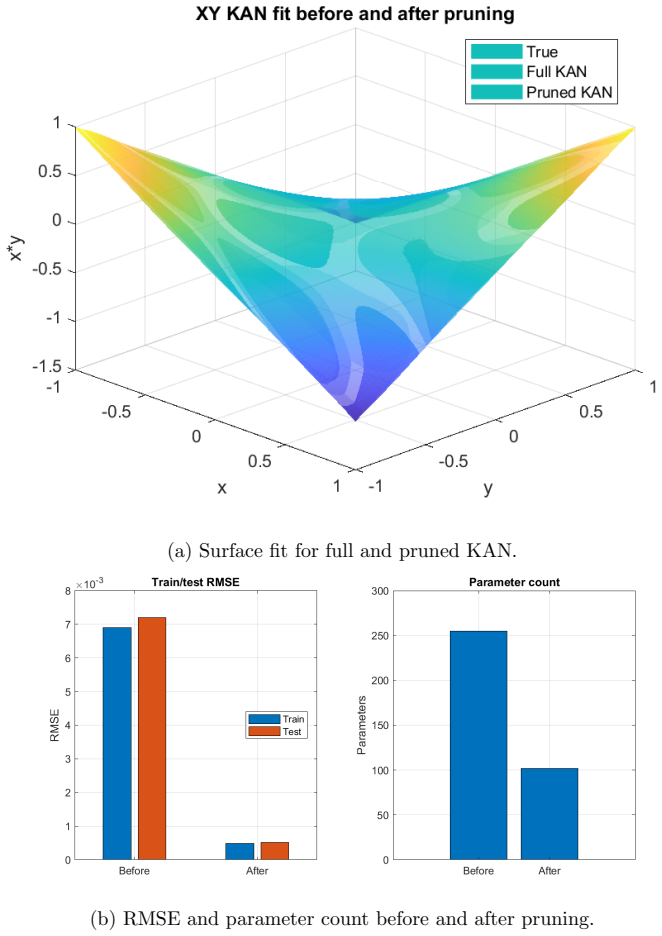


read the original abstract
We propose a novel hybrid neural architecture, the Geometry-aware R-Structured Kolmogorov-Arnold Network (GRS-KAN), which integrates V.L.Rvachev's R-functions into the Kolmogorov-Arnold Network (KAN) framework. The proposed approach combines two complementary modeling mechanisms: smooth nonlinear structure is learned by KAN branches, while known geometric or logical constraints are encoded analytically using differentiable R-functions. This enables explicit representation of discontinuities, feasible regions, and implicit geometric boundaries within a trainable neural architecture. The framework implements differentiable logical operations through R-conjunctions and R-disjunctions, allowing complex geometric supports to be represented analytically and incorporated directly into regression models. Several GRS-KAN variants are introduced, including additive, multiplicative, and agnostic branch-weighted architectures. The method is demonstrated on regression problems involving discontinuities with circular and rectangular supports. Numerical experiments show that explicit geometric encoding substantially improves predictive accuracy and boundary localization compared with standard KANs. In the considered benchmarks, geometry-aware GRS-KAN models reduce test RMSE by up to 67% while simultaneously improving interpretability through explicit analytical representation of the learned geometric structure. The agnostic variant further demonstrates the ability to automatically determine whether geometric priors are beneficial for a given learning task.
Editorial analysis
A structured set of objections, weighed in public.
Referee Report
Summary. The paper proposes Geometry-aware R-Structured Kolmogorov-Arnold Networks (GRS-KAN), a hybrid architecture that uses KAN branches to learn smooth nonlinear structure while analytically encoding known geometric or logical constraints via differentiable R-functions (R-conjunctions and R-disjunctions). Several variants (additive, multiplicative, agnostic) are introduced and tested on regression tasks with circular and rectangular discontinuities, with the central claim that explicit geometric encoding yields up to 67% lower test RMSE and improved boundary localization and interpretability compared to standard KANs.
Significance. If the hybrid construction preserves KAN expressivity while correctly injecting analytic geometric priors, the approach could provide a principled route to interpretable models on problems with known feasible regions or discontinuities; the agnostic variant's ability to decide when priors are useful would be a notable practical contribution.
major comments (3)
- [Abstract, §4] Abstract and §4 (numerical experiments): the 67% RMSE reduction claim is presented without dataset sizes, baseline descriptions, training protocols, error bars, or statistical tests, so the quantitative result cannot be assessed or reproduced from the given information.
- [§3] §3 (architecture): the central assumption that R-function integration leaves the modeling capacity of the KAN branches for smooth nonlinearities intact is not supported by any ablation, sensitivity analysis, or comparison on purely smooth sub-problems; the fixed analytic form of R-conjunctions could bias joint optimization or force spline compensation, and no evidence rules this out.
- [§4] §4 (benchmarks): all reported gains occur on tasks whose discontinuities exactly match the supplied geometric prior; without results on tasks where the prior is absent or partially incorrect, it is impossible to confirm that performance on the smooth component remains comparable to a pure KAN.
minor comments (2)
- [Abstract, §2] Notation for the three GRS-KAN variants is introduced in the abstract but not defined with equations until later; a short table or explicit definitions in §2 would improve readability.
- [§1] The paper cites R-function literature but does not compare against other hybrid approaches that inject hard constraints (e.g., via constrained optimization or physics-informed losses); a brief related-work paragraph would help situate the contribution.
Simulated Author's Rebuttal
We thank the referee for the constructive and detailed comments. We address each major comment point-by-point below, agreeing that additional details and experiments are required for a stronger manuscript.
read point-by-point responses
-
Referee: [Abstract, §4] Abstract and §4 (numerical experiments): the 67% RMSE reduction claim is presented without dataset sizes, baseline descriptions, training protocols, error bars, or statistical tests, so the quantitative result cannot be assessed or reproduced from the given information.
Authors: We agree that the current presentation of the 67% RMSE reduction lacks the necessary details for reproducibility and evaluation. In the revised manuscript we will expand §4 to report exact dataset sizes, full baseline descriptions (including standard KAN configurations), training protocols (optimizer, learning rates, number of epochs, initialization), error bars computed over multiple independent runs, and statistical significance tests supporting the reported improvements. revision: yes
-
Referee: [§3] §3 (architecture): the central assumption that R-function integration leaves the modeling capacity of the KAN branches for smooth nonlinearities intact is not supported by any ablation, sensitivity analysis, or comparison on purely smooth sub-problems; the fixed analytic form of R-conjunctions could bias joint optimization or force spline compensation, and no evidence rules this out.
Authors: We acknowledge that the manuscript does not contain an explicit ablation isolating the effect of R-function integration on smooth sub-problems. While the architecture is constructed so that analytic R-functions handle discontinuities and leave KAN branches responsible for smooth nonlinearities, we agree that direct evidence is needed. We will add a new ablation study in the revised §4 comparing GRS-KAN variants against standard KANs on purely smooth regression tasks without geometric discontinuities. revision: yes
-
Referee: [§4] §4 (benchmarks): all reported gains occur on tasks whose discontinuities exactly match the supplied geometric prior; without results on tasks where the prior is absent or partially incorrect, it is impossible to confirm that performance on the smooth component remains comparable to a pure KAN.
Authors: The reported experiments intentionally evaluate the method on tasks where the supplied geometric prior is known to be correct, which matches the intended use case. The agnostic variant is presented as a mechanism to detect when a prior is not beneficial. We agree that results on mismatched or absent priors are required to fully substantiate that smooth-component performance is preserved. We will add new benchmark experiments in the revision that include cases with absent priors and deliberately incorrect priors, reporting both GRS-KAN and standard KAN performance on the smooth components. revision: yes
Circularity Check
No circularity in derivation chain
full rationale
The provided abstract and description present GRS-KAN as a hybrid architecture that combines standard KAN branches for smooth nonlinearities with externally defined differentiable R-functions (from V.L. Rvachev) for geometric constraints. No equations, derivations, or claims reduce a prediction or result to a quantity fitted from the same model by construction. The reported RMSE improvements are empirical outcomes on benchmarks rather than tautological outputs of the architecture itself. The method is explicitly described as building on independent prior literature for both KAN and R-functions, with no load-bearing self-citations or ansatzes smuggled in. This is a standard non-circular proposal of a new hybrid model.
Axiom & Free-Parameter Ledger
axioms (1)
- domain assumption R-functions are differentiable and can represent geometric supports and logical operations analytically.
Reference graph
Works this paper leans on
-
[1]
S. Kucherenko, N. Shah, and O. V. Klymenko. Analytical identification of process design spaces using r-functions.Computers & Chemical Engineering, 198:109112, 2025
work page 2025
-
[2]
S. Kucherenko, N. Shah, and O. V. Klymenko. Identification of feasible regions using r- functions.Journal of Process Control, 154:103539, 2025
work page 2025
-
[3]
Z. Liu, Y. Wang, S. Vaidya, F. Ruehle, J. Halverson, M. Soljacic, T. Y. Hou, and M. Tegmark. Kan: Kolmogorov-arnold networks.arXiv preprint arXiv:2404.19756, 2024. 26
work page internal anchor Pith review Pith/arXiv arXiv 2024
-
[4]
Ziming Liu, Yixuan Wang, Sachin Vaidya, Fabian Ruehle, James Halverson, Marin Soljacic, Thomas Y. Hou, and Max Tegmark. Kan: Kolmogorov-arnold networks.International Conference on Learning Representations, 2025
work page 2025
-
[5]
V. L. Rvachev. On analytical description of some geometric objects.Reports of Academy of Sciences, USSR, 153:765–768, 1963
work page 1963
-
[6]
V. L. Rvachev.Theory of R-functions and Some Applications. Naukova Dumka, Kiev, 1982. In Russian
work page 1982
-
[7]
V. Shapiro. Theory of r-functions and applications: A primer. Technical Report TR91-1219, Cornell University, 1991
work page 1991
-
[8]
V. Shapiro. Semi-analytic geometry with r-functions.Acta Numerica, 16:239–303, 2007. 27
work page 2007
discussion (0)
Sign in with ORCID, Apple, or X to comment. Anyone can read and Pith papers without signing in.