On Reconstructing a Convex Polygon from Partial Information
Pith reviewed 2026-07-03 00:52 UTC · model grok-4.3
The pith
A systematic study determines for which one- or two-feature combinations a convex polygon can be reconstructed.
A machine-rendered reading of the paper's core claim, the machinery that carries it, and where it could break.
Core claim
The reconstruction problem asks to construct a (convex) polygon that has a specified set of features, such as an ordered set of edge-lengths or an ordered set of polygon-angles. In this paper, we do a systematic exploration of the reconstruction problem in all scenarios where one or two sets of features have been specified. Some of these scenarios were well-studied already, for some we develop testing-algorithms and/or hardness results, and many give rise to interesting open problems for future study.
What carries the argument
the reconstruction problem of building a convex polygon matching one or two ordered feature sets such as edge lengths or angles
Load-bearing premise
The supplied feature sets are ordered and come from some convex polygon.
What would settle it
A specific pair of feature types for which the paper supplies neither an algorithm nor a hardness proof nor labels the case open would show the exploration is incomplete.
Figures




read the original abstract
The reconstruction problem asks to construct a (convex) polygon that has a specified set of features, such as an ordered set of edge-lengths or an ordered set of polygon-angles. In this paper, we do a systematic exploration of the reconstruction problem in all scenarios where one or two sets of features have been specified. Some of these scenarios were well-studied already, for some we develop testing-algorithms and/or hardness results, and many give rise to interesting open problems for future study.
Editorial analysis
A structured set of objections, weighed in public.
Referee Report
Summary. The paper claims to perform a systematic exploration of reconstructing convex polygons given one or two ordered feature sets (e.g., edge lengths, angles). It reviews previously studied scenarios, develops testing algorithms and/or hardness results for additional combinations, and identifies many open problems, with the input feature sets required to be consistent with some convex polygon.
Significance. If the algorithms and hardness results hold, the work organizes a broad family of reconstruction problems in computational geometry and supplies a useful map of solved cases versus open questions. The explicit consistency precondition avoids ill-posed instances and is a positive modeling choice.
minor comments (2)
- [Abstract] Abstract: the phrase 'testing-algorithms and/or hardness results' is vague; listing the specific feature-pair combinations that receive new results would help readers locate the contributions.
- The manuscript would benefit from a summary table that cross-references each feature combination with its status (known, new algorithm, hardness, open).
Simulated Author's Rebuttal
We thank the referee for the positive summary, significance assessment, and recommendation of minor revision. No specific major comments were raised in the report.
Circularity Check
No circularity: enumeration of reconstruction variants with explicit assumptions
full rationale
The paper performs a systematic case-by-case exploration of convex polygon reconstruction from one or two ordered feature sets (e.g., edge lengths, angles). It states the consistency assumption explicitly as a precondition for the problem to be well-posed and develops testing algorithms or hardness results for various combinations, while noting open problems. No equations, fitted parameters, predictions, or self-citations form a load-bearing derivation chain that reduces to inputs by construction. The structure is enumerative and algorithmic rather than deductive, making the contribution self-contained against external benchmarks.
Axiom & Free-Parameter Ledger
Reference graph
Works this paper leans on
-
[1]
Open problems from CCCG 2025
Hugo Akitaya, Shahin Kamali, Seyed-Mohammad Seyed-Javadi, and Frederick Stock. Open problems from CCCG 2025. InProceedings of the 37th Annual Canadian Conference on Computational Geometry, CCCG 2025, August 13-15, 2025, York University, Toronto, Canada, 2025. URL: https://cccg.ca/proceedings/2025/CCCG2025-Proceedings.pdf
2025
-
[2]
Polygon reconstruction from line cross- sections
Gill Barequet, Craig Gotsman, and Avishay Sidlesky. Polygon reconstruction from line cross- sections. InProceedings of the 18th Annual Canadian Conference on Computational Geometry, CCCG 2006, August 14-16, 2006, Queen’s University, Ontario, Canada, 2006. URL: https://cccg. ca/proceedings/2006/cccg21.pdf
2006
-
[3]
Reconstructing polygons from scanner data
Therese Biedl, Stephane Durocher, and Jack Snoeyink. Reconstructing polygons from scanner data. Theoretical Computer Science, 412(32):4161–4172, July 2011.doi:10.1016/j.tcs.2010.10.026
-
[4]
Danny Z. Chen and Haitao Wang. An improved algorithm for reconstructing a simple polygon from its visibility angles.Computational Geometry, 45(5-6):254–257, 2012. doi:10.1016/j.comgeo.2012. 01.005
-
[5]
Rigidity of nonconvex polyhedra with respect to edge lengths and dihedral angles.Discrete & Computational Geometry, 74(2):302–336, 2025
Yunhi Cho and Seonhwa Kim. Rigidity of nonconvex polyhedra with respect to edge lengths and dihedral angles.Discrete & Computational Geometry, 74(2):302–336, 2025. doi:10.1007/ S00454-024-00670-W
2025
-
[6]
Collette R. Coullard and Anna Lubiw. Distance visibility graphs.International Journal of Computa- tional Geometry & Applications, 2(4):349–362, 1992.doi:10.1142/S0218195992000202
-
[7]
Yann Disser, Mat´ uˇ s Mihal´ ak, and Peter Widmayer. A polygon is determined by its angles.Computa- tional Geometry, 44(8):418–426, October 2011.doi:10.1016/j.comgeo.2011.04.003
-
[8]
Alon Efrat, Radoslav Fulek, Stephen Kobourov, and Csaba T´ oth. Polygons with Prescribed Angles in 2D and 3D.Journal of Graph Algorithms and Applications, 26(3):363–380, June 2022. doi: 10.7155/jgaa.00599
-
[9]
Smoothing the gap between NP and ER
Jeff Erickson, Ivor van der Hoog, and Tillmann Miltzow. Smoothing the gap between NP and ER. SIAM Journal on Computing, 53(6):FOCS20–102–FOCS20–138, 2024.doi:10.1137/20M1385287
-
[10]
Martin F¨ urer. How fast can we multiply large integers on an actual computer? InLATIN 2014: Theoretical Informatics, pages 660–670, Berlin, Heidelberg, 2014. Springer Berlin Heidelberg. doi:10.1007/978-3-642-54423-1_57
-
[11]
M. R. Garey and D. S. Johnson.Computers and Intractability: A Guide to the Theory of NP- Completeness. Freeman, 1979
1979
-
[12]
Goodman, Joseph O’Rourke, and Csaba D
Jacob E. Goodman, Joseph O’Rourke, and Csaba D. T´ oth, editors.Handbook of discrete and computational geometry. CRC Press, Boca Raton London New York, third edition, 2018. 9
2018
-
[13]
Ziegler.Convex polytopes
Branko Gr¨ unbaum, Volker Kaibel, Victor Klee, and G¨ unter M. Ziegler.Convex polytopes. Springer, New York, 2003
2003
-
[14]
Yong Huang, Deane Yang, and Gaoyong Zhang. Minkowski problems for geometric measures.Bulletin of the American Mathematical Society, 62(3):359–425, July 2025.doi:10.1090/bull/1858
-
[15]
Dualising polyhedra, 2024
Guy Inchbald. Dualising polyhedra, 2024. Web page last accessed April 2026. URL: https: //www.steelpillow.com/polyhedra/duality/duality.html
2024
-
[16]
William J. Lenhart and Sue Whitesides. Reconfigurating closed polygonal chains in Euclidean d-space. Discrete & Computational Geometry, 13:123–140, 1995.doi:10.1007/BF02574031
-
[17]
C. T. Ng, M. S. Barketau, T. C. E. Cheng, and Mikhail Y. Kovalyov. “Product Partition” and related problems of scheduling and systems reliability: Computational complexity and approximation. European Journal of Operational Research, 207(2):601–604, December 2010. doi:10.1016/j.ejor. 2010.05.034
-
[18]
Iosif Pinelis. Cyclic polygons with given edge lengths: Existence and uniqueness.Journal of Geometry, 82:156–171, 2005.doi:10.1007/s00022-005-1752-8
-
[19]
PhD thesis, Yale University, 1978
Michael Ian Shamos.Computational Geometry. PhD thesis, Yale University, 1978
1978
-
[20]
J. Snoeyink. Cross-Ratios and Angles Determine a Polygon.Discrete & Computational Geometry, 22(4):619–631, December 1999.doi:10.1007/PL00009481
-
[21]
Alina Stancu. The discrete planar L0-Minkowski problem.Advances in Mathematics, 167(1):160–174, 2002.doi:10.1006/aima.2001.2040
-
[22]
Geometry of planar graphs with angles
Gopalakrishnan Vijayan. Geometry of planar graphs with angles. InProceedings of the Second Annual Symposium on Computational Geometry, SCG ’86, page 116–124, New York, NY, USA, 1986. Association for Computing Machinery.doi:10.1145/10515.10528. 10 A Further Related Results The literature on reconstruction problems in the plane is quite rich, and there are ...
-
[23]
3.I ′ = (h′ 0,
The reduced instanceI ′ has a convex realization. 3.I ′ = (h′ 0, . . . , h′ k−1)either has size 3, or satisfies Pk/2−1 j=0 (ψ+1 2j + ψ−1 2j ) < 360◦ where ψℓ 2j (for ℓ = ±1) is the solution toarccos(h ′ 2j/h′ 2j+ℓ)in(0,90 ◦). 4.I ′ has a convex realization where edge rays hit the interior of their edges. The rest of this subsection is devoted to the (leng...
-
[24]
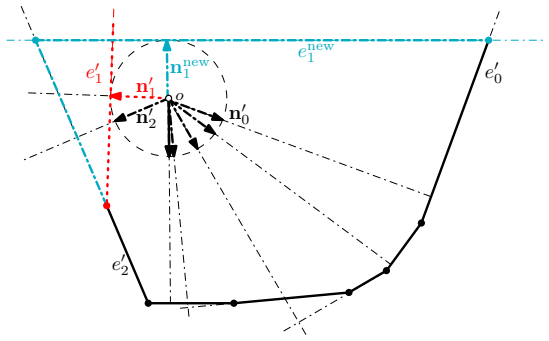
Definen new 1 := − 1 2(n′ 0 +n ′
-
[25]
and note that this lies betweenn ′ 0 andn ′ 2 in ccw order and forms angles less than 180 ◦ with both. If we hence remove from P ′ the half-plane defined byn ′ 1 and add to it the half-plane defined byn new 1 and the corresponding edge distance, then the intersection of these half-spaces is a realization ofI ′. For the next implication we need an insight ...
-
[26]
, ℓ) between the two edges e′ 0 and e′ 1 that realized edge distance h′ 0 and h′
(Recall that all distances are distinct, which is crucial in this construction.) So we must add a new edge ei (for i = 1, . . . , ℓ) between the two edges e′ 0 and e′ 1 that realized edge distance h′ 0 and h′
-
[27]
Let c′ 1 be the corner between e′ 0 and e′ 1, and x0 and x1 be the tangent points of these edges
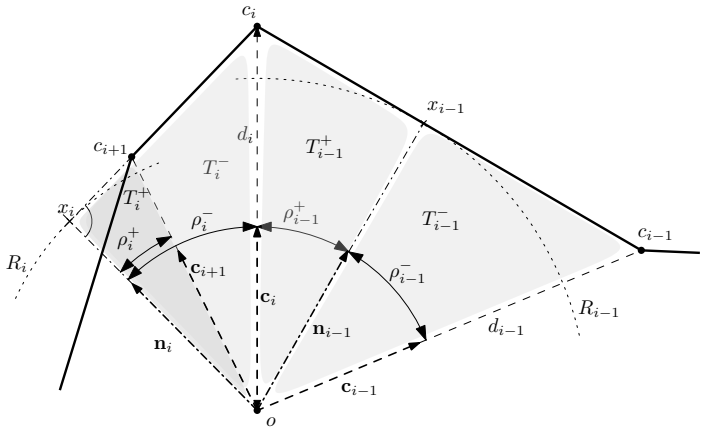
Consider Figure 12. Let c′ 1 be the corner between e′ 0 and e′ 1, and x0 and x1 be the tangent points of these edges. Imagine sliding a segment e = ab where initially a=x 0 andb=c ′ 1, at the enda=c ′ 1 andb=x 1, and the points move at uniform speed. h′ 0 o h′ 1 x0 x1 c′ 1 h1 hℓ Figure 12: Closeup: insert edges between a local minimum and a local maximum....
-
[28]
So in particular both x0 and x1 remain as points on e′ 0 and e′
-
[29]
corner vectors and areas
Therefore, the edges that we added here do not interfere with any edges that we might add for some other minimum-maximum pair elsewhere. Hence, repeating this approach at all other such pairs gives (1). We note that this construction crucially needs distinct edge distances; it is not clear how one could insert two equidistant edges if flat angles are not ...
-
[30]
corner vectors and edge distance
Once we know ci, edge ei can have either increasing or decreasing slope; either way it forms a right triangle with the horizontal through ci and the (vertical) corner ray for ci+1. The distance between the corner rays is 4 ai, and the vertical distance between ci and ci+1 hence p ℓ2 i −(4a i)2 = 3ai. Thus, ei either adds or subtracts 3 ai to the y-coordin...
discussion (0)
Sign in with ORCID, Apple, or X to comment. Anyone can read and Pith papers without signing in.