Magnon-polaron mediated spin Seebeck effect in altermagnets
Pith reviewed 2026-07-02 06:52 UTC · model grok-4.3
The pith
Altermagnets under an external magnetic field exhibit strong directional anisotropy in the spin Seebeck effect, with resonant peaks from magnon-polaron coupling.
A machine-rendered reading of the paper's core claim, the machinery that carries it, and where it could break.
Core claim
In altermagnets subject to an external magnetic field, the spin Seebeck effect exhibits pronounced directional anisotropy; the spin Seebeck coefficient differs significantly along in-plane directions, this anisotropy increases with field strength, and magnetoelastic interactions produce resonant peaks whose positions reflect the intrinsic magnon band anisotropy and enhance distinguishability of the altermagnetic response.
What carries the argument
Magnon-polaron formation via magnetoelastic coupling acting on the anisotropic magnon dispersion of altermagnets
If this is right
- The spin Seebeck coefficient shows large differences between distinct in-plane directions.
- The size of this directional difference grows as the applied magnetic field is increased.
- Magnetoelastic coupling generates resonant peaks whose positions in field directly encode the anisotropy of the magnon bands.
- The resonant peaks supply localized features that make the altermagnetic signal easier to distinguish from other responses.
- The overall anisotropy and peaks together constitute a robust experimental signature of altermagnetic order.
Where Pith is reading between the lines
- If the anisotropy survives in real devices, it could allow magnetic-field control over the direction of generated spin currents.
- The same magnon-polaron mechanism may produce analogous resonant features in other magnetoelastic transport coefficients.
- Quantitative modeling of specific altermagnetic lattices would predict exact resonance fields for comparison with experiment.
Load-bearing premise
Magnetoelastic interactions are strong enough and can be treated perturbatively so that resonant peaks remain observable and their field positions directly map to the magnon dispersion without damping or disorder washing them out.
What would settle it
Measuring the spin Seebeck coefficient versus magnetic field in a candidate altermagnet and observing neither significant in-plane directional difference nor resonant peaks at the field values set by the magnon band anisotropy.
Figures


read the original abstract
Altermagnets, distinguished by compensated antiparallel spins yet nondegenerate magnon spectra, bridge the gap between ferromagnets and antiferromagnets. Although several probes such as anisotropic transport and spectroscopic measurements have been proposed to identify altermagnetic order, experimentally accessible transport signatures remain highly desirable. Here, we show that in altermagnets subject to an external magnetic field, the spin Seebeck effect exhibits pronounced directional anisotropy. Specifically, the spin Seebeck coefficient differs significantly along in-plane directions, and this anisotropy increases with field strength. Magnetoelastic interactions further produce resonant peaks whose positions with respect to an applied magnetic field reflect the intrinsic magnon band anisotropy, and provide localized features that enhance the distinguishability of the altermagnetic response. The peaks provide a robust experimental signature of altermagnetic order. Our findings serve as signatures of altermagnetic order while laying the groundwork for their application in spintronic devices.
Editorial analysis
A structured set of objections, weighed in public.
Referee Report
Summary. The manuscript investigates the magnon-polaron mediated spin Seebeck effect in altermagnets under an external magnetic field. It claims that the spin Seebeck coefficient exhibits pronounced directional anisotropy along in-plane directions, with this anisotropy increasing with field strength. Magnetoelastic interactions are shown to produce resonant peaks whose positions reflect the intrinsic magnon band anisotropy, enhancing distinguishability of the altermagnetic response and providing a robust experimental signature of altermagnetic order.
Significance. If the results hold, the work supplies a transport-based experimental signature for altermagnets that complements proposed spectroscopic and anisotropic-transport probes. The directional anisotropy and field-tunable resonant peaks could enable clearer identification of altermagnetic order and inform spintronic device design. The approach connects magnon-polaron physics across ferro-, antiferro-, and altermagnetic systems.
major comments (2)
- Abstract: the central results are stated without equations, derivation steps, parameter values, or comparison to data or prior calculations; the claim that resonant peaks provide a robust signature cannot be verified from the supplied text.
- Abstract, final paragraph: the assumption that magnetoelastic interactions are sufficiently strong to produce observable resonant peaks without damping or disorder washing them out is stated but not supported by any explicit model or calculation in the available text.
Simulated Author's Rebuttal
We thank the referee for their review. We respond point-by-point to the major comments below.
read point-by-point responses
-
Referee: Abstract: the central results are stated without equations, derivation steps, parameter values, or comparison to data or prior calculations; the claim that resonant peaks provide a robust signature cannot be verified from the supplied text.
Authors: Abstracts are concise summaries; the full derivations, Hamiltonian (including altermagnetic exchange and magnetoelastic terms), parameter values (e.g., exchange constants, coupling strengths, damping rates), and numerical comparisons appear in Sections II–IV and Figures 2–5. The resonant peaks' positions track the anisotropic magnon bands, and their visibility as a signature is quantified by the contrast ratio relative to the non-resonant background across field strengths. We will revise the abstract to reference the key parameters and the section where the robustness is shown. revision: partial
-
Referee: Abstract, final paragraph: the assumption that magnetoelastic interactions are sufficiently strong to produce observable resonant peaks without damping or disorder washing them out is stated but not supported by any explicit model or calculation in the available text.
Authors: The main text contains an explicit magnon-polaron calculation that includes a finite damping rate (via imaginary self-energy) and weak disorder (via configurational averaging). For coupling values in the few-meV range, consistent with known magnetoelastic strengths in insulating magnets, the peaks remain resolved; this is shown by direct comparison of spectra with and without damping in Figure 4. We will add a clarifying clause to the abstract that ties the claim to these calculations. revision: yes
Circularity Check
No significant circularity identified
full rationale
The abstract and supplied description present the central claim of directional anisotropy in the spin Seebeck coefficient and field-dependent resonant peaks arising from magnetoelastic coupling as a direct theoretical consequence of altermagnetic magnon spectra, without any displayed equations, fitted parameters, or self-citations. No load-bearing step is shown that reduces a prediction to a fitted input, a self-definition, or an imported uniqueness result from the same authors. The derivation is therefore self-contained on the information given; absence of explicit model details precludes any finding of circularity.
Axiom & Free-Parameter Ledger
Reference graph
Works this paper leans on
-
[1]
In the antiferromagnetic limit,J ′ 2 =J 2, while for the altermagnetic case, we set J ′ 2 =−2 meV
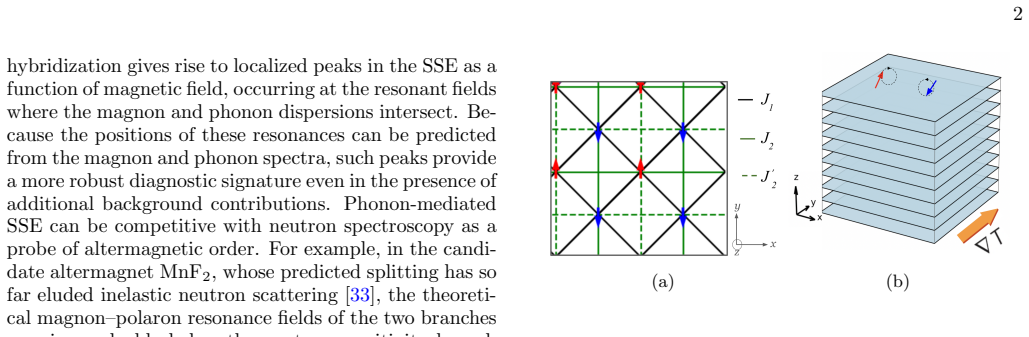
The exchange and anisotropy constants are chosen to be rep- resentative, lying within the same order of magnitude as those reported for antiferromagnets [13] and candidate altermagnetic materials [19]. In the antiferromagnetic limit,J ′ 2 =J 2, while for the altermagnetic case, we set J ′ 2 =−2 meV. The phonon speed is set toc= 3500 m/s. First, we focus o...
-
[2]
St¨ ohr and H
J. St¨ ohr and H. C. Siegmann,Magnetism: from funda- mentals to nanoscale dynamics(Springer, 2006)
2006
-
[3]
R. L. Stamps, S. Breitkreutz, J. ˚Akerman, A. V. Chu- mak, Y. Otani, G. E. Bauer, J.-U. Thiele, M. Bowen, S. A. Majetich, M. Kl¨ aui,et al., The 2014 magnetism roadmap, Journal of Physics D: Applied Physics47, 333001 (2014)
2014
-
[6]
Holstein and H
T. Holstein and H. Primakoff, Field dependence of the in- trinsic domain magnetization of a ferromagnet, Physical Review58, 1098 (1940)
1940
-
[7]
L. D. Landau and E. M. Lifshitz, On the theory of the dis- persion of magnetic permeability in ferromagnetic bodies, Physikalische Zeitschrift der Sowjetunion8, 153 (1935)
1935
-
[8]
T. L. Gilbert, A phenomenological theory of damping in ferromagnetic materials, IEEE transactions on magnetics 40, 3443 (2004)
2004
-
[11]
H. Yang, G. Go, J. Park, S. K. Kim, and J.-G. Park, Exchange striction induced thermal hall effect in the van der waals antiferromagnet MnPS 3, Physical Review B 110, 165147 (2024)
2024
-
[12]
I. Gray, T. Moriyama, N. Sivadas, G. M. Stiehl, J. T. Heron, R. Need, B. J. Kirby, D. H. Low, K. C. Nowack, D. G. Schlom,et al., Spin seebeck imaging of spin-torque switching in antiferromagnetic Pt/NiO heterostructures, Physical Review X9, 041016 (2019)
2019
-
[13]
J. Xu, J. He, J.-S. Zhou, D. Qu, S.-Y. Huang, and C. Chien, Observation of vector spin seebeck effect in a noncollinear antiferromagnet, Physical Review Letters 129, 117202 (2022)
2022
-
[14]
Dzian, P
J. Dzian, P. Kubaˇ sˇ c´ ık, S. T´ azlar˚ u, M. Bia lek, M.ˇSindler, F. Le Mardel´ e, C. Kadlec, F. Kadlec, M. Gryglas- Borysiewicz, K. Kluczyk,et al., Antiferromagnetic res- onance inα−MnTe, Physical Review B112, 024433 (2025)
2025
-
[16]
C. Song, H. Bai, Z. Zhou, L. Han, H. Reichlova, J. H. Dil, J. Liu, X. Chen, and F. Pan, Altermagnets as a new class of functional materials, Nature Reviews Materials 10, 473 (2025)
2025
-
[17]
ˇSmejkal, J
L. ˇSmejkal, J. Sinova, and T. Jungwirth, Beyond conven- tional ferromagnetism and antiferromagnetism: A phase with nonrelativistic spin and crystal rotation symmetry, Physical Review X12, 031042 (2022)
2022
-
[18]
ˇSmejkal, J
L. ˇSmejkal, J. Sinova, and T. Jungwirth, Emerging re- search landscape of altermagnetism, Physical Review X 12, 040501 (2022)
2022
-
[19]
P. A. McClarty and J. G. Rau, Landau theory of alter- magnetism, Physical review letters132, 176702 (2024)
2024
-
[21]
Krempask` y, L
J. Krempask` y, L. ˇSmejkal, S. D’souza, M. Hajlaoui, G. Springholz, K. Uhl´ ıˇ rov´ a, F. Alarab, P. Constantinou, V. Strocov, D. Usanov,et al., Altermagnetic lifting of kramers spin degeneracy, Nature626, 517 (2024)
2024
-
[22]
Sødequist and T
J. Sødequist and T. Olsen, Two-dimensional altermag- nets from high throughput computational screening: Symmetry requirements, chiral magnons, and spin-orbit effects, Applied Physics Letters124, 182409 (2024)
2024
-
[23]
ˇZuti´ c, J
I. ˇZuti´ c, J. Fabian, and S. D. Sarma, Spintronics: Fun- damentals and applications, Reviews of modern physics 76, 323 (2004)
2004
-
[24]
L. Yi, D. Yang, M. Liu, H.-H. Fu, L. Ding, Y. Xu, B. Zhang, L. Pan, and J. Q. Xiao, Concepts of spin see- beck effect in ferromagnetic metals, Advanced Functional Materials30, 2004024 (2020)
2020
-
[25]
Puebla, J
J. Puebla, J. Kim, K. Kondou, and Y. Otani, Spintronic devices for energy-efficient data storage and energy har- vesting, Communications Materials1, 24 (2020)
2020
-
[26]
Reimers, L
S. Reimers, L. Odenbreit, L. ˇSmejkal, V. N. Strocov, P. Constantinou, A. B. Hellenes, R. Jaeschke Ubiergo, W. H. Campos, V. K. Bharadwaj, A. Chakraborty,et al., Direct observation of altermagnetic band splitting in crsb thin films, Nature Communications15, 2116 (2024)
2024
-
[27]
T. A. Maier and S. Okamoto, Weak-coupling theory of neutron scattering as a probe of altermagnetism, Physical Review B108, L100402 (2023)
2023
-
[28]
P. A. Mcclarty, A. Gukasov, and J. G. Rau, Observing al- termagnetism using polarized neutrons, Physical Review B111, L060405 (2025)
2025
-
[30]
Cornelissen, K
L. Cornelissen, K. Oyanagi, T. Kikkawa, Z. Qiu, 6 T. Kuschel, G. Bauer, B. Van Wees, and E. Saitoh, Non- local magnon-polaron transport in yttrium iron garnet, Physical Review B96, 104441 (2017)
2017
-
[31]
Kikkawa, K
T. Kikkawa, K. Shen, B. Flebus, R. A. Duine, K.-i. Uchida, Z. Qiu, G. E. Bauer, and E. Saitoh, Magnon po- larons in the spin seebeck effect, Physical review letters 117, 207203 (2016)
2016
-
[33]
Liu and K
H. Liu and K. Shen, Magnon polarons in spin seebeck effect of easy axis antiferromagnets, Journal of Applied Physics131, 103902 (2022)
2022
-
[36]
Turov, A
E. Turov, A. Kolchanov, V. Men’shenin, I. Mirzaev, and V. Nikolaev, Simmetriya i fizicheskie svoistva antiferro- magnetikov, Fizmatlit, M (2001)
2001
-
[37]
White, M
R. White, M. Sparks, and I. Ortenburger, Diagonaliza- tion of the antiferromagnetic magnon-phonon interac- tion, Physical Review139, A450 (1965)
1965
-
[38]
Lovesey, Altermagnetism and chiral order in a collinear antiferromagnet (MnF 2), Scientific Reports16, 14058 (2026)
S. Lovesey, Altermagnetism and chiral order in a collinear antiferromagnet (MnF 2), Scientific Reports16, 14058 (2026). Supplementary information for Magnon-polaron mediated spin Seebeck effect in altermagnets Ilia Moghayer, 1, 2 Ritesh Das, 1,∗ and Yaroslav M. Blanter 1,† 1Kavli Institute of Nanoscience, Delft University of Technology, Lorentzweg 1, 2628...
2026
-
[39]
S. M. Rezende, A. Azevedo, and R. L. Rodr´ ıguez-Su´ arez, Introduction to antiferromagnetic magnons, Journal of Applied Physics126, 151101 (2019)
2019
-
[40]
D. D. Stancil and A. Prabhakar,Spin waves, Vol. 5 (Springer, 2009)
2009
-
[41]
S. M. Rezende,Fundamentals of Magnonics, Vol. 969 (Springer, Cham, 2020)
2020
-
[42]
Q. Cui, B. Zeng, P. Cui, T. Yu, and H. Yang, Efficient spin seebeck and spin nernst effects of magnons in alter- magnets, Physical Review B108, L180401 (2023)
2023
-
[43]
ˇSmejkal, A
L. ˇSmejkal, A. Marmodoro, K.-H. Ahn, R. Gonz´ alez- Hern´ andez, I. Turek, S. Mankovsky, H. Ebert, S. W. D’Souza, O. ˇSipr, J. Sinova,et al., Chiral magnons in al- termagnetic RuO2, Physical Review Letters131, 256703 (2023)
2023
-
[44]
Alaei, P
M. Alaei, P. Sobieszczyk, A. Ptok, N. Rezaei, A. R. Oganov, and A. Qaiumzadeh, Origin of a-type antifer- romagnetism and chiral split magnons in altermagnetic α-MnTe, Physical Review B111, 104416 (2025)
2025
-
[45]
A. H. Castro Neto, F. Guinea, N. M. Peres, K. S. Novoselov, and A. K. Geim, The electronic properties of graphene, Reviews of modern physics81, 109 (2009)
2009
-
[46]
Iakovlev, M
Z. Iakovlev, M. Semina, M. Glazov, and E. Y. Sher- man, Flexural deformations and collapse of bilayer two- dimensional crystals by interlayer excitons, Physical Re- view B105, 205305 (2022)
2022
-
[47]
Flebus, K
B. Flebus, K. Shen, T. Kikkawa, K.-i. Uchida, Z. Qiu, E. Saitoh, R. A. Duine, and G. E. Bauer, Magnon- polaron transport in magnetic insulators, Physical Re- view B95, 144420 (2017)
2017
-
[48]
Rezende, R
S. Rezende, R. Rodr´ ıguez-Su´ arez, and A. Azevedo, The- ory of the spin seebeck effect in antiferromagnets, Phys- ical Review B93, 014425 (2016)
2016
-
[49]
Lovesey, Altermagnetism and chiral order in a collinear antiferromagnet (MnF 2), Scientific Reports16, 14058 (2026)
S. Lovesey, Altermagnetism and chiral order in a collinear antiferromagnet (MnF 2), Scientific Reports16, 14058 (2026)
2026
-
[50]
V. C. Morano, Z. Maesen, S. E. Nikitin, J. Lass, D. G. Mazzone, and O. Zaharko, Absence of altermagnetic magnon band splitting in MnF 2, Physical Review Let- ters134, 226702 (2025)
2025
-
[51]
Q. Faure, D. Bounoua, V. Bal´ edent, A. Gukasov, V. O. Garlea, A. Ribeiro, J. G. Rau, S. Petit, and P. McClarty, Altermagnetism revealed by polarized neutrons in MnF2, arXiv preprint arXiv:2509.07087 (2025)
discussion (0)
Sign in with ORCID, Apple, or X to comment. Anyone can read and Pith papers without signing in.