Modification of Damon-Eshbach magnetostatic mode spectra in ferromagnet/paramagnet bilayer
Pith reviewed 2026-07-02 06:57 UTC · model grok-4.3
The pith
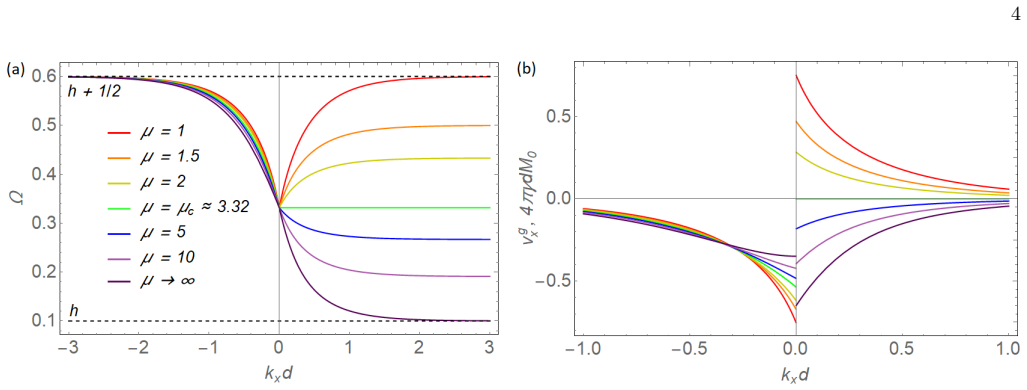
Dipolar coupling in a ferromagnet-paramagnet bilayer renders surface spin waves unidirectional with field- and temperature-tunable nonreciprocity.
A machine-rendered reading of the paper's core claim, the machinery that carries it, and where it could break.
Core claim
In the magnetostatic approximation applied to an in-plane magnetized ferromagnet/paramagnet bilayer, dipolar coupling polarizes the paramagnet according to its susceptibility and thereby modifies the Damon-Eshbach magnetostatic mode spectra, producing unidirectional surface spin waves whose frequency nonreciprocity reaches a magnitude set by the divergence of susceptibility near the Curie temperature.
What carries the argument
The paramagnet's magnetic susceptibility χ ∝ 1/(T − T_C) that grows large near the Curie temperature and amplifies the dipolar polarization effect on the surface modes.
If this is right
- Surface spin waves become capable of carrying energy in only one direction once the paramagnet susceptibility is sufficiently large.
- The magnitude of the frequency nonreciprocity for these unidirectional waves follows directly from the calculated spectra.
- The unidirectional propagation regime can be switched on and off by varying the external magnetic field at fixed temperature.
- The unidirectional propagation regime can be switched on and off by varying temperature near T_C at fixed field.
Where Pith is reading between the lines
- The same bilayer geometry could be used to test whether nonreciprocity persists when the paramagnet is replaced by other materials with strong temperature-dependent response.
- If the nonreciprocity is large enough, the structure might allow isolation of magnonic signals without external circulators.
- Experimental mapping of the dispersion relation at multiple temperatures would directly test the model's assumption that only dipolar coupling, not exchange, sets the modification.
Load-bearing premise
The paramagnet responds to the ferromagnet's stray dipolar field with a susceptibility that follows χ proportional to one over (T minus T_C) and becomes very large near the Curie temperature.
What would settle it
Measurement of the difference in spin-wave frequency or propagation direction for opposite wavevectors in a fabricated bilayer as temperature approaches T_C from above, to check whether the observed nonreciprocity follows the predicted dependence on the diverging susceptibility.
Figures




read the original abstract
Using the magnetostatic approximation, we calculate the spectra of bulk and surface spin waves in an in-plane magnetized ferromagnet/paramagnet bilayer. Due to the dipolar coupling between the layers, the paramagnet becomes polarized, which in turn modifies the spectrum of the Damon-Eshbach magnetostatic modes. We assume that the paramagnet is characterized by a magnetic susceptibility, $\chi \propto 1/(T-T_C)$, which reaches large values when the system temperature $T$ is close to the Curie temperature $T_C$. We find the conditions under which surface spin waves become unidirectional, i.e., capable of carrying energy in only one direction, and determine the magnitude of their frequency nonreciprocity. We demonstrate the possibility of switching the unidirectional wave regime on and off by varying the external magnetic field or temperature, making the ferromagnet/paramagnet system an attractive platform for tunable magnonic logic devices.
Editorial analysis
A structured set of objections, weighed in public.
Referee Report
Summary. The manuscript calculates spin-wave spectra in an in-plane magnetized ferromagnet/paramagnet bilayer within the magnetostatic approximation. Dipolar coupling polarizes the paramagnet, modifying the Damon-Eshbach surface modes; with the assumed paramagnetic susceptibility χ ∝ 1/(T−T_C) becoming large near the Curie point, the surface modes are predicted to become unidirectional, exhibiting tunable frequency nonreciprocity that can be switched on/off by external field or temperature.
Significance. If the central results hold, the work identifies a mechanism for electrically or thermally tunable unidirectional magnonic waveguides, extending standard Damon-Eshbach theory to bilayers and offering a platform for magnonic logic. The calculation is analytic and parameter-light once the susceptibility form is accepted.
major comments (1)
- [Abstract and susceptibility assumption] Abstract and susceptibility assumption: the unidirectional regime and its on/off switching by temperature rest on inserting a frequency-independent χ ∝ 1/(T−T_C) directly into the magnetostatic boundary-value problem. Because magnon frequencies lie in the GHz range, critical slowing down near T_C can keep the dynamic |χ(ω,T)| modest even when the static susceptibility diverges; this would remove the predicted nonreciprocity. A dynamic susceptibility or explicit justification for the static approximation is required to support the central claim.
Simulated Author's Rebuttal
We thank the referee for their careful reading of the manuscript and for highlighting an important point regarding the susceptibility. We address this comment below and will revise the manuscript to incorporate additional justification.
read point-by-point responses
-
Referee: [Abstract and susceptibility assumption] Abstract and susceptibility assumption: the unidirectional regime and its on/off switching by temperature rest on inserting a frequency-independent χ ∝ 1/(T−T_C) directly into the magnetostatic boundary-value problem. Because magnon frequencies lie in the GHz range, critical slowing down near T_C can keep the dynamic |χ(ω,T)| modest even when the static susceptibility diverges; this would remove the predicted nonreciprocity. A dynamic susceptibility or explicit justification for the static approximation is required to support the central claim.
Authors: We acknowledge that the static susceptibility form is an approximation and that critical slowing down near T_C can render the dynamic susceptibility frequency-dependent, potentially limiting the magnitude of χ(ω) at GHz frequencies. In the revised manuscript we will add an explicit discussion of the validity of this approximation. Specifically, we will note that the static form remains appropriate provided the paramagnetic relaxation rate exceeds the magnon frequency (i.e., ωτ ≪ 1), a regime that can be realized in materials with sufficiently fast spin dynamics or at temperatures where the divergence of τ has not yet become prohibitive. We will also state that a full frequency-dependent treatment would constitute a valuable extension but lies beyond the analytic magnetostatic framework of the present work. revision: yes
Circularity Check
No circularity: derivation applies standard magnetostatic boundary conditions to an explicit susceptibility ansatz
full rationale
The paper states its central calculation as solving the magnetostatic boundary-value problem for the bilayer with the given frequency-independent susceptibility χ ∝ 1/(T-T_C) inserted directly into the permeability tensor. No parameter is fitted to the predicted nonreciprocity or unidirectionality; the unidirectional regime is an output of the dispersion relation under that assumption. No self-citations, uniqueness theorems, or prior-author results are invoked to justify the ansatz or forbid alternatives. The derivation chain therefore remains independent of its target results.
Axiom & Free-Parameter Ledger
free parameters (1)
- Curie temperature T_C
axioms (2)
- domain assumption Magnetostatic approximation holds for the bilayer geometry and frequencies of interest
- domain assumption Paramagnet susceptibility follows χ ∝ 1/(T - T_C)
Reference graph
Works this paper leans on
-
[1]
V. V. Kruglyak, S. O. Demokritov, and D. Grundler, Magnonics, J. Phys. D: Appl. Phys. 43, 264001 (2010)
2010
-
[2]
Mahmoud, F
A. Mahmoud, F. Ciubotaru, F. Vanderveken, A. V. Chu- mak, S. Hamdioui, C. Adelmann, and S. Cotofana, In- troduction to spin wave computing, J. Appl. Phys. 128, 161101 (2020)
2020
-
[3]
Flebus, D
B. Flebus, D. Grundler, B. Rana, Y. Otani, I. Bar- sukov, A. Barman, G. Gubbiotti, P. Landeros, J. Aker- man, U. Ebels, P. Pirro, V. E. Demidov, K. Schultheiss, G. Csaba, Q. Wang, F. Ciubotaru, D. E. Nikonov, P. Che, R. Hertel, T. Ono, et al. , The 2024 magnonics roadmap, J. Phys.: Condens. Matter 36, 363501 (2024)
2024
-
[4]
X. Han, H. Wu, and T. Zhang, Magnonics: Materi- als, physics, and devices, Appl. Phys. Lett. 125, 020501 (2024)
2024
-
[5]
A. V. Chumak, P. Kabos, M. Wu, C. Abert, C. Adel- mann, A. O. Adeyeye, J. ˚ Akerman, F. G. Aliev, A. Anane, A. Awad, C. H. Back, A. Barman, G. E. W. Bauer, M. Becherer, E. N. Beginin, V. A. S. V. Bitten- court, Y. M. Blanter, P. Bortolotti, I. Boventer, D. A. Bozhko, et al. , Advances in Magnetics Roadmap on Spin- Wave Computing, IEEE Trans. Magn. 58, 1 (2022)
2022
-
[6]
R. W. Damon and J. R. Eshbach, Magnetostatic modes of a ferromagnet slab, J. Phys. Chem. Solids 19, 308 (1961)
1961
-
[7]
Seshadri, Surface magnetostatic modes of a ferrite sl ab, Proc
S. Seshadri, Surface magnetostatic modes of a ferrite sl ab, Proc. IEEE 58, 506 (1970)
1970
-
[8]
R. E. De Wames and T. Wolfram, Characteristics of mag- netostatic surface waves for a metalized ferrite slab, J. Appl. Phys. 41, 5243 (1970)
1970
-
[9]
Mruczkiewicz and M
M. Mruczkiewicz and M. Krawczyk, Nonreciprocal dis- persion of spin waves in ferromagnetic thin films cov- ered with a finite-conductivity metal, J. Appl. Phys. 115, 113909 (2014)
2014
-
[10]
I. A. Golovchanskiy, N. N. Abramov, V. S. Stolyarov, V. V. Ryazanov, A. A. Golubov, and A. V. Ustinov, Mod- ified dispersion law for spin waves coupled to a supercon- ductor, J. Appl. Phys. 124, 233903 (2018)
2018
-
[11]
M. A. Kuznetsov and A. A. Fraerman, Temperature- sensitive spin-wave nonreciprocity induced by interlayer dipolar coupling in ferromagnet/paramagnet and ferro- magnet/superconductor hybrid systems, Phys. Rev. B 105, 214401 (2022)
2022
-
[12]
Kharlan, K
J. Kharlan, K. Sobucki, K. Szulc, S. Memarzadeh, and J. W. K/suppress los, Spin-wave confinement in a hybrid superconductor-ferrimagnet nanostructure, Phys. Rev. Applied 21, 064007 (2024)
2024
-
[13]
X.-H. Zhou, X. Ye, L. Bai, and T. Yu, Giant enhance- ment of magnon transport by superconductor Meissner screening, Phys. Rev. B 110, L020404 (2024)
2024
-
[14]
Udvardi and L
L. Udvardi and L. Szunyogh, Chiral asymmetry of the spin-wave spectra in ultrathin magnetic films, Phys. Rev. Lett. 102, 207204 (2009)
2009
-
[15]
Moon, S.-M
J.-H. Moon, S.-M. Seo, K.-J. Lee, K.-W. Kim, J. Ryu, H.-W. Lee, R. D. McMichael, and M. D. Stiles, Spin-wave propagation in the presence of interfacial Dzyaloshinskii - Moriya interaction, Phys. Rev. B 88, 184404 (2013)
2013
-
[16]
K. Di, V. L. Zhang, H. S. Lim, S. C. Ng, M. H. Kuok, X. Qiu, and H. Yang, Asymmetric spin-wave dispersion due to Dzyaloshinskii-Moriya interaction in an ultrathin Pt/CoFeB film, Appl. Phys. Lett. 106, 052403 (2015)
2015
-
[17]
Wolfram, Magnetostatic surface waves in layered mag - netic structures, J
T. Wolfram, Magnetostatic surface waves in layered mag - netic structures, J. Appl. Phys. 41, 4748 (1970)
1970
-
[18]
R. E. Camley and A. A. Maradudin, Magnetostatic in- terface waves in ferromagnets, Solid State Commun. 41, 585 (1982)
1982
-
[19]
P. X. Zhang and W. Zinn, Spin-wave modes in antipar- allel magnetized ferromagnetic double layers, Phys. Rev. B 35, 5219 (1987)
1987
-
[20]
R. A. Gallardo, T. Schneider, A. K. Chaurasiya, A. Oelschl¨ agel, S. S. P. K. Arekapudi, A. Rold´ an-Molina, R. H¨ ubner, K. Lenz, A. Barman, J. Fassbender, J. Lind- ner, O. Hellwig, and P. Landeros, Reconfigurable spin- wave nonreciprocity induced by dipolar interaction in a coupled ferromagnetic bilayer, Phys. Rev. Applied 12, 034012 (2019)
2019
-
[21]
W. Song, X. Wang, W. Wang, C. Jiang, X. Wang, and G. Chai, Backward magnetostatic surface spin waves in coupled Co/FeNi bilayers, Phys. Status Solidi RRL 14, 2000118 (2020)
2020
-
[22]
Heins, V
C. Heins, V. Iurchuk, O. Gladii, L. K¨ orber, A. K´ akay, J. Fassbender, K. Schultheiss, and H. Schultheiss, Nonre- ciprocal spin-wave dispersion in magnetic bilayers, Phys. Rev. B 111, 134434 (2025)
2025
-
[23]
A. V. Vashkovskii and E. G. Lokk, The magnetic-wall effect on the characteristics of magnetostatic waves in an in-plane magnetized ferrite plate, J. Commun. Technol. Electron. 51, 568 (2006)
2006
-
[24]
Mikuszeit, S
N. Mikuszeit, S. Meckler, R. Wiesendanger, and R. Mi- randa, Magnetostatics and the rotational sense of cy- cloidal spin spirals, Phys. Rev. B 84, 054404 (2011)
2011
-
[25]
A. A. Fraerman and K. R. Mukhamatchin, Chiral insta- bility of the homogeneous state of a ferromagnetic film on a magnetic substrate, J. Exp. Theor. Phys. 131, 963 (2020)
2020
-
[26]
M. A. Kuznetsov and A. A. Fraerman, Magnetostatic mechanism of chiral symmetry breaking in multilayer magnetic structures, J. Exp. Theor. Phys. 137, 442 (2023)
2023
-
[27]
M. A. Kuznetsov, K. R. Mukhamatchin, and A. A. Fraerman, Effective interfacial Dzyaloshinskii-Moriya interaction and skyrmion stabilization in ferromag- net/paramagnet and ferromagnet/superconductor hy- brid systems, Phys. Rev. B 107, 184428 (2023)
2023
-
[28]
E. H. Lokk, The properties of isofrequency dependences and the laws of geometrical optics, Phys.-Usp. 51, 375 (2008)
2008
-
[29]
Grassi, M
M. Grassi, M. Geilen, D. Louis, M. Mohseni, T. Br¨ acher, M. Hehn, D. Stoeffler, M. Bailleul, P. Pirro, and Y. Henry, Slow-wave-based nanomagnonic diode, Phys. Rev. Applied 14, 024047 (2020)
2020
-
[30]
J. Chen, H. Yu, and G. Gubbiotti, Unidirectional spin- wave propagation and devices, J. Phys. D: Appl. Phys. 55, 123001 (2022)
2022
-
[31]
A. G. Gurevich and G. A. Melkov, Magnetization Oscil- lations and Waves (CRC Press, 1996)
1996
-
[32]
R. E. Camley, Nonreciprocal surface waves, Surf. Sci. Rep. 7, 103 (1987)
1987
-
[33]
V. G. Veselago, Electrodynamics of substances with si- multaneously negative electrical and magnetic permeabil- ities, Sov. Phys. Usp. 10, 504 (1968)
1968
-
[34]
A. V. Chumak, P. Dhagat, A. Jander, A. A. Serga, and B. Hillebrands, Reverse Doppler effect of magnons with 9 negative group velocity scattered from a moving Bragg grating, Phys. Rev. B 81, 140404(R) (2010)
2010
-
[35]
V. E. Pafomov, Transition radiation and Cerenkov radi- ation, Soviet. Phys. JETP 36, 1853 (1959)
1959
-
[36]
S. A. Ahern, M. J. C. Martin, and W. Sucksmith, The spontaneous magnetization of nickel+copper alloys, Proc. A 248, 145 (1958)
1958
-
[37]
Sebastian, K
T. Sebastian, K. Schultheiss, B. Obry, B. Hillebrands, and H. Schultheiss, Micro-focused Brillouin light scatter - ing: imaging spin waves at the nanoscale, Front. Phys. 3 (2015)
2015
discussion (0)
Sign in with ORCID, Apple, or X to comment. Anyone can read and Pith papers without signing in.