Reexamination of collisional ionization cross sections including double photoionization processes
Pith reviewed 2026-07-02 02:47 UTC · model grok-4.3
The pith
Including shake-off processes and reduced recombination rates improves fits to XFEL aluminum plasma data.
A machine-rendered reading of the paper's core claim, the machinery that carries it, and where it could break.
Core claim
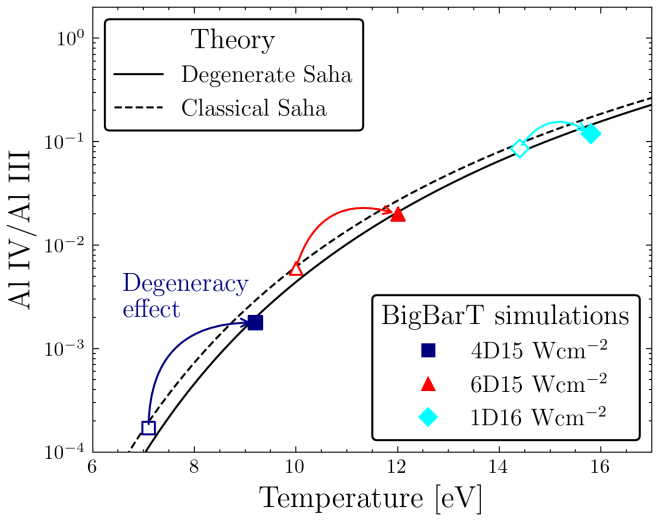
The central claim is that previous collisional-radiative models of XFEL-heated aluminum overlooked shake-off processes whose spectral signatures overlap with collisional ionization; when the BibBarT model is extended to include shake-off self-consistently with non-thermal electron evolution and degeneracy, the match to observed emission improves, and further improvement follows from lowering three-body recombination rates, indicating that those rates are overestimated in the experimental regime.
What carries the argument
BibBarT collisional-radiative model that evolves non-thermal electron populations and degeneracy effects while now incorporating shake-off atomic processes.
If this is right
- Shake-off must be treated explicitly in models used to extract collisional ionization cross sections from dense-plasma spectra.
- Three-body recombination rates currently used for these conditions are likely too large.
- Self-consistent treatment of non-thermal electrons and degeneracy changes the inferred ionization balance in XFEL-heated targets.
- Double photoionization contributes measurably to the ionization state reached in x-ray heated solid-density matter.
Where Pith is reading between the lines
- The same modeling adjustments could resolve similar discrepancies reported in other XFEL or laser-driven plasma experiments on different materials.
- Inertial confinement fusion simulations that rely on the same recombination rates may need revision for ionization balance at solid density.
- Experiments that scan XFEL photon energy across the aluminum K-edge could separate the energy dependence of shake-off from true collisional ionization.
Load-bearing premise
That the chosen XFEL dataset and the BibBarT model contain no other unaccounted competing processes or systematic measurement errors that could produce the same improvement in fit.
What would settle it
A direct laboratory measurement of the three-body recombination rate in aluminum plasma at solid density and similar temperature that matches the original higher value without adjustment would show that lowering the rate is not required.
Figures


read the original abstract
Collisional ionization (CI) cross sections in dense plasmas remain difficult to constrain due to uncertainties in plasma conditions and the overlapping spectral signatures of competing atomic processes. The use of x-ray free electron lasers (XFELs) to both heat and probe solid-density targets has significantly advanced the field by eliminating assumptions about ion density. However, questions remain regarding collisional cross sections, suprathermal electron evolution and competing atomic processes. In this work, we revisit experimental data from XFEL-heated aluminum, previously analyzed using collisional radiative models that did not treat the degenerate electron distribution and atomic processes self consistently. We present a new analysis using BibBarT which dynamically evolves non-thermal electron populations and explicitly includes degeneracy effects. Furthermore, we incorporate an important atomic process recently observed in plasma state that mimic signatures of CI, shake-off. Our results show that including shake-off processes improves agreement with observed emission features, and lowering recombination rates further improves the agreement with data -- indicating a possible overestimate of three-body recombination in these conditions.
Editorial analysis
A structured set of objections, weighed in public.
Referee Report
Summary. The manuscript reexamines collisional ionization cross sections for dense plasmas using XFEL-heated aluminum data previously analyzed without self-consistent degeneracy and non-thermal electron treatment. It introduces the BibBarT collisional-radiative model that evolves non-thermal electrons, incorporates degeneracy effects, and adds shake-off (double photoionization) processes. The central claim is that including shake-off improves agreement with observed emission features, and further lowering recombination rates yields additional improvement, indicating a possible overestimate of three-body recombination under these conditions.
Significance. If the quantitative improvements hold under rigorous validation, the work would strengthen the case for including shake-off in collisional-radiative models of XFEL-driven solid-density plasmas and suggest revisions to three-body recombination rates. The self-consistent treatment of degeneracy and non-thermal electrons in BibBarT is a methodological advance over prior analyses.
major comments (2)
- [Abstract] Abstract: The claim that 'including shake-off processes improves agreement with observed emission features' and that 'lowering recombination rates further improves the agreement' is presented without any quantitative metric (chi-squared, residual norms, or sensitivity analysis) or reference to specific figures/tables showing the before/after comparison. This makes it impossible to determine whether the improvement is attributable to shake-off rather than remaining model freedom or data systematics.
- [Abstract] Abstract: The inference that three-body recombination is overestimated rests on the assumption that BibBarT plus the chosen XFEL dataset have no other unaccounted competing processes or calibration uncertainties; the manuscript provides no discussion of alternative explanations (e.g., other double-ionization channels or line-shape systematics) or tests that would falsify this interpretation.
Simulated Author's Rebuttal
We thank the referee for the constructive feedback on our manuscript. We address each major comment below and will revise the manuscript to strengthen the presentation of our results.
read point-by-point responses
-
Referee: [Abstract] Abstract: The claim that 'including shake-off processes improves agreement with observed emission features' and that 'lowering recombination rates further improves the agreement' is presented without any quantitative metric (chi-squared, residual norms, or sensitivity analysis) or reference to specific figures/tables showing the before/after comparison. This makes it impossible to determine whether the improvement is attributable to shake-off rather than remaining model freedom or data systematics.
Authors: We agree that the abstract would benefit from explicit quantitative support. In the revised manuscript we will add references to the relevant figures (showing before/after comparisons) and include quantitative metrics such as chi-squared values or residual norms to document the improvement attributable to shake-off. These metrics will be drawn from the BibBarT runs already performed and will be added both to the abstract and to the main text. revision: yes
-
Referee: [Abstract] Abstract: The inference that three-body recombination is overestimated rests on the assumption that BibBarT plus the chosen XFEL dataset have no other unaccounted competing processes or calibration uncertainties; the manuscript provides no discussion of alternative explanations (e.g., other double-ionization channels or line-shape systematics) or tests that would falsify this interpretation.
Authors: We acknowledge that the current manuscript does not contain an explicit discussion of alternative explanations. In the revision we will add a dedicated paragraph (or subsection) that enumerates plausible competing processes (other double-ionization channels, line-shape uncertainties, calibration offsets) and explains why the data and model favor the three-body recombination interpretation. We will also note the limitations of the present dataset and the tests that would be needed to falsify the conclusion. revision: yes
Circularity Check
Lowering recombination rates to fit data makes the 'overestimate of three-body recombination' claim reduce to a fitted adjustment by construction
specific steps
-
fitted input called prediction
[Abstract]
"Our results show that including shake-off processes improves agreement with observed emission features, and lowering recombination rates further improves the agreement with data -- indicating a possible overestimate of three-body recombination in these conditions."
The paper adjusts (lowers) the recombination rate parameter until agreement with XFEL emission data improves, then interprets the need for that adjustment as evidence that three-body recombination rates are overestimated in the model. The 'indication' is therefore the direct output of the fitting step rather than an independent derivation or prediction.
full rationale
The abstract explicitly states that shake-off inclusion improves agreement and that further lowering recombination rates improves agreement further, which is then interpreted as indicating an overestimate. This is a direct instance of fitting a parameter to data and presenting the fit result as evidence of a physical conclusion. No other load-bearing steps are identifiable from the provided text, and the model updates (BibBarT degeneracy, non-thermal electrons) appear independent, so the circularity is partial rather than total. Full text might contain quantitative metrics that break the reduction, but the quoted claim stands alone as circular.
Axiom & Free-Parameter Ledger
free parameters (1)
- three-body recombination rate scaling factor
axioms (1)
- domain assumption Shake-off processes produce spectral signatures that mimic collisional ionization in the observed emission features
Reference graph
Works this paper leans on
-
[1]
Achievement of target gain larger than unity in an inertial fusion experiment, Phys. Rev. Lett. 132, 065102 (2024)
2024
-
[2]
Vorberger, F
J. Vorberger, F. Graziani, D. Riley, A. D. Baczewski, I. Baraffe, M. Bethkenhagen, S. Blouin, M. P. B¨ ohme, M. Bonitz, M. Bussmann, A. Casner, W. Cayzac, P. Celliers, G. Chabrier, N. Chamel, D. Chapman, M. Chen, J. Cl´ erouin, G. Collins, F. Coppari, T. D¨ oppner, T. Dorn- heim, L. B. Fletcher, D. O. Gericke, S. Glenzer, A. F. Goncharov, G. Gregori, S. H...
2025
-
[3]
D. Ranjan, K. Ramakrishna, K. Voigt, O. S. Humphries, B. Heuser, M. G. Stevenson, J. L¨ utgert, Z. He, C. Qu, S. Schumacher, P. T. May, A. Amouretti, K. Appel, E. Bram- brink, V. Cerantola, D. Chekrygina, L. B. Fletcher, S. G¨ ode, M. Harmand, N. J. Hartley, S. P. Hau-Riege, M. Makita, A. Pelka, A. K. Schuster, M. ˇSm´ ıd, T. Toncian, M. Zhang, T. R. Pres...
-
[4]
A. L´ evy, P. Audebert, R. Shepherd, J. Dunn, M. Cammarata, O. Ciricosta, F. Deneuville, F. Dorchies, M. Fajardo, C. Fourment, D. Fritz, J. Fuchs, J. Gaudin, M. Gauthier, A. Graf, H. J. Lee, H. Lemke, B. Nagler, J. Park, O. Peyrusse, A. B. Steel, S. M. Vinko, J. S. Wark, G. O. Williams, D. Zhu, and R. W. Lee, The creation of large-volume, gradient-free wa...
-
[5]
G. O. Williams, S. K¨ unzel, S. Daboussi, B. Iwan, A. I. Gonzalez, W. Boutu, V. Hilbert, U. Za- strau, H. J. Lee, B. Nagler, E. Granados, E. Galtier, P. Heimann, B. Barbrel, G. Dovillaire, R. W. Lee, J. Dunn, V. Recoules, C. Blancard, P. Renaudin, A. G. de la Varga, P. Velarde, P. Audebert, H. Merdji, P. Zeitoun, and M. Fajardo, Tracking the ultrafast xuv...
-
[6]
S. Vinko, V. Vozda, J. Andreasson, S. Bajt, J. Bielecki, T. Burian, J. Chalupsky, O. Ciri- costa, M. Desjarlais, H. Fleckenstein, J. Hajdu, V. Hajkova, P. Hollebon, L. Juha, M. Kasim, E. McBride, K. Muehlig, T. Preston, D. Rackstraw, S. Roling, S. Toleikis, J. Wark, and H. Zacharias, Time-resolved xuv opacity measurements of warm dense aluminum, Physical ...
-
[7]
Cho, X-ray spectroscopies of high energy density matter created with x-ray free electron lasers, Applied Sciences9, 4812 (2019)
B. Cho, X-ray spectroscopies of high energy density matter created with x-ray free electron lasers, Applied Sciences9, 4812 (2019)
2019
-
[8]
Q. van den Berg, E. Fernandez-Tello, T. Burian, J. Chalupsk´ y, H.-K. Chung, O. Ciricosta, G. Dakovski, V. H´ ajkov´ a, P. Hollebon, L. Juha, J. Krzywinski, R. Lee, M. Minitti, T. Pre- ston, A. de la Varga, V. Vozda, U. Zastrau, J. Wark, P. Velarde, and S. Vinko, Clocking femtosecond collisional dynamics via resonant x-ray spectroscopy, Physical Review Le...
-
[9]
C. J. Fontes, D. H. Sampson, and H. L. Zhang, Method for calculating the electron-impact ionization of ions of any complexity, Physical Review A48, 1975–1982 (1993)
1975
-
[10]
S. Ren, Y. Shi, Q. Y. van den Berg, M. F. Kasim, H.-K. Chung, E. V. Fernandez-Tello, P. Velarde, J. S. Wark, and S. M. Vinko, Non-thermal evolution of dense plasmas driven by intense x-ray fields, Communications Physics6, 10.1038/s42005-023-01216-x (2023)
-
[11]
Tallents, Free electron degeneracy effects on collisional excitation, ionization, de-excitation 14 and three-body recombination, High Energy Density Physics20, 9–16 (2016)
G. Tallents, Free electron degeneracy effects on collisional excitation, ionization, de-excitation 14 and three-body recombination, High Energy Density Physics20, 9–16 (2016)
2016
-
[12]
G. O. Williams, H.-K. Chung, S. K¨ unzel, V. Hilbert, U. Zastrau, H. Scott, S. Daboussi, B. Iwan, A. I. Gonzalez, W. Boutu, H. J. Lee, B. Nagler, E. Granados, E. Galtier, P. Heimann, B. Barbrel, R. W. Lee, B. I. Cho, P. Renaudin, H. Merdji, P. Zeitoun, and M. Fajardo, Impact of free electron degeneracy on collisional rates in plasmas, Physical Review Rese...
-
[13]
A. G. de la Varga, P. Velarde, F. de Gaufridy, D. Portillo, M. Cotelo, A. Barbas, A. Gonz´ alez, and P. Zeitoun, Non-maxwellian electron distributions in time-dependent simulations of low- z materials illuminated by a high-intensity x-ray laser, High Energy Density Physics9, 542 (2013)
2013
-
[14]
Garc´ ıa de la Varga,Modelizaci´ on de las propiedades radiativas e interacci´ on de l´ aseres ultraintensos con la materia, Ph.D
A. Garc´ ıa de la Varga,Modelizaci´ on de las propiedades radiativas e interacci´ on de l´ aseres ultraintensos con la materia, Ph.D. thesis, Universidad Polit´ ecnica de Madrid - University Library (2014)
2014
-
[15]
Ansia, P
L. Ansia, P. Velarde, M. Fajardo, and G. O. Williams, Relaxation pathways in x-ray free- electron-laser heated iron, Phys. Rev. E112, 025201 (2025)
2025
-
[16]
G. O. Williams, L. Ansia, M. Makita, P. Estrela, M. Hussain, T. R. Preston, J. Chalupsk´ y, V. Hajkova, T. Burian, M. Nakatsutsumi, J. Kaa, Z. Konopkova, N. Kujala, K. Appel, S. G¨ ode, V. Cerantola, L. Wollenweber, E. Brambrink, C. Baehtz, J.-P. Schwinkendorf, V. Vozda, L. Juha, H. K. Chung, P. Vagovic, H. Scott, P. Velarde, U. Zastrau, and M. Fajardo, S...
2025
-
[17]
P. Emma, R. Akre, J. Arthur, R. Bionta, C. Bostedt, J. Bozek, A. Brachmann, P. Bucks- baum, R. Coffee, F.-J. Decker, Y. Ding, D. Dowell, S. Edstrom, A. Fisher, J. Frisch, S. Gile- vich, J. Hastings, G. Hays, P. Hering, Z. Huang, R. Iverson, H. Loos, M. Messerschmidt, A. Miahnahri, S. Moeller, H.-D. Nuhn, G. Pile, D. Ratner, J. Rzepiela, D. Schultz, T. Smi...
2010
-
[18]
Nagler, B
B. Nagler, B. Arnold, G. Bouchard, R. F. Boyce, R. M. Boyce, A. Callen, M. Campell, R. Curiel, E. Galtier, J. Garofoli, E. Granados, J. Hastings, G. Hays, P. Heimann, R. W. Lee, D. Milathianaki, L. Plummer, A. Schropp, A. Wallace, M. Welch, W. White, Z. Xing, J. Yin, J. Young, U. Zastrau, and H. J. Lee, The matter in extreme conditions instrument at the l...
2015
- [19]
-
[20]
T. A. Carlson and C. W. Nestor, Calculation of electron shake-off probabilities as the result of x-ray photoionization of the rare gases, Physical Review A8, 2887–2894 (1973)
1973
-
[21]
Torres and J
M. Torres and J. Daz-Luque, Analysis of the k satellite lines in x-ray emission spectra, in X-Ray Spectroscopy(InTech, 2012)
2012
-
[22]
Turning solid aluminium transparent by intense soft x-ray photoionization, Nature Physics5, 693–696 (2009). Appendix A: Intensity dependence Within the 0D modeling framework, a more realistic representation of the total emitted spectrum is obtained by considering several intensity zones and averaging their individual contributions. This provides an approx...
2009
discussion (0)
Sign in with ORCID, Apple, or X to comment. Anyone can read and Pith papers without signing in.