No Country for Old Privacy: The Evolving Challenges of Anonymity in Bitcoin
Pith reviewed 2026-07-02 10:46 UTC · model grok-4.3
The pith
Detectable Bitcoin privacy protocols are used in less than 1 percent of transactions and declined after regulatory events.
A machine-rendered reading of the paper's core claim, the machinery that carries it, and where it could break.
Core claim
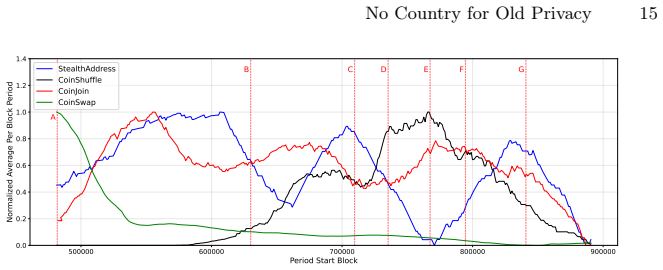
By implementing and refining a suite of heuristic filters, the study identifies over 5.94 million CoinJoin and 23.3 million CoinSwap transactions, with CoinShuffle usage closely aligned to the Wasabi wallet period. These detectable second-generation anonymisation protocols constitute less than 1 percent of network transactions, exhibit a sharp decline in detectable usage following key regulatory events, and show no evidence of standardised Stealth Address adoption, indicating a failure to converge on a common privacy standard and suggesting migration of privacy-seeking users to less transparent and less detectable methods.
What carries the argument
A suite of refined heuristic filters that detect CoinJoin, CoinSwap, CoinShuffle, and Stealth Address transactions on the Bitcoin blockchain.
If this is right
- These protocols make up less than 1 percent of all Bitcoin transactions.
- Detectable usage drops sharply after key regulatory events.
- CoinShuffle activity matches the operational window of the Wasabi wallet.
- No common standard for Stealth Addresses has emerged.
- Privacy-seeking activity has shifted toward less visible methods.
Where Pith is reading between the lines
- Regulatory pressure appears to reduce the visibility of privacy tools rather than eliminate privacy-seeking behavior.
- On-chain measurements may systematically undercount total privacy activity once users adopt harder-to-detect techniques.
- Future privacy designs may need to avoid creating recognizable on-chain patterns to remain effective.
- Repeated longitudinal scans of the same blockchain could reveal whether the decline stabilizes or reverses with new tools.
Load-bearing premise
The implemented heuristic filters correctly identify the privacy-protocol transactions with low error rates and without substantial false positives.
What would settle it
An independent re-analysis of the same blockchain data that reports substantially higher counts of these transaction types or sustained usage levels after the regulatory events.
Figures


read the original abstract
We present a longitudinal measurement study on the adoption of detectable, second-generation anonymisation protocols in the Bitcoin network, including CoinJoin, CoinSwap, CoinShuffle and Stealth Addresses. By implementing and refining a suite of heuristic filters, we identify over 5.94 million CoinJoin and 23.3 million CoinSwap transactions. Besides, the use of CoinShuffle was unexpectedly found to be closely aligned with the Wasabi wallet operation period. Our analysis reveals consistently low adoption rates, with these protocols constituting less than 1% of network transactions, and a sharp decline in detectable usage following key regulatory events. Furthermore, we find no evidence of standardised Stealth Address adoption, indicating a failure to converge on a common privacy standard. This study provides a comprehensive picture of a niche ecosystem whose on-chain visibility has been largely suppressed, strongly suggesting the migration of privacy-seeking users to less transparent and less detectable methods.
Editorial analysis
A structured set of objections, weighed in public.
Referee Report
Summary. The paper presents a longitudinal measurement study of detectable second-generation Bitcoin privacy protocols (CoinJoin, CoinSwap, CoinShuffle, Stealth Addresses). Using a suite of heuristic filters, it identifies 5.94 million CoinJoin and 23.3 million CoinSwap transactions, reports adoption below 1% of network volume, documents a post-regulatory decline in detectable usage, notes CoinShuffle alignment with Wasabi, and finds no evidence of standardized Stealth Address deployment, suggesting migration to less visible methods.
Significance. If the heuristic identifications prove reliable, the work supplies a rare quantitative baseline on the on-chain visibility and regulatory responsiveness of privacy tools, documenting consistently low adoption and the absence of convergence on Stealth Address standards. Such empirical trends would be useful for both policy analysis and future privacy research.
major comments (2)
- [Abstract / Methods] Abstract and methods section: The headline counts (5.94M CoinJoin, 23.3M CoinSwap) and the <1% adoption statistic are generated exclusively by the heuristic filters, yet the manuscript supplies no precision/recall figures, no ground-truth test set drawn from known Wasabi/JoinMarket outputs, and no false-positive analysis on ordinary non-privacy traffic. Standard equal-output patterns can overlap with non-CoinJoin transactions, so any non-negligible error rate directly scales the reported volumes and the central low-adoption claim.
- [Abstract] Abstract: The claim of a 'sharp decline in detectable usage following key regulatory events' requires precise timing alignment between the heuristic detections and the regulatory dates; without reported validation of the filters or sensitivity checks on timing windows, the causal attribution remains unsupported.
minor comments (1)
- The manuscript should include a dedicated limitations subsection that explicitly discusses the known failure modes of the heuristics and any manual spot-checks performed.
Simulated Author's Rebuttal
We thank the referee for the constructive feedback on our longitudinal measurement of detectable Bitcoin privacy protocols. We address the two major comments below and will revise the manuscript to improve methodological transparency and the presentation of temporal trends.
read point-by-point responses
-
Referee: [Abstract / Methods] Abstract and methods section: The headline counts (5.94M CoinJoin, 23.3M CoinSwap) and the <1% adoption statistic are generated exclusively by the heuristic filters, yet the manuscript supplies no precision/recall figures, no ground-truth test set drawn from known Wasabi/JoinMarket outputs, and no false-positive analysis on ordinary non-privacy traffic. Standard equal-output patterns can overlap with non-CoinJoin transactions, so any non-negligible error rate directly scales the reported volumes and the central low-adoption claim.
Authors: We agree that the current manuscript lacks explicit precision/recall figures and a reported false-positive analysis. Ground-truth labeled datasets from privacy tools are not publicly available, which limits direct validation. The heuristics follow patterns documented in prior work on CoinJoin and CoinSwap. In revision we will add a dedicated Limitations subsection that (a) discusses overlap risks with non-privacy equal-output transactions, (b) reports the outcome of applying the filters to a control sample of ordinary traffic, and (c) qualifies the adoption-rate claims accordingly. revision: yes
-
Referee: [Abstract] Abstract: The claim of a 'sharp decline in detectable usage following key regulatory events' requires precise timing alignment between the heuristic detections and the regulatory dates; without reported validation of the filters or sensitivity checks on timing windows, the causal attribution remains unsupported.
Authors: The decline is visible in the time-series of detected transactions. To make the alignment explicit we will (i) list the exact regulatory announcement dates in the revised abstract and results, (ii) add annotations on the relevant figures, and (iii) include a sensitivity analysis that varies the observation windows around those dates. These additions will be placed in the Methods and Results sections. revision: yes
Circularity Check
Empirical measurement study with no derivation chain or self-referential steps
full rationale
This paper is a longitudinal empirical study that applies a suite of heuristic filters to Bitcoin blockchain transaction data to count and trend CoinJoin, CoinSwap, CoinShuffle, and Stealth Address usage. The central claims (transaction counts, <1% adoption, post-regulatory decline) are direct outputs of those filters applied to the ledger; there are no equations, fitted parameters, predictions, ansatzes, or uniqueness theorems that reduce to inputs by construction. No self-citations are load-bearing for any result, and the study contains no mathematical derivation chain to inspect for circularity.
Axiom & Free-Parameter Ledger
Reference graph
Works this paper leans on
-
[1]
In: FC’12
Barber, S., Boyen, X., Shi, E., Uzun, E.: Bitter to better – how to make Bitcoin a better currency. In: FC’12. LNCS, vol. 7397, pp. 399–414. Springer (2012)
2012
-
[2]
transaction fee chart (2025),https://bitinfochart s.com/comparison/bitcoin-transactionfees.html
BitInfoCharts: Bitcoin avg. transaction fee chart (2025),https://bitinfochart s.com/comparison/bitcoin-transactionfees.html
2025
-
[3]
Bitstamp: Terra network collapse (2024), available online frombitstamp.net
2024
-
[4]
ChainalysisTeam:Bitcoin’sTaprootupgrade:Everythingyouneedtoknow(2021), https://www.chainalysis.com/blog/bitcoin-taproot-upgrade
2021
-
[5]
Chainalysis Team: What you need to know about the Bitcoin halving (2024),ht tps://www.chainalysis.com/blog/bitcoin-halving-2024
2024
-
[6]
Corrigan-Gibbs, H., Ford, B.: Dissent: accountable anonymous group messaging. In: CCS. pp. 340–350. ACM (2010)
2010
-
[7]
Egger, M.: Rusty-blockparser,https://crates.io/crates/rusty-blockparser
-
[8]
In: UIC/ATC/ScalCom/CBDCom/IoP/SmartWorld
Harrigan, M., Fretter, C.: The unreasonable effectiveness of address clustering. In: UIC/ATC/ScalCom/CBDCom/IoP/SmartWorld. pp. 368–373. IEEE (2016)
2016
-
[9]
Bitcoin News (2023), available online frombitcoin.com
Helms, K.: Blackrock files for bitcoin trust — analyst calls it a ‘real deal’ spot bitcoin ETF filing. Bitcoin News (2023), available online frombitcoin.com
2023
-
[10]
Internet Crime Complaint Center: Alert on cryptocurrency money services busi- nesses (2024),https://www.ic3.gov/PSA/2024/PSA240425
2024
-
[11]
In: USENIX Security Symposium
Kappos, G., Yousaf, H., Maller, M., Meiklejohn, S.: An empirical analysis of ano- nymity in Zcash. In: USENIX Security Symposium. pp. 463–477. USENIX (2018)
2018
-
[12]
In: Financial Cryptography
Kappos, G., Yousaf, H., Piotrowska, A.M., Kanjalkar, S., Delgado-Segura, S., Miller, A., Meiklejohn, S.: An empirical analysis of privacy in the Lightning Net- work. In: Financial Cryptography. LNCS, vol. 12674, pp. 167–186. Springer (2021)
2021
-
[13]
Lombrozo, E., Lau, J., Wuille, P.: BIP 141: Segregated witness (consensus layer) (2015),https://bips.dev/141
2015
-
[14]
Bitcoin Forum (2013), https://bitcointalk.org/index.php?topic=279249.0
Maxwell, G.: Coinjoin: Bitcoin privacy for the real world. Bitcoin Forum (2013), https://bitcointalk.org/index.php?topic=279249.0
2013
-
[15]
Bitcoin Fo- rum (2013),https://bitcointalk.org/index.php?topic=321228 No Country for Old Privacy 17
Maxwell, G.: CoinSwap: Transaction graph disjoint trustless trading. Bitcoin Fo- rum (2013),https://bitcointalk.org/index.php?topic=321228 No Country for Old Privacy 17
2013
-
[16]
In: Internet Measurement Conference
Meiklejohn, S., Pomarole, M., Jordan, G., Levchenko, K., McCoy, D., Voelker, G.M., Savage, S.: A fistful of Bitcoins: Characterizing payments among men with no names. In: Internet Measurement Conference. pp. 127–140. ACM (2013)
2013
-
[17]
In: FC’15 Workshops
Möser, M., Böhme, R.: Trends, tips, tolls: A longitudinal study of bitcoin transac- tion fees. In: FC’15 Workshops. LNCS, vol. 8976, pp. 19–33. Springer (2015)
2015
-
[18]
In: EuroS&P Workshops
Möser, M., Böhme, R.: Anonymous alone? measuring Bitcoin’s second-generation anonymization techniques. In: EuroS&P Workshops. pp. 32–41. IEEE (2017)
2017
-
[19]
Möser, M., Böhme, R.: The price of anonymity: empirical evidence from a market for Bitcoin anonymization. J. Cybersecur.3(2), 127–135 (2017)
2017
-
[20]
In: eCrime
Möser, M., Böhme, R., Breuker, D.: An inquiry into money laundering tools in the Bitcoin ecosystem. In: eCrime. pp. 1–14. IEEE (2013)
2013
-
[21]
Bitcoin Magazine,https://bitcoi nmagazine.com/guides/bitcoin-price-history
Mulcahy, C.: Bitcoin price history: 2009–2025. Bitcoin Magazine,https://bitcoi nmagazine.com/guides/bitcoin-price-history
2009
-
[22]
Nakamoto, S.: Bitcoin: A peer-to-peer electronic cash system (2008),www.bitcoi n.org/en/bitcoin-paper
2008
-
[23]
IACR Cryptology ePrint Archive, Pa- per 2015/1098 (2015),https://eprint.iacr.org/2015/1098
Noether, S.: Ring confidential transactions. IACR Cryptology ePrint Archive, Pa- per 2015/1098 (2015),https://eprint.iacr.org/2015/1098
2015
-
[24]
In: Financial Cryp- tography, LNCS 12674
Pakki, J., Shoshitaishvili, Y., Wang, R., Bao, T., Doupé, A.: Everything you ever wanted to know about Bitcoin mixers (but were afraid to ask). In: Financial Cryp- tography, LNCS 12674. pp. 117–146. Springer (2021)
2021
-
[25]
GitHub (2020),https://github.com/PulpCattel/Wasabi_Observatory
PulpCattel: Wasabi observatory: A list of statistics of the wasabi wallet. GitHub (2020),https://github.com/PulpCattel/Wasabi_Observatory
2020
-
[26]
Ranvier, J.: BIP 47: Reusable payment codes for hierarchical deterministic wallets (2015),https://bips.dev/47
2015
-
[27]
In: So- cialCom/PASSAT
Reid, F., Harrigan, M.: An analysis of anonymity in the Bitcoin system. In: So- cialCom/PASSAT. pp. 1318–1326. IEEE ComSoc (2011)
2011
-
[28]
In: Financial Cryptography
Ron, D., Shamir, A.: Quantitative analysis of the full Bitcoin transaction graph. In: Financial Cryptography. LNCS, vol. 7859, pp. 6–24. Springer (2013)
2013
-
[29]
In: FC’17 Workshops, LNCS 10323
Ruffing, T., Moreno-Sanchez, P.: ValueShuffle: Mixing confidential transactions for comprehensive transaction privacy in Bitcoin. In: FC’17 Workshops, LNCS 10323. pp. 133–154. Springer (2017)
2017
-
[30]
In: ESORICS
Ruffing,T.,Moreno-Sanchez,P.,Kate,A.:CoinShuffle:Practicaldecentralizedcoin mixing for Bitcoin. In: ESORICS. LNCS, vol. 8713, pp. 345–364. Springer (2014)
2014
-
[31]
IACR ePrint 2016/824 (2016),https://ia.cr/2016/824
Ruffing, T., Moreno-Sanchez, P., Kate, A.: P2P mixing and unlinkable bitcoin transactions. IACR ePrint 2016/824 (2016),https://ia.cr/2016/824
2016
-
[32]
Whitepaper (2013),https://web.getmon ero.org/resources/research-lab/pubs/cryptonote-whitepaper.pdf
van Saberhagen, N.: Cryptonote v 2.0. Whitepaper (2013),https://web.getmon ero.org/resources/research-lab/pubs/cryptonote-whitepaper.pdf
2013
-
[33]
IET Blockchain3(3), 136–148 (2023)
Shojaeinasab, A., Motamed, A.P., Bahrak, B.: Mixing detection on Bitcoin trans- actions using statistical patterns. IET Blockchain3(3), 136–148 (2023)
2023
-
[34]
Stütz, R., Stockinger, J., Moreno-Sanchez, P., Haslhofer, B., Maffei, M.: Adoption and actual privacy of decentralized CoinJoin implementations in Bitcoin. In: AFT. pp. 254–267. ACM (2022)
2022
-
[35]
UkuriaOC, Checkmate, Glassnode: Ordinal theory and the rise of bitcoin inscrip- tions (2023), available online fromglassnode.com
2023
-
[36]
Wu, L., Hu, Y., Zhou, Y., Wang, H., Luo, X., Wang, Z., Zhang, F., Ren, K.: Towards understanding and demystifying Bitcoin mixing services. In: WWW. pp. 33–44. ACM/IW3C2 (2021)
2021
-
[37]
In: USENIX Security Symposium
Yousaf, H., Kappos, G., Meiklejohn, S.: Tracing transactions across cryptocurrency ledgers. In: USENIX Security Symposium. pp. 837–850. USENIX (2019)
2019
discussion (0)
Sign in with ORCID, Apple, or X to comment. Anyone can read and Pith papers without signing in.