A Geometric View of Combinatorial Fiedler Theory
Pith reviewed 2026-07-02 01:59 UTC · model grok-4.3
The pith
The maximization parameter B(G) in combinatorial Fiedler theory equals the average of a graph's two largest vertex degrees.
A machine-rendered reading of the paper's core claim, the machinery that carries it, and where it could break.
Core claim
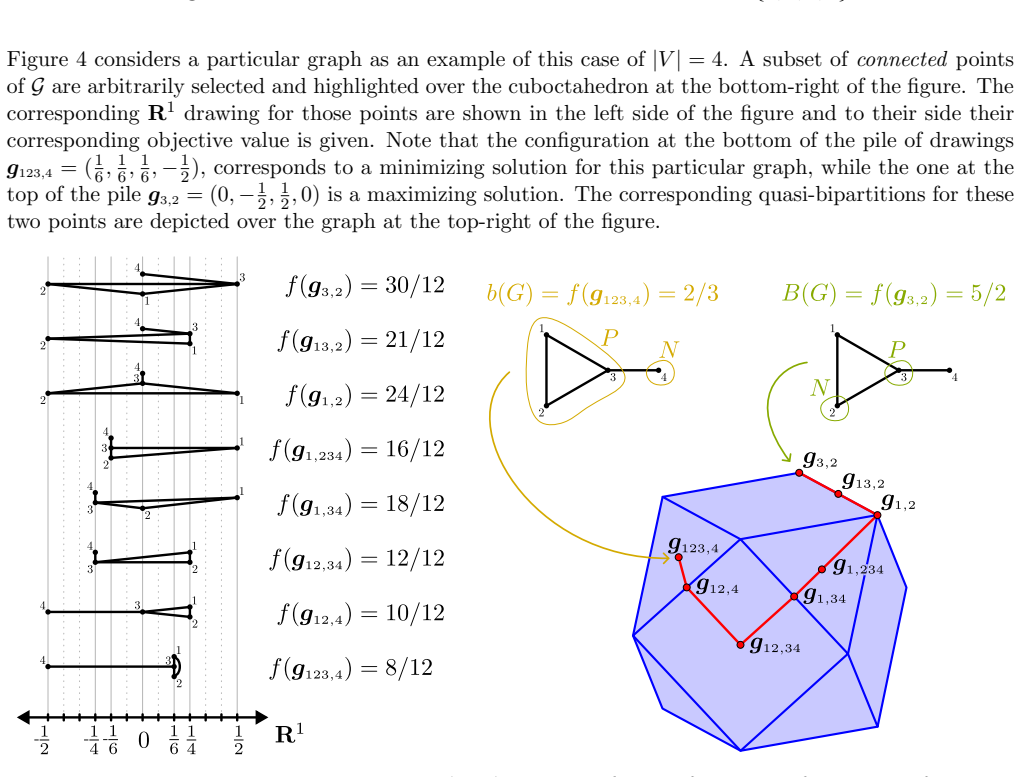
We show that the new parameter B(G) associated with this maximization problem admits a simple exact description: it is the average of the two largest vertex degrees of G. A unified combinatorial treatment of the minimization and maximization problems is presented first. Later, both optimization problems are reinterpreted in a geometrical setting. The feasible set is identified with a (n-2)-dimensional cuboctahedron shell where n=|V|. Additional structure is presented for this polyhedron, including the fact that maximizing solutions arise at its vertices and minimizing solutions arise at the centers of its facets. Finally, we analyze the number of optimal vectors for b(G) and B(G) for several
What carries the argument
The (n-2)-dimensional cuboctahedron shell that encodes the feasible set of the ℓ1 optimization problems, with maximizers located at its vertices and minimizers at the centers of its facets.
If this is right
- B(G) is determined exactly by the two largest degrees and requires no optimization to compute.
- All maximizing vectors lie at the vertices of the cuboctahedron shell.
- All minimizing vectors lie at the centers of the facets of the cuboctahedron shell.
- Counting the number of vectors that achieve B(G) is #P-complete even though the numerical value itself is immediate from the degree sequence.
Where Pith is reading between the lines
- The closed form for B(G) separates the problem of computing the extremal value from the problem of enumerating the vectors that attain it.
- The cuboctahedron-shell geometry may supply a uniform way to compare the combinatorial min and max problems with classical spectral quantities such as algebraic connectivity.
- Because the value depends only on degrees, B(G) could serve as an immediate upper bound in algorithms that already compute degree sequences.
Load-bearing premise
The feasible set of the optimization problems is identified with a (n-2)-dimensional cuboctahedron shell where n = |V|.
What would settle it
A single graph whose maximum attained value of the ℓ1-analog objective differs from the average of its two largest degrees.
Figures



read the original abstract
Recently, Andrade and Dahl introduced combinatorial Fiedler theory by studying a parameter $b(G)$ defined as the $\ell_1$-analog of the Rayleigh quotient minimization characterization of the algebraic connectivity of a graph $G=(V,E)$. In this work, we study the corresponding maximization problem, which plays the role of the $\ell_1$-analog of the largest Laplacian eigenvalue. We show that the new parameter $B(G)$ associated with this maximization problem admits a simple exact description: it is the average of the two largest vertex degrees of $G$. A unified combinatorial treatment of the minimization and maximization problems is presented first. Later, both optimization problems are reinterpreted in a geometrical setting. The feasible set is identified with a $(n-2)$-dimensional cuboctahedron shell where $n=|V|$. Additional structure is presented for this polyhedron, including the fact that maximizing solutions arise at its vertices and minimizing solutions arise at the centers of its facets. Finally, we analyze the number of optimal vectors for $b(G)$ and $B(G)$ for several graph families. Although the value of $B(G)$ is determined by the two largest degrees, we prove that counting the vectors that attain this value is actually $\#\mathrm{P}$-complete.
Editorial analysis
A structured set of objections, weighed in public.
Referee Report
Summary. The paper defines B(G) as the maximization analog (under l1 norm) of the Rayleigh quotient for the largest Laplacian eigenvalue of a graph G. It proves via a combinatorial argument that B(G) equals the average of the two largest vertex degrees. A unified combinatorial treatment of the minimization parameter b(G) and B(G) is given first; both problems are then reinterpreted geometrically by identifying the feasible set with an (n-2)-dimensional cuboctahedron shell (n = |V|), with maximizers at vertices and minimizers at facet centers. The paper additionally proves that counting the number of optimal vectors attaining B(G) is #P-complete, even though the value itself depends only on the two largest degrees.
Significance. If the central combinatorial claim holds, the result supplies a simple, closed-form expression for B(G) that stands in contrast to the more involved minimization parameter b(G). The geometric reinterpretation supplies additional structure (cuboctahedron shell, vertex/facet location of optima) and the #P-completeness result cleanly separates evaluation from enumeration. The unified combinatorial treatment of both extremal problems is a clear strength.
minor comments (3)
- [Abstract / Introduction] The abstract states that the feasible set is identified with a (n-2)-dimensional cuboctahedron shell, but the precise embedding (coordinate scaling, centering, and verification that the l1-ball constraints map exactly onto the shell) is not previewed; a one-sentence outline in the introduction would help readers track the later geometric section.
- [Section 2] Notation for the two optimization problems (objective, constraint set, and relation to the Laplacian) is introduced gradually; consolidating the definitions into a single displayed block early in Section 2 would improve readability.
- [Final section] The #P-completeness proof for counting optimal vectors is stated for several graph families; a brief remark on whether the reduction preserves the two-largest-degree condition would clarify that the hardness is not an artifact of degree variation.
Simulated Author's Rebuttal
We thank the referee for the positive summary of our manuscript, recognition of its strengths in providing a closed-form expression for B(G), the geometric cuboctahedron reinterpretation, and the #P-completeness separation of evaluation from enumeration, as well as the recommendation for minor revision. No major comments were listed in the report.
Circularity Check
No significant circularity; central claim independent of citations
full rationale
The paper establishes the value of B(G) via a unified combinatorial treatment presented before any geometric reinterpretation. This derivation of the exact description (average of two largest degrees) does not reduce to the cited Andrade-Dahl minimization result b(G) by construction or self-citation chain. The geometric claims (cuboctahedron shell feasible set, vertex/facet solutions) are reinterpretations after the combinatorial result and do not feed back into it. Minor self-citation of the minimization analog is not load-bearing for the maximization claim. The #P-completeness counting result is consistent with but does not alter the value derivation. No self-definitional, fitted-prediction, or ansatz-smuggling patterns appear in the load-bearing steps.
Axiom & Free-Parameter Ledger
axioms (1)
- standard math Standard properties of graphs, Laplacian matrices, and Rayleigh quotients
Reference graph
Works this paper leans on
-
[1]
W. N. Anderson and T. D. Morley. Eigenvalues of the Laplacian of a graph.Linear and Multilinear Algebra, 18(2):141–145, 1985
1985
-
[2]
Andrade and G
E. Andrade and G. Dahl. Combinatorial Fiedler theory and graph partition.Linear Algebra and its Applications, 687:229–251, 2024
2024
-
[3]
Ardila, M
F. Ardila, M. Beck, S. Ho¸ sten, J. Pfeifle, and K. Seashore. Root polytopes and growth series of root lattices.SIAM Journal on Discrete Mathematics, 25(1):360–378, 2011
2011
-
[4]
A. E. Brouwer and W. H. Haemers.Spectra of graphs. Springer Science & Business Media, 2011
2011
-
[5]
K. C. Chang, S. Shao, and D. Zhang. The 1-Laplacian Cheeger cut: Theory and algorithms.Journal of Computational Mathematics, 33(5):443–467, 2015
2015
-
[6]
F. R. K. Chung.Spectral Graph Theory, volume 92 ofCBMS Regional Conference Series in Mathe- matics. American Mathematical Society, Providence, RI, 1997
1997
-
[7]
D. H. Doehlert and V. L. Klee. Experimental designs through level reduction of thed-dimensional cuboctahedron.Discrete Mathematics, 2(4):309–334, 1972
1972
-
[8]
M. Fiedler. Algebraic connectivity of graphs.Czechoslovak mathematical journal, 23(2):298–305, 1973
1973
-
[9]
K. Fukuda. From the zonotope construction to the Minkowski addition of convex polytopes.Journal of Symbolic Computation, 38(4):1261–1272, 2004
2004
-
[10]
R. L. Graham, D. E. Knuth, and O. Patashnik.Concrete Mathematics: A Foundation for Computer Science. Addison-Wesley, 2 edition, 1994
1994
-
[11]
Greenhill
C. Greenhill. The complexity of counting colourings and independent sets in sparse graphs and hypergraphs.Computational Complexity, 9(1):52–72, Nov. 2000
2000
-
[12]
K. M. Hall. Anr-dimensional quadratic placement algorithm.Management science, 17(3):219–229, 1970. 22
1970
-
[13]
Y. Koren. Drawing graphs by eigenvectors: Theory and practice.Computers & Mathematics with Applications, 49(11-12):1867–1888, 2005
2005
-
[14]
Prodinger and R
H. Prodinger and R. F. Tichy. Fibonacci numbers of graphs.The Fibonacci Quaterly, 20(1):16–21, 1982
1982
-
[15]
M. Rajesh Kannan and R. Roy. Structural and extremal properties ofℓ 1-Fiedler value. Arxiv.org/pdf/2601.05771, 2026
-
[16]
X.-D. Zhang. The Laplacian eigenvalues of graphs: A survey.arXiv preprint arXiv:1111.2897, 2011. 23
work page internal anchor Pith review Pith/arXiv arXiv 2011
discussion (0)
Sign in with ORCID, Apple, or X to comment. Anyone can read and Pith papers without signing in.