REVIEW 1 major objections 45 references
CLIP embeddings detect adversarial attacks in a zero-shot black-box manner by identifying non-arbitrary shifts from perturbations.
Reviewed by Pith at T0; open to challenge. T0 means a machine referee read the full paper against a public rubric. the ladder, T0–T4 →
T0 review · grok-4.3
2026-07-01 06:42 UTC pith:3APCNZZC
load-bearing objection CLIP is used here for zero-shot attack detection in a fully agnostic way, but the key claim rests on an unproven assumption about consistent embedding shifts. the 1 major comments →
A Classifier-Agnostic Zero-Shot Adversarial Attack Detection via CLIP
The pith
A machine-rendered reading of the paper's core claim, the machinery that carries it, and where it could break.
Core claim
The central claim is that A^4D, a detector relying on CLIP's prompt similarities, achieves state-of-the-art performance in detecting adversarial attacks in fully attack-agnostic and classifier-agnostic settings, based on the observations that CLIP is sensitive to imperceptible perturbations and that the resulting embedding shifts are structured enough to serve as reliable indicators.
What carries the argument
Prompt-based similarity scores derived from CLIP, which quantify how well an input image matches various text prompts and thereby reveal perturbation effects.
Load-bearing premise
The shift in CLIP embedding space caused by adversarial perturbations is not arbitrary and can be used as a robust attack indicator.
What would settle it
Finding a set of adversarial attacks where the CLIP similarity scores fail to separate clean images from attacked ones with high accuracy would disprove the claim.
If this is right
- Adversarial detection becomes possible without white-box access to the classifier.
- The method requires no training on specific adversarial examples.
- Performance holds across multiple attack types and datasets.
- Detection works in a completely black-box zero-shot fashion.
Where Pith is reading between the lines
- Such an approach might extend to detecting other types of image manipulations beyond adversarial attacks.
- Integrating CLIP-based detection could improve robustness in deployed vision systems without retraining models.
- The non-arbitrary nature of shifts suggests potential for analyzing the direction of perturbations for attack characterization.
Editorial analysis
A structured set of objections, weighed in public.
Referee Report
Summary. The paper proposes A^4D, a black-box zero-shot adversarial attack detector that relies on prompt-based similarity scores from CLIP. It rests on two observations: CLIP's sensitivity to small non-semantic perturbations and the claim that embedding-space shifts under attack are non-arbitrary and thus usable as a robust indicator. The manuscript asserts that this yields SOTA detection performance in fully attack-agnostic and classifier-agnostic settings across multiple attacks, datasets, and models.
Significance. A working version of the method would be significant as the first reported use of CLIP for zero-shot adversarial detection without attack-specific assumptions or white-box access. It could offer a practical, general-purpose detector if the embedding-shift property holds invariantly.
major comments (1)
- [Abstract] Abstract, observation (ii): The assertion that 'the shift in CLIP embedding space is not arbitrary and can be used as a robust attack indicator' is presented without derivation, statistical test, invariance argument, or empirical quantification of consistency across attacks or images. This assumption is load-bearing for the attack-agnostic and classifier-agnostic SOTA claim; if the shift direction or magnitude varies with attack type or image content, the reported detection results cannot be attributed to a general CLIP property.
Simulated Author's Rebuttal
We thank the referee for the constructive feedback on our manuscript. We address the major comment point by point below.
read point-by-point responses
-
Referee: [Abstract] Abstract, observation (ii): The assertion that 'the shift in CLIP embedding space is not arbitrary and can be used as a robust attack indicator' is presented without derivation, statistical test, invariance argument, or empirical quantification of consistency across attacks or images. This assumption is load-bearing for the attack-agnostic and classifier-agnostic SOTA claim; if the shift direction or magnitude varies with attack type or image content, the reported detection results cannot be attributed to a general CLIP property.
Authors: We agree that the abstract presents observation (ii) concisely without supporting details. The manuscript's experimental section demonstrates the claim empirically by showing that A^4D achieves strong detection performance consistently across multiple attacks, datasets, and classifiers in fully agnostic settings; this performance would not hold if shifts were arbitrary. To directly address the concern, the revised manuscript will add a dedicated analysis subsection providing statistical quantification of shift consistency (e.g., variance in direction and magnitude across attacks and images) and a brief invariance argument grounded in CLIP's contrastive training objective. revision: yes
Circularity Check
No circularity detected; empirical observations and experimental validation are independent of inputs
full rationale
The paper states its method rests on two explicit observations about CLIP behavior and validates performance via experiments across multiple attacks, datasets, and classifiers. No equations, fitted parameters renamed as predictions, self-citations, or uniqueness theorems are present in the provided text that would reduce the central claim to a definitional or fitted input by construction. The approach is therefore self-contained against external benchmarks.
Axiom & Free-Parameter Ledger
read the original abstract
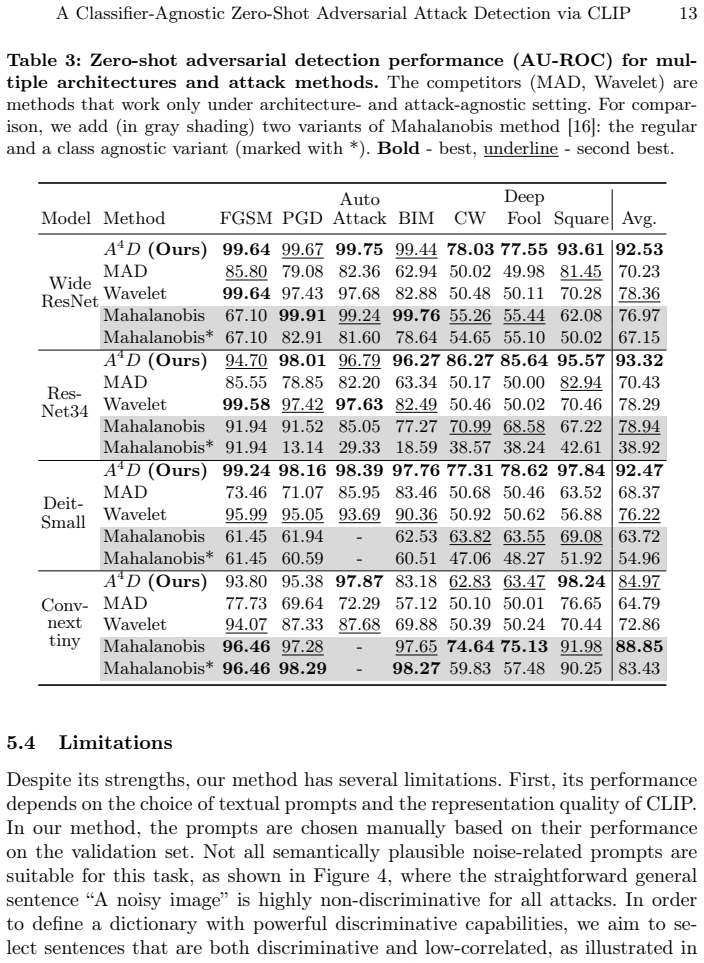
Adversarial attacks pose a challenge to the reliability of deep learning models, motivating effective detection methods. Existing techniques often rely on attack-specific assumptions, access to adversarial samples, or knowledge of the underlying classifier (white-box). We propose $A^4D$ Attack- and Architecture-Agnostic Adversarial Detector, a completely black-box, zero-shot adversarial attack detection framework that utilizes prompt-based similarity scores derived from CLIP. To the best of our knowledge this is the first attempt to utilize CLIP for such a task. The method is based on two key observations: (i) CLIP is sensitive even to small imperceptible non-semantic perturbations; (ii) The shift in CLIP embedding space is not arbitrary and can be used as a robust attack indicator. Experiments across multiple attacks, datasets and classifiers validate that $A^4D$ achieves SOTA detection results in the attack-agnostic and classifier-agnostic setting.
Figures



Reference graph
Works this paper leans on
-
[1]
In: European conference on computer vision
Andriushchenko, M., Croce, F., Flammarion, N., Hein, M.: Square attack: a query- efficient black-box adversarial attack via random search. In: European conference on computer vision. pp. 484–501. Springer (2020)
2020
-
[2]
In: 42nd International conference on machine learning (2025)
Betser, R., Levi, M.Y., Gilboa, G.: Whitened clip as a likelihood surrogate of images and captions. In: 42nd International conference on machine learning (2025)
2025
-
[3]
In: Euro- pean Conference on Computer Vision
Cao, Y., Zhang, J., Frittoli, L., Cheng, Y., Shen, W., Boracchi, G.: Adaclip: Adapt- ing clip with hybrid learnable prompts for zero-shot anomaly detection. In: Euro- pean Conference on Computer Vision. pp. 55–72. Springer (2024) A Classifier-Agnostic Zero-Shot Adversarial Attack Detection via CLIP 15
2024
-
[4]
In: 2017 ieee symposium on security and privacy (sp)
Carlini, N., Wagner, D.: Towards evaluating the robustness of neural networks. In: 2017 ieee symposium on security and privacy (sp). pp. 39–57. Ieee (2017)
2017
-
[5]
In: international conference on machine learning
Cohen, J., Rosenfeld, E., Kolter, Z.: Certified adversarial robustness via random- ized smoothing. In: international conference on machine learning. pp. 1310–1320. PMLR (2019)
2019
-
[6]
In: International conference on machine learning
Croce, F., Hein, M.: Reliable evaluation of adversarial robustness with an ensemble of diverse parameter-free attacks. In: International conference on machine learning. pp. 2206–2216. PMLR (2020)
2020
-
[7]
In: European conference on computer vision
Crowson, K., Biderman, S., Kornis, D., Stander, D., Hallahan, E., Castricato, L., Raff, E.: Vqgan-clip: Open domain image generation and editing with natural lan- guage guidance. In: European conference on computer vision. pp. 88–105. Springer (2022)
2022
-
[8]
Electronics 14(15), 3015 (2025)
Danesh, W., Sapireddy, S.R., Rahman, M.: Understanding and detecting adversar- ial examples in iot networks: A white-box analysis with autoencoders. Electronics 14(15), 3015 (2025)
2025
-
[9]
Detecting Adversarial Samples from Artifacts
Feinman, R., Curtin, R.R., Shintre, S., Gardner, A.B.: Detecting adversarial sam- ples from artifacts. arXiv preprint arXiv:1703.00410 (2017)
work page internal anchor Pith review Pith/arXiv arXiv 2017
-
[10]
Explaining and Harnessing Adversarial Examples
Goodfellow, I.J., Shlens, J., Szegedy, C.: Explaining and harnessing adversarial examples. arXiv preprint arXiv:1412.6572 (2014)
work page internal anchor Pith review Pith/arXiv arXiv 2014
-
[11]
He,K.,Zhang,X.,Ren,S.,Sun,J.:Deepresiduallearningforimagerecognition.In: Proceedings of the IEEE conference on computer vision and pattern recognition. pp. 770–778 (2016)
2016
-
[12]
In: Proceedings of the IEEE/CVF conference on computer vision and pattern recognition
Hendrycks, D., Zhao, K., Basart, S., Steinhardt, J., Song, D.: Natural adversarial examples. In: Proceedings of the IEEE/CVF conference on computer vision and pattern recognition. pp. 15262–15271 (2021)
2021
-
[13]
Kapp, A., Hoffmann, E., Weigmann, E., Mihaljević, H.: StreetSurfaceVis: a dataset of crowdsourced street-level imagery annotated by road surface type and quality. Scientific Data12(1), 92 (2025).https://doi.org/10.1038/s41597-024-04295- 9,https://doi.org/10.1038/s41597-024-04295-9
-
[14]
Torchattacks: A pytorch repository for adversar- ial attacks.arXiv preprint arXiv:2010.01950, 2020
Kim, H.: Torchattacks: A pytorch repository for adversarial attacks. arXiv preprint arXiv:2010.01950 (2020)
-
[15]
In: Artificial intelligence safety and security, pp
Kurakin, A., Goodfellow, I.J., Bengio, S.: Adversarial examples in the physical world. In: Artificial intelligence safety and security, pp. 99–112. Chapman and Hall/CRC (2018)
2018
-
[16]
Advances in neural information processing systems31(2018)
Lee, K., Lee, K., Lee, H., Shin, J.: A simple unified framework for detecting out- of-distribution samples and adversarial attacks. Advances in neural information processing systems31(2018)
2018
-
[17]
In: Proceedings of the 42nd International Conference on Machine Learning
Levi, M.Y., Gilboa, G.: The double ellipsoid geometry of clip. In: Proceedings of the 42nd International Conference on Machine Learning. Proceedings of Machine Learning Research, vol. 267. PMLR, Vancouver, Canada (2025)
2025
-
[18]
IEEE Transactions on Information Forensics and Security (2025)
Li, Q., Wu, C., Chen, J., Zhang, Z., He, K., Du, R., Wang, X., Zhao, Q., Liu, Y.: Privacy-preserving universal adversarial defense for black-box models. IEEE Transactions on Information Forensics and Security (2025)
2025
-
[19]
Electronics11(8), 1283 (2022)
Liang, H., He, E., Zhao, Y., Jia, Z., Li, H.: Adversarial attack and defense: A survey. Electronics11(8), 1283 (2022)
2022
-
[20]
In: Proceedings of the IEEE/CVF conference on computer vision and pattern recognition
Liu, Z., Mao, H., Wu, C.Y., Feichtenhofer, C., Darrell, T., Xie, S.: A convnet for the 2020s. In: Proceedings of the IEEE/CVF conference on computer vision and pattern recognition. pp. 11976–11986 (2022)
2022
-
[21]
Neuro- computing508, 293–304 (2022) 16 H
Luo, H., Ji, L., Zhong, M., Chen, Y., Lei, W., Duan, N., Li, T.: Clip4clip: An empirical study of clip for end to end video clip retrieval and captioning. Neuro- computing508, 293–304 (2022) 16 H. Krakover et al
2022
-
[22]
In: Pro- ceedings of the Computer Vision and Pattern Recognition Conference
Ma,W.,Zhang,X.,Yao,Q.,Tang,F.,Wu,C.,Li,Y.,Yan,R.,Jiang,Z.,Zhou,S.K.: Aa-clip: Enhancing zero-shot anomaly detection via anomaly-aware clip. In: Pro- ceedings of the Computer Vision and Pattern Recognition Conference. pp. 4744– 4754 (2025)
2025
-
[23]
Characterizing Adversarial Subspaces Using Local Intrinsic Dimensionality
Ma, X., Li, B., Wang, Y., Erfani, S.M., Wijewickrema, S., Schoenebeck, G., Song, D., Houle, M.E., Bailey, J.: Characterizing adversarial subspaces using local intrin- sic dimensionality. arXiv preprint arXiv:1801.02613 (2018)
work page internal anchor Pith review Pith/arXiv arXiv 2018
-
[24]
Towards Deep Learning Models Resistant to Adversarial Attacks
Madry, A., Makelov, A., Schmidt, L., Tsipras, D., Vladu, A.: Towards deep learning models resistant to adversarial attacks. arXiv preprint arXiv:1706.06083 (2017)
work page internal anchor Pith review Pith/arXiv arXiv 2017
-
[25]
In: Proceedings of the 2017 ACM SIGSAC conference on computer and communi- cations security
Meng, D., Chen, H.: Magnet: a two-pronged defense against adversarial examples. In: Proceedings of the 2017 ACM SIGSAC conference on computer and communi- cations security. pp. 135–147 (2017)
2017
-
[26]
On Detecting Adversarial Perturbations
Metzen, J.H., Genewein, T., Fischer, V., Bischoff, B.: On detecting adversarial perturbations. arXiv preprint arXiv:1702.04267 (2017)
work page internal anchor Pith review Pith/arXiv arXiv 2017
-
[27]
mnmoustafa, Ali, M.: Tiny imagenet.https://kaggle.com/competitions/tiny- imagenet(2017), kaggle
2017
-
[28]
In: Proceedings of the IEEE conference on computer vision and pattern recognition
Moosavi-Dezfooli, S.M., Fawzi, A., Frossard, P.: Deepfool: a simple and accurate method to fool deep neural networks. In: Proceedings of the IEEE conference on computer vision and pattern recognition. pp. 2574–2582 (2016)
2016
-
[29]
arXiv preprint arXiv:2508.21715 (2025)
Nazeri, A., Hafez, W.: Entropy-based non-invasive reliability monitoring of convo- lutional neural networks. arXiv preprint arXiv:2508.21715 (2025)
-
[30]
Deep k-Nearest Neighbors: Towards Confident, Interpretable and Robust Deep Learning
Papernot, N., McDaniel, P.: Deep k-nearest neighbors: Towards confident, inter- pretable and robust deep learning. arXiv preprint arXiv:1803.04765 (2018)
work page internal anchor Pith review Pith/arXiv arXiv 2018
-
[31]
In: Proceedings of the IEEE/CVF Conference on Computer Vision and Pattern Recognition
Peng, Z., Xu, Z., Zeng, Z., Wen, C., Huang, Y., Yang, M., Tang, F., Shen, W.: Understanding fine-tuning clip for open-vocabulary semantic segmentation in hy- perbolic space. In: Proceedings of the IEEE/CVF Conference on Computer Vision and Pattern Recognition. pp. 4562–4572 (2025)
2025
-
[32]
In: International conference on machine learning
Radford, A., Kim, J.W., Hallacy, C., Ramesh, A., Goh, G., Agarwal, S., Sastry, G., Askell, A., Mishkin, P., Clark, J., et al.: Learning transferable visual models from natural language supervision. In: International conference on machine learning. pp. 8748–8763. PmLR (2021)
2021
-
[33]
In: International conference on machine learning
Ramesh, A., Pavlov, M., Goh, G., Gray, S., Voss, C., Radford, A., Chen, M., Sutskever, I.: Zero-shot text-to-image generation. In: International conference on machine learning. pp. 8821–8831. Pmlr (2021)
2021
-
[34]
Advances in neural information processing systems35, 36479–36494 (2022)
Saharia, C., Chan, W., Saxena, S., Li, L., Whang, J., Denton, E.L., Ghasemipour, K., Gontijo Lopes, R., Karagol Ayan, B., Salimans, T., et al.: Photorealistic text- to-image diffusion models with deep language understanding. Advances in neural information processing systems35, 36479–36494 (2022)
2022
-
[35]
Shafahi, A., Najibi, M., Ghiasi, M.A., Xu, Z., Dickerson, J., Studer, C., Davis, L.S., Taylor, G., Goldstein, T.: Adversarial training for free! Advances in neural information processing systems32(2019)
2019
-
[36]
Frontiers in Computer Science7, 1631561 (2025)
Stenhuis, R., Liu, D., Qiao, Y., Conti, M., Panaousis, M., Liang, K.: Meetsafe: en- hancing robustness against white-box adversarial examples. Frontiers in Computer Science7, 1631561 (2025)
2025
-
[37]
In: 2023 IEEE Applied Imagery Pattern Recognition Workshop (AIPR)
Sultan, M., Jacobs, L., Stylianou, A., Pless, R.: Exploring clip for real world, text-based image retrieval. In: 2023 IEEE Applied Imagery Pattern Recognition Workshop (AIPR). pp. 1–6. IEEE (2023)
2023
-
[38]
In: International conference on machine learning
Touvron, H., Cord, M., Douze, M., Massa, F., Sablayrolles, A., Jégou, H.: Training data-efficient image transformers & distillation through attention. In: International conference on machine learning. pp. 10347–10357. PMLR (2021) A Classifier-Agnostic Zero-Shot Adversarial Attack Detection via CLIP 17
2021
-
[39]
In: Proceedings of the IEEE/CVF conference on computer vision and pattern recognition
Wei, Y., Cao, Y., Zhang, Z., Peng, H., Yao, Z., Xie, Z., Hu, H., Guo, B.: iclip: Bridgingimageclassificationandcontrastivelanguage-imagepre-trainingforvisual recognition. In: Proceedings of the IEEE/CVF conference on computer vision and pattern recognition. pp. 2776–2786 (2023)
2023
-
[40]
In: Interna- tional conference on machine learning
Weng, Z., Yang, X., Li, A., Wu, Z., Jiang, Y.G.: Open-vclip: Transforming clip to an open-vocabulary video model via interpolated weight optimization. In: Interna- tional conference on machine learning. pp. 36978–36989. PMLR (2023)
2023
-
[41]
arXiv preprint arXiv:2310.01403 (2023)
Wu, S., Zhang, W., Xu, L., Jin, S., Li, X., Liu, W., Loy, C.C.: Clipself: Vision transformer distills itself for open-vocabulary dense prediction. arXiv preprint arXiv:2310.01403 (2023)
-
[42]
Feature Squeezing: Detecting Adversarial Examples in Deep Neural Networks
Xu, W., Evans, D., Qi, Y.: Feature squeezing: Detecting adversarial examples in deep neural networks. arXiv preprint arXiv:1704.01155 (2017)
work page internal anchor Pith review Pith/arXiv arXiv 2017
-
[43]
Zagoruyko, S., Komodakis, N.: Wide residual networks. arXiv preprint arXiv:1605.07146 (2016)
work page internal anchor Pith review Pith/arXiv arXiv 2016
-
[44]
In: The 22nd International Conference on Artificial Intelligence and Statistics
Zhang, Y., Liang, P.: Defending against whitebox adversarial attacks via random- ized discretization. In: The 22nd International Conference on Artificial Intelligence and Statistics. pp. 684–693. PMLR (2019)
2019
-
[45]
arXiv preprint arXiv:2310.18961 , year=
Zhou, Q., Pang, G., Tian, Y., He, S., Chen, J.: Anomalyclip: Object-agnostic prompt learning for zero-shot anomaly detection. arXiv preprint arXiv:2310.18961 (2023)
discussion (0)
Sign in with ORCID, Apple, or X to comment. Anyone can read and Pith papers without signing in.