Protection Switching in Hybrid Hollow-Core and Single-Mode Fiber Networks: Challenges, Analysis, and Mitigation Strategies
Pith reviewed 2026-06-26 06:05 UTC · model grok-4.3
The pith
Dedicated 1+1 protection outperforms shared backup path protection in hybrid hollow-core and single-mode fiber networks.
A machine-rendered reading of the paper's core claim, the machinery that carries it, and where it could break.
Core claim
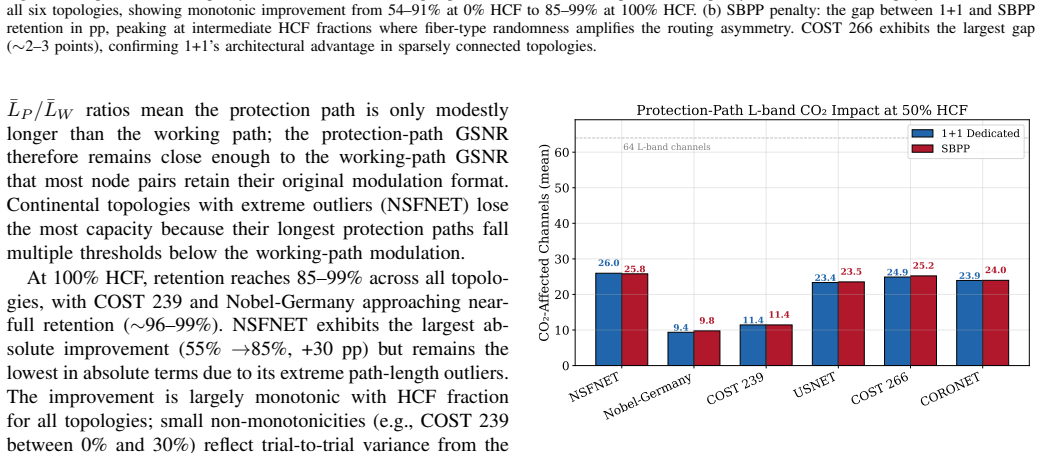
The central discovery is that in hybrid networks, 1+1 dedicated protection is preferable because it incurs lower chromatic dispersion steps and generalized signal-to-noise ratio penalties than shared backup path protection, with the two switching directions showing fundamental asymmetry: HCF-to-SMF causes large penalties while the reverse improves quality. At 50% hollow-core fiber deployment, mean CD steps range 4,000-22,000 ps/nm with 1.6-3.1 dB GSNR penalties and 38-59% of pairs needing modulation downgrade under 1+1, while SBPP adds up to 7% more CD steps and 4% more downgrades in sparse topologies. Capacity retention improves to 85-99% at full deployment.
What carries the argument
Comparative Monte Carlo simulation of 1+1 dedicated and shared backup path protection architectures under random hybrid fiber assignments, tracking chromatic dispersion steps and GSNR penalties.
If this is right
- SBPP exhibits up to 7% higher CD steps and 4 percentage points more modulation downgrades than 1+1 in sparsely connected topologies.
- Switching from hollow-core to single-mode fiber doubles the CD step and causes about 10 dB GSNR penalty, unlike the reverse direction.
- Capacity retention for protection paths improves with increasing hollow-core fiber penetration, reaching 85-99% at full deployment.
- Mitigation via DSP pre-loading, spectral pre-equalization, and careful network planning can address the identified penalties.
Where Pith is reading between the lines
- Network operators upgrading to hollow-core fiber should consider prioritizing dedicated protection schemes to maintain signal integrity during failures.
- The observed asymmetry in switching directions implies that path selection algorithms could be optimized to minimize transitions from high-quality to lower-quality fiber types.
- Real-world validation of these simulation results could involve monitoring protection switches in early hybrid deployments by cloud providers.
- Extending the analysis to include dynamic traffic and specific deployment patterns beyond random assignment may strengthen the case for one architecture.
Load-bearing premise
Simulations using random per-link fiber assignments in reference topologies reflect the fiber deployment and traffic patterns found in actual production hybrid networks.
What would settle it
Measurement of actual chromatic dispersion steps and GSNR penalties during protection switching in an operational hybrid hollow-core and single-mode fiber network would test the accuracy of the simulated penalties and the preference for 1+1 protection.
Figures


read the original abstract
Hollow-core fibers (HCF) are transitioning from laboratory curiosities to production-deployed infrastructure, with cloud providers operating thousands of kilometers of hollow-core links. As operators upgrade their networks, working and protection paths will inevitably traverse different fiber types, creating a class of protection switching challenges absent in homogeneous single-mode fiber networks. This article provides a comprehensive overview of these challenges and presents a comparative analysis of protection switching under two architectures - 1+1 dedicated and shared backup path protection (SBPP) - in hybrid hollow-core and single-mode fiber networks. Using Monte Carlo simulation with random per-link fiber assignment across six reference topologies (1,602 node pairs), we quantify chromatic dispersion (CD) steps, generalized signal-to-noise ratio (GSNR) penalties, and modulation-format degradation for both architectures. At 50% HCF deployment mean CD steps range from 4,000 to 22,000 ps/nm, with GSNR penalties of 1.6-3.1 dB and 38-59% of node pairs requiring modulation downgrade under 1+1 protection. A complementary cross-fiber extreme analysis reveals that the two switching directions are fundamentally asymmetric: HCF-to-SMF switching doubles the CD step and inflicts about a 10 dB GSNR penalty while SMF-to-HCF switching delivers a negative GSNR penalty (the protection path is higher quality than the working path). SBPP shows up to 7% higher CD steps and 4 percentage points more downgrade in sparsely connected topologies due to its greedy shortest-first path selection. Capacity retention improves with HCF penetration for both architectures, reaching 85-99% at full HCF deployment. We present mitigation strategies including DSP pre-loading, spectral pre-equalization, and network planning guidelines, concluding that 1+1 dedicated protection is preferable to SBPP for hybrid deployments.
Editorial analysis
A structured set of objections, weighed in public.
Referee Report
Summary. The manuscript analyzes protection switching challenges in hybrid hollow-core fiber (HCF) and single-mode fiber (SMF) networks. It compares 1+1 dedicated protection versus shared backup path protection (SBPP) using Monte Carlo simulation with random per-link fiber assignment on six reference topologies (1,602 node pairs). Reported outcomes include mean CD steps of 4,000–22,000 ps/nm at 50% HCF penetration, GSNR penalties of 1.6–3.1 dB, 38–59% modulation downgrades under 1+1, asymmetry between HCF-to-SMF (positive penalties) and SMF-to-HCF (negative penalties) switching, up to 7% higher CD steps and 4 pp more downgrades for SBPP in sparse topologies, and capacity retention improving to 85–99% at full HCF deployment. The paper concludes that 1+1 is preferable and outlines mitigation strategies including DSP pre-loading and spectral pre-equalization.
Significance. If the simulation model is representative, the work supplies timely quantitative data on an emerging class of hybrid-fiber protection issues, including the first reported asymmetry in cross-fiber switching penalties and a direct architecture comparison. The use of multiple topologies and a large node-pair sample provides a reproducible baseline for operators planning HCF rollouts alongside legacy SMF infrastructure.
major comments (2)
- [Abstract / Monte Carlo simulation] Abstract and Monte Carlo simulation description: the central claim that 1+1 dedicated protection is preferable to SBPP rests on results generated under uniform random per-link HCF/SMF assignment; no sensitivity analysis is presented for clustered or traffic-correlated deployment patterns that could alter the reported CD-step distributions (4k–22k ps/nm) and the 10 dB HCF-to-SMF vs. negative SMF-to-HCF GSNR asymmetry, potentially narrowing or reversing the observed 7% CD-step and 4 pp downgrade gaps.
- [Results] Results section: the numerical claims on GSNR penalties, modulation downgrades, and capacity retention are obtained from simulation without reported validation against laboratory measurements or field data for hybrid HCF/SMF switching events, limiting assessment of the absolute penalty values (1.6–3.1 dB, 38–59% downgrades).
minor comments (2)
- [Abstract / Results] The term 'CD steps' is used throughout without an explicit definition or formula relating it to the underlying dispersion parameters; a short clarifying equation or reference would improve reproducibility.
- [Simulation setup] The six reference topologies are mentioned but not identified by name or citation; adding standard topology labels (e.g., NSFNET, COST239) would aid comparison with prior literature.
Simulated Author's Rebuttal
We thank the referee for the constructive feedback on our manuscript. We address each major comment below with point-by-point responses and indicate proposed revisions.
read point-by-point responses
-
Referee: [Abstract / Monte Carlo simulation] Abstract and Monte Carlo simulation description: the central claim that 1+1 dedicated protection is preferable to SBPP rests on results generated under uniform random per-link HCF/SMF assignment; no sensitivity analysis is presented for clustered or traffic-correlated deployment patterns that could alter the reported CD-step distributions (4k–22k ps/nm) and the 10 dB HCF-to-SMF vs. negative SMF-to-HCF GSNR asymmetry, potentially narrowing or reversing the observed 7% CD-step and 4 pp downgrade gaps.
Authors: The uniform random per-link assignment serves as a reproducible baseline for early-stage hybrid deployments where specific patterns remain undefined. The reported asymmetry stems from fundamental differences in fiber dispersion and loss characteristics, which are independent of assignment clustering. We agree that additional sensitivity analysis would strengthen the work and will add a new subsection in the revised manuscript presenting results for clustered HCF deployments to bound potential variations in the CD and downgrade gaps. revision: partial
-
Referee: [Results] Results section: the numerical claims on GSNR penalties, modulation downgrades, and capacity retention are obtained from simulation without reported validation against laboratory measurements or field data for hybrid HCF/SMF switching events, limiting assessment of the absolute penalty values (1.6–3.1 dB, 38–59% downgrades).
Authors: Our Monte Carlo model is parameterized using established published values for HCF and SMF chromatic dispersion, loss, and nonlinear coefficients. While we acknowledge the absence of direct hybrid switching experiments limits confidence in absolute numbers, the relative comparisons (architecture preference and directional asymmetry) are internally consistent. In revision we will expand the methods section with additional citations to experimental HCF studies and add an explicit limitations paragraph on the simulation-based nature of the absolute penalties. revision: partial
Circularity Check
No circularity; results from independent Monte Carlo on fixed topologies
full rationale
The paper's core claims rest on Monte Carlo simulations with random per-link HCF/SMF assignments across six reference topologies (1602 node pairs). Metrics such as CD steps (4k–22k ps/nm), GSNR penalties, and modulation downgrades are generated outputs under the stated random model; they do not reduce by construction to fitted parameters, self-definitions, or prior self-citations. No equations, uniqueness theorems, or ansatzes are invoked that loop back to the inputs. The analysis is self-contained against external benchmarks (reference topologies and random assignment), satisfying the default expectation of no significant circularity.
Axiom & Free-Parameter Ledger
axioms (1)
- domain assumption Random per-link fiber assignment models realistic HCF deployment
Reference graph
Works this paper leans on
-
[1]
Broadband optical fibre with an attenuation lower than 0.1 decibel per kilometre,
M. N. Petrovich, E. Numkam Fokoua, Y . Chen, H. Sakr, A. I. Adamu, R. Hassan, D. Wu, R. Fatobene Ando, A. Papadimopoulos, S. R. Sandoghchi, G. T. Jasion, and F. Poletti, “Broadband optical fibre with an attenuation lower than 0.1 decibel per kilometre,”Nature Photonics, vol. 19, no. 11, pp. 1203–1208, 2025
2025
-
[2]
Opportunities and challenges for long- distance transmission in hollow-core fibres,
P. Poggiolini and F. Poletti, “Opportunities and challenges for long- distance transmission in hollow-core fibres,”Journal of Lightwave Technology, vol. 40, no. 6, pp. 1605–1616, 2022
2022
-
[3]
How hollow core fiber is accelerating AI,
O. Khan, “How hollow core fiber is accelerating AI,” Microsoft Azure Blog, 2024, accessed: 2026-03-15. [Online]. Available: https://azure. microsoft.com/en-us/blog/how-hollow-core-fiber-is-accelerating-ai/
2024
-
[4]
Bidirec- tional full C-band transmission over hollow-core cable using 400G ZR,
Y . Hong, A. Ali, M. Kamalian-Kopae, S. Bakhtiari Gorajoobi, J. Hooley, C. Wallace, J. Gaudette, D. J. Richardson, and B. J. Puttnam, “Bidirec- tional full C-band transmission over hollow-core cable using 400G ZR,” inProceedings of the Optical Fiber Communication Conference (OFC), 2026, p. M1B.4
2026
-
[5]
Emerging network-wide use cases for hollow core fibers,
M. Ibrahimi, G. S. Sticca, F. Musumeci, and M. Tornatore, “Emerging network-wide use cases for hollow core fibers,” inProceedings of the Optical Fiber Communication Conference (OFC), 2026, p. W1H.1
2026
-
[6]
Optimal placement of hollow-core fiber spans in optical transport networks with CAPEX constraints,
J. Pedro, B. Correia, and D. Mor ˜ao, “Optimal placement of hollow-core fiber spans in optical transport networks with CAPEX constraints,” in Proceedings of the Optical Fiber Communication Conference (OFC), 2026, p. W1H.2
2026
-
[7]
Optimal output power for C-band optical amplifiers in transparent WDM networks based on hollow core fiber,
T. Zami, N. Rossi, and B. Lavigne, “Optimal output power for C-band optical amplifiers in transparent WDM networks based on hollow core fiber,” inProceedings of the Optical Fiber Communication Conference (OFC), 2026, p. W1H.3
2026
-
[8]
Loss in hollow-core optical fibers: mechanisms, scaling rules, and limits,
E. Numkam Fokoua, S. Abokhamis Mousavi, G. T. Jasion, D. J. Richard- son, and F. Poletti, “Loss in hollow-core optical fibers: mechanisms, scaling rules, and limits,”Advances in Optics and Photonics, vol. 15, no. 1, pp. 1–85, 2023
2023
-
[9]
Accelerating hollow-core fiber deployment: an efficient one-shot field measurement technique to characterize CO 2 absorption-induced OSNR penalty,
Y . He, S. Chen, L. Dou, Z. Zhai, H. Zhang, Y . Su, and A. P. T. Lau, “Accelerating hollow-core fiber deployment: an efficient one-shot field measurement technique to characterize CO 2 absorption-induced OSNR penalty,” inProceedings of the Optical Fiber Communication Conference (OFC), 2026, p. Tu3E.3
2026
-
[10]
A quick method for finding shortest pairs of disjoint paths,
J. W. Suurballe and R. E. Tarjan, “A quick method for finding shortest pairs of disjoint paths,”Networks, vol. 14, no. 2, pp. 325–336, 1984
1984
-
[11]
Nested antiresonant nodeless hollow core fiber,
F. Poletti, “Nested antiresonant nodeless hollow core fiber,”Optics Express, vol. 22, no. 20, pp. 23 807–23 828, 2014
2014
-
[12]
Digital coherent optical receivers: algorithms and subsys- tems,
S. J. Savory, “Digital coherent optical receivers: algorithms and subsys- tems,”IEEE Journal of Selected Topics in Quantum Electronics, vol. 16, no. 5, pp. 1164–1179, 2010
2010
-
[13]
Characterization of CO 2 absorption-induced OSNR penalty in hollow- core fiber transmission,
S. Chen, Y . He, L. Dou, Z. Zhai, H. Zhang, Y . Su, and A. P. T. Lau, “Characterization of CO 2 absorption-induced OSNR penalty in hollow- core fiber transmission,” inProceedings of the European Conference on Optical Communication (ECOC), 2025, p. We3F.4
2025
-
[14]
Gas line absorption mitigation in hollow- core fibre using spectral pre-equalisation,
E. Sillekens and R. Sohanpal, “Gas line absorption mitigation in hollow- core fibre using spectral pre-equalisation,” inProceedings of the Optical Fiber Communication Conference (OFC), 2026, p. Th2A.50
2026
-
[15]
Burst mode receiver for 112 Gb/s DP-QPSK with parallel DSP,
B. C. Thomsen, R. Maher, D. S. Millar, and S. J. Savory, “Burst mode receiver for 112 Gb/s DP-QPSK with parallel DSP,”Optics Express, vol. 19, no. 26, pp. B770–B776, 2011. PLACE PHOTO HERE Md Ghulam Saberreceived the bachelor’s and Master of Science degrees in electrical and electronic engineering from the Islamic University of Technol- ogy (IUT), Banglad...
2011
-
[16]
He then joined Huawei Technologies Canada
He was a Senior Designer in optical modem technologies at Nortel Networks from 2000 to 2010. He then joined Huawei Technologies Canada. He is currently a Distinguished Engineer. His research in- terests include performance modeling, optimization, and monitoring in fiber communication systems
2000
discussion (0)
Sign in with ORCID, Apple, or X to comment. Anyone can read and Pith papers without signing in.