Cell sensing: from physical limits to active behaviors
Pith reviewed 2026-06-27 02:05 UTC · model grok-4.3
The pith
Cells actively amplify, share, and prioritize sensory information to surpass passive physical limits.
A machine-rendered reading of the paper's core claim, the machinery that carries it, and where it could break.
Core claim
While physics sets the information contained in sensed signals, cells are active rather than passive sensors. They shape and reshape both the environment and themselves through coordination with other cells, environmental remodeling, internal state updates, and signal discrimination. These active behaviors enable amplification, redistribution, sharing, and prioritization of sensory information, often surpassing or obviating passive physical limits.
What carries the argument
Four active sensing implementations—coordinating with other cells, reshaping the environment, dynamically updating themselves, and discriminating signals—that carry the argument by allowing cells to exceed passive limits.
If this is right
- Cell collectives can process and share information at scales larger than single-cell physics permits.
- Dynamic internal updates let cells adapt their sensing to changing external conditions.
- Signal discrimination allows prioritization of relevant inputs over noise.
- Environmental reshaping can increase the effective information available to the cell.
Where Pith is reading between the lines
- Sensing models in biology should treat cells as feedback controllers rather than fixed detectors.
- Synthetic circuits could be designed to replicate these active strategies for enhanced detection.
- The same active principles may apply to other biological information-processing tasks such as chemotaxis or quorum sensing.
Load-bearing premise
Active cell behaviors genuinely exceed the information limits set by passive physics.
What would settle it
An experiment in which disabling the four listed active mechanisms leaves cells unable to exceed the classic passive precision bounds would falsify the central claim.
Figures




read the original abstract
Physics sets the information contained in the signals that cells sense. But cells are active, not passive, sensors. They shape and reshape both the environment and themselves. These active behaviors allow cells to amplify, redistribute, share, and prioritize sensory information, often surpassing or obviating passive physical limits. Here, we review recent results on active sensing. After describing classic and more recent limits to sensory precision, we focus on four ways that cells implement active sensing: coordinating with other cells, reshaping their environment, dynamically updating themselves, and discriminating signals. We conclude with potential future directions.
Editorial analysis
A structured set of objections, weighed in public.
Referee Report
Summary. The manuscript is a review that first outlines classic and recent physical limits on sensory precision in cells, then synthesizes literature on four classes of active cellular behaviors—coordinating with other cells, reshaping the environment, dynamically updating themselves, and discriminating signals—arguing that these allow amplification, redistribution, sharing, and prioritization of sensory information, often surpassing or obviating passive physical limits. It concludes with potential future directions.
Significance. If the synthesis of the cited primary studies holds, the review offers a coherent framework integrating physical constraints with active biological mechanisms in cell sensing. It explicitly credits the underlying empirical and theoretical results from the literature for establishing both the passive limits and the active circumventions.
minor comments (1)
- [Abstract] Abstract: the phrase 'recent results' is used without indicating the temporal scope or selection criteria for the reviewed literature.
Simulated Author's Rebuttal
We thank the referee for their positive review and recommendation to accept the manuscript. We are pleased that the synthesis of physical limits and active sensing strategies was viewed as coherent and appropriately crediting the underlying literature.
Circularity Check
No significant circularity
full rationale
This is a review paper that synthesizes existing literature on passive sensory limits and active cellular behaviors. No new derivations, equations, parameter fits, or predictions are introduced. The central framing—that active behaviors can surpass passive limits—is presented as a synthesis of cited primary studies rather than a self-derived result. No load-bearing steps reduce to self-definition, fitted inputs renamed as predictions, or self-citation chains. The manuscript is self-contained against external benchmarks via the referenced works.
Axiom & Free-Parameter Ledger
Reference graph
Works this paper leans on
-
[1]
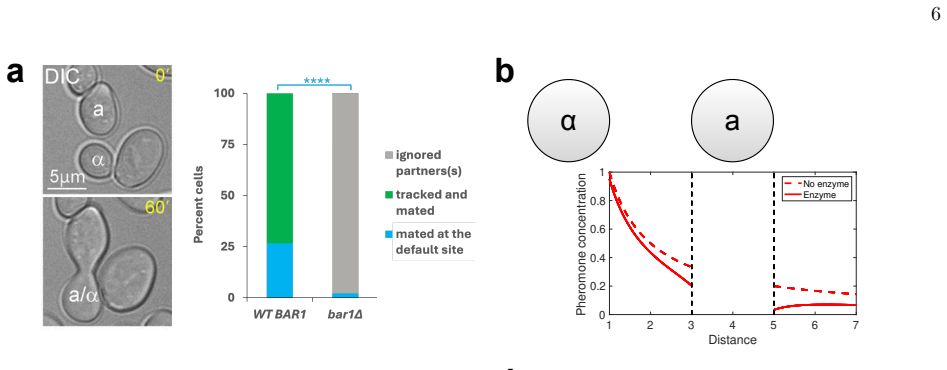
(Fig. 4b), and a key result is a precision limit for the anisotropyAwhen degradation is weak, δA A ∼ 1 ga r c aDt(1 +β) ,(8) where c= s 4πDr0 (1−u 1β), g= s 4πDr 2 0 (1 +u 2β).(9) Here,r 0 is the separation between two mating cells,sis the pheromone secretion rate,β≪1 is a dimensionless parameter characterizing the strength of the degrading enzyme, andu 1...
-
[2]
XUj8IJSZxTdJAPd5wlpIgZYcSAg=
and deciding between two cell fates based on a mor- phogen concentration in embryogenesis [112]. The time required to reach a particular error threshold was found to be shorter than the time required to achieve an equiv- alent estimation error by fixed-time averaging, by factors of 2−3 [110] and 10 or more [112], respectively. Cells’ internal signaling ne...
2024
-
[3]
or that poor information need not always correspond to poor migratory performance [135]. What will care- ful measurement of acquired information reveal in other organisms? Are eukaryotic cells, which sense chemical gradients spatially rather than temporally, similarly far from the physical limit? Active sensing requires energy. The energy require- ments f...
-
[4]
To what extent are other active matter phenomena altered or limited by sensory capabilities [144]? Sensing is a cell’s window to the world
changes dramatically when the motile agents sense concentration gradients [143]. To what extent are other active matter phenomena altered or limited by sensory capabilities [144]? Sensing is a cell’s window to the world. It remains to be seen how broadly the physics of sensing shapes the biology of the cell. ACKNOWLEDGMENTS This work was supported by Nati...
-
[5]
H. C. Berg and E. M. Purcell, Physics of chemorecep- tion, Biophysical journal20, 193 (1977)
1977
-
[6]
Beroz, L
F. Beroz, L. Jawerth, S. M¨ unster, D. Weitz, C. Broed- ersz, and N. Wingreen, Physical limits to biomechanical sensing in disordered fibre networks nat (2017)
2017
-
[7]
Beroz, D
F. Beroz, D. Zhou, X. Mao, and D. K. Lubensky, Phys- ical limits to sensing material properties, Nature com- munications11, 5170 (2020)
2020
-
[8]
Mora and N
T. Mora and N. S. Wingreen, Limits of sensing temporal concentration changes by single cells, Physical review letters104, 248101 (2010)
2010
-
[9]
Mora and I
T. Mora and I. Nemenman, Physical limit to concentra- tion sensing in a changing environment, Physical review letters123, 198101 (2019)
2019
-
[10]
B. A. Bicknell, P. Dayan, and G. J. Goodhill, The lim- its of chemosensation vary across dimensions, Nature communications6, 7468 (2015)
2015
-
[11]
Gonz´ alez, H
L. Gonz´ alez, H. Gwak, B. Han, and A. Mugler, Quan- tifying cellular autonomy in multicue environments, Physical Review Research7, 033068 (2025)
2025
-
[12]
H. H. Mattingly, K. Kamino, B. B. Machta, and T. Emonet, Escherichia coli chemotaxis is information limited, Nature physics17, 1426 (2021)
2021
-
[13]
H. H. Mattingly, K. Kamino, J. Ong, R. Kottou, T. Emonet, and B. B. Machta, E. coli chemosensing accuracy is not limited by stochastic molecule arrivals, Nature Physics , 1 (2026)
2026
-
[14]
Bialek and S
W. Bialek and S. Setayeshgar, Physical limits to biochemical signaling, Proceedings of the National Academy of Sciences102, 10040 (2005)
2005
-
[15]
Bialek and S
W. Bialek and S. Setayeshgar, Cooperativity, sensitiv- ity, and noise in biochemical signaling, Physical Review Letters100, 258101 (2008)
2008
-
[16]
R. G. Endres and N. S. Wingreen, Maximum likelihood and the single receptor, Physical review letters103, 158101 (2009)
2009
-
[17]
Skoge, Y
M. Skoge, Y. Meir, and N. S. Wingreen, Dynamics of cooperativity in chemical sensing among cell-surface re- ceptors, Physical review letters107, 178101 (2011)
2011
-
[18]
Skoge, S
M. Skoge, S. Naqvi, Y. Meir, and N. S. Wingreen, Chem- ical sensing by nonequilibrium cooperative receptors, Physical review letters110, 248102 (2013)
2013
-
[19]
Kaizu, W
K. Kaizu, W. De Ronde, J. Paijmans, K. Takahashi, F. Tostevin, and P. R. Ten Wolde, The berg-purcell limit revisited, Biophysical journal106, 976 (2014)
2014
-
[20]
R. G. Endres and N. S. Wingreen, Accuracy of direct gradient sensing by single cells, Proceedings of the Na- tional Academy of Sciences105, 15749 (2008)
2008
-
[21]
R. G. Endres and N. S. Wingreen, Accuracy of direct gradient sensing by cell-surface receptors, Progress in biophysics and molecular biology100, 33 (2009)
2009
-
[22]
B. Hu, W. Chen, W.-J. Rappel, and H. Levine, Physical limits on cellular sensing of spatial gradients, Physical review letters105, 048104 (2010)
2010
-
[23]
Mugler, A
A. Mugler, A. Levchenko, and I. Nemenman, Limits to the precision of gradient sensing with spatial commu- nication and temporal integration, Proceedings of the National Academy of Sciences113, E689 (2016)
2016
-
[24]
P. J. Van Haastert and M. Postma, Biased random walk by stochastic fluctuations of chemoattractant-receptor interactions at the lower limit of detection, Biophysical journal93, 1787 (2007)
2007
-
[25]
Varennes and A
J. Varennes and A. Mugler, Sense and sensitivity: phys- ical limits to multicellular sensing, migration, and drug response, Molecular pharmaceutics13, 2224 (2016)
2016
-
[26]
D. B. Dusenbery, Limits of thermal sensation, Journal of theoretical biology131, 263 (1988)
1988
-
[27]
Vennettilli, S
M. Vennettilli, S. Saha, U. Roy, and A. Mugler, Pre- cision of protein thermometry, Physical Review Letters 127, 098102 (2021)
2021
-
[28]
Hurme, K
R. Hurme, K. D. Berndt, S. J. Normark, and M. Rhen, A proteinaceous gene regulatory thermometer in salmonella, Cell90, 55 (1997)
1997
-
[29]
G. S. Bakken and A. R. Krochmal, The imaging prop- erties and sensitivity of the facial pits of pitvipers as determined by optical and heat-transfer analysis, Jour- nal of Experimental Biology210, 2801 (2007)
2007
-
[30]
E. O. Gracheva, N. T. Ingolia, Y. M. Kelly, J. F. Cordero-Morales, G. Hollopeter, A. T. Chesler, E. E. S´ anchez, J. C. Perez, J. S. Weissman, and D. Julius, Molecular basis of infrared detection by snakes, Nature 464, 1006 (2010). 12
2010
-
[31]
I. R. Graf and B. B. Machta, A bifurcation integrates information from many noisy ion channels and allows for millikelvin thermal sensitivity in the snake pit organ, Biophysical Journal123, 325a (2024)
2024
-
[32]
Bouffanais, J
R. Bouffanais, J. Sun, and D. K. Yue, Physical limits on cellular directional mechanosensing, Physical Review E—Statistical, Nonlinear, and Soft Matter Physics87, 052716 (2013)
2013
-
[33]
Ursell, J
T. Ursell, J. Kondev, D. Reeves, P. A. Wiggins, and R. Phillips, Role of lipid bilayer mechanics in mechanosensation, inMechanosensitive Ion Channels (Springer, 2008) pp. 37–70
2008
-
[34]
W. J. Polacheck, A. E. German, A. Mammoto, D. E. Ingber, and R. D. Kamm, Mechanotransduction of fluid stresses governs 3d cell migration, Proceedings of the National Academy of Sciences111, 2447 (2014)
2014
-
[35]
Olesen, D
S.-P. Olesen, D. Claphamt, and P. Davies, Haemody- namic shear stress activates a k+ current in vascular endothelial cells, Nature331, 168 (1988)
1988
-
[36]
D´ ecav´ e, D
E. D´ ecav´ e, D. Rieu, J. Dalous, S. Fache, Y. Br´ echet, B. Fourcade, M. Satre, and F. Bruckert, Shear flow- induced motility of dictyostelium discoideum cells on solid substrate, Journal of cell science116, 4331 (2003)
2003
-
[37]
Makino, E
A. Makino, E. R. Prossnitz, M. B¨ unemann, J. M. Wang, W. Yao, and G. W. Schmid-Sch¨ onbein, G protein-coupled receptors serve as mechanosensors for fluid shear stress in neutrophils, American Journal of Physiology-Cell Physiology290, C1633 (2006)
2006
-
[38]
J. Y. Park, S. J. Yoo, L. Patel, S. H. Lee, and S.-H. Lee, Cell morphological response to low shear stress in a two-dimensional culture microsystem with magnitudes comparable to interstitial shear stress, Biorheology47, 165 (2010)
2010
-
[39]
W. J. Polacheck, J. L. Charest, and R. D. Kamm, Inter- stitial flow influences direction of tumor cell migration through competing mechanisms, Proceedings of the Na- tional Academy of Sciences108, 11115 (2011)
2011
-
[40]
McLaughlin and M
S. McLaughlin and M. Poo, The role of electro-osmosis in the electric-field-induced movement of charged macromolecules on the surfaces of cells, Biophysical journal34, 85 (1981)
1981
-
[41]
M. J. Brown and L. M. Loew, Electric field-directed fibroblast locomotion involves cell surface molecular re- organization and is calcium independent., The Journal of cell biology127, 117 (1994)
1994
-
[42]
G. M. Allen, A. Mogilner, and J. A. Theriot, Elec- trophoresis of cellular membrane components creates the directional cue guiding keratocyte galvanotaxis, Current Biology23, 560 (2013)
2013
-
[43]
B. M. Kobylkevich, A. Sarkar, B. R. Carlberg, L. Huang, S. Ranjit, D. M. Graham, and M. A. Messerli, Reversing the direction of galvanotaxis with controlled increases in boundary layer viscosity, Physical biology15, 036005 (2018)
2018
-
[44]
Sarkar, B
A. Sarkar, B. M. Kobylkevich, D. M. Graham, and M. A. Messerli, Electromigration of cell surface macro- molecules in dc electric fields during cell polarization and galvanotaxis, Journal of theoretical biology478, 58 (2019)
2019
-
[45]
Nwogbaga, A
I. Nwogbaga, A. H. Kim, and B. A. Camley, Physical limits on galvanotaxis, Physical Review E108, 064411 (2023)
2023
-
[46]
K. V. Mardia and P. E. Jupp,Directional statistics (John Wiley & Sons, 2009)
2009
-
[47]
Ellison, A
D. Ellison, A. Mugler, M. D. Brennan, S. H. Lee, R. J. Huebner, E. R. Shamir, L. A. Woo, J. Kim, P. Amar, I. Nemenman, A. J. Ewald, and A. Levchenko, Cell–cell communication enhances the capacity of cell ensembles to sense shallow gradients during morphogenesis, Pro- ceedings of the National Academy of Sciences113, E679 (2016)
2016
-
[48]
Malet-Engra, W
G. Malet-Engra, W. Yu, A. Oldani, J. Rey-Barroso, N. S. Gov, G. Scita, and L. Dupr´ e, Collective cell motility promotes chemotactic prowess and resistance to chemorepulsion, Current Biology25, 242 (2015)
2015
-
[49]
Fancher and A
S. Fancher and A. Mugler, Fundamental limits to collec- tive concentration sensing in cell populations, Physical review letters118, 078101 (2017)
2017
-
[50]
Kravchenko-Balasha, J
N. Kravchenko-Balasha, J. Wang, F. Remacle, R. D. Levine, and J. R. Heath, Glioblastoma cellular architec- tures are predicted through the characterization of two- cell interactions, Proceedings of the National Academy of Sciences111, 6521 (2014)
2014
-
[51]
Gregor, D
T. Gregor, D. W. Tank, E. F. Wieschaus, and W. Bialek, Probing the limits to positional information, Cell130, 153 (2007)
2007
-
[52]
Erdmann, M
T. Erdmann, M. Howard, and P. R. Ten Wolde, Role of spatial averaging in the precision of gene expression patterns, Physical review letters103, 258101 (2009)
2009
-
[53]
Fancher and A
S. Fancher and A. Mugler, Diffusion vs. direct transport in the precision of morphogen readout, Elife9, e58981 (2020)
2020
-
[54]
W. J. Rosoff, J. S. Urbach, M. A. Esrick, R. G. McAllis- ter, L. J. Richards, and G. J. Goodhill, A new chemo- taxis assay shows the extreme sensitivity of axons to molecular gradients, Nature neuroscience7, 678 (2004)
2004
-
[55]
Theveneau, L
E. Theveneau, L. Marchant, S. Kuriyama, M. Gull, B. Moepps, M. Parsons, and R. Mayor, Collective chemotaxis requires contact-dependent cell polarity, De- velopmental cell19, 39 (2010)
2010
-
[56]
D. Cai, W. Dai, M. Prasad, J. Luo, N. S. Gov, and D. J. Montell, Modeling and analysis of collective cell migration in an in vivo three-dimensional environment, Proceedings of the National Academy of Sciences113, E2134 (2016)
2016
-
[57]
Haeger, K
A. Haeger, K. Wolf, M. M. Zegers, and P. Friedl, Collec- tive cell migration: guidance principles and hierarchies, Trends in cell biology25, 556 (2015)
2015
-
[58]
Varennes, B
J. Varennes, B. Han, and A. Mugler, Collective chemo- taxis through noisy multicellular gradient sensing, Bio- physical journal111, 640 (2016)
2016
-
[59]
Camley, J
B. Camley, J. Zimmermann, H. Levine, and W.-J. Rap- pel, Emergent collective chemotaxis without single-cell gradient sensing, Biophysical Journal110, 306a (2016)
2016
-
[60]
B. A. Camley, J. Zimmermann, H. Levine, and W.-J. Rappel, Collective signal processing in cluster chemo- taxis: Roles of adaptation, amplification, and co- attraction in collective guidance, PLoS computational biology12, e1005008 (2016)
2016
-
[61]
Varennes, S
J. Varennes, S. Fancher, B. Han, and A. Mugler, Emer- gent versus individual-based multicellular chemotaxis, Physical review letters119, 188101 (2017)
2017
-
[62]
B. A. Camley and W.-J. Rappel, Cell-to-cell variation sets a tissue-rheology–dependent bound on collective gradient sensing, Proceedings of the National Academy of Sciences114, E10074 (2017)
2017
-
[63]
B. A. Camley, Collective gradient sensing and chemo- taxis: modeling and recent developments, Journal of 13 Physics: Condensed Matter30, 223001 (2018)
2018
-
[64]
B. A. Camley and W.-J. Rappel, Physical models of collective cell motility: from cell to tissue, Journal of physics D: Applied physics50, 113002 (2017)
2017
-
[65]
Carmona-Fontaine, E
C. Carmona-Fontaine, E. Theveneau, A. Tzekou, M. Tada, M. Woods, K. M. Page, M. Parsons, J. D. Lambris, and R. Mayor, Complement fragment c3a con- trols mutual cell attraction during collective cell migra- tion, Developmental cell21, 1026 (2011)
2011
-
[66]
E. O. Budrene and H. C. Berg, Complex patterns formed by motile cells of escherichia coli, Nature349, 630 (1991)
1991
-
[67]
Z. Long, B. Quaife, H. Salman, and Z. N. Oltvai, Cell- cell communication enhances bacterial chemotaxis to- ward external attractants, Scientific reports7, 12855 (2017)
2017
-
[68]
S. Saha, S. Fancher, and A. Mugler, Effects of cell-cell communication on bacterial chemotaxis, Physics Review E (2026)
2026
-
[69]
Adler, Chemotaxis in bacteria: Motile escherichia coli migrate in bands that are influenced by oxygen and or- ganic nutrients., Science153, 708 (1966)
J. Adler, Chemotaxis in bacteria: Motile escherichia coli migrate in bands that are influenced by oxygen and or- ganic nutrients., Science153, 708 (1966)
1966
-
[70]
E. F. Keller and L. A. Segel, Traveling bands of chemo- tactic bacteria: a theoretical analysis, Journal of theo- retical biology30, 235 (1971)
1971
-
[71]
Saragosti, V
J. Saragosti, V. Calvez, N. Bournaveas, B. Perthame, A. Buguin, and P. Silberzan, Directional persistence of chemotactic bacteria in a traveling concentration wave, Proceedings of the National Academy of Sciences108, 16235 (2011)
2011
-
[72]
X. Fu, S. Kato, J. Long, H. H. Mattingly, C. He, D. C. Vural, S. W. Zucker, and T. Emonet, Spatial self-organization resolves conflicts between individual- ity and collective migration, Nature communications9, 2177 (2018)
2018
-
[73]
Mart´ ınez-Calvo, T
A. Mart´ ınez-Calvo, T. Bhattacharjee, R. K. Bay, H. N. Luu, A. M. Hancock, N. S. Wingreen, and S. S. Datta, Morphological instability and roughening of growing 3d bacterial colonies, Proceedings of the National Academy of Sciences119, e2208019119 (2022)
2022
-
[74]
Tweedy, O
L. Tweedy, O. Susanto, and R. H. Insall, Self-generated chemotactic gradients—cells steering themselves, Cur- rent opinion in cell biology42, 46 (2016)
2016
-
[75]
Scherber, A
C. Scherber, A. J. Aranyosi, B. Kulemann, S. P. Thayer, M. Toner, O. Iliopoulos, and D. Irimia, Epithelial cell guidance by self-generated egf gradients, Integrative Bi- ology4, 259 (2012)
2012
-
[76]
M. C. U¸ car, Z. Alsberga, J. Alanko, M. Sixt, and E. Hannezo, Self-generated chemotaxis of mixed cell populations, Proceedings of the National Academy of Sciences122, e2504064122 (2025)
2025
-
[77]
A. J. Muinonen-Martin, O. Susanto, Q. Zhang, E. Smethurst, W. J. Faller, D. M. Veltman, G. Kalna, C. Lindsay, D. C. Bennett, O. J. Sansom,et al., Melanoma cells break down lpa to establish local gradi- ents that drive chemotactic dispersal, PLoS biology12, e1001966 (2014)
2014
-
[78]
Don` a, J
E. Don` a, J. D. Barry, G. Valentin, C. Quirin, A. Khmelinskii, A. Kunze, S. Durdu, L. R. Newton, A. Fernandez-Minan, W. Huber,et al., Directional tis- sue migration through a self-generated chemokine gra- dient, Nature503, 285 (2013)
2013
-
[79]
Irannejad, N
R. Irannejad, N. G. Tsvetanova, B. T. Lobingier, and M. Von Zastrow, Effects of endocytosis on receptor- mediated signaling, Current opinion in cell biology35, 137 (2015)
2015
-
[80]
L. J. Mutch, J. D. Howden, E. P. L. Jenner, N. S. Poul- ter, and J. Z. Rappoport, Polarised clathrin-mediated endocytosis of egfr during chemotactic invasion, Traffic 15, 648 (2014)
2014
discussion (0)
Sign in with ORCID, Apple, or X to comment. Anyone can read and Pith papers without signing in.