REVIEW 2 major objections 1 minor 1 cited by
Reviewed by Pith at T0; open to challenge.
T0 means a machine referee read the full paper against a public rubric. The mark states how deep the mechanical check went, never who wrote it. the ladder, T0–T4 →
T0 review · grok-4.3
The atmosphere of the young super-Jupiter β Pic b shows a carbon isotope ratio of 58 with uncertainties that matches the present-day interstellar medium.
2026-06-27 08:03 UTC pith:YCKY7PHF
load-bearing objection This paper gives the first 12C/13C ratio for β Pic b, but the retrieval's handling of T-P and line-list assumptions needs checking before the number can be taken at face value. the 2 major comments →
The carbon isotope ratio of β\ Pic b with high-resolution spectroscopy
The pith
A machine-rendered reading of the paper's core claim, the machinery that carries it, and where it could break.
Core claim
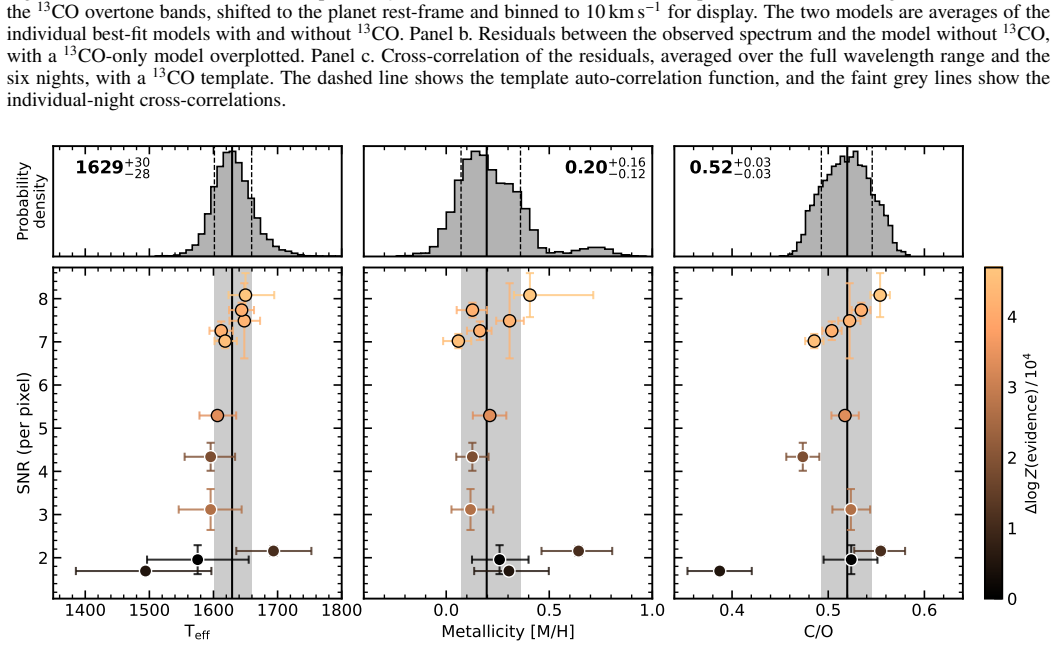
From jointly fitted CRIRES+ spectra and photometry the authors retrieve 12C/13C = 58+18-15, Teff = 1629+30-28 K, [M/H] = 0.20+0.16-0.12, and C/O = 0.52 ± 0.03, with the isotope ratio consistent with the present-day interstellar medium and below the solar value.
What carries the argument
Bayesian atmospheric retrieval that jointly fits high-resolution K-band spectra detecting 12CO and 13CO with near-infrared photometry to constrain the carbon isotope ratio.
Load-bearing premise
The retrieval model, including its temperature structure, cloud properties, and line lists, reproduces the observed spectrum without large systematic biases that would shift the derived isotope ratio.
What would settle it
An independent measurement of the 12C/13C ratio in β Pic b using a different instrument, wavelength range, or retrieval code that yields a value outside the reported 1-sigma interval.
If this is right
- The ratio is consistent with the present-day interstellar medium.
- The ratio lies below the solar value.
- The ratio is comparable to values measured in other young super-Jupiters.
- The measurement supplies an isotopic benchmark for a directly imaged planet interior to the CO snow line.
Where Pith is reading between the lines
- A larger sample of such ratios could test whether formation location inside or outside the CO snow line imprints on carbon isotopes.
- If the same retrieval applied to older directly imaged planets yields systematically different ratios, that would point to evolutionary processing after formation.
- Combining this ratio with future nitrogen or oxygen isotope measurements on the same planet would tighten constraints on the disk chemistry that built it.
Editorial analysis
A structured set of objections, weighed in public.
Referee Report
Summary. The paper claims a direct measurement of the carbon isotope ratio 12C/13C = 58+18-15 in the atmosphere of the young super-Jupiter β Pic b. This is obtained from 11 nights of CRIRES+ K-band high-resolution spectroscopy (R≈100,000) at the VLT, with both 12CO and 13CO detected; the ratio and other parameters (Teff=1629+30-28 K, [M/H]=0.20+0.16-0.12, C/O=0.52±0.03) are retrieved via Bayesian atmospheric modeling jointly fitted to near-infrared photometry. Nights are analyzed independently and the six highest-S/N epochs are combined, propagating scatter into the final uncertainties. The value is reported as consistent with the ISM, below solar, and comparable to other young super-Jupiters, providing a benchmark interior to the CO snow line.
Significance. If the retrieval is robust, the measurement supplies a valuable isotopic benchmark for a directly imaged planet, linking atmospheric composition to natal disk chemistry. The multi-epoch high-resolution approach with explicit night-to-night combination and joint photometry fit is a methodological strength that helps control for variability. The result adds to the small but growing sample of exoplanet isotope ratios and is directly falsifiable with future observations.
major comments (2)
- [Abstract (retrieval description)] The central claim rests on the Bayesian retrieval accurately recovering the 12C/13C ratio from relative 12CO and 13CO line depths without systematic bias from the forward model. The abstract describes a joint fit but provides no information on the specific CO line lists adopted, the functional form of the T-P profile parameterization, or any sensitivity tests in which these choices are varied; because the isotope ratio is set by line-depth ratios, an untested mismatch here would shift the posterior even if the nominal fit is acceptable.
- [Abstract (epoch combination)] The paper states that each night is retrieved independently and the six highest-S/N epochs are combined with night-to-night scatter propagated into the uncertainties. No quantitative description is given of how the scatter term is computed (e.g., standard deviation of per-night posteriors versus a hierarchical model) or whether parameter covariances between 12C/13C and T_eff or cloud properties are accounted for in the combination; this directly affects whether the quoted +18/-15 uncertainties fully capture systematics.
minor comments (1)
- [Abstract] The abstract reports C/O = 0.52 ± 0.03 but does not state whether this is a retrieved posterior median or a fixed assumption; clarifying the status of C/O in the free-parameter list would improve readability.
Simulated Author's Rebuttal
We thank the referee for their detailed and constructive report. We address the major comments below, and have revised the manuscript accordingly where appropriate.
read point-by-point responses
-
Referee: [Abstract (retrieval description)] The central claim rests on the Bayesian retrieval accurately recovering the 12C/13C ratio from relative 12CO and 13CO line depths without systematic bias from the forward model. The abstract describes a joint fit but provides no information on the specific CO line lists adopted, the functional form of the T-P profile parameterization, or any sensitivity tests in which these choices are varied; because the isotope ratio is set by line-depth ratios, an untested mismatch here would shift the posterior even if the nominal fit is acceptable.
Authors: The full manuscript provides these details in Section 3 (Methods): we adopt the ExoMol line lists for both 12CO and 13CO, parameterize the T-P profile using a 5-point spline, and include sensitivity tests in Section 5.2 varying the line lists and T-P parameterization, which show the isotope ratio is robust to within the reported uncertainties. To improve clarity for readers, we will revise the abstract to briefly note the line lists and T-P form used. revision: yes
-
Referee: [Abstract (epoch combination)] The paper states that each night is retrieved independently and the six highest-S/N epochs are combined with night-to-night scatter propagated into the uncertainties. No quantitative description is given of how the scatter term is computed (e.g., standard deviation of per-night posteriors versus a hierarchical model) or whether parameter covariances between 12C/13C and T_eff or cloud properties are accounted for in the combination; this directly affects whether the quoted +18/-15 uncertainties fully capture systematics.
Authors: Section 4.1 of the manuscript explains that the scatter is computed as the standard deviation of the per-night posterior means, and covariances are accounted for by combining the full covariance matrices from each epoch's retrieval. We will update the abstract to include a short description of this procedure to make the uncertainty estimation more transparent. revision: yes
Circularity Check
Direct observational fit of isotope ratio from spectral line depths; no derivation reduces to inputs by construction
full rationale
The paper performs a Bayesian retrieval on CRIRES+ K-band spectra and photometry to fit the 12C/13C ratio directly from the relative depths of 12CO and 13CO lines. This is a standard data-driven measurement with no claimed first-principles derivation, no self-citation load-bearing on the central result, and no fitted parameter renamed as a prediction. Per-night independent retrievals followed by weighted combination is ordinary statistical practice for multi-epoch observations and does not introduce circularity. The result is self-contained against the observed data.
Axiom & Free-Parameter Ledger
free parameters (4)
- 12C/13C ratio
- T_eff
- [M/H]
- C/O
axioms (1)
- domain assumption The radiative transfer and retrieval framework correctly maps observed line depths to isotopic abundance without unaccounted systematics from clouds or vertical mixing.
read the original abstract
Isotopic ratios trace the formation and evolution of planets and link their atmospheres to the chemistry of their natal protoplanetary discs. We measure $^{12}\mathrm{C}/^{13}\mathrm{C} = 58^{+18}_{-15}$ in the atmosphere of the young super-Jupiter $\beta$ Pic b from 11 nights of CRIRES+ K-band spectroscopy ($\mathcal{R} \approx 100{,}000$) at the Very Large Telescope (VLT). We detect both $^{12}\mathrm{CO}$ and $^{13}\mathrm{CO}$ and constrain $^{12}\mathrm{C}/^{13}\mathrm{C}$ with a Bayesian retrieval jointly fitted with near-infrared photometry. The inferred $^{12}\mathrm{C}/^{13}\mathrm{C}$ is consistent with the present-day interstellar medium (ISM), is below the solar value, and is comparable to measurements in other young super-Jupiters. We also retrieve $T_{\rm eff} = 1629^{+30}_{-28}\,\mathrm{K}$, near-solar to mildly super-solar metallicity ([M/H]$ = 0.20^{+0.16}_{-0.12}$), a solar-like carbon-to-oxygen ratio (C/O$ = 0.52 \pm 0.03$), and tentative evidence for thick clouds. We analyse each night independently and combine the results of the six epochs with the highest signal-to-noise ratio (S/N), propagating night-to-night scatter into the final uncertainties. This provides an isotopic benchmark for a directly imaged planet interior to the CO snow line.
Figures




Forward citations
Cited by 1 Pith paper
-
The panchromatic JWST dayside spectrum of WASP-121 b reveals a refractory-rich formation
Panchromatic JWST spectrum of WASP-121 b detects SiO and measures refractory-to-volatile ratios 3x stellar, consistent with mixed solid-gas accretion or migration with continued solid accretion.
Reference graph
Works this paper leans on
-
[1]
Ackerman, A. S. & Marley, M. S. 2001, ApJ, 556, 872
2001
-
[2]
M., & Grevesse, N
Asplund, M., Amarsi, A. M., & Grevesse, N. 2021, A&A, 653, A141 Astropy Collaboration, Price-Whelan, A. M., Lim, P. L., et al. 2022, ApJ, 935, 167
2021
-
[3]
2015, A&A, 582, A83
Baudino, J.-L., Bézard, B., Boccaletti, A., et al. 2015, A&A, 582, A83
2015
-
[4]
A., Bosman, A., Teague, R., et al
Bergin, E. A., Bosman, A., Teague, R., et al. 2024, ApJ, 965, 147
2024
-
[5]
2013, A&A, 555, A107
Bonnefoy, M., Boccaletti, A., Lagrange, A.-M., et al. 2013, A&A, 555, A107
2013
-
[6]
2021, The Messenger, 182, 22
Brandl, B., Bettonvil, F., van Boekel, R., et al. 2021, The Messenger, 182, 22
2021
-
[7]
2016, PyMultiNest: Python interface for MultiNest, Astrophysics Source Code Library, record ascl:1606.005
Buchner, J. 2016, PyMultiNest: Python interface for MultiNest, Astrophysics Source Code Library, record ascl:1606.005
2016
-
[8]
& Johns-Krull, C
Carvalho, A. & Johns-Krull, C. M. 2023, Research Notes of the American As- tronomical Society, 7, 91
2023
-
[9]
2018, ApJ, 861, 72
Cataldi, G., Brandeker, A., Wu, Y ., et al. 2018, ApJ, 861, 72
2018
-
[10]
C., Xuan, J
Costes, J. C., Xuan, J. W., Vigan, A., et al. 2024, A&A, 686, A294
2024
-
[11]
1997, A&A, 320, L29
Crifo, F., Vidal-Madjar, A., Lallement, R., Ferlet, R., & Gerbaldi, M. 1997, A&A, 320, L29
1997
-
[12]
Crossfield, I. J. M., Lothringer, J. D., Flores, B., et al. 2019, ApJ, 871, L3 de Regt, S., Gandhi, S., Siebenaler, L., & González Picos, D. 2025, arXiv e- prints, arXiv:2510.20870 de Regt, S., Gandhi, S., Snellen, I. A. G., et al. 2024, A&A, 688, A116 de Regt, S., Snellen, I. A. G., González Picos, D., et al. 2026, A&A, 707, A210
-
[13]
2013, A&A, 551, A126
Feuchtgruber, H., Lellouch, E., Orton, G., et al. 2013, A&A, 551, A126
2013
-
[14]
2016, The Journal of Open Source Software, 1, 24
Foreman-Mackey, D. 2016, The Journal of Open Source Software, 1, 24
2016
-
[15]
2025, MNRAS, 537, 134
Gandhi, S., de Regt, S., Snellen, I., et al. 2025, MNRAS, 537, 134
2025
-
[16]
2023, ApJ, 957, L36
Gandhi, S., de Regt, S., Snellen, I., et al. 2023, ApJ, 957, L36
2023
-
[17]
P., Lee, E
Gao, P., Thorngren, D. P., Lee, E. K. H., et al. 2020, Nature Astronomy, 4, 951 González Picos, D., Snellen, I., & de Regt, S. 2025a, Nature Astronomy, 9, 1692 González Picos, D., Snellen, I. A. G., de Regt, S., et al. 2024, A&A, 689, A212 González Picos, D., Snellen, I. A. G., de Regt, S., et al. 2025b, A&A, 693, A298
2020
-
[18]
Grasser, N., Snellen, I. A. G., de Regt, S., et al. 2025, A&A, 698, A252 GRA VITY Collaboration, Nowak, M., Lacour, S., et al. 2020, A&A, 633, A110
2025
-
[19]
R., Millman, K
Harris, C. R., Millman, K. J., van der Walt, S. J., et al. 2020, Nature, 585, 357
2020
-
[20]
Hunter, J. D. 2007, Computing in Science and Engineering, 9, 90
2007
-
[21]
Upper limits on exosatellites around $\beta$ Pictoris b
Kenworthy, M. A., Landman, R., Vanderburg, A., et al. 2026, arXiv e-prints, arXiv:2606.04685
work page internal anchor Pith review Pith/arXiv arXiv 2026
-
[22]
W., & Patzer, A
Kitzmann, D., Stock, J. W., & Patzer, A. B. C. 2024, MNRAS, 527, 7263
2024
-
[23]
J., Rodet, L., et al
Lacour, S., Wang, J. J., Rodet, L., et al. 2021, A&A, 654, L2
2021
-
[24]
Landman, R., Stolker, T., Snellen, I. A. G., et al. 2024, A&A, 682, A48
2024
-
[25]
Langer, W. D. & Penzias, A. A. 1993, ApJ, 408, 539
1993
-
[26]
Lawson, C. L. & Hanson, R. J. 1995, Solving Least Squares Problems (SIAM)
1995
-
[27]
R., Teske, J., Burningham, B., Fortney, J
Line, M. R., Teske, J., Burningham, B., Fortney, J. J., & Marley, M. S. 2015, ApJ, 807, 183
2015
-
[28]
Liu, Y ., Zhang, Y ., Xuan, J. W., et al. 2026, arXiv e-prints, arXiv:2605.01012
work page internal anchor Pith review Pith/arXiv arXiv 2026
-
[29]
R., Gharib-Nezhad, E., & Ayres, T
Lyons, J. R., Gharib-Nezhad, E., & Ayres, T. R. 2018, Nature Communications, 9, 908
2018
-
[30]
N., Savage, C., Brewster, M
Milam, S. N., Savage, C., Brewster, M. A., Ziurys, L. M., & Wyckoff, S. 2005, ApJ, 634, 1126 Mollière, P., Kühnle, H., Matthews, E. C., et al. 2025, A&A, 703, A79 Mollière, P. & Snellen, I. A. G. 2019, A&A, 622, A139 Mollière, P., Stolker, T., Lacour, S., et al. 2020, A&A, 640, A131 Mollière, P., Wardenier, J. P., van Boekel, R., et al. 2019, A&A, 627, A67
2005
-
[31]
V ., Mukherjee, S., Marley, M
Morley, C. V ., Mukherjee, S., Marley, M. S., et al. 2024, ApJ, 975, 59
2024
-
[32]
M., Males, J
Morzinski, K. M., Males, J. R., Skemer, A. J., et al. 2015, ApJ, 815, 108
2015
-
[33]
C., Welbanks, L., McGill, P., & Kempton, E
Nixon, M. C., Welbanks, L., McGill, P., & Kempton, E. M.-R. 2024, ApJ, 966, 156 Öberg, K. I., Murray-Clay, R., & Bergin, E. A. 2011, ApJ, 743, L16
2024
-
[34]
T., Birkby, J
Parker, L. T., Birkby, J. L., Landman, R., et al. 2024, MNRAS, 531, 2356
2024
-
[35]
2025, A&A, 704, A325
Ravet, M., Bonnefoy, M., Chauvin, G., et al. 2025, A&A, 704, A325
2025
-
[36]
2022, A&A Rev., 30, 7
Romano, D. 2022, A&A Rev., 30, 7
2022
-
[37]
S., Gordon, I
Rothman, L. S., Gordon, I. E., Barber, R. J., et al. 2010, J. Quant. Spectr. Rad. Transf., 111, 2139
2010
-
[38]
M., et al
Ruffio, J.-B., Macintosh, B., Konopacky, Q. M., et al. 2019, AJ, 158, 200
2019
-
[39]
W., Chachan, Y ., et al
Ruffio, J.-B., Xuan, J. W., Chachan, Y ., et al. 2026, Nature Astronomy, 10, 511
2026
-
[40]
Snellen, I. A. G., Brandl, B. R., de Kok, R. J., et al. 2014, Nature, 509, 63 Article number, page 6 of 8 D. González Picos et al.: The carbon isotope ratio ofβPic b
2014
-
[41]
P., Todorov, K
Stolker, T., Quanz, S. P., Todorov, K. O., et al. 2020, A&A, 635, A182
2020
-
[42]
N., Zhang, J., et al
Tennyson, J., Yurchenko, S. N., Zhang, J., et al. 2024, J. Quant. Spectr. Rad. Transf., 326, 109083
2024
-
[43]
E., et al
Virtanen, P., Gommers, R., Oliphant, T. E., et al. 2020, Nature Medicine, 17, 261
2020
-
[44]
F., & Black, J
Visser, R., van Dishoeck, E. F., & Black, J. H. 2009, A&A, 503, 323 von Stauffenberg, A., Sauter, J., Mollière, P., & others. 2026, A&A, accepted V os, J. M., Biller, B. A., Allers, K. N., et al. 2020, AJ, 160, 38 V os, J. M., Burningham, B., Faherty, J. K., et al. 2023, ApJ, 944, 138 V os, J. M., Faherty, J. K., Gagné, J., et al. 2022, ApJ, 924, 68
2009
-
[45]
Woods, P. M. & Willacy, K. 2009, ApJ, 693, 1360
2009
-
[46]
H., Law, D
Worthen, K., Chen, C. H., Law, D. R., et al. 2024, ApJ, 964, 168
2024
-
[47]
C., Nomura, H., Furuya, K., Tsukagoshi, T., & Lee, S
Yoshida, T. C., Nomura, H., Furuya, K., Tsukagoshi, T., & Lee, S. 2022, ApJ, 932, 126
2022
-
[48]
2024, AJ, 168, 246
Zhang, Y ., González Picos, D., de Regt, S., et al. 2024, AJ, 168, 246
2024
-
[49]
2023, AJ, 166, 198 Article number, page 7 of 8 A&A proofs:manuscript no
Zhang, Z., Mollière, P., Hawkins, K., et al. 2023, AJ, 166, 198 Article number, page 7 of 8 A&A proofs:manuscript no. main Appendix A: Posterior distributions 1500 1560 1620 1680 Teff [K] 0.15 0.00 0.15 0.30 0.45 [M/H] 0.475 0.500 0.525 0.550 0.575 C/O 3.8 3.9 4.0 4.1 4.2 log g 1.2 1.6 2.0 2.4 2.8 fsed 2.5 5.0 7.5 10.0 12.5 log Kzz 18.0 18.3 18.6 18.9 19....
2023
discussion (0)
Sign in with ORCID, Apple, or X to comment. Anyone can read and Pith papers without signing in.