Overcoming the Matrix-Product-State Encoding Barrier via DMRG-Guided Probabilistic Imaginary-Time Evolution
Pith reviewed 2026-06-29 06:24 UTC · model grok-4.3
The pith
A hybrid DMRG-MPS-PITE framework prepares ground states by stopping encoding at the logistic inflection and using DMRG estimates to fix a linear PITE schedule.
A machine-rendered reading of the paper's core claim, the machinery that carries it, and where it could break.
Core claim
Stopping the MPD encoder at the inflection point L* of logistic Schmidt-rank growth, then correcting the remaining infidelity with a DMRG-guided linear PITE schedule, yields a practical route to ground-state preparation whose total circuit depth and post-selection overhead are both substantially smaller than either technique used in isolation.
What carries the argument
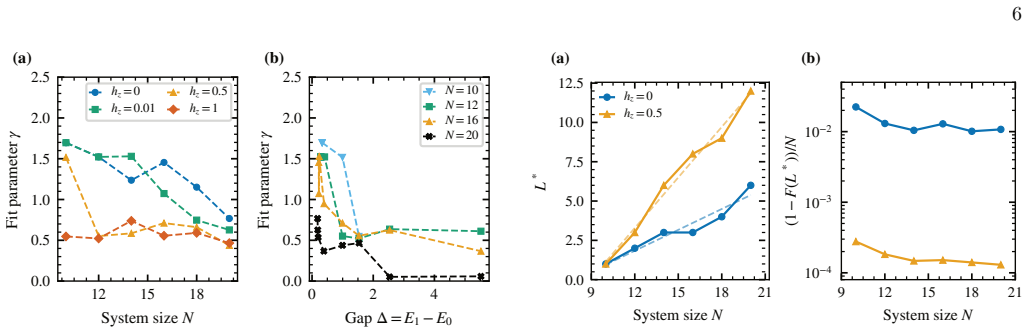
Optimization-free matrix-product disentangler (MPD) encoding circuit whose central-bond Schmidt rank grows logistically with layer count; the inflection point L* separates the efficient-encoding regime from the costly tail.
If this is right
- The number of MPD layers needed beyond L* to reach target infidelity scales as O(N^5 log(N/ε)), so early termination at L* followed by PITE removes this polynomial cost.
- Because the PITE schedule is fixed from DMRG data, no variational optimization on the quantum device is required after the initial encoding.
- The hybrid cost is dominated by the shallow MPD circuit up to L* plus a modest number of PITE steps whose success probability is set by the DMRG overlap.
- The framework applies to any system for which DMRG can supply a reliable initial MPS, energy, and gap estimate.
Where Pith is reading between the lines
- If the logistic growth of Schmidt rank is generic across one-dimensional models, then the same L*-stopping rule may apply to other tensor-network encodings.
- The deterministic PITE schedule could be replaced by an adaptive one if DMRG estimates contain moderate error, but the paper does not explore that variant.
- The method leaves open whether a different classical preprocessor (tensor-network or otherwise) could supply even better initial overlaps while remaining compatible with the MPD encoder.
Load-bearing premise
The DMRG-computed ground-state energy, effective gap, and reference overlap are accurate enough to set a linear PITE schedule that does not introduce large bias or require further optimization.
What would settle it
Run the full three-stage protocol on the spin-1/2 staggered Heisenberg chain for system sizes where DMRG is known to be exact and measure whether the observed post-selection success probability matches the value predicted from the DMRG overlap and gap.
Figures




read the original abstract
Ground-state preparation is a fundamental task in quantum simulation, because the overlap of the prepared state with the true ground state significantly affects the overall cost of subsequent quantum algorithms. We propose a three-stage framework in which a matrix product state (MPS) of an $N$-site system obtained by the density-matrix renormalization group (DMRG) is loaded onto an $N$-qubit quantum register through an optimization-free matrix product disentangler (MPD) encoding circuit, and the residual error is then reduced by probabilistic imaginary-time evolution (PITE). We demonstrate that the central-bond Schmidt rank of intermediate states during MPS encoding grows logistically with the number of layers. Its inflection point $L^{*}$ marks the boundary of the efficient encoding regime. Beyond this point, the gain in fidelity slows rapidly, and the number of additional MPD layers required to reach a target infidelity $\varepsilon$ empirically scales as $\mathcal{O}(N^5\log(N/\varepsilon))$. To avoid this encoding-only tail, we stop the encoder at $L^{*}$ and suppress the remaining excited-state components by PITE, with the linear PITE schedule fixed deterministically from the ground-state energy, the effective gap, and the reference overlap estimated by DMRG. Numerical experiments on the spin-$1/2$ staggered-field Heisenberg chain show that the framework avoids very deep encoding circuits and substantially suppresses the post-selection overhead intrinsic to PITE. Combining classical preprocessing by DMRG, optimization-free MPS encoding, and deterministically scheduled PITE, the present framework offers a practical hybrid route to ground-state preparation in quantum simulation.
Editorial analysis
A structured set of objections, weighed in public.
Referee Report
Summary. The paper proposes a three-stage hybrid framework for ground-state preparation: DMRG computes an MPS for an N-site system, which is loaded onto qubits via an optimization-free matrix-product disentangler (MPD) encoding circuit stopped at the logistic inflection point L* of central-bond Schmidt rank growth; residual excited-state components are then suppressed by probabilistic imaginary-time evolution (PITE) whose linear schedule is fixed deterministically from DMRG estimates of ground-state energy, effective gap, and reference overlap. Numerical experiments on the spin-1/2 staggered-field Heisenberg chain are reported to show avoidance of deep encoding circuits and reduced PITE post-selection overhead, yielding a practical hybrid route.
Significance. If the robustness claims hold, the work supplies a concrete hybrid classical-quantum pathway that leverages DMRG preprocessing to enable shallower MPD encoding and bias-controlled PITE, potentially lowering overall circuit depth and post-selection cost for ground-state preparation tasks that feed into larger quantum simulation algorithms.
major comments (2)
- [Abstract] Abstract, final paragraph: the central claim that DMRG estimates of energy, gap, and overlap 'fix the linear PITE schedule deterministically' without significant bias is load-bearing, yet no analytic bound or error-propagation analysis is supplied showing that finite DMRG truncation errors leave post-selection probability and final infidelity unchanged to the claimed precision. Experiments are performed only on the staggered Heisenberg chain where DMRG converges rapidly; this assumption requires either a quantitative robustness test or explicit error analysis to support the hybrid route.
- [Abstract] Abstract (encoding scaling paragraph): the empirical claim that the number of additional MPD layers beyond L* scales as O(N^5 log(N/ε)) is presented without derivation details, full numerical data, or error bars, undermining independent verification of the 'encoding tail' that the PITE stage is meant to avoid.
Simulated Author's Rebuttal
We thank the referee for the constructive comments, which help clarify the presentation of our hybrid DMRG-MPD-PITE framework. We address each major comment below and commit to revisions that strengthen the supporting evidence without altering the core claims.
read point-by-point responses
-
Referee: [Abstract] Abstract, final paragraph: the central claim that DMRG estimates of energy, gap, and overlap 'fix the linear PITE schedule deterministically' without significant bias is load-bearing, yet no analytic bound or error-propagation analysis is supplied showing that finite DMRG truncation errors leave post-selection probability and final infidelity unchanged to the claimed precision. Experiments are performed only on the staggered Heisenberg chain where DMRG converges rapidly; this assumption requires either a quantitative robustness test or explicit error analysis to support the hybrid route.
Authors: We agree that an explicit error-propagation analysis or additional robustness tests would strengthen the manuscript. The current work relies on the well-established accuracy of DMRG observables for the models studied and demonstrates the framework numerically on the staggered Heisenberg chain. To address the concern directly, we will add a new subsection containing quantitative robustness tests: we will perturb the DMRG estimates of energy, gap, and overlap within their typical truncation-error ranges and report the resulting variation in post-selection probability and final infidelity. This provides the requested numerical evidence of robustness. revision: yes
-
Referee: [Abstract] Abstract (encoding scaling paragraph): the empirical claim that the number of additional MPD layers beyond L* scales as O(N^5 log(N/ε)) is presented without derivation details, full numerical data, or error bars, undermining independent verification of the 'encoding tail' that the PITE stage is meant to avoid.
Authors: The scaling is presented as an empirical observation obtained from numerical fits. We will expand the manuscript to include the complete dataset of required MPD layers versus N and ε, together with error bars on the fitted exponent, and move the fitting procedure and raw data to an appendix to enable independent verification. revision: yes
Circularity Check
No significant circularity; derivation is self-contained
full rationale
The paper's three-stage framework uses standard DMRG as external classical preprocessing to supply energy, gap, and overlap estimates that deterministically set the PITE schedule parameters; this is an input from an independent classical method rather than a quantity fitted inside the quantum derivation and then relabeled as a prediction. The logistic growth of Schmidt rank and the choice to stop at its inflection point L* are presented as numerical observations on the staggered Heisenberg model, not as a self-definitional or fitted-input reduction. No self-citations, uniqueness theorems, or ansatzes from prior author work are invoked to justify load-bearing steps, and the hybrid claim does not reduce to its own inputs by construction.
Axiom & Free-Parameter Ledger
axioms (1)
- domain assumption DMRG provides sufficiently accurate ground-state energy, effective gap, and reference overlap to fix the linear PITE schedule deterministically
Reference graph
Works this paper leans on
-
[1]
Figure 10 gives the RZZ-native implementation of the controlled real-time- evolution block used in the PITE cost evaluation
(B4) Eshift is the DMRG-informed energy shift used in the main text, and α = s∆τk. Figure 10 gives the RZZ-native implementation of the controlled real-time- evolution block used in the PITE cost evaluation. Appendix C: T ail-fit window diagnostics In Fig. 7, we fit the post- L∗ tail of the per-site infidelity as 1 − F (l) N = C(N ) + A(N )e−k(N )l. (C1) ...
-
[2]
Lloyd, Science 273, 1073 (1996)
S. Lloyd, Science 273, 1073 (1996)
1996
-
[3]
Y. Cao, J. Romero, J. P. Olson, M. Degroote, P. D. Johnson, M. Kieferová, I. D. Kivlichan, T. Menke, B. Per- opadre, N. P. D. Sawaya, S. Sim, L. Veis, and A. Aspuru- Guzik, Chemical Reviews 119, 10856 (2019)
2019
-
[4]
Bauer, S
B. Bauer, S. Bravyi, M. Motta, and G. K.-L. Chan, Chemical Reviews 120, 12685 (2020)
2020
-
[5]
Yoshioka, T
N. Yoshioka, T. Okubo, Y. Suzuki, Y. Koizumi, and W. Mizukami, npj Quantum Information 10, 45 (2024)
2024
-
[6]
A. M. Childs, J.-P. Liu, and A. Ostrander, Quantum 5, 574 (2021)
2021
-
[7]
S. S. Bharadwaj and K. R. Sreenivasan, Proceedings of the National Academy of Sciences 120, e2311014120 (2023)
2023
-
[8]
Aspuru-Guzik, A
A. Aspuru-Guzik, A. D. Dutoi, P. J. Love, and M. Head- Gordon, Science 309, 1704 (2005)
2005
-
[9]
S. Lee, J. Lee, H. Zhai, Y. Tong, A. M. Dalzell, A. Kumar, P. Helms, J. Gray, Z.-H. Cui, W. Liu, M. Kastoryano, R. Babbush, J. Preskill, D. R. Reichman, E. T. Camp- bell, E. F. Valeev, L. Lin, and G. K.-L. Chan, Nature Communications 14, 1952 (2023)
1952
-
[10]
Fomichev, K
S. Fomichev, K. Hejazi, M. S. Zini, M. Kiser, J. Fraxanet, P. A. M. Casares, A. Delgado, J. Huh, A.-C. Voigt, J. E. Mueller, and J. M. Arrazola, PRX Quantum 5, 040339 (2024)
2024
-
[11]
P. J. Ollitrault, C. L. Cortes, J. F. Gonthier, R. M. Par- rish, D. Rocca, G.-L. Anselmetti, M. Degroote, N. Moll, R. Santagati, and M. Streif, Phys. Rev. Lett. 133, 250601 (2024)
2024
-
[12]
D. W. Berry, Y. Tong, T. Khattar, A. White, T. I. Kim, G. H. Low, S. Boixo, Z. Ding, L. Lin, S. Lee, G. K.-L. Chan, R. Babbush, and N. C. Rubin, PRX Quantum 6, 020327 (2025)
2025
-
[13]
Schön, E
C. Schön, E. Solano, F. Verstraete, J. I. Cirac, and M. M. Wolf, Phys. Rev. Lett. 95, 110503 (2005)
2005
-
[14]
Schön, K
C. Schön, K. Hammerer, M. M. Wolf, J. I. Cirac, and E. Solano, Phys. Rev. A 75, 032311 (2007)
2007
-
[15]
Ran, Physical Review A 101, 032310 (2020)
S.-J. Ran, Physical Review A 101, 032310 (2020)
2020
-
[16]
D. Malz, G. Styliaris, Z.-Y. Wei, and J. I. Cirac, Phys. Rev. Lett. 132, 040404 (2024)
2024
-
[17]
K. C. Smith, A. Khan, B. K. Clark, S. Girvin, and T.-C. Wei, PRX Quantum 5, 030344 (2024)
2024
-
[18]
S. R. White, Phys. Rev. Lett. 69, 2863 (1992)
1992
-
[19]
S. R. White, Phys. Rev. B 48, 10345 (1993)
1993
-
[20]
Schollwöck, Annals of Physics 326, 96 (2011)
U. Schollwöck, Annals of Physics 326, 96 (2011)
2011
-
[21]
Peruzzo, J
A. Peruzzo, J. McClean, P. Shadbolt, M.-H. Yung, X.-Q. Zhou, P. J. Love, A. Aspuru-Guzik, and J. L. O’Brien, Nature Communications 5, 4213 (2014)
2014
-
[22]
Cerezo, A
M. Cerezo, A. Arrasmith, R. Babbush, S. C. Benjamin, S. Endo, K. Fujii, J. R. McClean, K. Mitarai, X. Yuan, L. Cincio, and P. J. Coles, Nature Reviews Physics 3, 625 (2021)
2021
-
[23]
J. R. McClean, S. Boixo, V. N. Smelyanskiy, R. Babbush, and H. Neven, Nature Communications 9, 4812 (2018)
2018
-
[24]
Lin and Y
L. Lin and Y. Tong, Quantum 4, 372 (2020)
2020
-
[25]
Kosugi, Y
T. Kosugi, Y. Nishiya, H. Nishi, and Y.-i. Matsushita, Physical Review Research 4, 033121 (2022)
2022
-
[26]
Nishi, K
H. Nishi, K. Hamada, Y. Nishiya, T. Kosugi, and Y.-i. Matsushita, Physical Review Research 5, 043048 (2023)
2023
-
[27]
H. Zhai, H. R. Larsson, S. Lee, Z.-H. Cui, T. Zhu, C. Sun, L. Peng, R. Peng, K. Liao, J. Tölle, J. Yang, S. Li, and G. K.-L. Chan, The Journal of Chemical Physics 159, 234801 (2023)
2023
-
[28]
Gray, Journal of Open Source Software 3, 819 (2018)
J. Gray, Journal of Open Source Software 3, 819 (2018)
2018
-
[29]
Nahum, S
A. Nahum, S. Vijay, and J. Haah, Phys. Rev. X 8, 021014 (2018)
2018
-
[30]
Nachtergaele and R
B. Nachtergaele and R. Sims, Communications in Math- ematical Physics 265, 119 (2006)
2006
-
[31]
Calabrese and J
P. Calabrese and J. Cardy, Journal of Statistical Mechan- ics: Theory and Experiment 2004, P06002 (2004)
2004
-
[32]
M. B. Hastings, Journal of Statistical Mechanics: Theory and Experiment 2007, P08024 (2007)
2007
-
[33]
H. F. Trotter, Proceedings of the American Mathematical Society 10, 545 (1959)
1959
-
[34]
Suzuki, Communications in Mathematical Physics 51, 183 (1976)
M. Suzuki, Communications in Mathematical Physics 51, 183 (1976)
1976
-
[35]
Suzuki, Physics Letters A 146, 319 (1990)
M. Suzuki, Physics Letters A 146, 319 (1990)
1990
-
[36]
A. M. Childs, Y. Su, M. C. Tran, N. Wiebe, and S. Zhu, Physical Review X 11, 011020 (2021)
2021
-
[37]
A. Javadi-Abhari, M. Treinish, K. Krsulich, C. J. Wood, J. Lishman, J. Gacon, S. Martiel, P. D. Nation, L. S. Bishop, A. W. Cross, B. R. Johnson, and J. M. Gambetta, Quantum computing with Qiskit (2024), arXiv:2405.08810 [quant-ph]
work page internal anchor Pith review Pith/arXiv arXiv 2024
-
[38]
Quantum State Preparation via Schmidt Spectrum Optimisation
J. Green, J. Snow, and J. B. Wang, Quantum state preparation via schmidt spectrum optimisation (2025), arXiv:2512.20537 [quant-ph]
work page internal anchor Pith review Pith/arXiv arXiv 2025
-
[39]
S. R. White and R. L. Martin, The Journal of Chemical Physics 110, 4127 (1999)
1999
-
[40]
G. K.-L. Chan and M. Head-Gordon, Journal of Chemical Physics 116, 4462–4476 (2002)
2002
-
[41]
G. K.-L. Chan and S. Sharma, Annual Review of Physical Chemistry 62, 465–481 (2011)
2011
-
[42]
Wouters and D
S. Wouters and D. Van Neck, The European Physical Journal D 68, 272 (2014)
2014
-
[43]
Zgid and M
D. Zgid and M. Nooijen, The Journal of Chemical Physics 128, 144116 (2008)
2008
-
[44]
Ghosh, J
D. Ghosh, J. Hachmann, T. Yanai, and G. K.-L. Chan, Journal of Chemical Physics 128, Art. No. 144117 (2008)
2008
-
[45]
J. T. Seeley, M. J. Richard, and P. J. Love, The Journal of Chemical Physics 137, 224109 (2012)
2012
-
[46]
Yanai, Y
T. Yanai, Y. Kurashige, W. Mizukami, J. Chalupský, T. N. Lan, and M. Saitow, International Journal of Quan- tum Chemistry 115, 283 (2015)
2015
-
[47]
Baiardi and M
A. Baiardi and M. Reiher, The Journal of Chemical Physics 152, 040903 (2020)
2020
-
[48]
Legeza and J
O. Legeza and J. Sólyom, Phys. Rev. B 68, 195116 (2003)
2003
-
[49]
Rissler, R
J. Rissler, R. M. Noack, and S. R. White, Chemical Physics 323, 519 (2006)
2006
discussion (0)
Sign in with ORCID, Apple, or X to comment. Anyone can read and Pith papers without signing in.