Extra-Merge: Tracing the Rank-1 Subspace of Model Merging in Language Model Pre-Training
Pith reviewed 2026-06-29 19:45 UTC · model grok-4.3
The pith
Merged checkpoints in LLM pre-training collapse onto a stable one-dimensional subspace allowing loss reduction by extrapolation alone.
A machine-rendered reading of the paper's core claim, the machinery that carries it, and where it could break.
Core claim
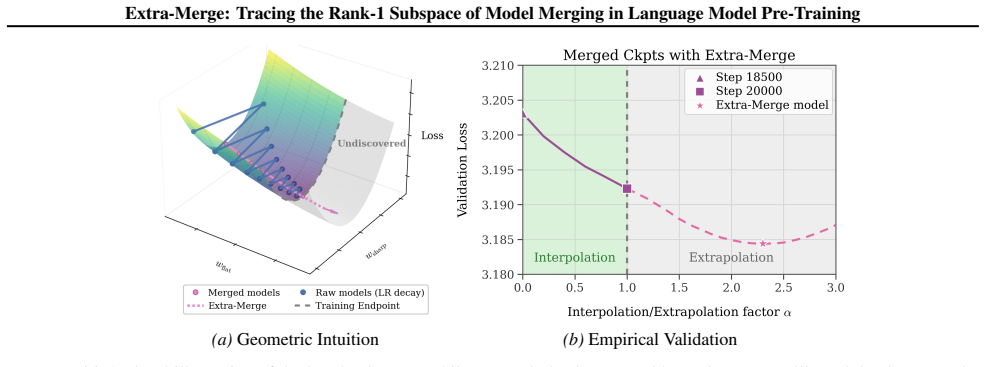
While raw optimization steps oscillate violently, consecutive merged checkpoints collapse onto a stable, approximately one-dimensional linear manifold. This is grounded in a river-valley landscape analysis where averaging acts as a geometric low-pass filter that dampens high-curvature noise to reveal the optimal descent direction. Extra-Merge extrapolates along this subspace to minimize loss without additional gradient updates.
What carries the argument
The Rank-1 Subspace formed by consecutive merged checkpoints, which is used as the direction for training-free extrapolation in the Extra-Merge method.
If this is right
- Extra-Merge consistently outperforms standard merging baselines across GPT-2 and LLaMA families from 124M to 2B parameters.
- It produces consistent zero-shot accuracy gains on Pythia-12B downstream tasks.
- The approach generalizes to the Muon optimizer.
- Loss can be minimized along the subspace without any gradient updates or additional training.
Where Pith is reading between the lines
- This suggests that late-stage pre-training trajectories contain hidden low-dimensional structure once noise is filtered.
- Similar merging and extrapolation could be tested on other architectures or training regimes to see if the rank-1 property holds.
- Combining Extra-Merge with other post-training techniques might produce further improvements in efficiency.
- The river-valley interpretation could motivate new smoothing methods for analyzing optimization paths.
Load-bearing premise
That the averaging process in merging removes high-curvature noise to expose a linear optimal descent direction in the loss landscape.
What would settle it
Observing that points obtained by extrapolating along the line between two consecutive merged checkpoints have higher loss than the merged points themselves would falsify the utility of the subspace for improvement.
Figures




read the original abstract
Model merging has emerged as a lightweight paradigm for enhancing Large Language Models (LLMs), yet its underlying mechanisms remain poorly understood. In this work, we analyze late-stage pre-training trajectories and uncover a \textbf{Rank-1 Subspace} phenomenon: while raw optimization steps oscillate violently, consecutive \emph{merged} checkpoints collapse onto a stable, approximately one-dimensional linear manifold. We theoretically ground this observation in a \emph{river-valley} landscape analysis: averaging acts as a geometric low-pass filter that dampens high-curvature noise to reveal the optimal descent direction. Capitalizing on this insight, we propose \textbf{Extra-Merge}, a training-free strategy that extrapolates along this subspace to minimize loss without additional gradient updates. Extensive experiments across GPT-2 and LLaMA families (124M to 2B) demonstrate that Extra-Merge consistently outperforms standard merging baselines. Notably, it yields consistent zero-shot accuracy gains on Pythia-12B downstream tasks and generalizes effectively to the Muon optimizer \citep{jordan2024muon}.
Editorial analysis
A structured set of objections, weighed in public.
Referee Report
Summary. The paper claims that during late-stage pre-training of LLMs, raw optimization trajectories oscillate while consecutive merged checkpoints collapse onto a stable, approximately rank-1 linear manifold. This is theoretically grounded in a river-valley landscape analysis in which averaging acts as a geometric low-pass filter that reveals the optimal descent direction. The authors introduce Extra-Merge, a training-free extrapolation procedure along this subspace that reduces loss without gradient steps, and report consistent gains over standard merging baselines on GPT-2 and LLaMA models (124M–2B parameters), with additional results on Pythia-12B zero-shot tasks and the Muon optimizer.
Significance. If the rank-1 manifold observation and the effectiveness of the extrapolation hold under rigorous verification, the work would supply both a geometric explanation for merging behavior and a practical, training-free improvement technique. The breadth of experiments across model families and the reported generalization to Muon constitute concrete strengths that would increase the result’s potential influence on efficient LLM post-training methods.
major comments (2)
- [theoretical analysis / abstract] River-valley landscape analysis (abstract and theoretical section): the claim that averaging necessarily isolates a single stable rank-1 direction as the optimal descent direction is asserted without an explicit projection operator, eigenvalue bound, or extrapolation-error term. This step is load-bearing for the justification of Extra-Merge; its absence leaves the central geometric argument without a verifiable guarantee that loss decreases along the extrapolated vector.
- [experiments] Experimental results (presumed §4–5): no error bars, ablation on the extrapolation coefficient, or dataset descriptions are supplied in the abstract-level summary, rendering it impossible to judge whether the reported zero-shot gains are statistically reliable or sensitive to hyper-parameter choices. This directly affects the empirical support for the rank-1 subspace claim.
minor comments (2)
- [method] Notation for the merged checkpoint sequence and the extrapolation vector should be introduced with explicit equations rather than prose descriptions.
- [results] The statement that the manifold is “approximately one-dimensional” would benefit from a quantitative measure (e.g., explained variance ratio of the first principal component) reported in a table.
Simulated Author's Rebuttal
We thank the referee for the constructive feedback on the theoretical analysis and experimental reporting. We address each major comment below and will incorporate revisions to strengthen the manuscript.
read point-by-point responses
-
Referee: River-valley landscape analysis (abstract and theoretical section): the claim that averaging necessarily isolates a single stable rank-1 direction as the optimal descent direction is asserted without an explicit projection operator, eigenvalue bound, or extrapolation-error term. This step is load-bearing for the justification of Extra-Merge; its absence leaves the central geometric argument without a verifiable guarantee that loss decreases along the extrapolated vector.
Authors: We agree that the river-valley analysis would benefit from greater formality. In the revised manuscript we will introduce an explicit orthogonal projection operator onto the estimated rank-1 subspace, derive a simple eigenvalue bound on the curvature along the valley floor, and add an extrapolation-error term that bounds the loss change under the low-pass filtering interpretation. These additions will appear in the theoretical section and will directly support the loss-decrease claim for Extra-Merge. revision: yes
-
Referee: Experimental results (presumed §4–5): no error bars, ablation on the extrapolation coefficient, or dataset descriptions are supplied in the abstract-level summary, rendering it impossible to judge whether the reported zero-shot gains are statistically reliable or sensitive to hyper-parameter choices. This directly affects the empirical support for the rank-1 subspace claim.
Authors: Dataset descriptions for both pre-training corpora and downstream zero-shot tasks are already present in Sections 4 and 5. However, we acknowledge that error bars across random seeds and a systematic ablation on the extrapolation coefficient are missing. We will add multi-seed error bars to all reported metrics and include an ablation varying the extrapolation coefficient (with corresponding loss and accuracy curves) in the revised experimental section. revision: yes
Circularity Check
No circularity; empirical observation and river-valley analysis remain independent
full rationale
The paper reports an empirical collapse of merged checkpoints onto a rank-1 manifold, then supplies a separate river-valley landscape argument that averaging functions as a geometric low-pass filter. No equation or definition in the abstract reduces the claimed subspace direction to a fitted parameter or to the extrapolation step itself; the theoretical grounding is presented as explanatory rather than tautological. Experiments on GPT-2, LLaMA, and Pythia models supply external performance checks that are not forced by the observation alone. No self-citation chain, ansatz smuggling, or renaming of known results is exhibited.
Axiom & Free-Parameter Ledger
Reference graph
Works this paper leans on
-
[1]
PMLR, 2020. Gao, L., Tow, J., Abbasi, B., Biderman, S., Black, S., DiPofi, A., Foster, C., Golding, L., Hsu, J., Le Noac’h, A., Li, H., McDonell, K., Muennighoff, N., Ociepa, C., Phang, J., Reynolds, L., Schoelkopf, H., Skowron, A., Sutawika, L., Tang, E., Thite, A., Wang, B., Wang, K., and Zou, A. A framework for few-shot language model evaluation, 12 20...
work page internal anchor Pith review Pith/arXiv arXiv 2020
-
[2]
(Eigengap)There exist β >0 and β♭ >0 such that for all w∈U , |λd(∇2L(w))|< β ♭ and λd−1(∇2L(w))> β+ 4β ♭
-
[3]
straight river
(Slow spinning)There exist ρ∈[0,0.01) and 0< ν min ≤ν such that for all w∈U , νmin <∥∇L(w)∥ 2 2 ≤ν and ∥∇v(w)∥op ≤ρ· β 2ν . 16 Extra-Merge: Tracing the Rank-1 Subspace of Model Merging in Language Model Pre-Training To obtain closed-form(N, T)-dependent bounds, we adopt the standard “straight river” simplification. Assumption C.2(Straight river on U).On U...
-
[4]
Since the process is stationary and zero-mean,E[(¯u(j))2] = Var(¯u(j))
By orthogonality of the basis {qj}, this isPd−1 j=1 E[(¯u(j))2]. Since the process is stationary and zero-mean,E[(¯u(j))2] = Var(¯u(j)). Var(¯u(j)) = Var 1 N N−1X m=0 u(j) k0+mT ! = 1 N2 N−1X m=0 N−1X n=0 Cov(u(j) k0+mT , u(j) k0+nT ) = 1 N2 N−1X m=0 N−1X n=0 a|m−n|T j Var(u(j)) = Var(u(j)) N2 X m=n a0·T j + X m̸=n a|m−n|T j . The double summation ...
-
[5]
Since the mountain process is stationary and zero-mean,E[ε s] = 0
Therefore, E[∥εs −¯ε∥2 2]≤E[∥ε s −c∥ 2 2] for any constant vector c. Since the mountain process is stationary and zero-mean,E[ε s] = 0. Choosingc= 0gives: E[∥˜εs∥2 2]≤E[∥ε s∥2 2]. Finally, by definition,ε s =P S( ¯w(s) −w ⋆), so its squared norm is the squared river deviation: E[∥εs∥2 2] =E[∥P S( ¯w(s) −w ⋆)∥2 2] =ED( ¯w(s))2. Combining these inequalities...
discussion (0)
Sign in with ORCID, Apple, or X to comment. Anyone can read and Pith papers without signing in.