Quantitative Evaluation of a Hybrid Target for Ultraslow-Muon Production in μTRISTAN
Pith reviewed 2026-06-29 19:33 UTC · model grok-4.3
The pith
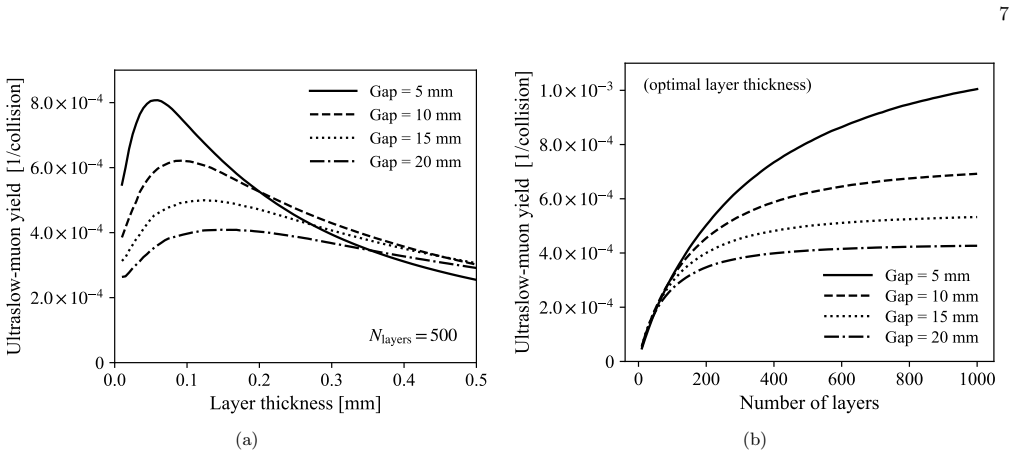
Monte Carlo simulations of a hybrid target estimate an ultraslow-muon yield of 10^{-3} per p-Li collision before extraction, assuming unit conversion efficiency.
A machine-rendered reading of the paper's core claim, the machinery that carries it, and where it could break.
Core claim
Monte Carlo simulations of the hybrid target, which combines a pion production target with a surrounding pion- and muon-stopping target that also functions as a muonium-production target, show that the number of positive muons stopped near the tungsten surface reaches a level that supports an ultraslow-muon yield of 10^{-3} per p-Li nuclear collision before extraction, under the assumption of unit muon-to-muonium conversion efficiency.
What carries the argument
Monte Carlo simulation of pion and muon transport through the hybrid target geometry to count muons stopped within the thin layer near the tungsten surface that can form muonium.
If this is right
- The hybrid target provides a quantitative benchmark that can be used to optimize the design of an intense ultraslow-muon source.
- Yields at the 10^{-3} level per collision set a scale for the proton-beam intensity required to reach collider luminosities.
- The stopping distribution near the surface determines how much of the produced muons can contribute to the extracted beam.
- The simulation framework can be reapplied to alternative target materials or geometries to compare performance.
Where Pith is reading between the lines
- If the conversion efficiency can be measured independently, the yield number can be rescaled without rerunning the full transport simulation.
- The same hybrid-target geometry might be tested at existing muon or pion facilities to validate the simulated stopping fractions.
- Scaling the yield to higher beam powers would require checking whether thermal management or radiation damage alters the surface properties assumed in the model.
Load-bearing premise
The muon-to-muonium conversion efficiency is exactly unity.
What would settle it
An experimental measurement of the actual muon-to-muonium conversion efficiency in the tungsten surface geometry that returns a value significantly below one would reduce the predicted yield proportionally.
Figures




read the original abstract
We present the first quantitative evaluation of the hybrid target concept proposed in $\mu$TRISTAN. The $\mu$TRISTAN project is a positive-muon collider concept based on the ultraslow-muon production technique, in which thermal muonium emitted from a material surface is subsequently laser-ionized. The hybrid target consists of a pion production target and a surrounding pion- and muon-stopping target that also serves as a muonium-production target. In this paper, Monte Carlo simulations of the hybrid target are performed to evaluate the yield of positive muons stopped near the tungsten surface, where they can contribute to muonium emission. The ultraslow-muon yield at the hybrid target before extraction is estimated to reach the 10$^{-3}$ level per p--Li nuclear collision, assuming unit muon-to-muonium conversion efficiency. This study provides a quantitative benchmark for hybrid-target design toward an intense ultraslow-muon source.
Editorial analysis
A structured set of objections, weighed in public.
Referee Report
Summary. The manuscript reports Monte Carlo simulations of a hybrid target (pion production target plus surrounding pion/muon-stopping and muonium-production target) for the μTRISTAN ultraslow-muon collider. It estimates that the fraction of positive muons stopped near the tungsten surface yields an ultraslow-muon production rate at the 10^{-3} level per p-Li nuclear collision, under the explicit assumption of unit muon-to-muonium conversion efficiency. The work positions this as a quantitative benchmark for hybrid-target design.
Significance. If the stopped-muon fraction from the simulations is robust and the efficiency assumption can be independently justified, the result supplies a useful design benchmark for an intense ultraslow-muon source. The use of particle-transport Monte Carlo modeling to quantify the stopped-muon fraction near the emission surface is a clear methodological strength of the study.
major comments (1)
- [Abstract] Abstract: the reported ultraslow-muon yield of 10^{-3} per p-Li collision is obtained only after multiplying the simulated stopped-muon fraction by a muon-to-muonium conversion efficiency that is set exactly to unity. No experimental value, reference, temperature dependence, surface-condition model, or sensitivity study for this efficiency is supplied anywhere in the manuscript, so the central quantitative claim remains conditional on an unverified external parameter.
minor comments (1)
- The abstract (and presumably the methods section) provides no summary of the Monte Carlo geometry, physics lists, event statistics, or convergence checks; these details are required for readers to assess the reliability of the stopped-muon fraction.
Simulated Author's Rebuttal
We thank the referee for the careful review and the constructive comment on the conversion-efficiency assumption. We respond point-by-point below.
read point-by-point responses
-
Referee: [Abstract] Abstract: the reported ultraslow-muon yield of 10^{-3} per p-Li collision is obtained only after multiplying the simulated stopped-muon fraction by a muon-to-muonium conversion efficiency that is set exactly to unity. No experimental value, reference, temperature dependence, surface-condition model, or sensitivity study for this efficiency is supplied anywhere in the manuscript, so the central quantitative claim remains conditional on an unverified external parameter.
Authors: The manuscript explicitly states (abstract and Section 4) that the 10^{-3} ultraslow-muon yield is obtained under the assumption of unit muon-to-muonium conversion efficiency. The core quantitative result of the work is the Monte Carlo-derived stopped-muon fraction near the tungsten surface; this fraction is independent of the conversion efficiency. The yield figure is presented solely as an upper-bound benchmark for hybrid-target design under that stated assumption. We acknowledge that the paper supplies neither an experimental reference nor a sensitivity study for the efficiency, because the scope is limited to pion/muon transport and target geometry rather than surface muonium physics. We will revise the manuscript to (i) add a short paragraph in the discussion section noting that real efficiencies are typically <1 and citing representative literature values for tungsten and similar surfaces, and (ii) include a one-sentence sensitivity statement showing how the reported yield would scale for efficiencies of 0.1–0.5. This revision clarifies the conditional nature of the claim without changing the simulation results. revision: partial
Circularity Check
Monte Carlo yield scaled by external unit-efficiency assumption; no circular reduction
full rationale
The paper reports a Monte Carlo simulation of pion/muon production and stopping in the hybrid target, computing the fraction of positive muons that stop within the emission depth of the tungsten surface. The ultraslow-muon yield is then obtained by multiplying this simulated stopped-muon rate by a conversion efficiency that is explicitly set to unity. This efficiency value is not fitted from the simulation data, not derived from any equation in the paper, and not justified by self-citation to prior work by the same authors. No step equates the final yield to an input quantity by construction, and the result is presented as conditional on the stated assumption. The derivation chain is therefore self-contained as a simulation output under an external premise.
Axiom & Free-Parameter Ledger
free parameters (1)
- muon-to-muonium conversion efficiency
axioms (1)
- domain assumption Standard Monte Carlo modeling of hadronic and electromagnetic interactions in matter accurately predicts stopped-muon distributions near a tungsten surface.
Reference graph
Works this paper leans on
-
[1]
European Strategy Group,2020 Update of the European Strategy for Particle Physics, Tech. Rep. CERN-ESU-015 (CERN, Geneva, 2020)
2020
-
[2]
Accetturaet al., Towards a muon collider, The Euro- pean Physical Journal C83, 864 (2023)
C. Accetturaet al., Towards a muon collider, The Euro- pean Physical Journal C83, 864 (2023)
2023
-
[3]
Hamada, R
Y. Hamada, R. Kitano, R. Matsudo, H. Takaura, and M. Yoshida,µTRISTAN, Prog. Theor. Exp. Phys.2022, 053B02 (2022)
2022
-
[4]
Fridell, R
K. Fridell, R. Kitano, and R. Takai, Lepton flavor physics atµ +µ+ colliders, Journal of High Energy Physics2023, 86 (2023)
2023
-
[5]
Fukuda, T
H. Fukuda, T. Moroi, A. Niki, and S.-F. Wei, Search for wimps at futureµ +µ+ colliders, Journal of High Energy Physics2024, 214 (2024)
2024
-
[6]
Kriewald, E
J. Kriewald, E. Pinsard, and A. M. Teixeira, High-energy clfv atµ +tristan: Hnl extensions of the standard model, Journal of High Energy Physics2025, 116 (2025)
2025
-
[7]
Nagamine, Y
K. Nagamine, Y. Miyake, K. Shimomura, P. Birrer, J. P. Marangos, M. Iwasaki, P. Strasser, and T. Kuga, Ul- traslow positive-muon generation by laser ionization of thermal muonium from hot tungsten at primary proton beam, Phys. Rev. Lett.74, 4811 (1995)
1995
-
[8]
Abeet al., A new approach for measuring the muon anomalous magnetic moment and electric dipole moment, Prog
M. Abeet al., A new approach for measuring the muon anomalous magnetic moment and electric dipole moment, Prog. Theor. Exp. Phys.2019, 053C02 (2019)
2019
-
[9]
Aritomeet al., Acceleration of positive muons by a radio-frequency cavity, Phys
S. Aritomeet al., Acceleration of positive muons by a radio-frequency cavity, Phys. Rev. Lett.134, 245001 (2025)
2025
-
[10]
Reiser,Theory and Design of Charged Particle Beams, 2nd ed
M. Reiser,Theory and Design of Charged Particle Beams, 2nd ed. (Wiley-VCH, Weinheim, 2008) updated and Expanded Edition
2008
-
[11]
Kawamuraet al., New concept for a large-acceptance general-purpose muon beamline, Prog
N. Kawamuraet al., New concept for a large-acceptance general-purpose muon beamline, Prog. Theor. Exp. Phys. 2018, 113G01 (2018)
2018
-
[12]
A. P. Mills, J. Imazato, S. Saitoh, A. Uedono, Y. Kawashima, and K. Nagamine, Generation of thermal muonium in vacuum, Phys. Rev. Lett.56, 1463 (1986)
1986
-
[13]
G. A. Beeret al., Enhancement of muonium emission rate from silica aerogel with a laser-ablated surface, Prog. Theor. Exp. Phys.2014, 091C01 (2014)
2014
-
[14]
Beareet al., Study of muonium emission from laser- ablated silica aerogel, Prog
J. Beareet al., Study of muonium emission from laser- ablated silica aerogel, Prog. Theor. Exp. Phys.2020, 123C01 (2020)
2020
-
[15]
Zhang, T
C. Zhang, T. Hiraki, K. Ishida, S. Kamal, S. Kamioka, T. Mibe, A. Olin, N. Saito, K. Suzuki, S. Uetake, and Y. Mao, Modeling the diffusion of muonium in silica aero- gel and its application to a novel design of multi-layer tar- get for thermal muon generation, Nucl. Instrum. Methods Phys. Res. Sect. A1042, 167443 (2022)
2022
-
[16]
Baiet al., Conceptual design of the muonium-to- antimuonium conversion experiment (MACE), Nucl
A.-Y. Baiet al., Conceptual design of the muonium-to- antimuonium conversion experiment (MACE), Nucl. Sci. Tech.37, 57 (2026)
2026
-
[17]
Knasteret al., Overview of the IFMIF/EVEDA project, Nucl
J. Knasteret al., Overview of the IFMIF/EVEDA project, Nucl. Fusion57, 102016 (2017). 11
2017
-
[18]
Y. H. Caiet al., Towards a high-intensity muon source at CiADS, Phys. Rev. Accel. Beams27, 023403 (2024)
2024
-
[19]
Satoet al., Recent improvements of the particle and heavy ion transport code system – PHITS version 3.33, J
T. Satoet al., Recent improvements of the particle and heavy ion transport code system – PHITS version 3.33, J. Nucl. Sci. Tech.61, 127 (2024)
2024
-
[20]
Y. Nara, N. Otuka, A. Ohnishi, K. Niita, and S. Chiba, Relativistic nuclear collisions at 10aGeV energies from p+Be to Au+Au with the hadronic cascade model, Phys. Rev. C61, 024901 (2000)
2000
-
[21]
Apollonioet al.(HARP Collaboration), Large-angle production of charged pions with 3–12.9 GeV/cincident protons on nuclear targets, Phys
M. Apollonioet al.(HARP Collaboration), Large-angle production of charged pions with 3–12.9 GeV/cincident protons on nuclear targets, Phys. Rev. C77, 055207 (2008)
2008
-
[22]
Boudard, J
A. Boudard, J. Cugnon, J.-C. David, S. Leray, and D. Mancusi, New potentialities of the li` ege intranuclear cascade model for reactions induced by nucleons and light charged particles, Phys. Rev. C87, 014606 (2013)
2013
discussion (0)
Sign in with ORCID, Apple, or X to comment. Anyone can read and Pith papers without signing in.