Adapting the Interface, Not the Model: Runtime Harness Adaptation for Deterministic LLM Agents
Pith reviewed 2026-06-30 17:31 UTC · model grok-4.3
The pith
A runtime harness evolved from training failures improves frozen LLM agents on deterministic tasks without changing model weights.
A machine-rendered reading of the paper's core claim, the machinery that carries it, and where it could break.
Core claim
Life-Harness is a lifecycle-aware runtime harness that evolves from training trajectories by converting recurring interaction failures into reusable interventions across environment contracts, procedural skills, action realization, and trajectory regulation, then remains fixed for evaluation on unseen tasks, thereby improving frozen LLM agents on deterministic environments without any model weight changes.
What carries the argument
Life-Harness, a fixed runtime harness that translates observed trajectory failures into reusable interventions applied at the model-environment boundary.
If this is right
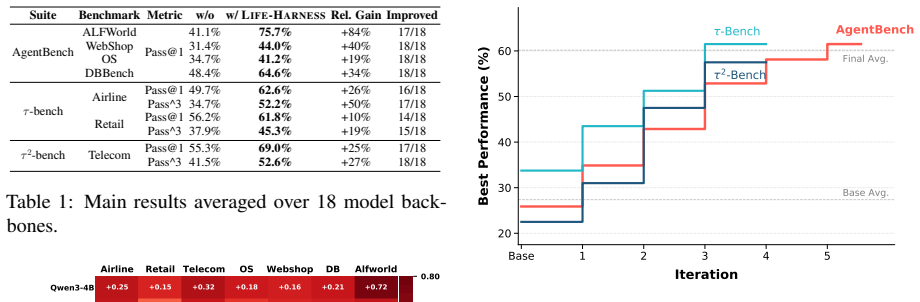
- Life-Harness improves 116 of 126 model-environment combinations across seven deterministic environments with an average relative gain of 88.5 percent.
- A harness evolved solely from Qwen3-4B-Instruct trajectories transfers to 17 other model backbones.
- The method works while keeping all evaluated models frozen and without modifying the underlying environments.
- Runtime interface adaptation is presented as complementary to model-centric training methods.
Where Pith is reading between the lines
- If the harness captures environment structure rather than model behavior, similar reusable fixes could be derived once per environment and reused across many future models.
- The transfer results suggest that interface-level interventions may reduce the frequency of full model retraining when deploying agents in stable rule-based domains.
- Extending the same failure-to-intervention conversion process to environments with partial observability or stochastic elements would test how far the current design generalizes.
Load-bearing premise
Recurring failures seen in training trajectories on these environments can be turned into a fixed set of reusable interventions that generalize to unseen tasks in the same environments without model-specific adjustments.
What would settle it
Measuring whether the reported gains vanish when the same harness is tested on new deterministic environments whose interaction patterns were never observed during harness evolution.
Figures




read the original abstract
LLM agents are shaped not only by their language models, but also by the runtime harness that mediates observation, tool use, action execution, feedback interpretation, and trajectory control. While existing agent adaptation methods mainly update model parameters, many failures in deterministic, rule-governed domains stem from mismatches at the model--environment interface. We propose Life-Harness, a lifecycle-aware runtime harness that improves frozen LLM agents without changing model weights or evaluation environments. Life-Harness evolves from training trajectories by converting recurring interaction failures into reusable interventions across environment contracts, procedural skills, action realization, and trajectory regulation, and remains fixed for evaluation on unseen tasks. On seven deterministic environments from $\tau$-bench, $\tau^2$-bench, and AgentBench, Life-Harness improves 116 out of 126 model--environment settings across 18 model backbones, with an average relative improvement of 88.5%. Harnesses evolved only from Qwen3-4B-Instruct trajectories transfer to 17 other models, showing that Life-Harness captures reusable environment-side structure rather than model-specific behavior. These results position runtime interface adaptation as a complementary alternative to model-centric agent training. Code is available at https://github.com/Tianshi-Xu/Life-Harness.
Editorial analysis
A structured set of objections, weighed in public.
Referee Report
Summary. The paper claims that LLM agent performance in deterministic environments can be improved by adapting the runtime harness (mediating observation, tool use, action execution, feedback, and trajectory control) rather than model parameters. Life-Harness evolves a fixed set of reusable interventions from training trajectories on recurring failures across environment contracts, procedural skills, action realization, and trajectory regulation; the harness is then frozen for evaluation on unseen tasks. On seven environments from τ-bench, τ²-bench, and AgentBench, it improves 116/126 model-environment settings across 18 backbones (average 88.5% relative gain), and harnesses derived solely from Qwen3-4B-Instruct trajectories transfer to 17 other models.
Significance. If the empirical results hold, the work demonstrates that environment-side interface mismatches are a substantial and addressable source of agent failure, providing a complementary alternative to model-centric training. The cross-model transfer experiment directly supports the claim that interventions capture reusable environment structure rather than model-specific patterns. Explicit code release at the cited GitHub repository is a clear strength for reproducibility.
major comments (1)
- [Methods] The central generalization claim—that interventions extracted from training trajectories on the evaluated environments transfer to unseen tasks within the same environments without model-specific tuning—requires explicit description of the intervention extraction procedure, failure categorization rules, and any filtering criteria. Without these details (likely in the Methods section), it is not possible to assess whether the reported gains on held-out tasks are independent of post-hoc selection on evaluation data.
minor comments (2)
- [Abstract] The abstract states an 'average relative improvement of 88.5%' but does not specify the exact baseline (e.g., success rate without harness) or weighting across the 126 settings; this should be clarified for interpretability.
- [Experiments] Table or figure captions reporting per-environment or per-model results should include the number of tasks per environment and any exclusion criteria applied to trajectories.
Simulated Author's Rebuttal
We thank the referee for their constructive feedback on our manuscript. We address the major comment below and will revise the paper to improve clarity on the methods.
read point-by-point responses
-
Referee: [Methods] The central generalization claim—that interventions extracted from training trajectories on the evaluated environments transfer to unseen tasks within the same environments without model-specific tuning—requires explicit description of the intervention extraction procedure, failure categorization rules, and any filtering criteria. Without these details (likely in the Methods section), it is not possible to assess whether the reported gains on held-out tasks are independent of post-hoc selection on evaluation data.
Authors: We agree that additional detail is required. In the revised manuscript we will expand the Methods section with an explicit description of the intervention extraction procedure. This will include: (1) the precise rules used to categorize recurring failures from training trajectories into the four intervention classes (environment contracts, procedural skills, action realization, trajectory regulation); (2) the filtering criteria applied to retain only reusable interventions; and (3) confirmation that extraction and selection occur exclusively on the designated training splits, with the resulting harness frozen before any evaluation on held-out tasks. These additions will make clear that no post-hoc selection on evaluation data occurs. revision: yes
Circularity Check
No significant circularity detected
full rationale
The paper presents an empirical approach: harnesses are derived once from training trajectories on deterministic environments and then held fixed for evaluation on held-out tasks and transfer to other models. No equations, derivations, or fitted parameters are described that would reduce the reported performance gains to quantities computed on the evaluation data itself. The central claim is supported by the transfer experiment (Qwen3-4B harness applied to 17 other backbones) and the design of freezing the harness after training. No self-citations, self-definitional steps, or ansatz smuggling appear in the provided text. This is a standard non-circular empirical result.
Axiom & Free-Parameter Ledger
axioms (1)
- domain assumption Recurring interaction failures in training trajectories can be converted into reusable interventions across environment contracts, procedural skills, action realization, and trajectory regulation that remain effective on unseen tasks.
Forward citations
Cited by 5 Pith papers
-
HarnessX: A Composable, Adaptive, and Evolvable Agent Harness Foundry
HarnessX assembles and evolves agent harnesses via substitution algebra and AEGIS trace analysis, reporting +14.5% average gains (up to +44%) on five benchmarks.
-
Think-Before-Speak: From Internal Evaluation to Public Expression in Multi-Agent Social Simulation
TBS is an interval-based multi-agent framework that separates private internal-state updates (dissonance appraisal, opinion climate, isolation risk, response strategy, willingness to speak) from public utterance selec...
-
Think-Before-Speak: From Internal Evaluation to Public Expression in Multi-Agent Social Simulation
TBS is an interval-based multi-agent LLM simulation framework that separates structured internal evaluative states from public utterance generation and shows these states vary systematically with turn-allocation, sile...
-
MUSE: A Unified Agentic Harness for MLLMs
MUSE is a unified agentic harness that improves off-the-shelf MLLMs on visual spatial planning, perception, multimodal reasoning, and fine-grained discrimination benchmarks through structured execution modules and ver...
-
LemonHarness Technical Report
LemonHarness constrains LLM agent state changes to a defined workspace, supplies callable rule knowledge, and adds time awareness, yielding 84.49% and 86.52% accuracy on Terminal-Bench 2.0 with two GPT-5 backbones.
Reference graph
Works this paper leans on
-
[1]
Osworld: Benchmarking multimodal agents for open-ended tasks in real computer environments. Advances in Neural Information Processing Systems, 37:52040–52094. Tianshi Xu, Yuteng Chen, and Meng Li. 2026. Cleaner: Self-purified trajectories boost agentic reinforcement learning.arXiv preprint arXiv:2601.15141. Chengrun Yang, Xuezhi Wang, Yifeng Lu, Hanxiao L...
-
[2]
Environment Contract Layer: clarify stable tool, action, policy, and answer- format constraints before interaction
-
[3]
Procedural Skill Layer: retrieve com- pact procedural skills distilled from train- ing trajectories and align them with the current task state
-
[4]
Action Realization Layer: validate model-generated actions before execution, canonicalize unambiguous interface-level errors, and block actions that would deter- ministically fail
-
[5]
Use these layers to address runtime-interface failures, not to solve tasks with hidden oracle information
Trajectory Regulation Layer: moni- tor post-execution trajectories, detect re- peated failures or non-progressing behav- ior, and trigger recovery when needed. Use these layers to address runtime-interface failures, not to solve tasks with hidden oracle information. The harness may expose stable environment-side structure, but it must not use test labels,...
-
[6]
a concise summary of the dominant failure patterns found
-
[7]
the harness layer responsible for each pro- posed update
-
[8]
the implemented code changes
-
[9]
a short explanation of why each update is safe under the deterministic environment contract
-
[10]
any remaining failure modes that should be monitored in the next iteration. A.3 Final Evolved Harness Inventory This appendix summarizes the concrete harness components used in the seven evaluated scenar- ios. The inventory follows the four lifecycle layers described in the main method section. Detailed implementations of these components are provided in ...
discussion (0)
Sign in with ORCID, Apple, or X to comment. Anyone can read and Pith papers without signing in.