Kinetic theory of the Thermal Farley-Buneman Instability in the E-region ionosphere
Pith reviewed 2026-06-30 18:04 UTC · model grok-4.3
The pith
Including the driving electric field in the kinetic ion description produces a comprehensive linear dispersion relation for the thermal Farley-Buneman instability.
A machine-rendered reading of the paper's core claim, the machinery that carries it, and where it could break.
Core claim
The central claim is that a kinetic description of ions that retains the driving electric field yields an exact linear wave dispersion relation for the combined thermal Farley-Buneman, ion thermal, and electron thermal instabilities; this relation remains expressible solely in terms of elementary functions and the plasma dispersion function evaluated at several arguments, extending earlier ion-kinetic treatments while remaining valid in the inherently kinetic frequency range above the ion-neutral collision frequency.
What carries the argument
The ion kinetic response function that retains the driving electric field and thereby folds the ion thermal instability into the dispersion relation.
If this is right
- The dispersion relation covers the full set of spatially uniform E-region instabilities without separate treatment of the ion thermal instability.
- Radar signal interpretation at altitudes where ions are unmagnetized can now use a single analytic expression rather than patchwork fluid or simplified kinetic models.
- The same kinetic framework applies directly to analogous collision-dominated instabilities in stellar chromospheres and other planetary atmospheres.
Where Pith is reading between the lines
- The same inclusion of the driving field in ion kinetics could be extended to magnetized-ion regimes above 110 km by adding gyro-motion terms.
- Numerical evaluation of the multi-argument plasma dispersion function for realistic E-region parameters would yield explicit growth-rate maps usable by radar observers.
- Because the relation involves only standard special functions, it can be inserted into existing fluid or hybrid simulation codes without new numerical libraries.
Load-bearing premise
Ions remain unmagnetized and wave frequencies stay at or above the ion-neutral collision frequency.
What would settle it
A measured wave frequency-wavenumber relation from E-region radar data below 110 km that deviates systematically from the predicted dispersion surface at frequencies near the ion-neutral collision frequency.
Figures
read the original abstract
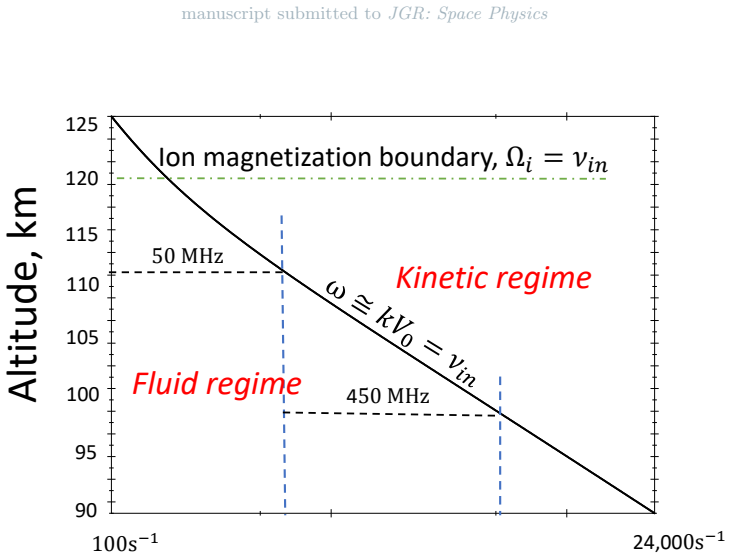
This paper develops a fully kinetic linear theory of the thermal Farley-Buneman instability (TFBI) in the E-region ionosphere with unmagnetized ions. The TFBI combines spatially uniform E-region plasma instabilities, such as the Farley-Buneman instability (FBI), ion thermal instability (ITI), and electron thermal instability (ETI). Similar collision-dominated plasma processes can also occur in the solar and stellar chromospheres, as well as in other planetary atmospheres. For the first time in the theory of the FBI-related processes, the kinetic description of ions includes the driving electric field, resulting in automatic inclusion of the ITI. This analytic theory has produced a comprehensive linear wave dispersion relation. It is remarkable that, similarly to the oversimplified earlier ion-kinetic studies, this much more general kinetic dispersion relation involves only elementary functions and the standard plasma dispersion function (albeit of several different arguments). This new theory is limited to plasma waves with the frequencies of the order, or larger than, the ion-neutral collision frequency. This inherently kinetic frequency range is of importance for accurate interpretation of radar signals scattered from relatively high E-region altitudes, but at altitudes where ions are unmagnetized (mostly, below 110 km).
Editorial analysis
A structured set of objections, weighed in public.
Referee Report
Summary. The manuscript develops a fully kinetic linear theory of the thermal Farley-Buneman instability (TFBI) combining FBI, ITI, and ETI in the E-region ionosphere with unmagnetized ions. It derives a comprehensive linear wave dispersion relation by including the driving electric field in the ion kinetic description for the first time, which automatically incorporates the ITI. The resulting relation is expressed using only elementary functions and the standard plasma dispersion function (of several arguments) and is restricted to wave frequencies of order or larger than the ion-neutral collision frequency (primarily below 110 km).
Significance. If the central derivation holds, the work is significant for providing a self-contained, parameter-free kinetic description of collision-dominated instabilities relevant to the ionosphere and other atmospheres. The automatic inclusion of ITI via the electric-field term in the ion response, combined with analytic tractability via the plasma dispersion function, offers a clear advance over prior ion-kinetic treatments. This could improve radar-signal interpretation at the stated altitudes without reliance on fitted parameters.
minor comments (2)
- The abstract is lengthy and contains several compound sentences; consider condensing the description of the dispersion-relation form and the altitude restriction for improved readability.
- The manuscript should add a short paragraph in the introduction or conclusions explicitly comparing the new dispersion relation to the earlier oversimplified ion-kinetic studies mentioned in the abstract, citing the specific functional differences.
Simulated Author's Rebuttal
We thank the referee for their positive assessment of the manuscript, recognition of its significance for providing a self-contained kinetic description of collision-dominated instabilities, and recommendation for minor revision. We note that no specific major comments were provided in the report.
Circularity Check
No significant circularity; derivation is self-contained from kinetic equations
full rationale
The paper presents a first-principles kinetic derivation of the linear dispersion relation for the TFBI, explicitly incorporating the driving electric field into the ion kinetic description (thereby including ITI automatically) and restricting validity to the stated regime of wave frequencies ≳ ion-neutral collision frequency with unmagnetized ions. No load-bearing step reduces by construction to a fitted parameter, a self-citation chain, or an ansatz imported from prior work by the same authors; the result is expressed using standard plasma dispersion functions and elementary functions without renaming known empirical patterns or invoking uniqueness theorems from overlapping citations. The derivation chain is therefore independent of its inputs.
Axiom & Free-Parameter Ledger
axioms (2)
- standard math Standard kinetic plasma theory framework (Boltzmann or Vlasov equation for distributions, linear perturbation analysis).
- domain assumption Ions are unmagnetized and the regime is collision-dominated with wave frequencies at or above the ion-neutral collision frequency.
Reference graph
Works this paper leans on
-
[1]
Abramowitz and I
M. Abramowitz and I. A. Stegun . Handbook of Mathematical Functions with Formulas, Graphs, and Mathematical Tables . Dover Publications, New York, 1972
1972
-
[2]
G. B. Arfken , H. J. Weber , and F. E. Harris . Mathematical methods for physicists, 7th ed. Elsevier Academic Press, Amsterdam, 2013
2013
-
[3]
P. L. Bhatnagar , E. P. Gross , and M. Krook . A Model for Collision Processes in Gases. I. Small Amplitude Processes in Charged and Neutral One-Component Systems . Phys. Rev. , 94(3):511--525, May 1954
1954
-
[4]
T. A. Blix , E. V. Thrane , S. Kirkwood , Y. S. Dimant , and R. N. Sudan . Experimental evidence for unstable waves in the lower E/Upper D-region excited near the bisector between the electric field and the drift velocity . Geophys. Res. Lett. , 23(16):2137--2140, August 1996
1996
-
[5]
O. Buneman . Excitation of Field Aligned Sound Waves by Electron Streams . Phys. Res. Lett. , 10(7):285--287, April 1963
1963
-
[6]
Y. S. Dimant . Deriving improved plasma fluid equations from collisional kinetic theory . Frontiers in Astronomy and Space Sciences , 11:1466909, November 2024
2024
-
[7]
Y. S. Dimant , G. V. Khazanov , and M. M. Oppenheim . Effects of Electron Precipitation on E-Region Instabilities: Theoretical Analysis . Journal of Geophysical Research (Space Physics) , 126(12):e29884, December 2021
2021
-
[8]
Y. S. Dimant and G. M. Milikh . Model of anomalous electron heating in the E region: 1. Basic theory . J. Geophys. Res. , 108(A9):1350, September 2003
2003
-
[9]
Y. S. Dimant and M. M. Oppenheim . Ion thermal effects on E-region instabilities: linear theory . J. Atmos. Solar-Terr. Phys. , 66:1639--1654, November 2004
2004
-
[10]
Y. S. Dimant and M. M. Oppenheim . Magnetosphere-ionosphere coupling through E region turbulence: 2. Anomalous conductivities and frictional heating . J. Geophys. Res. , 116(A9):A09304, September 2011
2011
-
[11]
Y. S. Dimant , M. M. Oppenheim , S. Evans , and J. Martinez-Sykora . Unified fluid theory of the collisional thermal Farley-Buneman instability including magnetized multi-species ions . Phys. Plasmas , 30(10):102101, October 2023
2023
-
[12]
Y. S. Dimant and R. N. Sudan . Kinetic theory of low-frequency cross-field instability in a weakly ionized plasma. I . Phys. Plasmas , 2(4):1157--1168, April 1995
1995
-
[13]
Y. S. Dimant and R. N. Sudan . Kinetic theory of low-frequency cross-field instability in a weakly ionized plasma. II . Phys. Plasmas , 2(4):1169--1181, April 1995
1995
-
[14]
Y. S. Dimant and R. N. Sudan . Kinetic theory of the Farley-Buneman instability in the E region of the ionosphere . J. Geophys. Res. , 100(A8):14605--14624, August 1995
1995
-
[15]
Y. S. Dimant and R. N. Sudan . Physical nature of a new cross-field current-driven instability in the lower ionosphere . J. Geophys. Res. , 102(A2):2551--2564, February 1997
1997
-
[16]
H. B. Dwight . Tables of Integrals and Other Mathematical Data . Macmillan, New York, 1961
1961
-
[17]
A. Erdelyi . Higher Transcendental Functions , volume 3. McGraw Hill Book Company, New York, 1955
1955
-
[18]
Evans , M
S. Evans , M. Oppenheim , J. Mart \' nez-Sykora , Y. Dimant , and R. Xiao . Multifluid Simulation of Solar Chromospheric Turbulence and Heating Due to Thermal Farley-Buneman Instability . Astrophys. J. , 949(2):59, June 2023
2023
-
[19]
D. T. Farley . Two-Stream Plasma Instability as a Source of Irregularities in the Ionosphere . Phys. Rev. Lett. , 10(7):279--282, April 1963
1963
-
[20]
D. T. Farley . Theory of equatorial electrojet plasma waves - New developments and current status . J. Atmos. Terr. Phys. , 47:729--744, October 1985
1985
-
[21]
D. T. Farley , Jr. A Plasma Instability Resulting in Field-Aligned Irregularities in the Ionosphere . J. Geophys. Res. , 68:6083, November 1963
1963
-
[22]
B. G. Fejer , J. Providakes , and D. T. Farley . Theory of plasma waves in the auroral E region . J. Geophys. Res. , 89(A9):7487--7494, September 1984
1984
-
[23]
J. C. Foster and P. J. Erickson . Simultaneous observations of E-region coherent backscatter and electric field amplitude at F-region heights with the Millstone Hill UHF Radar . Geophys. Res. Lett. , 27(19):3177--3180, October 2000
2000
-
[24]
Fried and Samuel D
Burton D. Fried and Samuel D. Conte . The Plasma Dispersion Function . Academic Press, New York, 1961
1961
-
[25]
I. S. Gradshteyn and I. M. Ryzhik . Table of Integrals, Series, and Products . Elsevier Academic Press, 2007
2007
-
[26]
A. V. Gurevich . Nonlinear phenomena in the ionosphere , volume 10. Springer-Verlag, New York, 1978
1978
-
[27]
F. C. Hoh . Instability of Penning-Type Discharges . Phys. Fluids , 6(8):1184--1191, August 1963
1963
-
[28]
D. L. Hysell and J. L. Chau . Imaging radar observations and nonlocal theory of large-scale plasma waves in the equatorial electrojet . Ann. Geophys. , 20(8):1167--1179, August 2002
2002
-
[29]
D. L. Hysell , J. Drexler , E. B. Shume , J. L. Chau , D. E. Scipion , M. Vlasov , R. Cuevas , and C. Heinselman . Combined radar observations of equatorial electrojet irregularities at Jicamarca . Ann. Geophys. , 25(2):457--473, March 2007
2007
-
[30]
D. L. Hysell , R. J. Miceli , and J. D. Huba . Implications of a heuristic model of auroral Farley Buneman waves and heating . Radio Science , 48(5):527--534, September 2013
2013
-
[31]
M. F. Ivarsen , D. R. Huyghebaert , M. D. Gillies , J.-P. St-Maurice , D. R. Themens , M. Oppenheim , B. J. Gustavsson , D. Billett , B. Pitzel , D. Galeschuk , E. Donovan , and G. C. Hussey . Turbulence Around Auroral Arcs . J. Geophys. Res. , 129(8):e2023JA032309, August 2024
2024
-
[32]
Janhunen
P. Janhunen . Perpendicular particle simulation of the E region Farley-Buneman instability . J. Geophys. Res. , 99(A6):11461--11474, June 1994
1994
-
[33]
Janhunen
P. Janhunen . On recent developments in E-region irregularity simulations and a summary of related theory . Ann. Geophys. , 13(7):791--806, July 1995
1995
-
[34]
L. M. Kagan and M. C. Kelley . A thermal mechanism for generation of small-scale irregularities in the ionospheric E region . J. Geophys. Res. , 105(A3):5291--5302, March 2000
2000
-
[35]
M. C. Kelley. The Earth's Ionosphere: Plasma physics and Electrodynamics . Academic Press, Amsterdam, 2009
2009
-
[36]
Koontaweepunya , Y
R. Koontaweepunya , Y. S. Dimant , and M. M. Oppenheim . Non-Maxwellian ion distribution in the equatorial and auroral electrojets . Frontiers in Astronomy and Space Sciences , 11:1478536, December 2024
2024
-
[37]
K. Lee , C. F. Kennel , and J. M. Kindel . High-Frequency Hall Current Instability . Radio Science , 6(2):209--213, February 1971
1971
-
[38]
Liang , J
J. Liang , J. P. St-Maurice , and E. Donovan . A Time-Dependent Two-Dimensional Model Simulation of Lower Ionospheric Variations Under Intense SAID . J. Geophys. Res. , 126(12):e29756, December 2021
2021
-
[39]
Maeda , T
K. Maeda , T. Tsuda , and H. Maeda . Theoretical Interpretation of the Equatorial Sporadic E Layers . Phys. Rev. Lett. , 11(9):406--407, November 1963
1963
-
[40]
R. A. Makarevich . Toward an Integrated View of Ionospheric Plasma Instabilities: 6. Analytic Analysis of Thermal Effects . J. Geophys. Res. , 126(9):e29178, September 2021
2021
-
[41]
G. M. Milikh and Y. S. Dimant . Model of anomalous electron heating in the E region: 2. Detailed numerical modeling . J. Geophys. Res. , 108(A9):1351, September 2003
2003
-
[42]
Oppenheim , Y
M. Oppenheim , Y. Dimant , W. Longley , and A. C. Fletcher . Newly Discovered Source of Turbulence and Heating in the Solar Chromosphere . Astrophys. J. , 891(1):L9, March 2020
2020
-
[43]
Oppenheim , N
M. Oppenheim , N. Otani , and C. Ronchi . Hybrid simulations of the saturated Farley-Buneman instability in the ionosphere . Geophys. Res. Lett. , 22(4):353--356, February 1995
1995
-
[44]
Oppenheim , N
M. Oppenheim , N. Otani , and C. Ronchi . Saturation of the Farley-Buneman instability via nonlinear electron ExB drifts . J. Geophys. Res. , 101(A8):17273--17286, August 1996
1996
-
[45]
M. M. Oppenheim , Y. Dimant , and L. P. Dyrud . Large-scale simulations of 2-D fully kinetic Farley-Buneman turbulence . Ann. Geophys. , 26(3):543--553, March 2008
2008
-
[46]
M. M. Oppenheim and Y. S. Dimant . Ion thermal effects on E-region instabilities: 2D kinetic simulations . J. Atmos. Solar-Terr. Phys. , 66(17):1655--1668, November 2004
2004
-
[47]
M. M. Oppenheim and Y. S. Dimant . Kinetic simulations of 3-D Farley-Buneman turbulence and anomalous electron heating . J. Geophys. Res. , 118(3):1306--1318, March 2013
2013
-
[48]
S. L. Ossakow , K. Papadopoulos , J. Orens , and T. Coffey . Parallel propagation effects on the type 1 electrojet instability . J. Geophys. Res. , 80(1):141, January 1975
1975
-
[49]
A. P. Prudnikov , Yu. A. Brychkov , and O. I. Marichev . Integrals and Series . Gordon and Breach Science Publishers, New York, 1986
1986
-
[50]
T. R. Robinson . The effects of small scale field aligned irregularities on E-region conductivities: implications for electron thermal processes . Advances in Space Research , 22(9):1357--1360, November 1998
1998
-
[51]
Sahr and Bela G
John D. Sahr and Bela G. Fejer . Auroral electrojet plasma irregularity theory and experiment: A critical review of present understanding and future directions . J. Geophys. Res. , 101(A12):26893--26910, December 1996
1996
-
[52]
Schlegel and J.-P
K. Schlegel and J.-P. St.-Maurice . Short wavelength gradient-drift waves at high latitudes . Ann. Geophys. , 1:259--264, June 1983
1983
-
[53]
Schlegel , T
K. Schlegel , T. Turunen , and D. R. Moorcroft . Auroral radar measurements at 16-cm wavelength with high range and time resolution . J. Geophys. Res. , 95(A11):19001--19009, November 1990
1990
-
[54]
M. J. Schmidt and S. P. Gary . Density gradients and the Farley-Buneman instability . J. Geophys. Res. , 78(34):8261--8265, December 1973
1973
-
[55]
Ionospheres: Physics, Plasma Physics, and Chemistry
Robert Schunk and Andrew Nagy . Ionospheres: Physics, Plasma Physics, and Chemistry . Cambridge University Press, New York, 2009
2009
-
[56]
A. Simon . Instability of a Partially Ionized Plasma in Crossed Electric and Magnetic Fields . Phys. Fluids , 6(3):382--388, March 1963
1963
-
[57]
J. P. St-Maurice and L. Goodwin . Revisiting the Behavior of the E Region Electron Temperature During Strong Electric Field Events at High Latitudes . J. Geophys. Res. , 126(2):e8288, February 2021
2021
-
[58]
St-Maurice , D
J.-P. St-Maurice , D. Huyghebaert , M. F. Ivarsen , and G. C. Hussey . Narrow Width Farley-Buneman Spectra Above 100 km Altitude . J. Geophys. Res. , 128(10):e2022JA031191, October 2023
2023
-
[59]
St.-Maurice and R
J.-P. St.-Maurice and R. S. Kissack . The role played by thermal feedback in heated Farley-Buneman waves at high latitudes . Annales Geophysicae , 18(5):532--546, May 2000
2000
-
[60]
R. T. Tsunoda , J. K. Olesen , and P. Stauning . Radar evidence for a new low-frequency crossed-field plasma instability in the polar mesopause region: A case study . Geophys. Res. Lett. , 24(10):1215--1218, May 1997
1997
-
[61]
Wiltberger , V
M. Wiltberger , V. Merkin , B. Zhang , F. Toffoletto , M. Oppenheim , W. Wang , J. G. Lyon , J. Liu , Y. Dimant , M. I. Sitnov , and G. K. Stephens . Effects of electrojet turbulence on a magnetosphere-ionosphere simulation of a geomagnetic storm . J. Geophys. Res. , 122(5):5008--5027, May 2017
2017
discussion (0)
Sign in with ORCID, Apple, or X to comment. Anyone can read and Pith papers without signing in.