Quantum metrology via partial quantum error correction
Pith reviewed 2026-06-30 22:55 UTC · model grok-4.3
The pith
Encoding probe states in superpositions of energetically different code states allows partial error correction to suppress local noise and preserve super-SQL metrology performance.
A machine-rendered reading of the paper's core claim, the machinery that carries it, and where it could break.
Core claim
By placing the probe in a superposition of energetically distinct states belonging to a quantum code, error correction performed with only a subset of the code checks becomes sufficient to protect the phase imprinting step against local noise both before and after the sensing operation occurs.
What carries the argument
Encoding of probe states into superpositions of energetically different states of the underlying quantum code, which permits error correction with only a subset of checks to act on noise around the phase-imprinting step.
If this is right
- Super-SQL sensing performance is retained while the number of syndrome measurements is reduced.
- All checks and phase imprinters remain local operators, avoiding non-local connectivity requirements.
- An adaptive increase of imprinter weight with system size maintains the sensing advantage at larger scales.
- Noise suppression is quantified by the exponent delta equals floor of (l plus 1) over 2 for weight-l parallel noise.
Where Pith is reading between the lines
- The approach may lower the overhead of fault-tolerant metrology on near-term hardware by tolerating incomplete syndrome extraction.
- It suggests that energy differences within the code space can substitute for full code distance in sensing applications.
- The method could be tested on small trapped-ion or superconducting systems by preparing the required superpositions and applying only partial stabilizer measurements.
Load-bearing premise
Encoding the probe into superpositions of energetically different code states makes a subset of checks sufficient to suppress noise both before and after phase imprinting.
What would settle it
A direct calculation or experiment that measures the residual noise strength after partial correction on such encoded states and finds it larger than p to the power floor((l+1)/2) for parallel noise of weight l would falsify the central claim.
Figures




read the original abstract
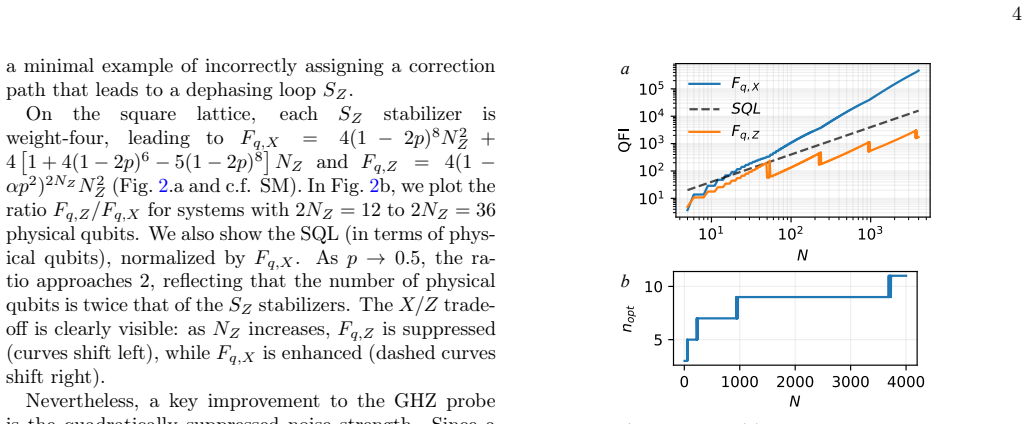
We introduce a method for error-corrected quantum metrology where only partial quantum error correction (QEC) is needed to suppress local noise and maintain the probe states' super-standard-quantum-limit (super-SQL) sensing performance. This stands in contrast to the existing QEC-assisted sensing schemes in Phys. Rev. Lett. 112, 080801 (2014) and Phys. Rev. Lett. 112, 150802 (2014), where a probe state is encoded into the logical subspace of a quantum code and error correction involves measurements on all checks of the code. Here, we encode the probe states into superpositions of energetically different states of the underlying quantum code. For our probe states, error correction using a subset of checks is enough to suppress noise both before and after phase imprinting. We analyze the tradeoff in noise suppression. For noise parallel to our phase imprinter of weight $l$, we achieve a suppression of $p^\delta$ where $p$ is the noise strength and $\delta = \lfloor (l+1)/2 \rfloor$. We propose an adaptive imprinter weight increasing strategy to maintain super-SQL performance as we scale up the system. In all our examples, checks and phase imprinters are chosen to be local operators avoiding non-local connectivity.
Editorial analysis
A structured set of objections, weighed in public.
Referee Report
Summary. The manuscript introduces a partial quantum error correction (QEC) scheme for quantum metrology. Probe states are encoded into superpositions of energetically distinct states within an underlying quantum code, so that measurements on only a subset of stabilizer checks suffice to suppress local noise both before and after the phase-imprinting step. For noise parallel to a weight-l phase imprinter the scheme achieves suppression scaling as p^δ with δ = ⌊(l+1)/2⌋. An adaptive strategy that increases imprinter weight with system size is proposed to preserve super-SQL scaling, with all checks and imprinters restricted to local operators.
Significance. If the central claims hold, the work reduces the QEC overhead relative to the full-correction protocols of PRL 112, 080801 and PRL 112, 150802, thereby improving the practicality of super-SQL metrology. Explicit code constructions, tradeoff analysis between partial and full correction, and concrete local-operator examples are provided; these directly address the key assumption that a subset of checks can protect the probe both pre- and post-imprinting.
minor comments (3)
- [§2.1] §2.1: the definition of the partial-correction subset should be accompanied by a short table listing, for each example code, which stabilizers are retained and which are omitted.
- [§4] The adaptive imprinter-weight strategy in §4 is described qualitatively; a brief scaling argument or pseudocode would clarify how the weight schedule is chosen to keep the effective noise below the SQL threshold.
- Figure captions should explicitly state the noise model (e.g., depolarizing vs. amplitude damping) and the precise figure of merit plotted (e.g., variance vs. p).
Simulated Author's Rebuttal
We thank the referee for the supportive summary, significance assessment, and recommendation of minor revision. No specific major comments are listed in the report, so we have no points requiring point-by-point rebuttal or manuscript changes at this stage.
Circularity Check
No significant circularity detected
full rationale
The paper derives the partial-QEC metrology scheme and the concrete suppression exponent δ = ⌊(l+1)/2⌋ from an explicit new encoding of probe states as superpositions of energetically distinct code states, together with direct analysis of noise suppression before and after phase imprinting using a subset of checks. No step reduces by construction to a fitted parameter, a self-citation chain, or a renamed known result; the central claims rest on the technical constructions and tradeoff analysis supplied in the manuscript rather than on any load-bearing self-reference.
Axiom & Free-Parameter Ledger
axioms (1)
- standard math Standard quantum mechanics and the existence of quantum error-correcting codes with local checks
Forward citations
Cited by 2 Pith papers
-
Precision limits for time-dependent quantum metrology under Markovian noise
Derives differential upper bounds on quantum Fisher information for time-dependent metrology under Markovian noise and proves universal long-time scaling laws saturated by quantum error correction.
-
Quantum Fisher Information under decoherence with explicit wavefunctions
A Monte Carlo method maps quantum Fisher information lower bounds for explicit many-body wavefunctions to classical expectation values, enabling efficient computation under decoherence for Jastrow-Gutzwiller states.
Reference graph
Works this paper leans on
-
[1]
∗ Equal contribution; yinanc@caltech.edu † Equal contribution; zongyuan.wang15@outlook.com ‡ sisi.zhou26@gmail.com
and Perimeter Institute for Theoretical Physics, a re- search institute supported in part by the Government of Canada through the Department of Innovation, Science and Economic Development Canada and by the Province of Ontario through the Ministry of Colleges and Univer- sities. ∗ Equal contribution; yinanc@caltech.edu † Equal contribution; zongyuan.wang1...
-
[2]
Quantum noise limited and entanglement-assisted magnetometry,
W. Wasilewski, K. Jensen, H. Krauter, J. J. Renema, M. V. Balabas, and E. S. Polzik, “Quantum noise limited and entanglement-assisted magnetometry,” Phys. Rev. Lett.104, 133601 (2010)
2010
-
[3]
Squeezed-light optical magnetometry,
Florian Wolfgramm, Alessandro Cerè, Federica A. Beduini, Ana Predojević, Marco Koschorreck, and Mor- gan W. Mitchell, “Squeezed-light optical magnetometry,” Phys. Rev. Lett.105, 053601 (2010)
2010
-
[4]
Enhanced sensitivity of the ligo gravita- tional wave detector by using squeezed states of light,
J. Aasiet al., “Enhanced sensitivity of the ligo gravita- tional wave detector by using squeezed states of light,” Nat. Photonics7, 613–619 (2013)
2013
-
[5]
Quantum-enhanced advanced ligo detec- tors in the era of gravitational-wave astronomy,
M. Tseet al., “Quantum-enhanced advanced ligo detec- tors in the era of gravitational-wave astronomy,” Phys. Rev. Lett.123, 231107 (2019)
2019
-
[6]
Multipartite entanglement and high- precision metrology,
Géza Tóth, “Multipartite entanglement and high- precision metrology,” Phys. Rev. A85, 022322 (2012)
2012
-
[7]
Measuringmultipartiteentanglementthrough dynamic susceptibilities,
Philipp Hauke, Markus Heyl, Luca Tagliacozzo, and Pe- terZoller,“Measuringmultipartiteentanglementthrough dynamic susceptibilities,” Nature Physics12, 778–782 (2016)
2016
-
[8]
We analyze this when we present our example protocols
We note that in the presence of noise, the scaling behav- ior depends on the quantum codes, the noise strength, and the imprinter. We analyze this when we present our example protocols
-
[9]
Quantum metrology,
Vittorio Giovannetti, Seth Lloyd, and Lorenzo Mac- cone, “Quantum metrology,” Phys. Rev. Lett.96, 010401 (2006)
2006
-
[10]
Quantum fisher information of the greenberger- horne-zeilinger state in decoherence channels,
Jian Ma, Yi-xiao Huang, Xiaoguang Wang, and C. P. Sun, “Quantum fisher information of the greenberger- horne-zeilinger state in decoherence channels,” Phys. Rev. A84, 022302 (2011)
2011
-
[11]
Bosonic entanglement and quantum sensing from energy transfer in two-tone floquet systems,
Yinan Chen, Andreas Elben, Angel Rubio, and Gil Re- fael, “Bosonic entanglement and quantum sensing from energy transfer in two-tone floquet systems,” Phys. Rev. Res.7, 043014 (2025)
2025
-
[12]
Quantum sensing with critical systems: impact of symmetry, imperfections, and decoherence,
Yinan Chen, Sara Murciano, Pablo Sala, and Jason Al- icea, “Quantum sensing with critical systems: impact of symmetry, imperfections, and decoherence,” (2026), arXiv:2601.04364
-
[13]
Preparing dicke states in a spin ensemble using phase estimation,
Yang Wang and Barbara M. Terhal, “Preparing dicke states in a spin ensemble using phase estimation,” Phys. Rev. A104, 032407 (2021)
2021
-
[14]
All macroscopic quantum states are fragile and hard to prepare,
AndreaLópez-Incera, PavelSekatski, andWolfgangDür, “All macroscopic quantum states are fragile and hard to prepare,” Quantum3, 118 (2019)
2019
-
[15]
TheelusiveHeisenberglimitinquantum- enhanced metrology,
Rafał Demkowicz-Dobrzański, Jan Kołodyński, and MădălinGuţă,“TheelusiveHeisenberglimitinquantum- enhanced metrology,” Nature Communications3, 1063 (2012)
2012
-
[16]
Im- proved quantum metrology using quantum error correc- tion,
W. Dür, M. Skotiniotis, F. Fröwis, and B. Kraus, “Im- proved quantum metrology using quantum error correc- tion,” Phys. Rev. Lett.112, 080801 (2014)
2014
-
[17]
Quantum error correction for metrology,
E. M. Kessler, I. Lovchinsky, A. O. Sushkov, and M. D. Lukin, “Quantum error correction for metrology,” Phys. Rev. Lett.112, 150802 (2014)
2014
-
[18]
Heisenberg limited metrology using Quantum Error-Correction Codes
Roee Ozeri, “Heisenberg limited metrology using quan- tum error-correction codes,” (2013), arXiv:1310.3432 [quant-ph]
work page internal anchor Pith review Pith/arXiv arXiv 2013
-
[19]
optimal measurement
The terminology “optimal measurement” comes from Ref. [11]. It is the measurement operator, given the probesstatesandtheimprinters, thatsaturatestheCRB. In this Letter, the optimal measurement operator is the strongsymmetry(seeRef.[?] fordefinitionincondensed matter physics) operator of the probe state by construc- tion. Hence, we use the two names interc...
-
[20]
Achieving the heisenberg limit in quantum metrology using quantum error correction,
Sisi Zhou, Mengzhen Zhang, John Preskill, and Liang Jiang, “Achieving the heisenberg limit in quantum metrology using quantum error correction,” Nature Com- munications9, 78 (2018)
2018
-
[21]
Quantum error correctionbelowthesurfacecodethreshold,
Google Quantum AI and Collaborators, “Quantum error correctionbelowthesurfacecodethreshold,” Nature638, 920–926 (2025)
2025
-
[22]
Scaling and logic in the colour code on a superconduct- ing quantum processor,
N. Lacroix, A. Bourassa, F. J. H. Heras, L. M. Zhang, J. Bausch, A. W. Senior, T. Edlich, N. Shutty,et al., “Scaling and logic in the colour code on a superconduct- ing quantum processor,” Nature645, 614–619 (2025)
2025
-
[23]
A fault- tolerant neutral-atom architecture for universal quantum computation,
Dolev Bluvstein, Alexandra A. Geim, Sophie H. Li, Si- mon J. Evered, J. Pablo Bonilla Ataides,et al., “A fault- tolerant neutral-atom architecture for universal quantum computation,” Nature649, 39–46 (2026)
2026
-
[24]
Fault-tolerant quantum computation with a neutral atom processor
Ben W. Reichardt, Adam Paetznick, David Aasen, Ivan Basov, Juan M. Bello-Rivas, Parsa Bonderson, Rui Chao, et al., “Fault-tolerant quantum computation with a neu- tral atom processor,” (2025), arXiv:2411.11822 [quant- ph]
work page internal anchor Pith review Pith/arXiv arXiv 2025
-
[25]
Multiple-particleinterferenceandquan- tum error correction,
AndrewSteane,“Multiple-particleinterferenceandquan- tum error correction,” Proceedings of the Royal Soci- ety A: Mathematical, Physical and Engineering Sciences 452, 2551–2577 (1996)
1996
-
[26]
Good quantum error-correctingcodesexist,
A. R. Calderbank and Peter W. Shor, “Good quantum error-correctingcodesexist,” Phys.Rev.A54,1098–1105 (1996)
1996
-
[27]
Low- overheadfault-tolerantquantumcomputationbygauging logical operators,
Dominic J. Williamson and Theodore J. Yoder, “Low- overheadfault-tolerantquantumcomputationbygauging logical operators,” Nature Physics22, 598–603 (2026)
2026
-
[28]
Animesh Datta, Lijian Zhang, Nicholas Thomas-Peter, Uwe Dorner, Brian J. Smith, and Ian A. Walms- ley, “Quantum metrology with imperfect states and de- tectors,” Physical Review A83(2011), 10.1103/phys- reva.83.063836
-
[29]
Quantum metrology including state preparation and readout times,
Shane Dooley, William J. Munro, and Kae Nemoto, “Quantum metrology including state preparation and readout times,” Physical Review A94(2016), 10.1103/physreva.94.052320
-
[30]
Symmetry: A fun- damental resource for quantum coherence and metrol- ogy,
Irénée Frérot and Tommaso Roscilde, “Symmetry: A fun- damental resource for quantum coherence and metrol- ogy,” Phys. Rev. Lett.133, 260402 (2024)
2024
-
[31]
Demonstrating quantum coherence and metrol- ogythat isresilient totransversalnoise,
Chao Zhang, Thomas R. Bromley, Yun-Feng Huang, Huan Cao, Wei-Min Lv, Bi-Heng Liu, Chuan-Feng Li, Guang-Can Guo, Marco Cianciaruso, and Gerardo Adesso, “Demonstrating quantum coherence and metrol- ogythat isresilient totransversalnoise,” Phys. Rev.Lett. 123, 180504 (2019)
2019
-
[32]
Fault-tolerant quantum computation by 7 anyons,
A.Yu. Kitaev, “Fault-tolerant quantum computation by 7 anyons,” Annals of Physics303, 2–30 (2003)
2003
-
[33]
Quantum codes on a lattice with boundary
S. B. Bravyi and A. Yu. Kitaev, “Quantum codes on a lattice with boundary,” (1998), arXiv:quant-ph/9811052 [quant-ph]
work page internal anchor Pith review Pith/arXiv arXiv 1998
-
[34]
Operator quantum error-correcting subsys- tems for self-correcting quantum memories,
Dave Bacon, “Operator quantum error-correcting subsys- tems for self-correcting quantum memories,” Phys. Rev. A73, 012340 (2006)
2006
-
[35]
Subsystem fault tolerance with the bacon-shor code,
Panos Aliferis and Andrew W. Cross, “Subsystem fault tolerance with the bacon-shor code,” Phys. Rev. Lett.98, 220502 (2007)
2007
-
[36]
Neverthe- less, we show that, even for this harsh estimation, it is possible to keep bothF q,X andF q,Z above the SQL by arranging the shape(m, n)
This is a harsh estimate of theFq,X following the argu- ment for repetition codes in [15], as the Bacon-Shor code doubles the weight of imprinter2nand dephasing on any single raw/column does not change the QFI. Neverthe- less, we show that, even for this harsh estimation, it is possible to keep bothF q,X andF q,Z above the SQL by arranging the shape(m, n)
-
[37]
Renormalization of ising cage- net model and generalized foliation,
Zongyuan Wang, Xiuqi Ma, David T. Stephen, Michael Hermele, and Xie Chen, “Renormalization of ising cage- net model and generalized foliation,” Phys. Rev. B108, 035148 (2023)
2023
-
[38]
Topological quantum distillation,
H. Bombin and M. A. Martin-Delgado, “Topological quantum distillation,” Phys. Rev. Lett.97, 180501 (2006)
2006
-
[39]
The boundaries and twist de- fects of the color code and their applications to topolog- ical quantum computation,
Markus S. Kesselring, Fernando Pastawski, Jens Eisert, and Benjamin J. Brown, “The boundaries and twist de- fects of the color code and their applications to topolog- ical quantum computation,” Quantum2, 101 (2018)
2018
-
[40]
Scaling and logic in the colour code on a superconducting quantum processor,
N. et al. Lacroix, “Scaling and logic in the colour code on a superconducting quantum processor,” Nature645, 614–619 (2025)
2025
-
[41]
Useful multiparticle entanglement and sub-shot-noise sensitivity in experimental phase es- timation,
Roland Krischek, Christian Schwemmer, Witlef Wiec- zorek, Harald Weinfurter, Philipp Hyllus, Luca Pezzé, and Augusto Smerzi, “Useful multiparticle entanglement and sub-shot-noise sensitivity in experimental phase es- timation,” Phys. Rev. Lett.107, 080504 (2011)
2011
-
[42]
Detecting metrologically use- ful entanglement in the vicinity of dicke states,
Iagoba Apellaniz, Bernd Lücke, Jan Peise, Carsten Klempt, and Géza Tóth, “Detecting metrologically use- ful entanglement in the vicinity of dicke states,” New Journal of Physics17, 083027 (2015)
2015
-
[43]
Achieving the heisenberg limit using fault-tolerant quantum error correction,
Himanshu Sahu, Qian Xu, and Sisi Zhou, “Achieving the heisenberg limit using fault-tolerant quantum error correction,” (2026), arXiv:2601.05457 [quant-ph]
-
[44]
Noisy metrology beyond the standard quantum limit,
R. Chaves, J. B. Brask, M. Markiewicz, J. Kołodyński, and A. Acín, “Noisy metrology beyond the standard quantum limit,” Phys. Rev. Lett.111, 120401 (2013)
2013
-
[45]
Compatibility in multiparameter quantum metrology,
Sammy Ragy, Marcin Jarzyna, and Rafał Demkowicz- Dobrzański, “Compatibility in multiparameter quantum metrology,” Phys. Rev. A94, 052108 (2016)
2016
-
[46]
Multi-parameter estimation beyond quantum fisher information,
Rafał Demkowicz-Dobrzański, Wojciech Górecki, and Mădălin Guţă, “Multi-parameter estimation beyond quantum fisher information,” Journal of Physics A: Mathematical and Theoretical53, 363001 (2020)
2020
-
[47]
The elusive heisenberg limit in quantum-enhanced metrology,
Rafał Demkowicz-Dobrzański, Jan Kołodyński, and Mădălin GuŢă, “The elusive heisenberg limit in quantum-enhanced metrology,” Nat. Commun.3, 1063 (2012). Supplemental Materials REMARKS Remark 1.In this work, we introduced a sensing method that utilizes only partial QEC on the probe states constructed from CSS codes to achieve enough noise suppression to ret...
2012
-
[48]
Consider a unitary phase imprinterU(θ) =e iθO and a strong symmetry of the probe stateT X ρ=t xρthat anticommuteswith the generatorO{T X , O}= 0
and a closely related version in [29]. Consider a unitary phase imprinterU(θ) =e iθO and a strong symmetry of the probe stateT X ρ=t xρthat anticommuteswith the generatorO{T X , O}= 0. Plugging into the error propagation formula, we have⟨T X ⟩θ = Tr U †(θ)TX U(θ)ρ =Tr U †2(θ)TX ρ =t xTr U †2(θ)ρ . Similarly,⟨T 2 X ⟩θ =Tr U †(θ)T 2 X U(θ)ρ =Tr T 2 X ρ =t 2...
discussion (0)
Sign in with ORCID, Apple, or X to comment. Anyone can read and Pith papers without signing in.